avatarJillian Enright

Free AI web copilot to create summaries, insights and extended knowledge, download it at here

6748

Abstract

.</i></p><h2 id="2396">**Proposed modified version:</h2><p id="ba9c"><i>Standardizing Coverage for Persons with Autism Spectrum Disorder, H-185.921:</i></p><p id="90b8"><i>Our AMA supports coverage and reimbursement for evidence-based services for Autism Spectrum Disorder</i>.”</p><h2 id="8c9e">A brief pause for a self-congratulatory statement</h2><p id="cf33">In doing my research for this article, I was utterly shocked and speechless (definitely weird for me!) when I discovered that…</p><p id="b2f4"><a href="https://readmedium.com/the-gold-standard-for-autistic-children-e815e9e7316a"><b>My work</b></a><b> was CITED IN THIS PROPOSAL!</b> This is amazing. I am overjoyed that <a href="https://readmedium.com/the-gold-standard-for-autistic-children-e815e9e7316a">my work</a> is, in some very small part, helping to fight the harms of ABA.</p><figure id="a924"><img src="https://cdn-images-1.readmedium.com/v2/resize:fit:800/1*HcOcSppMlLpOBHeNu8EYdw.png"><figcaption>Screen shot provided by author</figcaption></figure><p id="920b">I shall now return to our originally scheduled programming.</p><h2 id="647b">February 2023: PBIS is ABA in disguise</h2><p id="7456">A <a href="https://data.oireachtas.ie/ie/oireachtas/committee/dail/33/joint_committee_on_disability_matters/reports/2023/2023-02-23_report-on-aligning-disability-services-with-the-united-nations-convention-on-the-rights-of-persons-with-disabilities_en.pdf">recent report</a> shared by a joint committee on disability matters sought to explore how our United Nations can align disability services with the United Nations Convention on the Rights of Persons with Disabilities (UNCRPD).</p><p id="d661">Three paragraphs of the <a href="https://data.oireachtas.ie/ie/oireachtas/committee/dail/33/joint_committee_on_disability_matters/reports/2023/2023-02-23_report-on-aligning-disability-services-with-the-united-nations-convention-on-the-rights-of-persons-with-disabilities_en.pdf">report</a> (58–60) cover Applied Behaviour Analysis (ABA) and <a href="https://readmedium.com/behaviourism-is-not-inclusion-aecc591b2201">Positive Behavioural Interventions and Supports</a> (PBIS).</p><figure id="0291"><img src="https://cdn-images-1.readmedium.com/v2/resize:fit:800/1*amYyGXdApTVjQTyq_7Srbg.png"><figcaption>Screen shots provided by author — from Aligning Disability Services with the UNCRPD</figcaption></figure><blockquote id="e995"><p>“The Committee heard that autistic people consider ABA and behavioural interventionist therapies to be medicalised and significantly impact their rights.” <i> — The Joint Committee on Disability Matters</i></p></blockquote><p id="bc13">There’s no misunderstanding the message and conclusions drawn by this committee.</p><blockquote id="6ba8"><p>“…there is evidence to suggest that PBIS risks the same harms as ABA…” <i>— The Joint Committee on Disability Matters</i></p></blockquote><figure id="8ef8"><img src="https://cdn-images-1.readmedium.com/v2/resize:fit:800/1*_f74FG9XL09yPNqUL4c4wQ.png"><figcaption>Screen shot provided by author — from Aligning Disability Services with the UNCRPD</figcaption></figure><p id="4cad">That last sentence is critical.</p><blockquote id="6b38"><p>“Behavioural interventionist therapies are ultimately founded on modifying disabled people’s behaviour to meet goals decided by others; often to conform more closely with neurotypical communication, behaviour and/or norms and therefore the Committee believe cannot uphold the UNCRPD principles of autonomy, dignity, right to identity and freedom from non-consensual or degrading treatment.” <i>— The Joint Committee on Disability Matters</i></p></blockquote><p id="3175">Their report unequivocally denounced <a href="https://readmedium.com/my-anti-behaviourism-series-b0cbff1abf82">behavioural interventions</a> in favour of person-centred, <a href="https://readmedium.com/finding-neurodiversity-affirming-support-b57bae9b5b20">affirming</a> approaches which respect people’s identity and <a href="https://readmedium.com/children-are-entitled-to-autonomy-da05c2685d5d">autonomy</a>, such as Speech Language Pathology (SLP) and Occupational Therapy (OT).</p><h2 id="8f7e">What else can we say?</h2><p id="ced3">I am really hoping the American Medical Association (AMA) adopts this proposal — and quickly.</p><p id="7c49">If (<b>when</b>!) that happens, I will be cautiously optimistic that the <a href="https://www.cma.ca/">Canadian Medical Association</a> (CMA), along with other institutions (including many of our public school systems), should follow suit and adapt more person-centred programming.</p><p id="3ab1">The <a href="https://events.cma.ca/website/36416/eng/register/">CMA’s Health Summit</a> is this August (August 17–18, 2023) in Ottawa and online. I hope Canadian healthcare providers will be proposing similar policy amendments to the CMA.</p><p id="f767">I’m sure it wouldn’t hurt to <a href="https://www.cma.ca/about-us/contact">contact the CMA</a> to share your concerns and desire to see the Canadian Medical Association modernize its highly out-dated policies.</p><p id="b3d7">The overwhelming evidence illustrating the many risks and harms of behavioural interventions speaks for itself. I just hope the policy-makers are finally listening.</p><p id="95a1">© Jillian Enright, Neurodiversity MB</p><h1 id="17c9">Related Articles</h1><div id="1392" class="link-block"> <a href="https://readmedium.com/the-gold-standard-for-autistic-children-e815e9e7316a"> <div> <div> <h2>The “Gold Standard” for Autistic Children</h2> <div><h3>So many Autistic people explain how and why ABA is abusive and harmful, yet many professionals continue to push it.</h3></div> <div><p>medium.com</p></div> </div> <div> <div style="background-image: url(https://miro.readmedium.com/v2/resize:fit:320/1*5VbSSaoH9OnaRiYPXEg-uw.jpeg)"></div> </div> </div> </a> </div><div id="b809" class="link-block"> <a href="https://readmedium.com/stop-recommending-behavioural-therapy-94593a3f0a86"> <div> <div> <h2>Stop Recommending Behaviour Therapies</h2> <div><h3>The definition of “success” in these programs is compliance</h3></div> <div><p>medium.com</p></div> </div> <div> <div style="background-image: url(https://miro.readmedium.com/v2/resize:fit:320/1*2KojHt9JvxehCt1CLr6t4w.jpeg)"></div> </div> </div> </a> </div><div id="831b" class="link-block"> <a href="https://readmedium.com/children-are-cute-but-theyre-no

Options

t-puppies-c7c24178b4e6"> <div> <div> <h2>Children Are Cute, But They’re Not Puppies</h2> <div><h3>Nor are human beings like pigeons, rats, or any other animal to be “trained”</h3></div> <div><p>medium.com</p></div> </div> <div> <div style="background-image: url(https://miro.readmedium.com/v2/resize:fit:320/1*Gtu-ChyGnhL24HZg5mHbdg.jpeg)"></div> </div> </div> </a> </div><p id="8e89"><i>When you join medium, as a member you’ll have access to unlimited reads for only $5 per month. If you use <a href="https://twoemb.medium.com/membership">my referral link</a>, I’ll earn a small commission, and you’ll earn my undying gratitude.</i></p><p id="a5bc"><i>If you’d prefer give a one-time tip, you can <a href="https://ko-fi.com/neurodiversitymb">support my writing on Ko-Fi</a> — also, it’s free to <a href="https://facebook.com/NeurodiversityMB">follow me on Facebook</a> and <a href="https://linkedin.com/in/adhd2emb">LinkedIn</a>!</i></p><h2 id="cfed">Learn more</h2><div id="92b7" class="link-block"> <a href="https://readmedium.com/behaviourism-is-not-inclusion-aecc591b2201"> <div> <div> <h2>Behaviourism Is Not Inclusion</h2> <div><h3>PBIS is just ABA with different letters</h3></div> <div><p>medium.com</p></div> </div> <div> <div style="background-image: url(https://miro.readmedium.com/v2/resize:fit:320/1*Dx2aXZP8NrD0JGK0avryyA.png)"></div> </div> </div> </a> </div><div id="6661" class="link-block"> <a href="https://readmedium.com/my-anti-behaviourism-series-b0cbff1abf82"> <div> <div> <h2>My Anti-Behaviourism Series</h2> <div><h3>A collection of my articles explaining the many problems with behaviourism, backed by extensive research</h3></div> <div><p>medium.com</p></div> </div> <div> <div style="background-image: url(https://miro.readmedium.com/v2/resize:fit:320/1*TBZMqZ0-zw3v5sFlumSkzg.jpeg)"></div> </div> </div> </a> </div><div id="0055" class="link-block"> <a href="https://readmedium.com/alternatives-to-behaviour-therapies-547b917a1202"> <div> <div> <h2>Alternatives To Behaviour Therapies</h2> <div><h3>Alternatives to ABA therapy, as well as PTMB, PBIS, and all of its cousins</h3></div> <div><p>medium.com</p></div> </div> <div> <div style="background-image: url(https://miro.readmedium.com/v2/resize:fit:320/1*GF27vnIQNR3KC8TOwlzwjg.png)"></div> </div> </div> </a> </div><div id="99cf" class="link-block"> <a href="https://neurodiversitymb.ca/aba-alternatives"> <div> <div> <h2>Neurodiversity Manitoba</h2> <div><h3>We understand parents what to do what's best for their children. Neurodiversity Manitoba offers a multitude of…</h3></div> <div><p>neurodiversitymb.ca</p></div> </div> <div> <div style="background-image: url(https://miro.readmedium.com/v2/resize:fit:320/0*0_SZcFLA-Y2PEEsJ)"></div> </div> </div> </a> </div><h2 id="ab31">References</h2><p id="dc3d">American Medical Association. (2023). <i>AMA House Of Delegates Handbook</i>. AMA. [<a href="https://www.ama-assn.org/system/files/a23-combined-handbook.pdf">Online</a>].</p><p id="b7c3">Bonnello, C. (2018). 11,521 people answered this autism survey. Warning: the results may challenge you. — Autistic Not Weird. Autistic not Weird. Published October 1, 2018. Accessed April 15, 2022. <a href="https://autisticnotweird.com/2018survey/">https://autisticnotweird.com/2018survey</a></p><p id="2166">Bottema-Beutel, K., & Crowley, S. (2021). Pervasive Undisclosed Conflicts of Interest in Applied Behavior Analysis Autism Literature. <i>Frontiers in psychology</i>, <i>12</i>, 676303. <a href="https://doi.org/10.3389/fpsyg.2021.676303">https://doi.org/10.3389/fpsyg.2021.676303</a></p><p id="1b1e">Cassidy, S., Bradley, L., Shaw, R., Baron-Cohen, S. (2018). Risk markers for suicidality in autistic adults. <i>Molecular Autism, 9</i>(1), 42. <a href="https://doi.org/10.1186/s13229-018-0226-4">https://doi.org/10.1186/s13229-018-0226-4</a></p><p id="2084">Joint Committee on Disability Matters. (2023). <i>Aligning Disability Services with the United Nations Convention on the Rights of Persons with Disabilities</i>. Houses of the Oireachtas. [<a href="https://data.oireachtas.ie/ie/oireachtas/committee/dail/33/joint_committee_on_disability_matters/reports/2023/2023-02-23_report-on-aligning-disability-services-with-the-united-nations-convention-on-the-rights-of-persons-with-disabilities_en.pdf">Online</a>]</p><p id="86ea">Reichow, B., Hume, K., Barton, E. E., & Boyd, B. A. (2018). Early intensive behavioral intervention (EIBI) for young children with autism spectrum disorders (ASD). <i>The Cochrane database of systematic reviews</i>, <i>5</i>(5), CD009260. <a href="https://doi.org/10.1002/14651858.CD009260.pub3">https://doi.org/10.1002/14651858.CD009260.pub3</a></p><p id="99be">Shattuck, P.T., Roux, A.M., Hudson, L.E., Taylor, J.L., Maenner, M.J., Trani, J-F. (2012). Services for Adults with an Autism Spectrum Disorder. <i>The Canadian Journal of Psychiatry, 57</i>(5), 284–291. <a href="https://doi.org/10.1177/070674371205700503">https://doi.org/10.1177/070674371205700503</a></p><p id="c362">The American Medical Association. (2023). <i>AMA House of Delegates Handbook</i>. [<a href="https://www.ama-assn.org/system/files/a23-combined-handbook.pdf">Online</a>]</p><p id="b307">The Department of Defense. (2020). <i>The Department of Defense Comprehensive Autism Care Demonstration Annual Report</i>. The Department of Defense; 35. [<a href="https://iacc.hhs.gov/news/2020/annual_autism_care_report_2020.pdf">Online</a>]</p><p id="0aa6">Wong, C., Odom, S.L., Hume, K.A., Cox, A.W., Fettig, A., Kucharczyk, S., Brock, M.E., Plavnick, J.B., Fleury, V.P., Schultz, T.R. (2015). Evidence-Based Practices for Children, Youth, and Young Adults with Autism Spectrum Disorder: A Comprehensive Review. <i>Journal of Autism and Developmental Disorders, 45</i>(7), 1951–66. <a href="https://doi.org/10.1007/s10803-014-2351-z">https://doi.org/10.1007/s10803-014-2351-z</a></p></article></body>

The AMA On ABA

The American Medical Association’s stance on Applied Behavioural Analysis
Screen shots provided by author — ‘About Damn Time’ by Lizzo

The American Medical Association has received a proposal for the removal of AMA Support for Applied Behavior Analysis (ABA). This is very exciting news.

ABA has been pushed as the “gold standard” of treatment for Autism in children for decades, despite overwhelming anecdotal and objective evidence demonstrating the numerous risks and harms of coercive behavioural interventions.

It’s wonderful to see up and coming physicians speak up on this very important issue which has been ignored for way too long.

The full AMA House of Delegates Handbook is over 1500 pages long, so I won’t be able to summarize its contents in an article, but I will highlight the salient arguments brought forth by the Medical Student Section of the AMA (yay med students!).

AMA’s June 2023 Annual Meeting

The American Medical Association (AMA)

The full resolution proposal is outlined in the AMA House of Delegates Handbook (pp 1187–1189). I will provide a summary of the most relevant points, but have cited the full document for those who wish to read further.

  • ABA was conceived in 1961 by Dr. Ole Ivar Lovaas to condition neurotypical behaviors in children he viewed as “incomplete humans”
  • Desired behavior is often defined by the adult or behaviorist without input or requirement of consent from the child and may include non-harmful stimming or coping behaviors
  • ABA uses behavior modification techniques to eliminate behaviors deemed undesirable
  • ABA practices are historically based in abuse such as holding autistic children’s communication hostage through the use of their devices as leverage, and denying basic rights such as food and toileting privileges
  • Modern ABA still abides by the founding principle of making a child appear “normal” or “indistinguishable from one’s peers”, which serves to separate the humanity of the individual with autism from desired behaviors [emphasis added]
  • A 2018 study found that Adults with autism who have received ABA are more prone to suicide
  • ABA has been repeatedly linked to Post Traumatic Stress Disorder (PTSD), with 46% of 460 ABA participants meeting the diagnostic threshold for PTSD in an online survey
  • Adults with autism have been continuously outspoken about the trauma incurred by ABA practices experienced in their childhood
  • A 2012 literature review found the evidence base for services for adults with an ASD to be underdeveloped
  • A 2018 Cochrane review recommend further research after reporting very weak evidence in support of ABA
  • An informal online community survey found that 71% of adults with autism responded “disagree” or “strongly disagree” to the statement “Generally speaking, I support ABA therapy for autistic children” [emphasis added]
  • A 2020 Department of Defense report demonstrated a lack of correlation between improvement in symptoms and hours of direct ABA services
  • A 2021 study on conflicts of interest (COIs) in autism early intervention research found COIs to be prevalent and under-reported, with 70% of studies containing a conflict of interest and less than 6% declaring them as such
  • Current research supports alternatives to ABA such as the Developmental, Individual Differences, and Relationship-based (DIRTM) program, the PLAY Project, individualized Early Social Interaction (ESI) and, Social Communication, Emotional Regulation, and Transactional Support (SCERTSTM)

Concluding statement and proposal

Whereas current AMA policy supports the use of ABA through its advocation of coverage of ABA and the evidence-based treatment for autism and fails to recognize its harms or controversial nature within the community at large [emphasis added]; therefore be it

  • RESOLVED that our American Medical Association support research towards the evaluation and the development of interventions and programs for autistic individuals (New HOD Policy); and be it further
  • RESOLVED that our AMA work with relevant stakeholders to advocate for a comprehensive spectrum of primary and specialty care that recognizes the diversity and personhood of individuals who are neurodivergent, including people with autism (Directive to Take Action); and be it further
  • RESOLVED that our AMA amend Policy H-185.921 “Standardizing Coverage of Applied Behavioral Analysis Therapy for Persons with Autism Spectrum Disorder” by addition and deletion as follows:
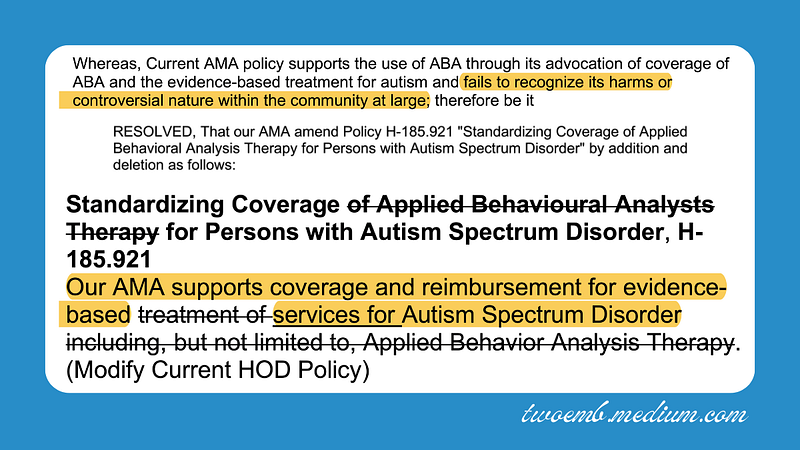
Quotes from AMA House of Delegates Handbook — screen shots provided by author

Previous wording:

Standardizing Coverage of Applied Behavioural Analysts Therapy for Persons with Autism Spectrum Disorder, H-185.921:

Our AMA supports coverage and reimbursement for evidence-based treatment of services for Autism Spectrum Disorder including, but not limited to, Applied Behavior Analysis Therapy.

**Proposed modified version:

Standardizing Coverage for Persons with Autism Spectrum Disorder, H-185.921:

Our AMA supports coverage and reimbursement for evidence-based services for Autism Spectrum Disorder.”

A brief pause for a self-congratulatory statement

In doing my research for this article, I was utterly shocked and speechless (definitely weird for me!) when I discovered that…

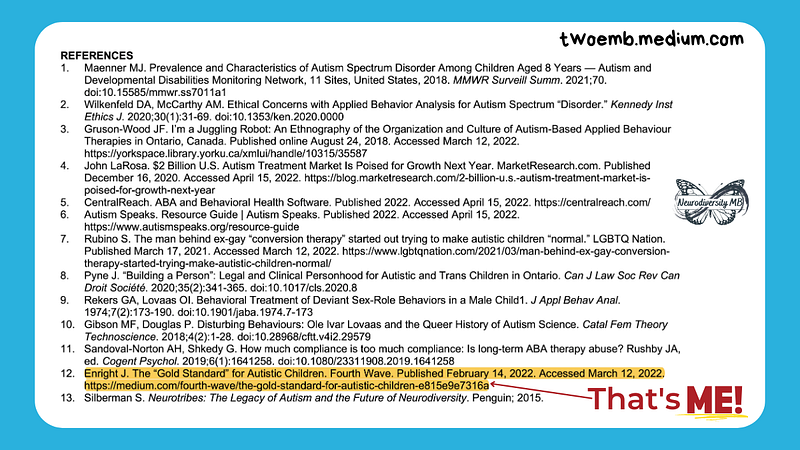
My work was CITED IN THIS PROPOSAL! This is amazing. I am overjoyed that my work is, in some very small part, helping to fight the harms of ABA.
Screen shot provided by author

I shall now return to our originally scheduled programming.

February 2023: PBIS is ABA in disguise

A recent report shared by a joint committee on disability matters sought to explore how our United Nations can align disability services with the United Nations Convention on the Rights of Persons with Disabilities (UNCRPD).

Three paragraphs of the report (58–60) cover Applied Behaviour Analysis (ABA) and Positive Behavioural Interventions and Supports (PBIS).
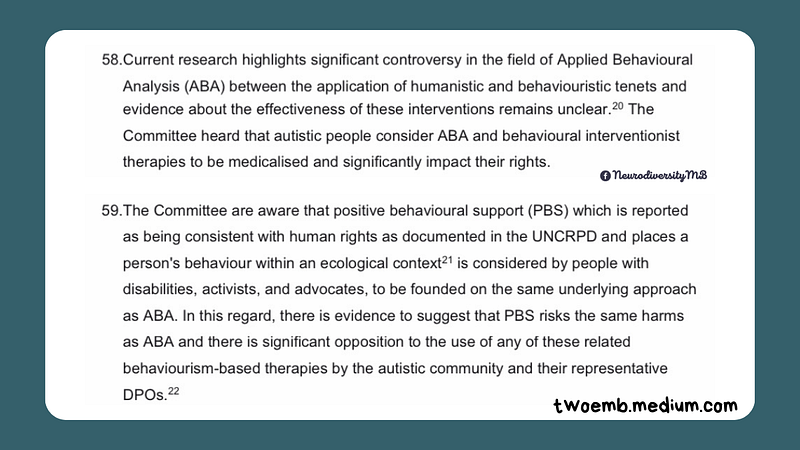
Screen shots provided by author — from Aligning Disability Services with the UNCRPD

“The Committee heard that autistic people consider ABA and behavioural interventionist therapies to be medicalised and significantly impact their rights.” — The Joint Committee on Disability Matters

There’s no misunderstanding the message and conclusions drawn by this committee.

“…there is evidence to suggest that PBIS risks the same harms as ABA…” — The Joint Committee on Disability Matters
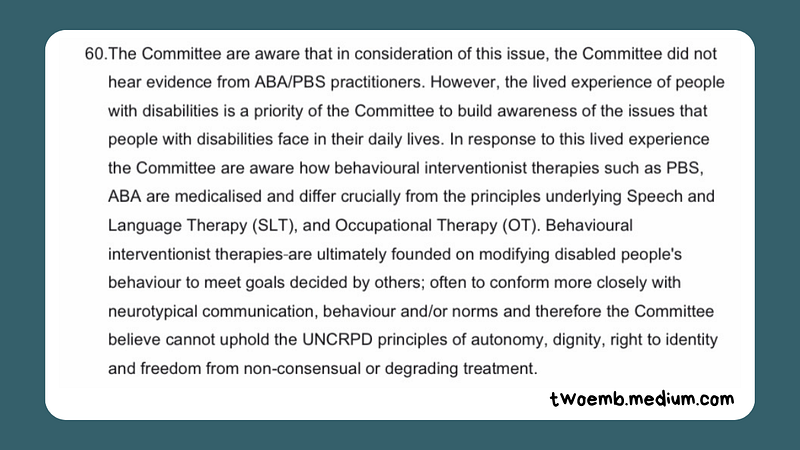
Screen shot provided by author — from Aligning Disability Services with the UNCRPD

That last sentence is critical.

“Behavioural interventionist therapies are ultimately founded on modifying disabled people’s behaviour to meet goals decided by others; often to conform more closely with neurotypical communication, behaviour and/or norms and therefore the Committee believe cannot uphold the UNCRPD principles of autonomy, dignity, right to identity and freedom from non-consensual or degrading treatment.” — The Joint Committee on Disability Matters

Their report unequivocally denounced behavioural interventions in favour of person-centred, affirming approaches which respect people’s identity and autonomy, such as Speech Language Pathology (SLP) and Occupational Therapy (OT).

What else can we say?

I am really hoping the American Medical Association (AMA) adopts this proposal — and quickly.

If (when!) that happens, I will be cautiously optimistic that the Canadian Medical Association (CMA), along with other institutions (including many of our public school systems), should follow suit and adapt more person-centred programming.

The CMA’s Health Summit is this August (August 17–18, 2023) in Ottawa and online. I hope Canadian healthcare providers will be proposing similar policy amendments to the CMA.

I’m sure it wouldn’t hurt to contact the CMA to share your concerns and desire to see the Canadian Medical Association modernize its highly out-dated policies.

The overwhelming evidence illustrating the many risks and harms of behavioural interventions speaks for itself. I just hope the policy-makers are finally listening.

© Jillian Enright, Neurodiversity MB

Related Articles

When you join medium, as a member you’ll have access to unlimited reads for only $5 per month. If you use my referral link, I’ll earn a small commission, and you’ll earn my undying gratitude.

If you’d prefer give a one-time tip, you can support my writing on Ko-Fi — also, it’s free to follow me on Facebook and LinkedIn!

Learn more

References

American Medical Association. (2023). AMA House Of Delegates Handbook. AMA. [Online].

Bonnello, C. (2018). 11,521 people answered this autism survey. Warning: the results may challenge you. — Autistic Not Weird. Autistic not Weird. Published October 1, 2018. Accessed April 15, 2022. https://autisticnotweird.com/2018survey

Bottema-Beutel, K., & Crowley, S. (2021). Pervasive Undisclosed Conflicts of Interest in Applied Behavior Analysis Autism Literature. Frontiers in psychology, 12, 676303. https://doi.org/10.3389/fpsyg.2021.676303

Cassidy, S., Bradley, L., Shaw, R., Baron-Cohen, S. (2018). Risk markers for suicidality in autistic adults. Molecular Autism, 9(1), 42. https://doi.org/10.1186/s13229-018-0226-4

Joint Committee on Disability Matters. (2023). Aligning Disability Services with the United Nations Convention on the Rights of Persons with Disabilities. Houses of the Oireachtas. [Online]

Reichow, B., Hume, K., Barton, E. E., & Boyd, B. A. (2018). Early intensive behavioral intervention (EIBI) for young children with autism spectrum disorders (ASD). The Cochrane database of systematic reviews, 5(5), CD009260. https://doi.org/10.1002/14651858.CD009260.pub3

Shattuck, P.T., Roux, A.M., Hudson, L.E., Taylor, J.L., Maenner, M.J., Trani, J-F. (2012). Services for Adults with an Autism Spectrum Disorder. The Canadian Journal of Psychiatry, 57(5), 284–291. https://doi.org/10.1177/070674371205700503

The American Medical Association. (2023). AMA House of Delegates Handbook. [Online]

The Department of Defense. (2020). The Department of Defense Comprehensive Autism Care Demonstration Annual Report. The Department of Defense; 35. [Online]

Wong, C., Odom, S.L., Hume, K.A., Cox, A.W., Fettig, A., Kucharczyk, S., Brock, M.E., Plavnick, J.B., Fleury, V.P., Schultz, T.R. (2015). Evidence-Based Practices for Children, Youth, and Young Adults with Autism Spectrum Disorder: A Comprehensive Review. Journal of Autism and Developmental Disorders, 45(7), 1951–66. https://doi.org/10.1007/s10803-014-2351-z

Autism
Mental Health
Human Rights
Equality
Advocacy
Recommended from ReadMedium