
The 7-Step Method to Become What You Truly Are
This is the essence of my ten years on this path

The simple formula for becoming what you truly are is: remove what you are not; what remains is what you are. But simple doesn’t mean easy. Finding out what you are not is challenging; and so is removing it.
You are controlled by countless programs that you learned when you grew up. These programs are the mental heritage not only of your parents, but of thousands of generations. At their core is an idea of what a human is, what the human potential is, and how to live as a human. Cultural, religious, national, regional, familial, and individual peculiarities extend this idea. These programs imprison you mentally.
But you are not these programs. They are what you must remove to become what you truly are. To do this, you must find them and become their master. That’s what I started doing at the end of 2011. In the following lines, I share the big picture of what I’ve been doing the last ten years, summarized as a method.
Prerequisites
Becoming what you truly are requires the following ingredients:
- curiosity,
- seriousness,
- courage,
- dedication,
- perseverance,
- patience,
- focus,
- humbleness,
- discipline, and
- egoism.
Egoism is the foundation. Egoism means putting yourself first. This is natural. Every animal does it. Every child does it — until it learns that egoism is bad, which is just one of the many programs we learn when we grow up. And it’s one of the first programs you must get rid of so you can become what you truly are.
Egoism can be dangerous when combined with the exercise of power. This combination results from the concept of freedom that equates freedom with power, as I explain in my article “This is the Problem with Our Concept of Freedom.” In our society, this concept leads to the ruthless enforcement of one’s own desires and interests at the expense of others. The result is manipulation and misuse of people, property, or the environment. However, if you use egoism to focus and work on becoming the best possible version of yourself, it is a powerful tool that not only serves you but also humankind, because it makes you fulfill your purpose as part of the whole, from which many other people will benefit.

The first three steps of the method presented below prepare you and get you in the mood for a mental voyage that will transform your life, provided you apply all the ingredients mentioned above. Therefore, as obvious as these three steps may seem, you must do them thoughtfully and with sobriety and dedication.
Step 1
Acknowledge that about 99% of your behavior and thoughts come from programs. In other words, you are on autopilot about 99% of the time.
[Before you can leave your prison, you must accept that you are in a prison.]
Do you doubt it is 99%?
“95% of what we do is habit.” (Aristotle)
Habits are programs. So Aristotle had already recognized that people are 95% controlled by their programs. But that was 2,300 years ago! There was no television, no internet, no computer games, no cell phones, no newspapers, and no books. Today, these media program us almost permanently. That’s why people today are much more on autopilot than the ancient Greeks.
People are 99 (or more) percent on autopilot. For many people it is 99.99%, for a few may be “only” 98%. This explains the wide disparity in our society. Someone who is “only” 98% on autopilot is 200 times freer (in the sense of being less on autopilot) than someone 99.99% on autopilot.
You see yourselves as you have learned to see yourselves — and you see yourselves compared to others. As long as you do that, you cannot recognize your mental prison and therefore you cannot free yourself from it, because everyone else is mentally imprisoned as well. You need the courage to take completely new perspectives. And you need the humbleness to acknowledge that almost every behavior and almost every thought comes from programs. This is not easy. I know that from experience. When you are doing something extraordinary or coaching people, it is even more difficult for you than for others to realize the full extent of your autopilot. If you are on, say, 98% autopilot and are surrounded by people 99.99% on autopilot, you do feel much closer to your truth already. But 98% autopilot is still a lot to find and remove!
Step 2
Decide that you want to know what you are without your programs.
[With this step, you choose to leave your prison.]
Not much can be achieved with an attitude like “I’ll try it and see what happens.” Ask yourself the question, “Do I really want to know what I am — no ifs, no buts?” If your answer is “yes,” the following steps will get you there.
Step 3
Acknowledge that you must free yourself from being controlled by your programs by becoming their master.
[With this step, you accept the process, the “means of transportation” for your voyage.]
From now on, we call this project ‘Becoming Free,’ that is, free from your programs.
Step 4
Take plenty of time for this project. Time for Becoming Free differs from time for yourself. For many people, time for themselves is a respite from the many tacit agreements they have with others, such as partners, children, parents, and friends. They use time for themselves to go for a walk, watch a movie, read a book, take a relaxing bath, etc. Time for Becoming Free is everything but recreation. It is time alone, during which you work mentally with and on yourself. This mental work is called self-exploration.
How much time would you invest in a project such as ‘Learning Tennis’? You would probably invest several hours a week and occasionally attend tennis camps. A camp is a period of days or weeks that you devote only to your project. Do the same for Becoming Free. Set aside several hours each week and occasionally host your own Becoming Free camp.
A Becoming Free camp should last at least a week, preferably several weeks. If possible, spend this time away from your usual environment. Refrain from social contact and media consumption. Conduct self-exploration. Spend time in nature — alone. Nature is free of human programs. Therefore, it supports you in freeing yourself from these programs.
Self-Exploration
Self-exploration is intensive mental work in which you dig for your truth.
In the first phase, you work with exercises like the ones found at the end of this article. These exercises introduce you to how to explore yourself. They also prepare you for the second phase.
In the second phase, you need to find the questions/exercises for exploring yourself. How do you do this? Think of your programs as corpses weighted down with rocks and sunk in a lake. When a program is ripe for you to master, it surfaces. Steps 1–3 and Phase 1 of Step 4, in a sense, shake these sunken corpses. This prepares them for surfacing. A surfacing may show as
- thoughts,
- feelings,
- actions,
- pain,
- diseases,
- accidents,
- encounters,
- observations,
- a headline that catches your eye,
- a word or phrase you pick up on,
- …
Observe your thoughts, feelings, actions, and your surroundings. A surfacing corpse is showed by a single strong signal or several temporally adjacent weak signals. If you notice something out of the ordinary or a pattern, research what program this points to. Ask questions like:
- Is the signal related to my current life situation?
- Is the signal related to my past?
- Is the signal related to my parents?
- …
For example, when you observe an argument between two people, ask yourself if you are fighting with someone or if there is a fight going on inside you. If you notice a sudden blur in your field of vision or a gradual deterioration of your vision, ask yourself what you don’t want to see. If you fall down because your foot got stuck, ask yourself where you got stuck in life. If you suffer from inflammations, ask yourself what makes you angry (= fiery) and why. Record in a journal what comes to mind. Look for patterns. These patterns show the underlying programs.

This is a meditation in the genuine sense of the word: the word meditate comes from Latin meditari (= to think over, reflect, consider; literally, to measure mentally). Imagine a tailor who measures a person before making a garment. This is how you meditate in the genuine sense of the word: look at mental content from as many sides as possible; explore it; look for connections. Meditation is research.
This understanding of meditation differs from what most people understand meditation to be today. Usually, people try to ignore their thoughts when they meditate; or they recite a mantra, hoping that the stream of thoughts will stop and they can enjoy thoughtlessness. This may be a nice relaxation exercise now and then, but your thoughts are expressions of your inner voice. Thought loops are outcries of your inner voice. If you want to free yourself from your programs, you must not ignore your inner voice; you must listen to it. You must learn to understand what it is saying.
Some people say: “You are not your thoughts. Your thoughts have nothing to do with you.” But the opposite is true. Your thoughts have everything to do with you — namely, with what you are today. And that is what you must embrace! You must accept your programs as your mental prison (cf Step 1). Only then can you free yourself from them. Over 99% of your thoughts come from your programs. Therefore, you can recognize many of them through your thoughts. By recognizing a program, analyzing it, and then observing it, you can learn to master it.
Next to your thoughts, your body is your most important guide for Becoming Free. It speaks to you. It guides you. You can find examples of how my body guided me in my article “Why I Isolated Myself Socially for 3.5 Years — and What Came Out of It” and in my book “Being Free : Get Out of the Box — The Method With 99 Exercises.”
The entire universe is giving you signals. The reason for this lies in the nature of our existence, which I outline in my article “Thoughts are Not Products of the Brain” and explain in detail in Chapter 16 of my book “Consciousness : Its Nature, Purpose, and How to Use It.”
Your body and the entire universe not only help you free yourself from your programs, they also show you how to live a life in which you fulfill your purpose.
Step 5
Once you have identified a program, observe yourself as thoroughly as possible and pay attention to when that program “strikes,” ie causes a behavior or thought to occur. Initially, you will probably notice it only after the program has struck, ie after the behavior or thought has occurred. As you continue to observe, you will recognize the program earlier and earlier until you recognize it before it strikes. At that point, you can stop it. You do this by willfully behaving or thinking differently. This will often not be easy. But it is the key to freeing yourself from the program. The formula is: every time you behave according to a program, you reinforce it; every time you behave differently, you weaken it.

Step 6
Extend the time for self-exploration, integrating it into your daily life. Be as thoroughly aware as possible of your thoughts, feelings, and behaviors in order to
- stop executing programs that you already identified and analyzed, and
- find other programs.
Be aware that everyone around you is on autopilot.
Be aware that your environment (which includes all people) is constantly shaping/programming you.
Be humble. If you walk this path, you are not better than others; you are different. Embrace your otherness. The more programs you master, the closer you get to your truth, the more challenging social interactions become, and the more enjoyable and powerful alone time becomes. People may ask you what’s wrong with you. Some will call you selfish — or call you names. Some will be angry because you no longer follow the programs these people are used to — and because you say “no” in situations where you used to say “yes” (and vice versa); and because you no longer allow others to manipulate and abuse you.
Step 7
Are you satisfied with what you have achieved so far? Do you want more?
Is there more? Yes! Imagine a cheetah that was born in a zoo. It has the potential to run 75 mph, but it never developed this potential. In the zoo, it doesn’t need to run fast because food comes from a keeper. And its prison is too small for it to learn to run that fast. If the cheetah wants to develop its full potential, it must leave the zoo. It must give up being fed. It must give up safety and take risks.
You, too, can unfold your full potential only if you free yourself from all your programs, including those that define what a human is, what the human potential is, and how to live as a human.
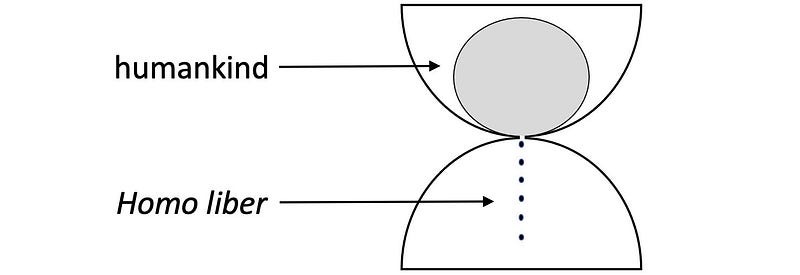
As a metaphor, imagine a human as a grain of sand. The programs generate dependencies (such as learned needs) and are thus a glue that turns humankind into an enormous lump of sand. Imagine that the lump is in the upper part of an hourglass.
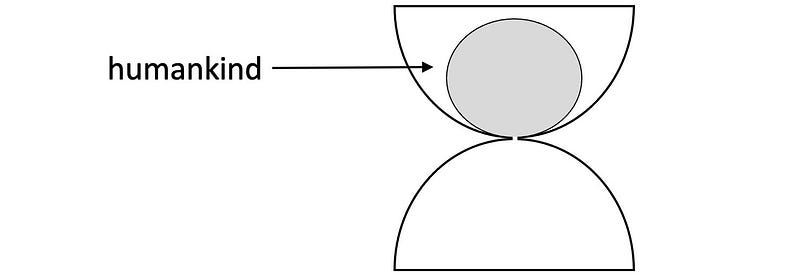
The lump of sand (humankind) cannot move downward, ie, it cannot go into the future. People can only advance individually. For this, they must free themselves from their dependencies. For this, they must free themselves from their programs. Those who have the courage to walk this path become free humans (Homo liber).
“You are the average of the five people you spend the most time with.” (Jim Rohn)
Your environment is constantly shaping/programming you. Every social interaction programs you. Every media consumption programs you. Every perception programs you. This keeps everyone inside the lump of sand. If you want to become a Homo liber, create an environment that supports you.
When will you be done? Never. Freeing yourself from thousands upon thousands of years of human programming is a life task. After over ten years on this path, I have freed myself from many programs and have thus come closer to my truth — and I continue to get closer to it day by day. I am a work in progress. If you set out on this path, you become a work in progress.
I also call this project ‘The First Ascent of Mount ME.’ No one else can climb this mountain. Only you can.
Exercises
With the following exercises, you can start with self-exploration (Phase 1 of Step 4). You can find more exercises in my other Mind Café articles (see the list at https://medium.com/@bernhardkutzler, the exercises are at the end of each article) and in my book “Being Free : Get Out of the Box — The Method With 99 Exercises.”
Exercise 1: Reflect on the importance of the ingredients for your project and how you are doing with them: egoism, discipline, curiosity, seriousness, courage, dedication, perseverance, patience, focus, and humbleness.
Exercise 2: What are you willing to let go of in order to free yourself from your programs? What are you willing to do to achieve this? Is there anything you want to keep no matter what? Family, friends, possessions, success, fame, knowledge, reputation, memories, plans…? Think about what it means wanting to keep something.
Exercise 3: Wanting to be seen is one of the most fundamental programs. What do you want to be seen as? What do you do to be seen like that? Choose something that happened recently. How did your desire to be seen influence your actions in that situation? Observe yourself over the next few hours. What do you say and do to be seen? What do others say and do to be seen?
Exercise 4: Make a list of the roles you have in life (child, mother, partner, teacher, doctor, cab driver, …). For each role, answer the following questions: How well do you function in that role? What are your responsibilities in that role? What are the advantages of it? What are the disadvantages? Choose something that happened recently. How did your role influence your behavior in this situation? How would you have behaved if you had a different role? For the next few hours, keep your role in mind and observe how it influences your behavior. What would your life be like if you no longer had that role?
Exercise 5: Make a list of what you own. For each item, think about what would happen if it were taken away from you. What if nothing on this list was in your life anymore?
Further (supplementary) readings:
Article “This is the Problem with Our Concept of Freedom”
Article “Why I Isolated Myself Socially for 3.5 Years — and What Came Out of It”
Article “Thoughts are Not Products of the Brain”
Book “Consciousness : Its Nature, Purpose, and How to Use It”
Book “Being Free : Get Out of the Box — The Method With 99 Exercises”
If you are not yet a member of medium, I invite you to consider membership. Membership gives you access not only to all my articles but also to the articles of thousands of other writers. If you use THIS LINK to become a member, you are supporting my writing.


