
Thoughts are Not Products of the Brain
Rigorous logic leads to a different and truly transformative perspective.

There are correlations between thinking and brain activities. But all we can conclude is that thinking leaves traces in the brain. Hence, exploring the mind by studying brain states might be like exploring an elephant by studying its footprints.
Follow along as I guide you with scientific meticulousness to a new perspective that provides more and better answers, is amazingly simple, and shows, among other things, what the lower self and the higher self are.
The Universe
Most people have a view of the world that can aptly be called a universe-centric perspective. The way we have learned to interpret our experiences, the universe comprises space and spatial phenomena. Of the latter, there are two types: physicochemical (coarse) spatial phenomena, such as matter, and electromagnetic (subtle) spatial phenomena, such as light.
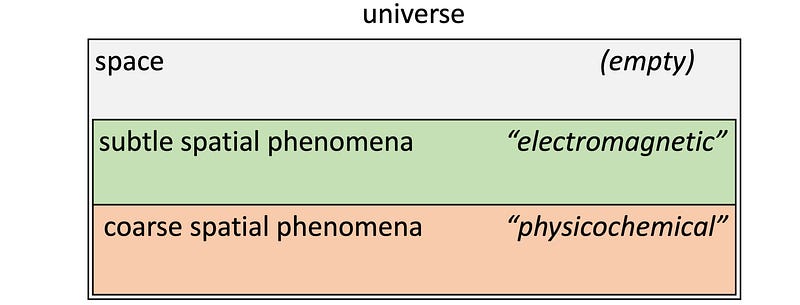
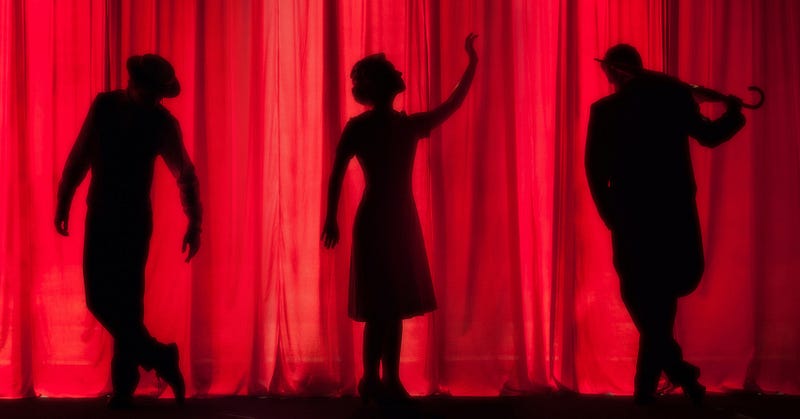
Think of the universe as a stage (space) on which actors (spatial phenomena) perform.
The essence of space is separateness. Between any two different points A and B, there is a distance that represents a path that needs to be traveled to get from A to B. Traveling this path takes time. Distance and time are basic units in physics.
Another word that describes the essence of space is stretch, which is the meaning of the word’s Proto-Indoeuropean root *(s)peh-. Space has stretch and so does every spatial phenomenon: coarse spatial phenomena have stretch because they occupy space. Subtle spatial phenomena stretch out by traveling at a certain speed in space.
The essence of the universe is stretch or, equivalently, separateness.
Another word that describes the universe is thing because this word also means stretch. (Its root is *ten- (= stretch).) Every“thing” in the universe, including space, is a thing because it has stretch. It can be measured — at least in principle — which is the basis of physics as a science.
Thoughts
Observe your mind. There is a continuous flow of knowing that includes four principal components.
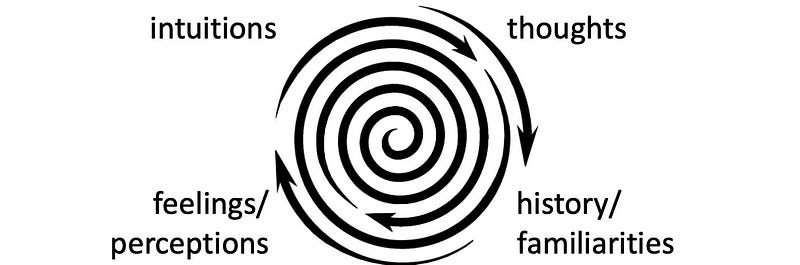
Feeling and perceiving refer to the same thing, a body state. ‘Perceive’ is mostly used in connection with the five external senses, ‘feel’ in connection with the internal senses. But both words mean the same, because the word feel comes from the Old English word felan (= to perceive). When you look at a tree, your eyes receive the light reflected from the tree and translate it into electromagnetic pulses that the nervous system transmits to your brain. You perceive/feel the electromagnetic state of your brain and nervous system along with the physicochemical state of your tissues and organs — and you have learned to describe this body and brain state as “I see a tree.” You have learned to describe a tense body state as fear and a boiling body state as rage.
Intuitions are knowings about a present situation outside your body without using your senses, such as an approaching danger. (For more on this, see my article “Why the 2004 Tsunami Killed 230,000 Humans But Virtually No Animals.”)
Thoughts are mental images that are either remembered past knowings (memories) or imagined, fictional knowings (eg plans for the future).
History is the record of the entire mind flow in a lifetime. Familiarities are patterns in it. The more often you have experienced something, such as seeing a tree, the more familiar you are with it. Familiarities are the key to meaningful interaction in your world: for this, you must be familiar with trees, houses, cars, sounds, words, and countless other objects, phenomena, and concepts.
Your history influences your perceptions, intuitions, and thoughts. An example is the following optical illusion, in which you see a white square even though there is no square.
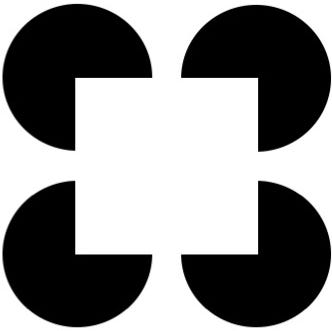
You see a square because you are familiar with squares. You are familiar with squares because you have seen countless squares in your life. Therefore, your history makes you see a square partly overlaying four black discs, rather than the truth of four incomplete black discs that look like Pac-Man figures. (I discuss this example in my article “The Prison of Your Mind is All Too Real.”)
The state of your brain and body affects the state of your mind through your feelings/perceptions. It is also the other way around. Imagine a romantic encounter — either as a memory or as a fictional imagination. The more vivid your thoughts are, the more strongly your body will respond. The state of your mind affects the state of your brain and body — which explains why brain activities correlate with thinking. This also explains the placebo effect.
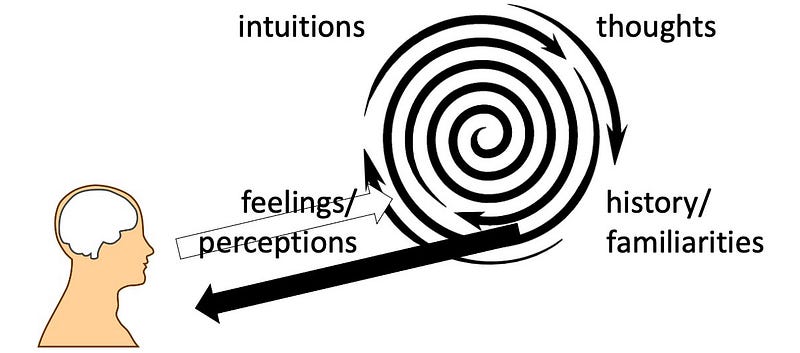
A state of your body affects the state of your mind, which, in turn, affects the state of your body. The result is an infinite loop between mind and body, in which thoughts and history are the central creative factors. (For more on the flow in your mind and this loop, see my book “Consciousness : Its Nature, Purpose, and How to Use It.”)
Is it all happening in your brain? This question entails countless other questions, such as What is the nature of a thought, how is it generated, and how is it stored? Is the entire life history stored in the brain and how? How are intuitions received?
In an article in Scientific American, Paul Reber estimates that the brain has a storage capacity of 2.5 petabytes (2.5 million gigabytes), which could hold 300 years of television shows. But a person’s history is much more extensive than television-quality video and audio. It also includes smell, taste, pain, feelings, etc. We don’t know how to store these, so any estimate of the storage capacity required is meaningless. Paul Reber argues memories are forgotten and thus free up space. People do forget, but forgetting is the inability to recall, and says nothing about memory. If memory were to decay, early childhood traumata would disappear, which could lead to the resulting disorders disappearing over time. However, the daily work of psychologists and psychotherapists suggests otherwise. There are convincing arguments that nothing ever gets lost, and it seems very unlikely that the brain can store a person’s entire life history.
The assumption that the brain produces thoughts and stores a person’s history is arbitrary and cannot be justified in any other way than “what else?”. From the universe-centric perspective, the universe is all there is, so the brain is the only candidate. However, this leaves countless questions unanswered. A truly curious person would question the perspective as an alternative approach. What if there is more than the universe?
Let’s explore this possibility and see where it takes us. Let’s “boldly go where most scientists dare not go,” out of the box of the physical universe. The word science comes from Latin scire (= to know). Knowledge, and therefore science, is NOT limited to the physical universe. As long as we strictly adhere to logic, while being guided by experience, curiosity, and imagination, our findings are scientific, because logic is the foundation of mathematics — and mathematics is the foundation of science.
More Than the Universe
Let’s do a thought experiment. What is left if we remove the universe, ie space and spatial phenomena? This is a challenging question, because the very idea of no-space seems absurd. Therefore, we need the highest precision in language and logic on this path.
Everything in the universe (including space) has stretch and is therefore a thing. To remove the universe is to remove all things. The result is ‘no thing’ … NO-THING … nothing — not even space. The usual interpretation of nothing is emptiness. But this is not true, because all that is not a thing belongs to nothing(ness). The mental flow in your mind is unlike any“thing” in the universe, so it could belong to NO-THING.
The word form comes from Latin forma (= appearance, shape). The Greek word for appearance is phainomenon, from which the English word phenomenon is derived. Therefore, phenomenon and FORM denote the same. In our thought experiment we removed space, ie we made it disappear. Since only an appearance can dis-appear, it is appropriate to call space an appearance/phenomenon in the first place. On this basis, THING and FORM denote the same, and so do NO-THING and NO-FORM.
The bottom line: if we remove the universe, NO-THING/NO-FORM remains.
The Latin prefix ‘in’ means “not.” For example, an incompetent person is a person who is not competent. Therefore, NO-FORM is … IN-FORM, or … IN-FORM-ATION. However, it is not information in the form of text, sounds, or images. The reason is that the Latin prefix ‘in’ has two meanings: ‘In’ means not only “not, without,” but also “into, upon.” Therefore, the word information means both without form (NO-FORM) and with form.
Texts, sounds, images, etc are information with form. Thoughts are information without form. Observe your thoughts for confirmation. They are of a different quality than texts, sounds, and images. They have no form. When you look for words or images to express your thoughts, you create a form out of NO-FORM.
Every form must have been formed. This is the causality principle in physics. With the entire universe, this is the question of how it was created. Not even the big bang theory provides an answer. It only gives a possible explanation of what happened from a fraction of a second after the creation. The only possible origin of the universe is NO-FORM, because before the universe was created, there was only that which is without the universe.
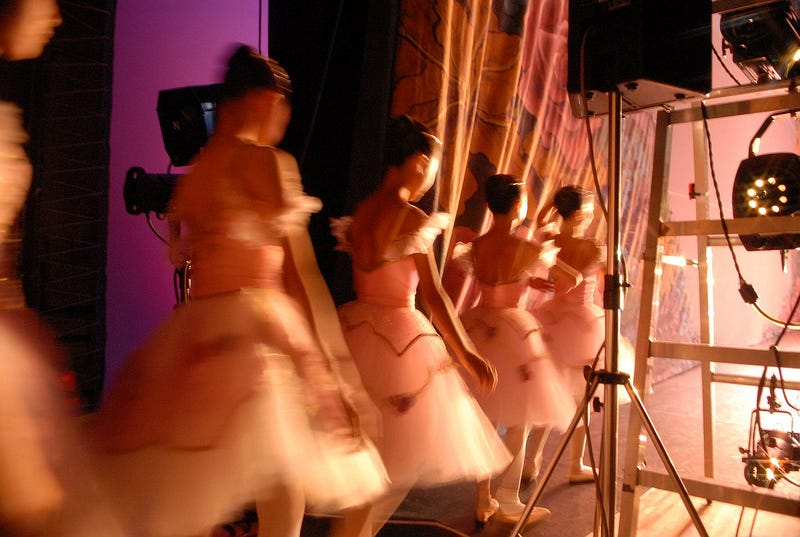
NO-FORM gives meanings to the words exist and appear. The word exist comes from Latin ex (= forth) and sistere (= come to stand), the word appear comes from Latin ad (= to) and parere (= to come forth). To stand forth and to come forth … forth from what? From FORM. FORM stands forth or comes forth from NO-FORM. The image of the universe as a stage on which actors perform illustrates this beautifully. NO-FORM is the backstage. The stage (space) and the actors (spatial phenomena) stand forth or come forth from backstage.
Unlike the universe, NO-FORM has no stretch, no separateness; there are no distances; all is interconnected. NO-FORM has no physics; it cannot be measured; it can only be known.
Since deletion is an act of separation, there can be no deletions in NO-FORM. An example: you cannot un-think a thought. Every thought contributes to your life history, which is constantly growing. NO-FORM is the “big version” of this.
The terms NO-FORM and NO-THING came from the process of finding it. I don’t like either as a name because they focus on what it is not. I call it EL as an abbreviation of ‘entanglement at large,’ which I consider its most characteristic property: all is connected/entangled with all.
The EL Perspective
From the universe-centric perspective, you are a body that has a thinking mind. The mind is a function of the body and, therefore, a local phenomenon.
From the EL perspective, you are mind piloting a body. Since your thoughts are the only actively creative element of your mind, you are thoughts piloting a body.
The thoughts and your entire life history are “in” EL. Your feelings/perceptions are pure information about your body. They are like the instrument display in a car. Intuitions are pure information from EL that is relevant to you in the present moment.
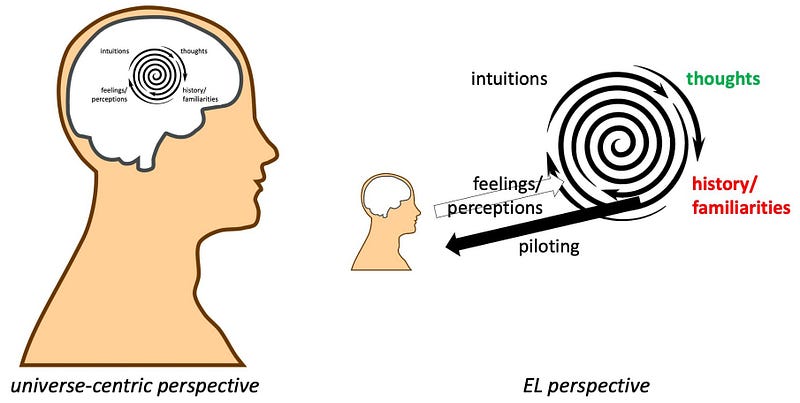
The universe-centric perspective, including the belief that the brain produces thoughts and the mind “sits” in the brain, is deeply rooted in our mental heritage. Expressions such as “to rack one’s brain,” “brainstorming,” “to have brains,” and “to pick someone’s brain” are evidence of this. Growing up, you learn this perspective, and you learn to identify with “your” body, “your” mind, and “your” history. You learn you are limited to yourself physically and mentally.
From the universe-centric perspective, your mind is independent of other people’s minds. From the EL perspective, “your” mind is an expression of EL that is connected/entangled with (all) EL — and therefore with all other expressions of EL, such as all “other” minds.
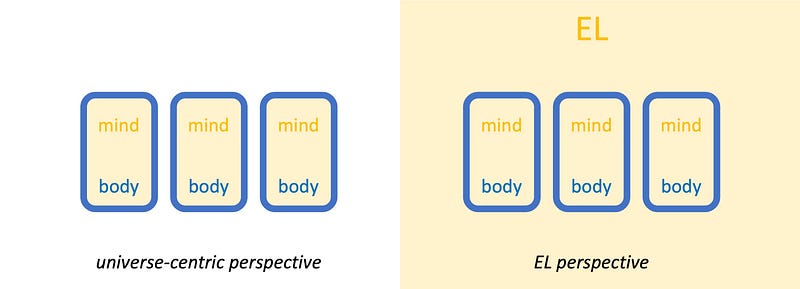
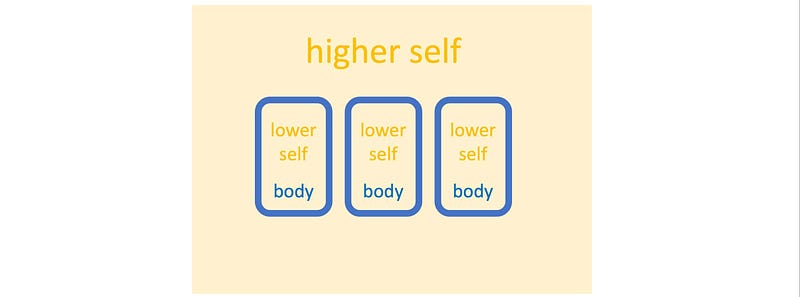
The identification with one’s own history is called the ego or the lower self. Since there are countless phenomena that cannot be explained with the lower self, people have postulated the existence of a higher self as an extension of the lower self. From the EL perspective, the higher self is nothing but EL.
Conclusion
From the universe-centric perspective, you are a body that thinks. This perspective leaves countless questions unanswered. From the EL perspective, you are thoughts piloting a body. This perspective provides explanations for virtually all known phenomena and combines science and spirituality. (More on this in my book on consciousness.)
A perspective is neither right nor wrong. It is only more or less useful in a given situation. Rigorous logic dictates the EL perspective.
Application
The change from the universe-centric perspective to the EL perspective is as fundamental as the change from the geocentric to the heliocentric perspective was a few hundred years ago. Taking this step can transform your life. Here are some exercises to help you get started:
Exercise 1: Look at an object. Observe how the resulting body state (feeling/perception) triggers thoughts. What familiarities are associated with it?
Exercise 2: Observe how thoughts trigger further thoughts. Which familiarities are associated with it?
Exercise 3: Watch for phrases that support the universe-centric perspective or the concept that the brain is the source of the mind. Stop using them. For example, replace ‘brainstorming’ with ‘mindstorming.’
Exercise 4: Practice imagining that you are thoughts (pure information) piloting a human body — the EL perspective. It may be helpful to practice mentally viewing yourself from outside your body.
Exercise 5: Practice taking the EL perspective while spending time with another person. It may be helpful to practice looking at yourself from the other person’s perspective, or to observe both of you from the perspective of a (fictitious) independent observer.
Further (supplementary) readings:
Article “Why the 2004 Tsunami Killed 230,000 Humans But Virtually No Animals.”
Article “The Prison of Your Mind is All Too Real”
Article “This is Exactly the Difference Between Humans and Animals”
Book “Consciousness: Its Nature, Purpose, and How to Use It”
If you are not yet a member of medium, I invite you to consider membership. Membership gives you access not only to all my articles but also to the articles of thousands of other writers. If you use THIS LINK to become a member, you are supporting my writing.


