
Why the 2004 Tsunami Killed 230,000 Humans but Virtually No Animals
A powerful lesson about survival — and more

On December 26, 2004, a tsunami in the Indian Ocean killed about 230,000 people, while virtually no animals died. They fled to higher ground before the water arrived. (See, for example, the National Geographic article “Did Animals Sense Tsunami Was Coming?”
Follow me as I propose and justify the most logical explanation for this and similar phenomena and what we can learn from it. I explain why this indicates that you were born with the potential of clairvoyance, and at the end of the article I suggest some exercises with which you can reactivate this potential.
Science Struggles to Find an Explanation
Among the explanations attempted is that the animals sensed the shaking of the earth caused by the earthquake that triggered the tsunami. The earthquake occurred up to 6.000 miles away. Any truck on a nearby road sends out more vibrations than what is left of an earthquake after such a distance. But sensing alone is not enough. Could you infer the cause of a tremor of the ground and know if you need to flee and in which direction? And there are many other phenomena for which there is no satisfactory scientific explanation. My favorite example is one of the most puzzling migration phenomena on the planet: the annual migration of some North American populations of the monarch butterfly (Danaus plexippus). They fly up to 2.100 miles from Canada to Mexico. When winds are unfavorable, they stop, rest, and wait for a wind that carries them where they need to go. How do they know if a wind is favorable?
There are more fascinating behaviors of non-human life forms, such as:
· animals leave their territory to find a new one when the old one no longer provides sustenance;
· migratory birds fly long distances to spend the winter; they leave at the right time, find their destination, fly back at the right time, and find their home;
· schools of fish, flocks of birds, herds of mammals, and colonies of insects often behave like a single organism;
· dogs wait at the front door for their owner before they can possibly hear, see, or otherwise perceive the owner’s arrival;
· horses and other animals follow the thoughts of their riders and trainers;
· plants grow new protection tools in response to new predators in their territory;
· paramecia find each other for conjugation;
· seeds know which direction to grow.
Usually, scientists study a single phenomenon and try to find a theory that explains it. Popular explanations include sun light and electromagnetism. But even if you had this information, could you make sense of it? Could you travel long distances using only the sun and a compass, without entering the data into a computer to process the information and give directions?
Nature is Simple
“Simplicity is the ultimate sophistication.” (Leonardo da Vinci)
I offer a simple explanation for the above (and other) phenomena: Animals, plants, and cells know. Before I explain what exactly I mean by know, follow me with a thought experiment:

Imagine that you have gotten married. You and your spouse are on a honeymoon in a luxurious beach hotel in Sri Lanka. It’s Sunday morning. You wake up with the desire to visit the famous royal city Kandy in the heartland of Sri Lanka. You kiss your partner awake and suggest going to Kandy. Your partner sleepily replies: “I don’t feel like it today. Let’s have a massage and then enjoy the beach. Tomorrow we’ll go to Kandy.” You agree. But you will never see Kandy. It’s December 26, 2004, and in a few hours a tsunami will flood the hotel and kill everyone. Like all animals, you had the impulse to get to safety. But you preferred to spend the day with your spouse instead of following that impulse.
“Something” inside you “knew” that you needed to leave the coast. It showed up as a desire to go to Kandy. But you ignored this desire/impulse. It works the same way with animals and other non-human life forms — but they don’t ignore it.
What exactly does it mean to know? This word originates from the root *gno- (= to know), which is but a circular definition. An archaic synonym for the word know is wit, which goes back to the Old English word witan (= to know), which in turn goes back to the root *weid- (= to see). So taken together, to know means to see. It is aptly used to denote seeing in a broader sense than just visual, including any sensory perception as well as seeing/perceiving something imaginary.
Four Types of Knowings
To make one thing clear: Knowing is a subjective experience and, per se, has nothing to do with truth.
“Everything we hear is an opinion, not a fact. Everything we see is a perspective, not the truth.” (Marcus Aurelius)
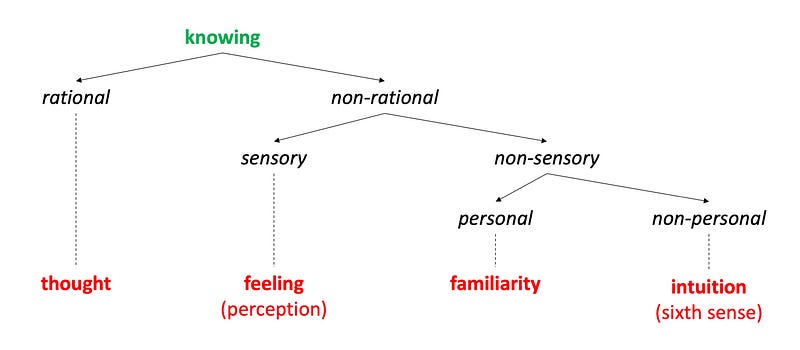
You experience four kinds of knowings:
Knowing that today is this or that day of the week is a rational knowing. It is a thought generated by the mind.
There are three types of non-rational knowings: one sensory and two non-sensory.
Knowing that it is cold is a sensory knowing. It is called a feeling and is a perception of the state of your body, which comprises the electromagnetic state of the nervous system and the physicochemical state of the organs and tissues. (I explain feelings in my article “Emotions are Not the Same as Feelings.”)
There are two types of non-sensory knowings: personal and non-personal.
Knowing that someone or something that you encounter has been in your life before, without being able to recall further details, is a personal non-sensory knowing. It is called familiarity.
Familiarities result from the life history. They arise when patterns of experiences are repeated. The more often a life form experiences a particular pattern (such as seeing an object or hearing a sound) or the more significant an experience is (such as an accident), the more prominent the pattern is in its life history. The more prominent a pattern is, the more familiar the life form is with it. The more familiar a life form is with a pattern, the stronger the automatism (compulsion) to act according to that pattern.
Knowing that you should leave the coast having no further information (as in the thought experiment) is a non-personal non-sensory knowing. It is called intuition. This word originates from Latin in (= in, at, on) and tueri (= to look at). It is a perception of something in the external world (such as an approaching danger) that is not based on the five physical senses and is, therefore, often called the sixth sense.
Here is a summary of the four types of knowings:
Every person has all four types of knowings at the same time — and often they conflict with each other. As an example, let’s analyze the thought experiment. You woke up with the intuition “flee,” which showed up as the desire to take a trip to the interior of the island. But when your spouse did not follow your suggestion, you silenced your intuition with your desire to be with your spouse (which is based on your familiarity of togetherness), with a rational argument such as “on my honeymoon I must stay with my spouse,” or both. Surely, your spouse also intuited the danger (see below), but the impulse was not strong enough to surface in a recognizable form.
Thoughts, feelings, and familiarities are strongly influenced by the programs that control us. (I describe these programs in my article “Who Are You?”) Intuition is not influenced by them and therefore provides access to truth, but the challenge is to distinguish intuition from the other knowings — and to trust it.
Back to the 2004 tsunami and other behaviors of non-human life forms. The simple explanation is that all life forms have all three types of non-rational knowings and behave accordingly:
· They have feelings, ie they perceive the state of their body. (Their reactions to changes in body state can be observed and measured.)
· They experience familiarities. There is a video on the internet, where you can see a tiger “joyfully” hugging a man. Many years ago, when the tiger was a baby, this man lovingly cared for it. Therefore, the tiger experiences a familiarity with his former keeper. It is said that elephants remember people who have hurt them. This has the same explanation. In such a case, the elephant has a negative familiarity with its former tormentor.
· They intuit dangers (such as an approaching tsunami), food sources, or anything else that is important for their survival, as long as it is compatible with the general symbiosis of all life forms. For example, not every zebra intuits every approaching lion because otherwise the lions would starve.
Animals in the wild do not have programs that would suppress truthful behavior. This can change when humans get involved. Here is an example: animals intuitively know that fire is dangerous. That’s why they usually run away from fire. But a lion can be trained to jump through a hoop of flames.
In the National Geographic article mentioned above, reference is made to the intuitive abilities of animals: “The belief that wild and domestic animals possess a sixth sense — and know in advance when the earth is going to shake — has been around for centuries.” However, this formulation is misleading. Animals do not know in advance. They intuit present, possibly distant situations that will lead to a threat — such as an earthquake that triggers a tsunami. Since there is no scientific model for intuition, it is dismissed as unscientific. (Think about this disingenuousness: If science has a theory for a phenomenon, it is considered scientific. If it does not have a theory because no one has an idea how to explain it, it is considered unscientific or pseudoscientific.)
I filled this gap in my exploration of consciousness and found a model that explains intuition. I discovered a “fabric” that is “everywhere and beyond.” This fabric is the basis of knowing — and thus of both awareness and consciousness. Knowing means “participating” in this fabric. I explain the fabric, how to find it, and what participation means in my article “A Logical Solution to the Hard Problem of Consciousness.” The full derivation, including an explicit description of intuition, a Theory of Mind (ToM), and a Theory of Everything (ToE) are in my book “Consciousness : Its Nature, Purpose, and How to Use It.”
Clairvoyance
The word clairvoyance is French and comes from clair (= clear) and voyant (= seeing); it means “to see clearly.” Clairvoyance is defined as the ability to receive information through non-sensory perception. This is exactly what we called intuition above. Clairvoyance is simply a refined form of using intuition as a tool. (Clairvoyance is sometimes mistakenly thought of as the ability to predict future events. Divination is the correct term for it.)
Telepathy is an aspect of clairvoyance. It involves the transmission of information from one person to another without using physical interaction or known sensory channels.

Animals, plants, and cells are clairvoyant. Fish that form a school communicate with each other through telepathy. Horses following the thoughts of their riders and plants following the thoughts of their owners use telepathy. Animals fleeing an approaching tsunami are clairvoyant. Non-human animals and plants are not conscious; therefore, they perform these “skills” unknowingly. Since humans are animals, we must have the same skills. Indeed, it would be illogical if such phenomena existed in non-human animals but not in humans. The challenge for us humans is simply to develop our innate clairvoyant potential and to use it consciously. The thought experiment about the honeymoon showed where the difficulty lies.
“At one time humans also had this sixth sense, but lost the ability when it was no longer needed or used.” (Alan Rabinowitz, Wildlife Conversation Society, New York)
Application
You were born with the potential of clairvoyance. Most likely you had clairvoyant experiences when you were little, but the adults around you programmed you that this was not real. So, it was buried before you could develop it into a useful and reliable tool. Here are three exercises you can use to get started again.
Exercise 1: Do experiments with pets or plants. Talk to them loudly or quietly and imagine that they are listening. Give them clear instructions. Repeat this exercise. Practice staying focused and knowing it’s working. Not only do you need to learn to talk to them, but your pets or plants need to learn to listen to you. (They are not used to you talking to them.) Practice makes perfect!
Exercise 2: Observe and analyze your knowings and match it to the four types above.
Exercise 3: Observe yourself throughout the day. Find situations of synchronicity, such as the phone rings and you know who is calling before you pick up the phone; you set an alarm clock (or a timer) and look at it seconds before it goes off.
Exercise 4: Design your own exercises.
Further (supplemental) readings:
Article “Emotions are Not the Same as Feelings”
Article “Who Are You?”
Article “A Logical Solution to the Hard Problem of Consciousness”
Book “Consciousness : Its Nature, Purpose, and How to Use It”
If you are not yet a member of medium, I invite you to consider membership. Membership gives you access not only to all my articles but also to the articles of thousands of other writers. If you use THIS LINK to become a member, you are supporting my writing.