
A Logical Solution to the Hard Problem of Consciousness
Pure logic led to a solution of striking simplicity and beauty — and an instruction manual for yourself.
In “The Simple Answer to the Hard Problem of Consciousness,” Shivendra Misra presented Philip Goff’s panpsychism as an answer to the Hard Problem of Consciousness. That is the problem of explaining why we experience the way we do. Knowing how consciousness works enables you to use your mind more effectively.
The idea of panpsychism is to posit that consciousness is a fundamental feature of all physical matter. This is a strong assumption that trivializes the Hard Problem of Consciousness because it postulates a solution. However, this does not explain consciousness and, therefore, is of limited value.
The first question must be: What is consciousness? All definitions of consciousness that I found are fuzzy. They either refer to other, similarly unsatisfactorily defined terms such as ‘awareness,’ or they circle back on themselves. That’s why I didn’t try to solve the Hard Problem of Consciousness in the first place. I am a mathematician and want to know everything precisely. My research started with a different question — and a solution to the Hard Problem of Consciousness came as a side result.
In my thought process, I used only pure logic and assumed nothing except that knowing is abstract. (Mathematicians strive to derive as much as possible from as little as possible.) Applying rigorous logic, I found “something” that I call EL (pronounced like “eel”), which brings forth a human phenomenon that can aptly be called consciousness (in the true sense of the word). Therefore, by explaining what it is, I offer a precise definition of consciousness and, as another side result, I provide a precise description of the difference between humans and non-human life forms.
I wanted to know who/what I am; how my mind works and how it is connected to my body; and I wanted precise answers. So, I gave up my career, my social life, and media consumption and put all my energy into exploring this question. After four years of intensive, original research I had fascinating answers, which I documented in the book “Consciousness : It’s Nature, Purpose, and How to Use It.” In this article, I lead you through the major steps of my thought process so that you can see the solution — and EL — for yourself. All details can be found in the book.
Join me on this mental journey. Your benefit is a new perspective on yourself and the nature of our existence. This will allow you to make better use of your most powerful tool: your mind.
I Started With the Question “What am I?”
Biologically, I am an ape. But obviously I am more than an ape — because otherwise I would live in the woods like all other apes. I am an ‘ape-Plus.’ To understand what I am, I had to understand the ape and the Plus.
An ape is an animal and, more generally, a life form. So, I had to understand life — and animals. For this, I took a pragmatic approach and asked: How would I engineer life?
The universe comprises space, coarse space phenomena such as matter (the physiochemical), and subtle space phenomena such as light (the electromagnetic). Logic dictates that life in this universe must perform five behaviors, the first of which is decay prevention. The other four logically follow from the goal of living as long as possible.
A cell is a perfect realization of these five behaviors — it is a perfect “survival machine” and lives potentially forever. However, it is microscopic. The development of macroscopic life required two steps:
(1) Joining of specialized cells into cell collectives: cell reproduction (the fifth behavior of life) becomes size growth, giving rise to “growing machines” — plants.
(2) Joining of specialized plants into plant collectives: building of sensorimotor systems, giving rise to “motility machines” — animals. (Animal organs and tissues can be considered specialized plants.)
This engineering process required the realization of the five behaviors of life at the cell collective level and the plant collective level. Although each step of the process was dictated only by logic, I found everything confirmed in real life.
Cells, plants, and animals follow their behavioral programs: the genetic program and, in animals, the sensorimotor program. The plasticity of these programs (this is the fourth behavior of life) leads to differences between conspecifics. But there are behaviors that cannot be explained with these programs. There must be more to non-human life forms than what I had engineered so far. I put that temporarily aside and continued with engineering humans. When I had the complete design of a human, I saw what was missing to understand non-human life forms completely.
Next, I had to understand the Plus in ‘human = ape-Plus,’ or, more generally, ‘human = animal-Plus.’ In other words, I had to understand the difference between humans and animals.
Non-human life forms are biological robots. They cannot help but follow their behavioral programs. If your dog greets you joyfully, it can’t help it. If one day it doesn’t greet you joyfully, there is a reason. Maybe it is sick. In such a case, it can’t help but not greet you joyfully that day. Humans can behave differently; humans can not follow their behavioral programs, but create new behavior. That doesn’t mean they always do.
Imagine a group of 100 apes. Heavy storm clouds gather and lightning strikes a nearby tree. The tree begins to burn. All 100 apes sense the danger and flee. They follow their behavioral programs. This was so hundreds of thousands of years ago and is so today. Next, imagine a group of 100 early humans. Heavy storm clouds gather and lightning strikes a nearby tree. The tree begins to burn. All 100 early humans sense the danger. 99 early humans flee. They follow their behavioral programs. One does not flee. It behaves differently. It is curious and explores this phenomenon.
Thus, or similarly, humans may have discovered fire as a tool. This was one of the most important steps in the evolution of humankind, because it enabled the tools with which we’ve built human civilization as an extension of nature. No other species on this planet has done that — not in millions of years; yet another proof that there is a difference.
All 100 early humans had the potential to do something else than flee. Maybe a handful realized they had a choice. But only one chose to behave differently. That is what matters. How could the early human behave differently? Where did its behavior come from, if not from a behavioral program? It created the new behavior. Humans can create behavior. We have a creativity system. This is the Plus in ‘human = animal-Plus.’
What is creativity? Most people connect this word with artists and their works, such as music or paintings. But this is too narrow a view. The word creative originates from the Latin word creare (= to grow). To be creative means to let something grow, to produce something — such as a behavior.
Here is an illustration: Imagine you can play the piano. You sit at a piano and have the notes of Beethoven’s Fifth Symphony in front of you. You have two possibilities: (1) You play the piece note for note. (2) You ignore the notes and improvise — whereby the improvisation has more or less or nothing to do with Beethoven’s Fifth.
Following your behavioral programs is like playing by notes. Creating behavior is like improvising. Non-human life forms can only play by notes. Humans can improvise. But we modern humans improvise only in the one percent range, most even only in the hundredth percent range of daily behavior and thinking. This is because of the programming we receive when we grow up, see my article “Who Are You?”.
What does the creativity system look like? Part of the specification is that a human must be able to “see” something imaginary. It needs to see itself behaving in a new way before it can perform this new behavior. It doesn’t need that when it follows a program. An archaic form of the word know is wit, which has the Proto-Indoeuropean root *weid- (= to see). Therefore, ‘to know’ can aptly be used to denote seeing in a broader sense than just visually — such as imaginary. So, in order to be creative, humans must be able to know. (Think of a thought as a knowing.)
How can knowing be engineered? This proved to be challenging. There are two possibilities for the nature of knowing: either it is concrete or it is abstract. If it is concrete, it must be physicochemical or electromagnetic. There are no indications that thoughts/knowings are physicochemical. It is simply not possible that all individual thoughts would be encoded as unique physical or chemical occurrences. If thoughts/knowings are electromagnetic, a lot of open questions arise that cannot be answered within the current scientific understanding of electromagnetic phenomena.
Letting go of the idea that thoughts must be concrete, what if knowing is abstract? Could this perspective help explain our experience of the universe? Assuming that knowing is abstract, there is nothing in the physical universe to realize it, because everything in the universe is concrete. Not wanting to postulate what is needed, we need to search outside the physical universe.
What Remains When “Removing” the Universe?
When we perceive an entity of matter, such as a tree, we really perceive only a form. We can’t perceive space, we can only deduce its existence. We can’t perceive light and other subtle spatial phenomena either, we also can only deduce their existence. When we free ourselves from the concepts of matter, space, light, etc, we really perceive only forms — forms that change; in other words, trans-form-ation.
Fascinatingly, the word universe means exactly that. It originates from the Latin words unus (= one) and vertere (= to transform, be changed). Those Greeks and Romans who created their languages seem to have encoded their knowledge about the nature of our existence, and thus their legacy, in their languages.
The physical universe contains but forms. When we see a tree, we see a form. This form comprises molecules that are made up of atoms. Atoms are forms. Subatomic particles are forms. Superstrings are forms. The physical universe can aptly be called the universe of forms.
What remains when the universe is “removed?” Then all forms disappear and no form remains. I had no idea what this was, so I simply named the result no-form. A Latin prefix denoting negation is in-. For example, an incompetent person is someone who is not competent. Therefore, no-form is also aptly called in-form — or information.
But beware! Usually, we don’t use this word in the sense of no-form — and yet we use it correctly. This is because the word information has two meanings: the Latin prefix in- also means “in/into.” Information denotes both no-form and something that has a form. (Information in the sense of no-form sometimes is referred to as ‘pure information.’)
We experience these two aspects of information when we think: Every thought, every idea starts as no-form. When we put it into words or pictures, such as when we want to communicate it, we give it a form. This is true for everything we experience. For example, the experience of love is no-form. It is beyond words, beyond pictures. When you say “I love you,” write a love letter, or compose a song to express your experience, you give it a form. But this form is only a shadow of the original no-form experience.
No-form is the source of forms; every form arises from no-form. This is beautifully expressed by the word exist, which originates from the Latin words ex (= forth) and sistere (= to stand). Form stands forth from no-form. No-form is the source of everything that exists.
No-Form is the opposite of the universe of forms / the physical universe. Therefore, its properties can be derived by negation of the characteristic properties of the physical universe. The essence of the physical universe is separateness. Between any two separate points A and B in the universe, there is a distance that represents a path that needs to be traveled to get from A to B. Traveling this path takes time. Distance and time are basic units in physics. It follows that in no-form there is no separateness, no distance, no time, no physics.
How can no-form be visualized? Imagine every point in the universe as simultaneously also belonging to no-form. Every point in the universe is like a coin with two sides — a form-side and a no-form-side. This picture expresses the fact that behind every form there is no-form/pure information that brings it forth. No-form is like an “extra dimension.”
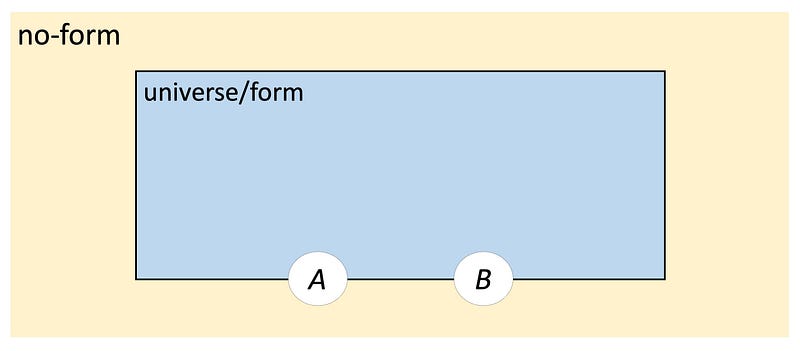
No-form matches the universe point for point and even reaches beyond the universe, but it has no physics. One can say that physics in no-form collapses because all distances are zero. In fact, this provides a simple explanation for the spooky action at a distance that is observed in quantum physics. What quantum physicists call entanglement is the zero-distance in no-form. A conclusion from this no-form-perspective is that any two points in the universe are entangled. This can aptly be called entanglement at large — EL for short. I chose this as name for no-form because I find this is its most iconic property. It is also consistent with the phrase “everything is connected.” EL provides an explanation.
The physical universe is concrete. Therefore, EL is abstract. Since knowing was posited as abstract, we have what is needed for engineering humans.
What is Consciousness?
Knowing is simply a human’s “participation” in EL. The creativity system “is” in EL.
What do you know at this moment? You know what you perceive and what you think. I call this your ‘present knowing.’ So, when you perceive or think, you “are” in EL. Your present knowing comprises two “parts:” perception and thinking.
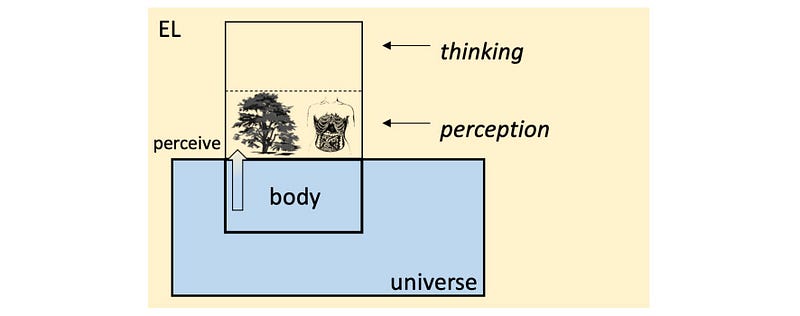
The ability to create a new behavior requires looking at past knowings, because otherwise you cannot know that you are following a program and choose to behave differently. So, there must be an automatic recording of present knowings to create a reservoir of past knowings. This recording “happens” in EL. The result is called the life form’s history.
Imagine a present knowing as a sheet of paper filled with what you know (perceive and think) in the present moment. As the moment passes, that sheet becomes part of your history — and a new sheet is filled with what you know in the new moment. It’s like recording a movie on many channels: video, audio, …, thoughts. Over the years, this creates a huge “stack of paper” — a gigantic “book” — your history.
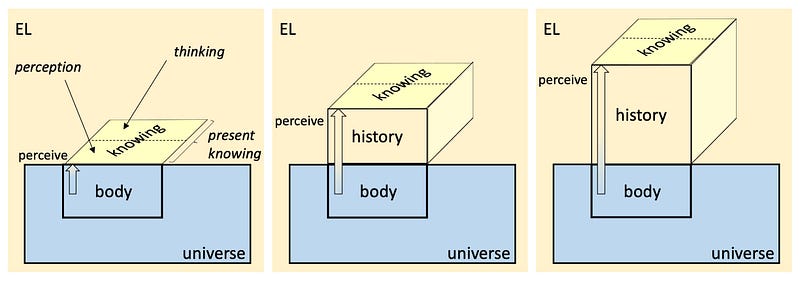
Your creativity system enables you to recall recorded knowings, ie to turn back in your “book” and make a past knowing a present knowing. This enables you to know of your history, that is, to know that you have a history.
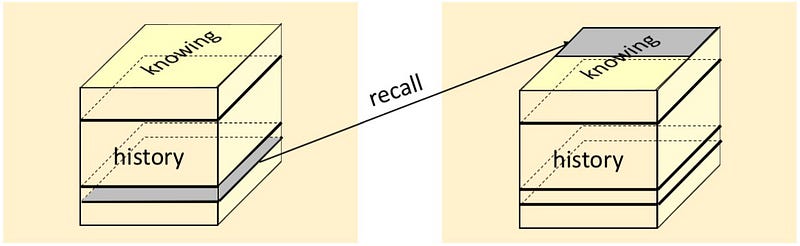
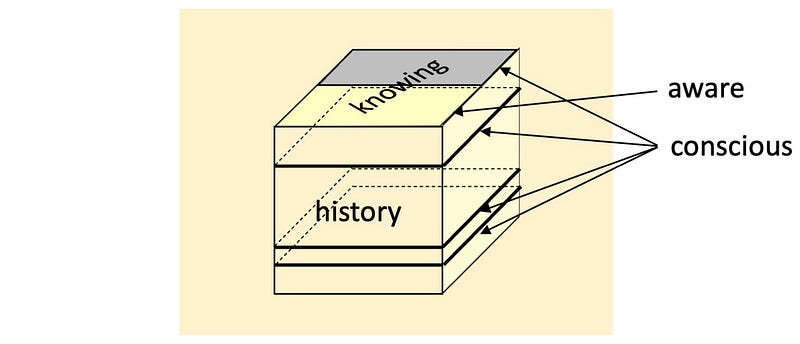
The creativity system is what we call mind. There is more to the creativity system/mind than knowing and recalling, but we don’t need that for this article. Next, I explain what consciousness is in this picture.
The word conscious originates from the Latin words com (= with, together) and scire (= to know). Therefore, conscious means “knowing together” or “knowing a togetherness,” and consciousness is “a knowing of a togetherness.” Knowing of your history is precisely that: the history is a togetherness of knowings, namely the collection of a lifetime of present knowings. Knowing of your history means to be conscious (in the true sense of the word).
A word that often is used as a synonym for consciousness is awareness. However, the word aware has the root *wer- (= perceive, watch out for), which is something different than what the word conscious means. To be conscious means to know of your history. To be aware means to perceive. Your awareness is your present knowing, ie your participation in EL. Your consciousness is your knowing that you have a history.
The history is but an additional behavioral program: It contains what I call familiarities. When you see a person and feel you know him or her, but can’t recall the name, a former encounter, or anything else, you experience a familiarity without remembering. Familiarities arise when patterns of experience repeat. The more often you experience a certain pattern or the more significant an experience is, the more prominent the pattern is in your history. The more prominent a pattern is, the more familiar you are with it. The more familiar you are with a pattern, the stronger the automatism (compulsion) to behave according to the pattern. Familiarities are … programs!
Every experience becomes part of the history and reinforces or weakens certain familiarities/programs. In this way, you are permanently programmed. In fact, you also permanently program yourself: Every thought is part of your present knowing and thus becomes part of your history, that is, it programs you. Likewise, every perception programs you. When you listen to music, you program yourself. When you read a book or watch a movie, you program yourself. Therefore, every thought and every perception counts. This is the true power of your mind. In every moment, the question is: What do you choose to perceive and think at this moment?
“As you think so you shall become.” (Bruce Lee)
Why should only humans participate in EL and have a history (even if non-human life forms can’t look back at it)? It would be illogical for the universe not to be homogeneously designed. In fact, if non-human life forms are aware and have histories, this provides explanations for all phenomena that cannot be explained with the biological programs. For example, when an animal seems to “remember” a person, it really experiences “only” a familiarity. Experiencing a familiarity can be considered an “involuntary remembering.”
All life forms participate in EL, ie know the present moment, ie are aware. Only humans know of their history, ie are conscious. Another formulation of the difference is: All life forms know — only humans know that they know.
Furthermore, there is no reason why awareness should be limited to life forms. Everything in the universe participates in EL, ie knows. This is why two electrons in a quantum physics entanglement experiment behave the way they do. They know about each other (via EL). In the book, I elaborate this perspective into a simple and concise theory of everything. There I also explain how EL and the physical universe form a pseudopolarity.
Applications
EL is the fabric of our existence. Its derivation shows how you are connected to EL — and through EL you are connected with the entire universe. In Doors of Perception (page 6) Aldous Huxley talks about a “Mind at Large,” which is nothing more than the ability to use this connectedness.
„The suggestion is that the function of the brain and nervous system and sense organs is in the main eliminative and not productive. Each person is at each moment capable of remembering all that has ever happened to him and of perceiving everything that is happening everywhere in the universe. … According to such a theory, each one of us is potentially Mind at Large.“ (Aldous Huxley)
The first step to opening your mind to a “Mind at Large” is to accept this potential as a truth. The logical deduction of EL provides all the arguments, so you don’t have to believe, but you can understand. The following meditations/exercises can help with this:
(1) Meditate on the two meanings of the word ‘information.’ Observe your thinking. Observe how every thought and every experience begins beyond words and images, and how your mind gives them form by attaching labels, judging, and drawing conclusions.
(2) Meditate on the properties of your knowledge. For example, there is no boundary between knowledge A and knowledge B. In your mind, everything is interconnected. Observe how in your mind thoughts trigger thoughts, which trigger further thoughts.
(3) Imagine a sponge in the ocean. The water that is “in” the sponge is also part of the ocean. Consider this situation first from the perspective of the sponge, then from the perspective of the ocean. What conclusions do you draw from comparing these two perspectives? Next, see yourself as the sponge and EL as the water. Meditate on overcoming the illusionary boundary of your physical body.
(4) EL provides stunningly simple explanations for phenomena such as clairvoyance, tele perception, and telekinesis. This opens the door to conduct your own experiments. Meditate on how you can achieve this.
Understanding familiarities is key to self-development. The following exercise can help with this:
(a) Meditate on your familiarities. Make a list of the most dominant ones. How did they develop? For each item on the list: What strengthens it? What weakens it?
read our print magazine for free
when you sign up to mind cafe’s newsletter, you’ll gain instant access to four articles from mind cafe’s gorgeous print magazine totally for free. click here to join.


