
This is the Problem with Our Concept of Freedom
Paradoxically, it leads to enslavement.

What is freedom? Probably the most common answer is, “I am free when I can do what I want.” This definition equates freedom with power: the more power you have, the more you can do what you want, the freer you are. So you need power to be free in this sense. With this definition, the search for freedom becomes a search for power.
Having power sounds desirable, but what if what you want conflicts with what someone else wants? Then you get into a power struggle and your own freedom/power becomes the other person’s unfreedom — or vice versa. So there is something wrong.
Follow along as I analyze this concept of freedom. In the end, I will offer you an alternative concept that is natural and supports your growth.
Doing What You Want
Doing what you want is egoistic. ‘Ego’ is the Latin word for ‘I.’ So egoism means putting yourself first. This is natural. Every animal does it. Every child does it — until it learns that egoism is bad, which is just a program.
“There is nothing either good or bad, but only thinking makes it so.” (William Shakespeare)
To paraphrase Shakespeare: No tool is either good or bad, it is the use that makes it so. You can use a hammer to fix something — or to kill someone. The hammer is neither good nor bad. Your use of it is.
Nature teaches us that egoism is a tool needed to survive and realize one’s potential. Most people who have achieved or are achieving something special were or are egoistic. Einstein was egoistic. Picasso was egoistic. Top athletes are egoistic. Successful people are egoistic.
But in our society, egoism is a dangerous tool because:
“Man can do what he wants, but he cannot want what he wants.” (Arthur Schopenhauer)
What Do People Want?
To find the truth in this, we must distinguish between natural and learned needs. For natural needs, let’s look at those humans who are closest to the true nature of humans: children. All a child wants is to satisfy its natural needs, of which there are two types:
(1) the biological needs for food, water, breathable air, light, warmth, and space;
(2) the mental need to understand the world and create in it.
Biological programs such as respiration, hunger for food, and hunger for sensorimotor experiences provide for the fulfillment of the biological needs. (Any life form with a sensorimotor system must use this system sufficiently — but not excessively — to keep it functioning.) Mental hunger, also called curiosity, provides for the fulfillment of the mental need.
Once its biological needs are satisfied, a child devotes all its energy to satisfying its mental hunger by curiously exploring the world through its play. It asks thousands of questions with all its senses and listens for answers. And by doing so, it grows at an incredible pace.
“Play is the highest form of research.” (Albert Einstein)
But this deeply fulfilling life stops when the child gets older. The child’s play/research is sabotaged by parents and peers, and it is programmed to (try to) satisfy its mental hunger with substitute methods including food, possession, power, and later, money, sex, information, travel, and drugs. But satisfying these learned needs doesn’t satisfy the natural mental hunger. As a result, people remain chronically mentally hungry. (I describe how this conditioning happens in my book “Curiosity : The Mental Hunger of Humans” and some of it also in my article “Stop Doing This to Your Child.”)

Conditioning during upbringing turns ravenously curious and creative children who enjoy life to the fullest into adults who function, feel more or less inferior, are loaded with learned needs, and try in vain to gain satisfaction through consumption.
It doesn’t take much to satisfy natural mental hunger, and it’s not destructive in any way. This can be observed in children, and even more so in children in countries without the absurd affluence of the modern consumer society. (Children are also programmed by being overloaded with fancy, unnatural toys that encourage consumption rather than creativity.)
But the more learned needs someone has, and the more their natural mental hunger goes unsatisfied, the more power they need to keep finding superficial satisfaction. These people become like drug addicts. They get caught in a loop where they constantly strive for power (such as money and command over others), acquire power, and exercise power, all in the vain attempt to find sufficient satisfaction. Being trapped in a loop means unfreedom.
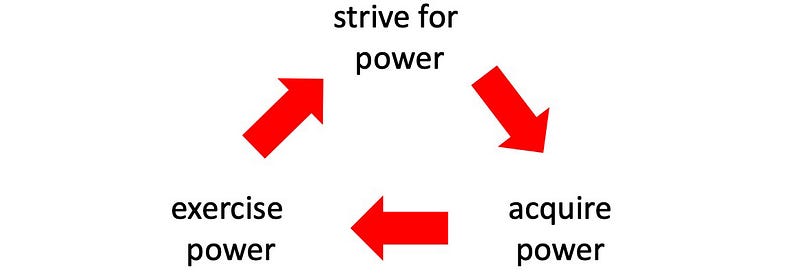
The excessive exercise of power to fulfill learned needs or for its own sake is all too often accompanied by the manipulation and abuse of others, property, or the environment. This is where the power-based definition of freedom becomes destructive.
Another dilemma is that you can lose these forms of power at any time. For example, if you have power in the form of money, authorities can take it away from you through demonetization or by freezing your bank account. Also, command over others can easily be taken away from you by people who have command over you. Most learned needs make people depend on other people, institutions, and authorities. Being dependent is unfreedom.
In the early 20th century, the occultist Aleister Crowley propagated the exercise of power, further fueling this unhealthy cycle. He founded a religion/philosophy called Thelema. Thelema is the Latin transliteration of the Greek word for ‘will.’ There was one simple rule: “Do what thou wilt shall be the whole of the Law.”
Artists popularized and continue to popularize Crowley’s mindset. His portrait or name can be found on the record covers of popular musicians and music groups. The above “Law” can also be found in whole or in part in song lyrics. As a result, masses of people have been and are being programmed to do what they want. These masses of people are striving for the power they need to do so.

Let’s summarize:
(1) People are programmed to believe that freedom means they can do what they want.
(2) People are programmed to do what they want.
(3) People are programmed to want this and that.
(4) People are programmed to strive for means of power, such as money.
The result is: people spend all their energy to acquire the power they need so that they can use it to get what they have been programmed to want. That makes them slaves to those who program us. That’s primarily the media — or rather, those who control the media.
Enslavement
When you want something, anyone who stands in your way is an obstacle. This can cause power struggles.
People invented many types of power struggles; crude and subtle ones. Who is physically stronger? Who has more money? Who has more supporters? Who knows more? Who has the smarter fine print in contracts? And so on. There are also power struggles in which there is neither a winner nor a loser. Bartering is one of these.
The word barter comes from the Old French word barater (= to cheat, deceive). Both parties to a barter have the same goal: “I’ll give you as little as possible and want from you as much as possible.” The one who negotiates more skillfully or is in the better position wins. Bartering is a power struggle.
Almost all barters on this planet are power struggles. This is true not only for purchases but also for employments, bank loans, partnerships, etc.

Power struggles in nature are about territory, food, hierarchy, or a female. Fights between predator and prey are not power struggles, but struggles for survival — for both. If two animals fight a power struggle, there is a winner and a loser. If the loser admits defeat with a gesture of submission, the winner accepts and the fight is over.
We humans are different. (I explain the essence of the difference in my article “This is Exactly the Difference Between Humans and Animals.”) Imagine that you and I have a power struggle that we fight as a fistfight. During the fight, I find you are stronger. I say, I give up. What do you do?
Your problem is that you can’t trust me. Animals always behave truthfully. An animal’s gesture of submission is truthful. It ends the fight and usually life goes on for both. A human gesture of submission can be a lie, because humans can — and often do — behave untruthfully.
Back to our fictional fistfight, where I say I give up. As soon as you turn your back on me, I might pull a knife and kill you. My surrender could have been a trick. Therefore, the question again: what do you do after I say I give up?
As the winner of the fight, you must make sure that I am no longer a threat to you. Since you can’t trust me, you have only two choices: either you kill me or you enslave me.
Originally, enslavement means that one person owns another person. Generalized, it means “to make dependent.” If you make me dependent on you, you can control me. The advantage of enslaving me is that you can let me work for you. The disadvantage is that you have to keep me enslaved/dependent, which may take some effort. So you have to do a cost-benefit analysis of whether enslavement is profitable.
In any social group, starting with the smallest, the partnership, there are several more or less subtle power struggles in different areas. Since group members can be more powerful in some areas and less powerful in others, this can lead to complex situations of mutual dependencies. After some time, virtually any social group will end up in a pyramidal power/dependence structure with more or less subtle forms of enslavement.
The Alternative
Egoism is an aspect of self-love. The word love has the Proto-Indoeuropean root *leubh- (= to care). Self-love means to take care of oneself. This is a matter of survival and therefore a natural behavior. Every non-human life form on this planet takes care of itself so that it survives not only, but thrives by developing its full potential. The only exception is motherhood. A mother takes care of her child before she takes care of herself. This is called mother love. Self-love serves the survival of the individual. Mother love serves the survival of the species.
Each cheetah develops its full potential to run about 75 mph — otherwise, it could not make prey and thus could not survive. A cheetah born in a zoo cannot develop this potential. It has no motivation to run so fast because it is fed by the keeper. For another, it also doesn’t have the space to run that fast.
A being is free when it can develop its full potential. A cheetah born in the wild is free. A cheetah born in a zoo is not free. Fittingly, the word free has the root *pri- (= to love). A constructive definition of freedom, therefore, is to equate it with self-love in the sense of caring for one’s own maximum personal growth.
You are free when you are not limited, either physically or mentally, so that you can grow into the best possible version of yourself. To become free in this sense, you must free yourself from dependencies and from being controlled by programs. (Dependencies result from programs. It has been my experience that you can work on this “from both ends.” Actively exiting dependencies helps with the programs — and working on the programs helps with dependencies.)
Conclusion
The problem with the usual concept of freedom is that it doesn’t work in our modern society. As long as you do this for your natural biological and mental needs, it is constructive and uplifting. But when you do it for your learned needs, it becomes destructive and abusive, ultimately leading to enslavement.
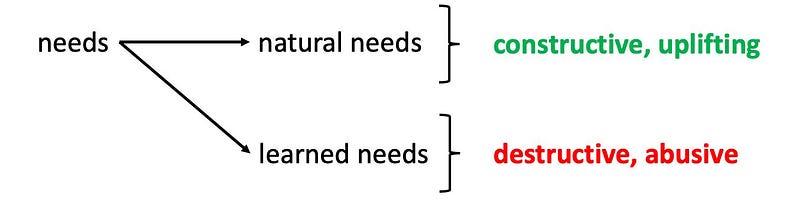
The freedom we should strive for is to be free from being controlled by programs, and thus from dependencies and learned needs. This freedom does not depend on means of power, other people, or institutions, and is purely constructive.
Application
Our lives are full of dependencies and more or less subtle power struggles. Awareness is the first step to resolve this. The following exercises get you started. You can find more exercises in my book “Being Free : Get Out of the Box — The Method With 99 Exercises.”
Exercise 1: What kinds of power do you have? How does it feel to have these kinds of power? When and how do you exercise them?
Exercise 2: What are the power struggles in your life? Explore this for each type of power you found in Exercise 1.
Exercise 3: What barters are there in your life?
Exercise 4: (If you are in a partnership): What do you get from your partnership? What does your partner get from it? What barters are there between you?
Exercise 5: What learned needs to do recognize in yourself?
Exercise 6: What programs are behind the learned needs you found in Exercise 5?
Further (supplementary) readings:
Article “Stop Doing This to Your Child”
Article “This is Exactly the Difference Between Humans and Animals”
Book “Curiosity : The Mental Hunger of Humans”
Book “Being Free : Get Out of the Box — The Method With 99 Exercises”
If you are not yet a member of medium, I invite you to consider membership. Membership gives you access not only to all my articles but also to the articles of thousands of other writers. If you use THIS LINK to become a member, you are supporting my writing.


