
This is Exactly the Difference Between Humans and Animals
These two basic abilities make us unique on this planet
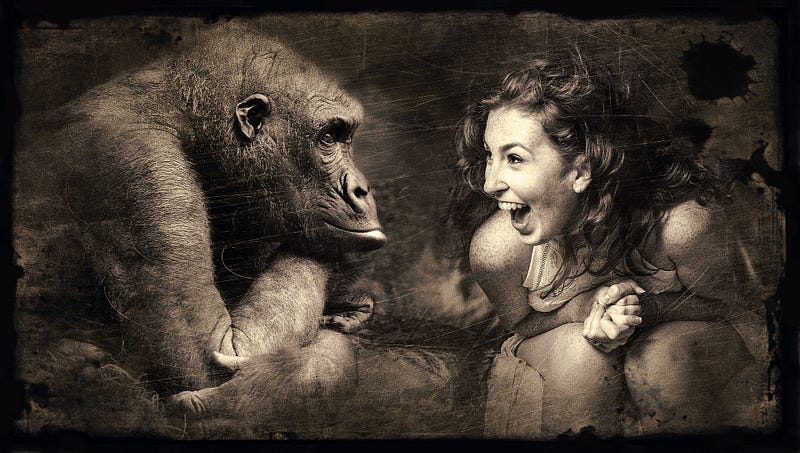
We are the only species that has transcended nature. We live in non-natural environments and produce non-natural substances and tools. No other species has done that.
What makes us unique? There are two ways to find out: zooming in and zooming out. Science zooms in, such as by examining the genetic code.
In the context of my exploration of the question ‘What am I?’, I zoomed out. The resulting perspective clearly shows what distinguishes us not only from animals but from all other life forms on this planet.
Follow along as I summarize this part of my research. This will give you a new perspective on yourself as part of the whole.
Biologically, We Are Animals
We belong to the great ape (hominid) family, which also includes orangutans, gorillas, bonobos, and chimpanzees. About 14 million years ago, the orangutan developed from a primordial hominid, about 10 million years ago the gorilla, about 6 million years ago humans, and about 2.5 million years ago the bonobo and the chimpanzee evolved. (R Wrangham, D Peterson: Demonic Males. Bloomsbury. London. 1997)
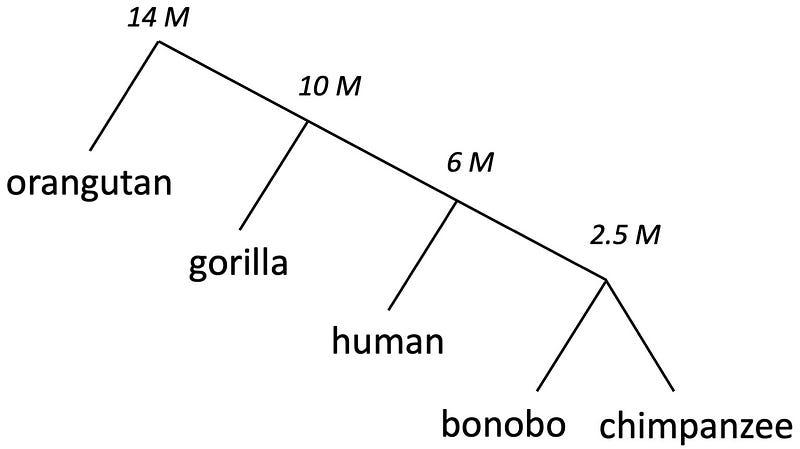
We share 96.9% genetic code with orangutans, 98.4% with gorillas, and 98.7% with both bonobos and chimps. The latter two are our closest biological relatives. Bonobos and chimps have a 99.6% genetic match. So, we are in the middle of this family tree. Genetically, there is no obvious reason why we have left the woods and created our own non-natural habitats and ways of life, while the other great apes have not.
We Are Different
We went beyond ape-ness. We must have a tool that no other ape (or any other animal) has. I call it ‘Plus’ so that a human is an ‘ape-Plus’ or, more generally, an ‘animal-Plus.’ All non-human life forms remain in their “behavioral boxes,” which can only be expanded through conditioning, such as when a lion is trained to jump through a hoop of fire. This is possible because every life form is programmable. Programmability is one of the five basic strategies of life. (I discuss all five in my book “Consciousness : Its Nature, Purpose, and How to Use It.”)
Every tool has two sides. Therefore, we are different, but not superior. A striking example of an associated weakness was the 2004 tsunami in the Indian Ocean, which killed 230,000 humans but virtually no animals. I discuss this phenomenon in my article “Why the 2004 Tsunami Killed 230,000 Humans but Virtually No Animals.”
We humans can leave our “behavioral boxes” spontaneously, but that doesn’t mean we always do.
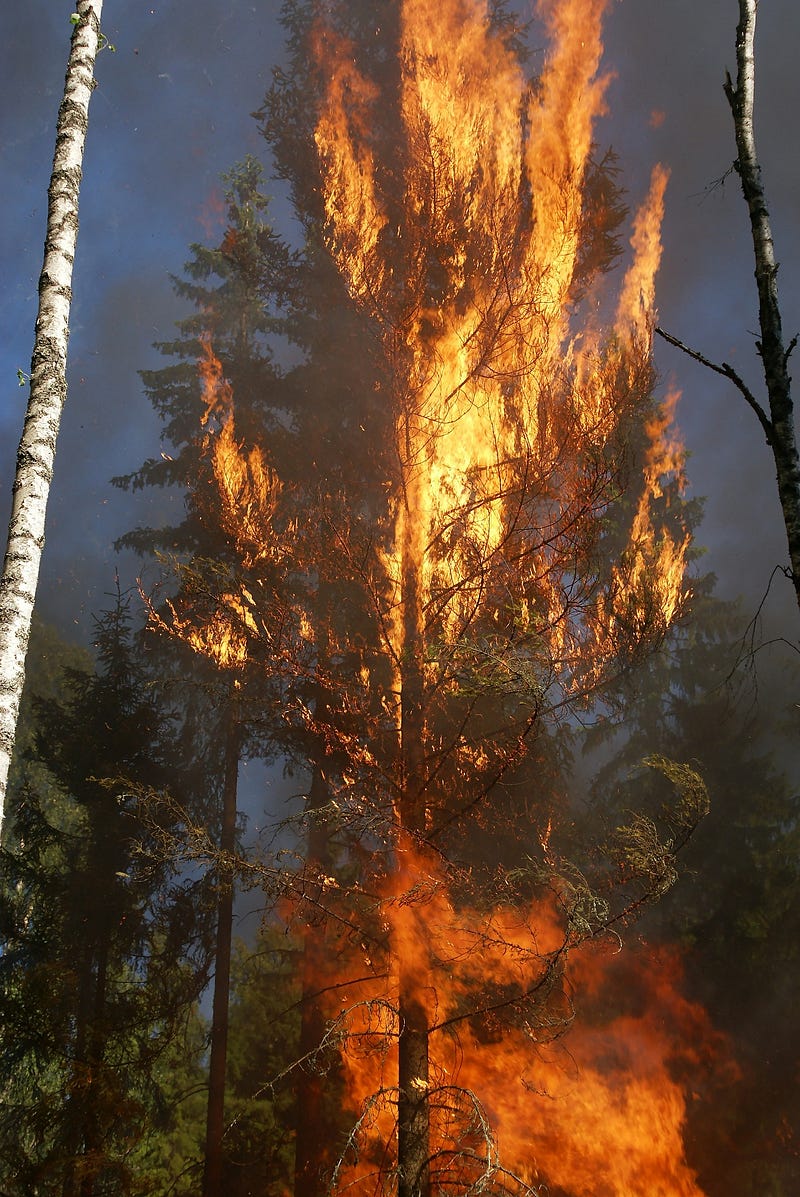
Imagine a group of 100 apes. Heavy storm clouds roll in and lightning strikes a nearby tree. The tree begins to burn. All 100 apes sense the danger and flee. They follow their behavioral programs. This was so hundreds of thousands of years ago and is so today. Next, imagine a group of 100 early humans. Heavy storm clouds roll in and lightning strikes a nearby tree. The tree begins to burn. All 100 early humans sense the danger. 99 early humans flee. They follow their behavioral programs. One does not flee. It behaves differently. It does something new. It is curious and explores this phenomenon. Thus, or similarly, humans might have discovered fire as a tool.
All 100 early humans had the potential to do something else than flee, because all humans have the human tool ‘Plus.’ Maybe a handful realized they had a choice. But only one chose to act differently. Where did its behavior come from, if not from a behavioral program? It created the new behavior. We humans have a creativity system, which is the ‘Plus’ in ‘human = ape-Plus.’
The word creative originates from the Latin word creare (= to grow). To create means to let something grow, to produce something — for example, a behavior. We create a behavior by creating a mental plan and executing it. The tool for creating a mental plan is our mind. It is the ‘Plus’ that distinguishes us from apes and all other non-human life forms.
What is the Mind?
Our body is made of physical matter, mostly water, and processes it in many ways; it is a chemical factory. The basic fabric of our mind is abstract information, so the mind is an “information factory” that is connected to our body.
For a precise understanding, we need to clarify the term ‘information.’ There are two types of information: concrete information, such as texts, images, and sounds, and abstract information, also called pure information. A thought is pure information. A thought stream is a flow of pure information. It is beyond texts, images, or sound.
The pure information that “is” in your mind in the present moment includes your perceptions/feelings, thoughts, and ideas/intuitions. I call it the present knowing. When you want to communicate a present knowing and therefore search for appropriate texts, images, or sounds, you transform pure information into concrete information, which can then be passed on in the physical world. However, the concrete information is always only a shadow of the original pure information, because abstract/pure information is infinitely richer. As an example, try to put an experience into words.
This rough understanding of information and knowings is sufficient for the purpose of this article. If you want to delve deeper into these topics, read my articles “A Logical Solution to the Hard Problem of Consciousness” (in which I logically deduce pure information as the fabric of the mind) and “Why the 2004 Tsunami Killed 230,000 Humans but Virtually No Animals” (in which I explain the different forms of knowings).
The mind processes knowings, ie pure information. This process is called thinking. (The word mind has the Proto-Indoeuropean root *men- (= to think).) Thinking comprises two basic abilities: remembering (recalling, retrieving) and editing.

Word processing software is a good analogy for how the mind works: You can (1) open/retrieve an existing text file or (2) use editing tools such as write, cut, copy, paste to change an existing text or create a new one. When you create the knowing of a pink elephant, for example, you recall the knowing of an elephant and the knowing of the color pink and combine these two knowings to create the new (imaginary) knowing of a pink elephant. When you create a knowing of something you have never seen, heard, or done before, you are inventing a new knowing.
The ability to recall past knowings requires a source of past knowings. There is only one way such a source is available: present knowings are recorded. Recording must be automatic because we do not constantly make willful decisions to record present knowings from one moment to the next. The records are called “history.”
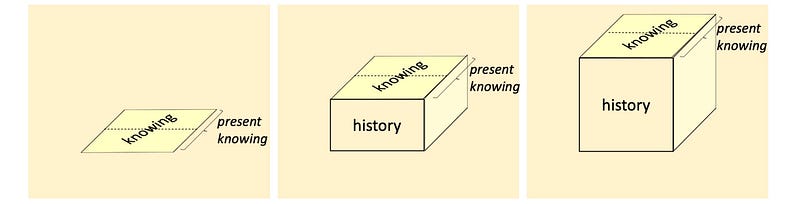
How well we can recall past knowings from our history is a matter of practice. When we repeat a specific knowing, such as something we are supposed to learn, we create additional “copies” in our history, so it becomes easier to recall.
The Difference Between Us and All Other Life Forms
All life forms have a present knowing and a history that is automatically recorded. We are the only species that also can think, ie remember/recall knowings and edit them. So, these two basic abilities distinguish us from all other life forms on this planet.
The ability to recall knowings from our history means that we know we have a history. It also means that we know that we know. Therefore, we humans know and we know that we know. All other life forms on this planet know, but they don’t know that they know.
Another formulation uses the terms awareness and consciousness, which I explain in detail in my article “Consciousness is Not the Same as Awareness.” In short, awareness means knowing the present, consciousness means knowing about the past, which results from the ability to recall past knowings. All life forms are aware. We are the only species that is also conscious.
But doesn’t it look like animals remember?
You might argue that animals must remember, for otherwise a dog would not recognize its owner. In fact, animals seem to recognize people even after years: There is a video on the internet in which you see a lion “joyfully” hugging a man. Many years ago, when the animal was a baby, this person was lovingly taking care of it.
To clarify, we need to understand precisely what happens when we remember. The history is built horizontally, ie “page by page,” with each “page” representing the knowing of a formerly present moment. Recalling/remembering a past knowing means accessing one of these pages and making it a present knowing.
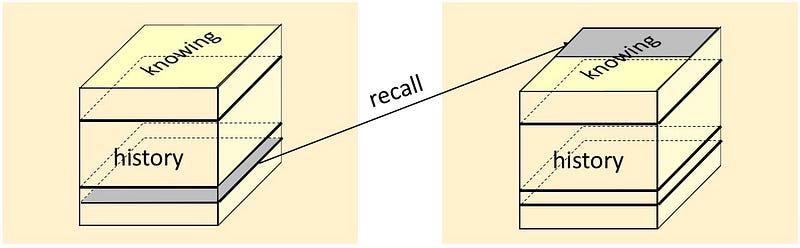
For example, you can choose to recall/remember what you did yesterday afternoon. An animal cannot do that. How do we know? By logic. Let’s do a thought experiment:
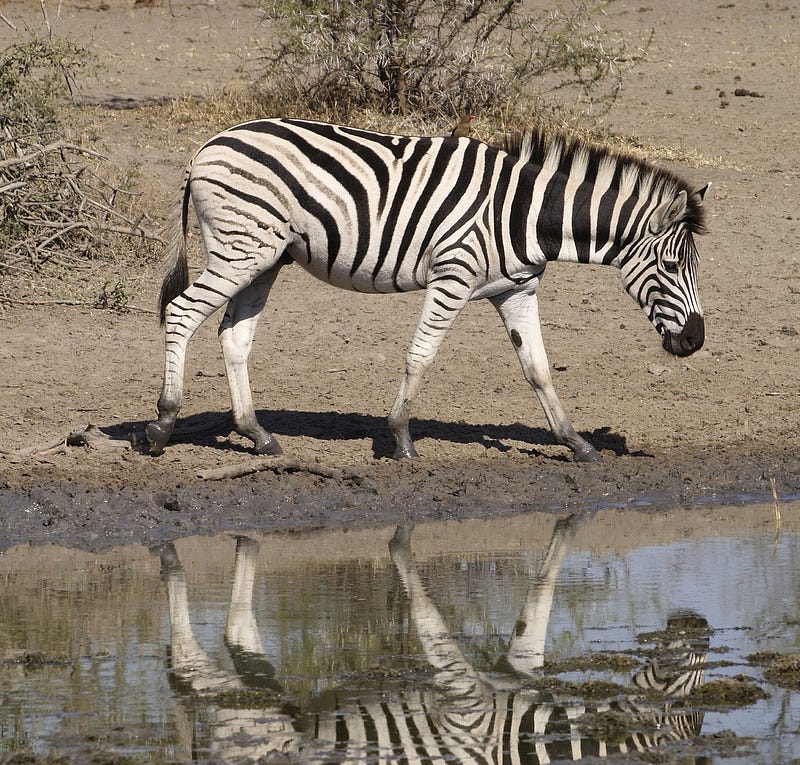
Imagine a zebra standing next to a water hole, remembering how it escaped a lion yesterday. Animals are permanently maximally aware of their surroundings, which maximizes their chances of survival. But while the zebra remembers yesterday, it is not maximally aware of its surroundings because remembering consumes part of its awareness. The expression ‘lost in thought’ expresses this. For example, when thinking about something while driving a car, one is less aware of the traffic situation and might miss a traffic sign.
It is the same in our thought experiment: While the zebra remembers how it escaped a lion yesterday, it fails to notice that a lion is sneaking up on it in the present — and dies. Animals that remember would have a lower chance of survival than animals that do not remember — and would therefore die out. It follows that animals do not remember.
Back to the lion hugging its former keeper. It doesn’t remember its keeper; the lion experiences a familiarity with it. A familiarity is a pattern in the history, which was created as follows: The more often something occurred in a life form’s past, the more past knowings (pages of the history) contain it. Samenesses across past knowings form vertical patterns: familiarities.
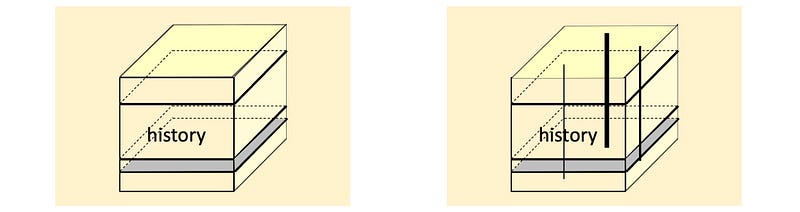
For example, you are familiar with trees because you have seen countless trees in your life. Therefore, many past knowings in your history contain trees. The more occurrences, the stronger the pattern/familiarity, and the more you are inclined to behave in a certain way — such as thinking of the word ‘tree’ when you see one. (More about familiarities in my book on consciousness.)
Remembering/recalling is an intentional “horizontal” access to the history. Experiencing a familiarity is an unintentional “vertical” access to the history that occurs when a present situation matches a vertical pattern and thus triggers it. This resonance phenomenon can be considered an implicit remembering. The fact that it is involuntary makes the history a behavioral program: the behavior of a life form depends on its history (more precisely, on all the familiarities within the history). Since we humans are the only species that can behave other than following our behavioral programs, and that is because we can create behavior, we can transcend our history. This is another way of saying that we can free ourselves from being controlled by our programs.
To clearly distinguish between these two fundamentally different phenomena, it is better to use the terms ‘experiencing a familiarity’ and ‘remembering’ — rather than ‘implicit’ and ‘explicit’ remembering.
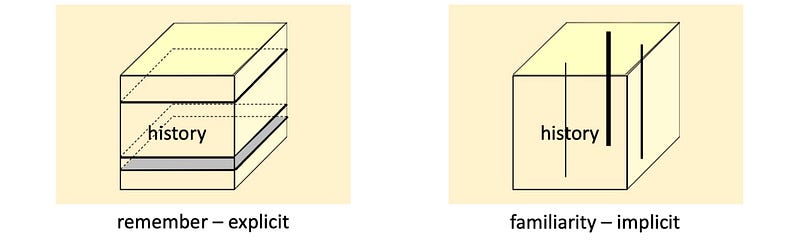
Dogs do not remember their owners; they are familiar with them. The lion does not remember its former keeper; it is familiar with the person. When you see a person and feel you know him or her, but cannot remember the name or anything else, you experience a familiarity without remembering. All life forms, including us, experience familiarities. Only we humans can remember.
Additional evidence
If you know that you know, you can also know that you don’t know. This can lead to wanting to know what you don’t know, and therefore to asking. Therefore, asking is an indicator of mind.
Behavioral scientists have developed methods to communicate with animals so that they can ask them questions. But answering is not an indicator of mind, because the answer may be a learned behavior. Has any animal ever asked a question?
The closest example I could find was a parrot named Alex. Alex was studied for ten years, and many believe he is the only animal that has ever asked a question. The story goes that one day, after years of training, Alex saw himself in the mirror and said, “What color?” (See Tijana Radeska’s article Alex the Parrot is the Only Non-Human to Ask the Existential Question — “What Color Am I?” While the headline suggests Alex said “What color am I?”, in the article it is stated that he asked “What color?”, without referring to himself.)
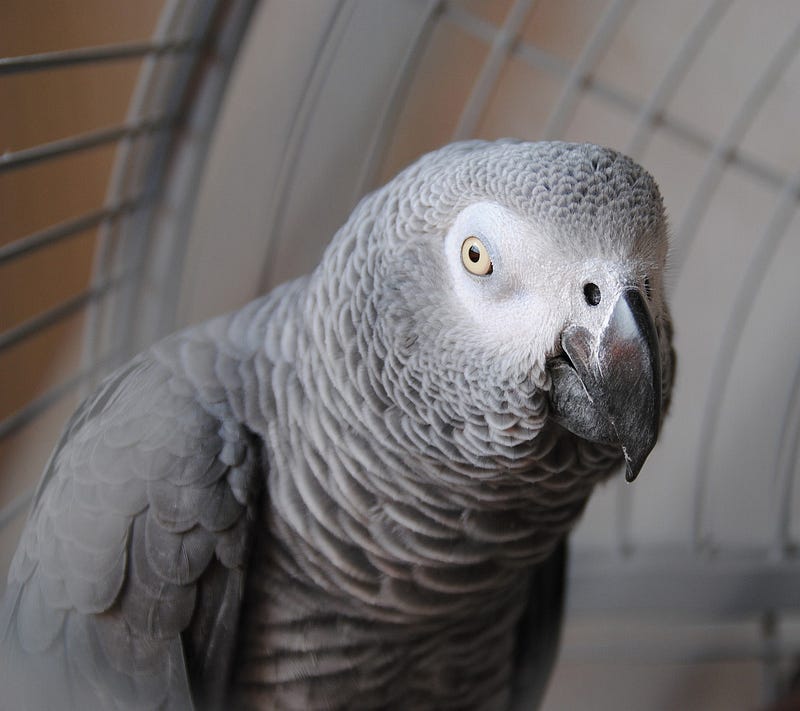
This sounds like a question — but was it a question? Was it an expression of a desire to know? Parrots repeat sound patterns they’ve heard many times before. And during his years of training, Alex had heard the question “What color?” thousands of times.
According to the report, after asking this “question,” Alex learned his own color ‘grey’ after being told six times.
Wait a minute! Why did it take Alex six times to learn the answer if he wanted to know it? This incident is no evidence of mind. (Others criticized this result as well.) All we can say is that a parrot produced a sound pattern that he had heard countless times.
Most pet owners ascribe human-like attributes to their animals, especially dogs. Some pets exhibit behavior that makes them very different from their wild conspecifics. A pet is an animal that lives in a highly unnatural environment that is created and populated by humans. This environment conditions the animal just like any environment. This is where their human-like attributes and behaviors come from. Pets are like lions that jump through a hoop of fire. They are highly conditioned and therefore cannot serve as examples to make claims about animals in general. A circus lion is not evidence that lions seek fire.
Even more arguments and the complete derivation of the difference between humans and animals can be found in my book on consciousness.
Conclusion
All non-human life forms just follow their behavioral programs, including familiarities, and therefore remain in their “behavioral boxes.” Their behavior is natural and truthful. When lions kill gazelles, it is truthful and constructive within the symbiosis of life on this planet: It keeps the lions alive and the number of gazelles at a healthy size.
Since we can behave otherwise than follow our behavioral programs, we can behave untruthfully. We can create destructive behavior and — directly or indirectly — even self-destructive behavior.
“Mankind invented the atomic bomb, but no mouse would ever construct a mousetrap.” (Albert Einstein)
Since we are the only species on this planet that can transcend nature, we have a responsibility not only for ourselves but also for many other life forms on this planet. We must replace arrogance with humility, learn to distinguish untruthful from truthful behavior, and live with nature rather than against it — because nature is sitting on the much longer branch.
“Nature can be without us. But we cannot be without nature.”
Application
Become familiar with the causes of behavior. Practice identifying causes and effects of behavior. Practice seeing behavior from the perspective of the symbiosis of many life forms. Practice seeing yourself and your behaviors from a bird’s-eye view.
Recall situations in which you felt you knew a person but could not remember the name or anything else. Use these examples to explore the difference between experiencing a familiarity and remembering.
Observe wildlife. Watch documentaries about wildlife (turn the sound down so you are not influenced by the interpretations offered). Visit a wildlife park. What familiarities can you observe in animals? Which ones in wild animals? Which ones in animals in wildlife parks? Which one in pets?
Consider the last 24 hours of your life. On what occasions do you think you have followed your behavioral programs, such as familiarities (habits)? On what occasions do you think you did something new, ie, something you had not done before? Which behavior was truthful? Which behavior was untruthful? Which behavior was constructive? Which behavior was destructive?
Further (supplemental) readings:
Article “Why the 2004 Tsunami Killed 230,000 Humans but Virtually No Animals”
Article “A Logical Solution to the Hard Problem of Consciousness”
Article “Consciousness is Not the Same as Awareness”
Book “Consciousness : Its Nature, Purpose, and How to Use It”
If you are not yet a member of medium, I invite you to consider membership. Membership gives you access not only to all my articles but also to the articles of thousands of other writers. If you use THIS LINK to become a member, you are supporting my writing.