
Consciousness is Not the Same as Awareness
Understanding the difference can help you become a master of your mind.

The words ‘consciousness’ and ‘awareness’ are often considered synonyms. This is not wrong if it is meant as a definition of one word in terms of the other, because definitions are free. But it is wrong from a linguistic point of view, because these two words have different etymological origins and, thus, different original meanings. Using them synonymously oversimplifies the language at the expense of its ability to describe the nuances of what we experience.
Join me as I explore how we have experiences. This will give insight into how the human mind works and clarify the use of the terms ‘consciousness’ and ‘awareness.’
The more you know about a car and how it works, the better you can pilot it. The more you know about the mind and how it works, the better you can pilot it. Therefore, this new understanding can help on your path to become a master of your mind.
Observe Yourself
Analyze what you are experiencing at this moment. You may see something. You may hear something. You may smell something. Etc. You perceive your surroundings via your outer senses. In addition, you perceive your body via your inner senses: You may experience warmth; or cold; or pain; etc. You have learned to consider this and thus your body and your environment as “real.”
What else are you experiencing at this moment? Your thoughts. They are of a different quality. Thoughts are not “real.” They are imagined. They are imaginary.
So, your present experience comprises two parts: a real part and an imaginary part. (For those with advanced knowledge of mathematics: I am NOT talking about complex numbers …) The real part of your experience is your perceptions. The imaginary part of your experience is your thoughts.
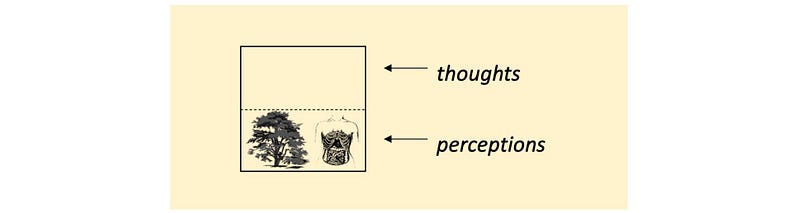
Look at an object. This is a perception. Close your eyes. Think of the object you just saw. Create a mental image of it by recalling what you saw a few seconds ago. This image may be more or less clear, more or less detailed, depending on your powers of imagination and recalling. This mental image is a thought.
Listen to something, such as a human voice, a song, or an arbitrary sound from the environment. This is a perception. Now think of what you just heard by recalling it. This imagined sound may be more or less clear, more or less detailed, depending on your powers of imagination and recalling. This mental sound is a thought.
When you hear something, the sound is “real.” When you recall what you heard, it is imaginary. When you open your eyes, the image you see is “real.” When you close your eyes and recall what you saw, the image is imaginary. What is the difference between “real” and imaginary images? You may say “clarity,” but clarity depends on your powers of imagination and recalling, which is a matter of training. There are people with photographic memory … Clarity is not a distinguishing characteristic.
What do you see in this image?
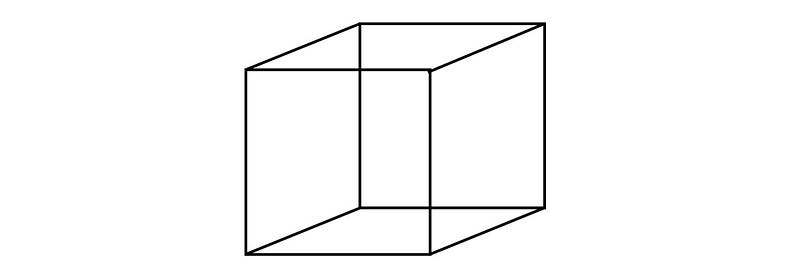
You may see a cube, which is a three-dimensional object. But this is clearly an illusion because the image is two-dimensional; it is simply a configuration of twelve line segments, which form an optical illusion that suggests a cube. In fact, the image even suggests two versions of a cube, one with the lower-left square as its front side and one with the upper-right square as its front side.
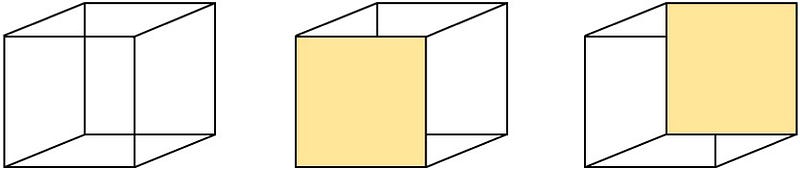
Therefore, this optical illusion has one “real” version (twelve line segments) and two “imaginary” versions (first cube, second cube), from which you can choose more or less easily. For most people, it is most difficult to see the truth of the twelve line segments, but it is the only “real” image one can see. When you see a cube, you see an imaginary image — although this is a perception and not a thought.
Once again, what is “real” and what is imaginary? This optical illusion teaches us that these two cases can merge into one other.
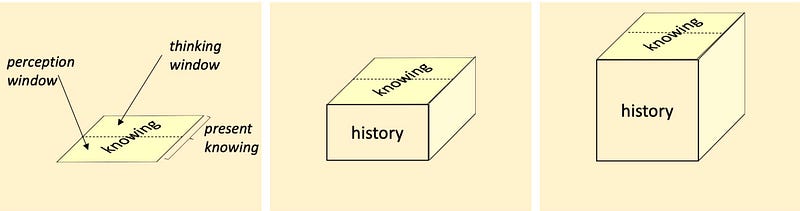
So, we should unify them. The word ‘know’ is aptly used to refer to seeing in a broader sense than just visually — like seeing the imaginary: The Old English word witan (= to know) has the Proto-Indoeuropean root *weid- (= to see). Therefore, ‘know’ can be used for seeing the real as well as for seeing the imaginary — and it can be generalized to all perceptions. Your most elementary experience is to know. Your present knowing comprises your perceptions and your thoughts.
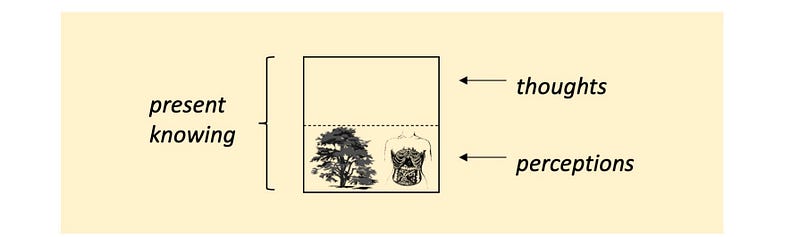
Your present knowing is constantly changing through new perceptions or new thoughts. It is like a movie. At every moment, your present knowing is replaced by a “new” present knowing and becomes part of your memory — your past — your history. Imagine each present knowing becoming a new page in a huge book — the book of your personal history.
You can access past knowings, that is to say, turn back in your book. This is denoted ‘recalling’ or ‘remembering.’ When you recall, you make a past knowing a (present) thought.
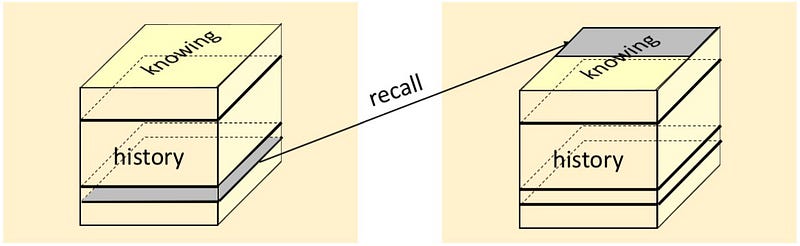
Your ability to recall enables you to look back on your history and thus know that you have a history. This experience is the origin of ‘I.’ ‘I’ is the identification with “your” history: “That’s me. I experienced all this.”
What are Consciousness and Awareness in This Picture?
The word conscious originates from the Latin words com (= with, together) and scire (= to know). Therefore, conscious means “knowing together” or “knowing a togetherness,” and consciousness is “a knowing of a togetherness.” The history is a togetherness of knowings, namely the collection of a lifetime of present knowings. Therefore, the word consciousness is aptly used to denote knowing of one’s history, which comes with the ability to recall.
The word aware has the root *wer- (= perceive). Therefore, aware means “perceiving” and awareness is “perception.” Awareness is the perception part of your present knowing.
Awareness “happens” in the perception “window” of your present knowing. Consciousness “happens” in the thinking “window.”
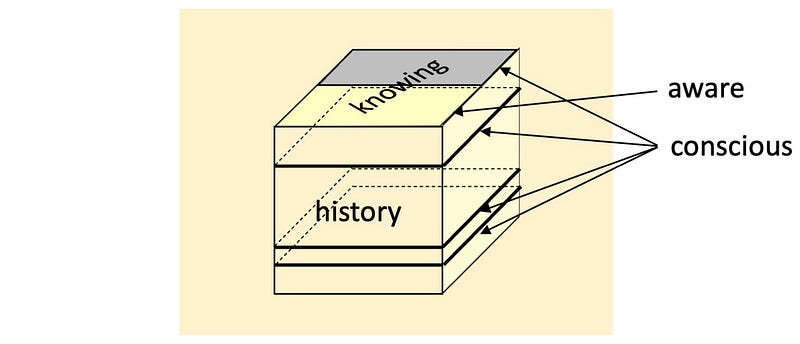
You choose what you focus on: the perception window or the thinking window. When you focus on the perception window, you are in the present moment. Everything your inner and outer senses are providing is now. When you focus on the thinking window, you can be in the present (when you are engaged in a mental activity such as reading or writing), you can be in the past (when you are rummaging through your history by recalling past knowings), and you can be in the future (when you are creating possible future scenarios/knowings).
Application
Visualize a knowing “screen” in your mind that comprises two windows: a perception window and a thinking window. The perception window is your gateway to the physical universe. It provides access to your outer and inner senses. The thinking window is your gateway beyond the physical world. It provides access to your history (and beyond); you use it to recall the past, create in the present, plan for the future, or receive ideas. This visualization can help you become an observer of your mind (and thus your ‘I’), which is an important step towards mastership.
Exercise 1: Observe your present knowing, ie “look” at your knowing screen. Categorize its content. For each “piece:” From which window does it come?
Exercise 2: Practice switching your focus between the two windows.
Exercise 3: Explore your perception window. When your focus is on this window, you are in the here and now.
Exercise 4: Explore your knowing window.
For a deeper and more detailed understanding of how your mind works, see my article “A Logical Solution to the Hard Problem of Consciousness” or my book “Consciousness : Its Nature, Purpose, and How to Use It.”


