
The 5 Simple Habits That Helped Me Reach a Low Body-Fat Percentage
How I went from ‘skinny fat’ to lean and athletic

Back in 2018, I was “skinny fat.”
Though I was thin, I had less muscle and more fat than I liked. This made it impossible to look as athletic as I wished.
Moreover, I had gallbladder surgery that year, a wake-up call.
“Being thin doesn’t mean you’re healthy,” my doctor said.
She wanted me to understand that my habits were partly to blame for my gallbladder’s untimely demise. I was sedentary, primarily ate ultra-processed foods, and hadn’t done anything for my muscles since school.
Though I have a genetic predisposition — my grandpa had his gallbladder removed when he was 65 — I was only 25.
This was the last push I needed to change my lifestyle, and, as a consequence, my physique.
Fast forward to today, I’ve achieved the lean, athletic physique I wanted. More importantly, I’ve done so by adopting habits that have allowed me to be the healthiest I’ve ever been.
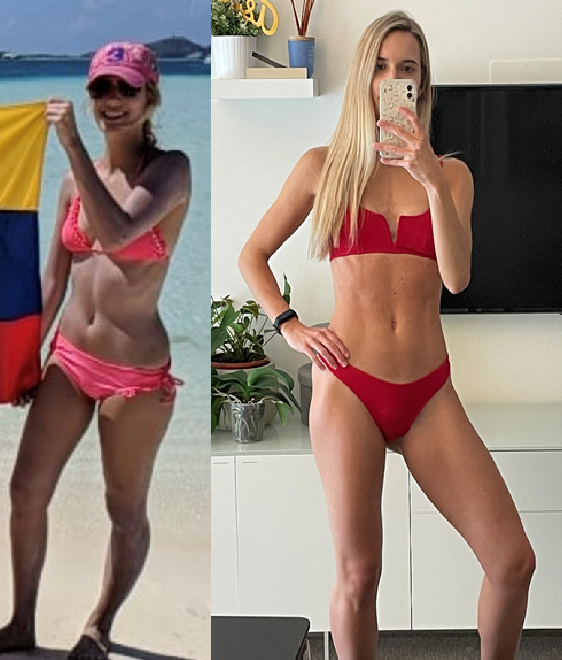
Though I weigh the same as I did in 2018, my muscle-to-fat ratio has completely changed thanks to what’s called a body recomposition: building muscle and losing fat simultaneously.
This helped me increase my metabolism, eat 500 calories more per day, and be the leanest I’ve ever been.
Still, two important caveats:
- Many other habits, such as intermittent fasting, calorie cycling, or other more advanced practices, can also play a part in someone’s body recomposition journey. However, the 5 below are the 20% that produce 80% of the results. They’re the cornerstone habits of sustainable, long-lasting fat loss*, which is why I’m focusing on them.
- Though my body fat percentage has never been lower, I’ve always been skinny. This means I can comfortably live with a very low fat percentage without harming my health. For instance, my menstrual cycle has remained completely regular throughout the process, which doesn’t happen for many people when they go below 20% body fat (I’m currently at 16-18% body fat). In short, consult your doctor before trying to lose more fat than might be healthy for you.
With that out of the way, here are the 5 simple habits that have helped me achieve a low body fat percentage:
#1. Focusing on Gaining Rather Than Losing
When pursuing a fitness goal, most of us focus on losing pounds on the scale.
Big mistake.
Unless you have a scale that measures your muscle and fat percentages, paying too much attention to your body’s natural weight fluctuations will only drive you crazy. Moreover, when you lose weight — especially if you fall under the normal weight spectrum — you often lose fat and muscle.
This lowers your metabolism — muscle tissue burns more calories than fat — which often leads to weight regain after several months, a regain that mainly consists of fat.
A body recomposition in reverse.
This mistake is what led to my “skinny fat” look in 2018. As I’d gained weight a few years before, I’d tried cutting my calories, which led to an all-too-common cycle: I lost weight (muscle and fat); I put it back on (primarily fat).
Everything changed when I learned about body recomposition.
Once I’d recovered from my gallbladder surgery, I changed my focus from losing to gaining.
Instead of aggressively cutting calories, I started resistance training. Though I made many mistakes at the start — being inconsistent, changing the workout plan too frequently, and having no idea about progressive overload — once I found my groove, I saw the magic.
Building muscle has allowed me to stay at a healthy weight even with a lower fat percentage. It has boosted my metabolism, helping me burn more fat.
It has made me stronger and healthier.
Building muscle through consistent, progressively challenging resistance training is the first and most important habit for achieving a leaner physique.
How to start:
If you’re new to resistance training, try doing 2 or 3 full-body sessions that focus on compound lifts, like:
- Squats
- Deadlifts
- Chest Press
- Bent Over Row
- Overhead Press
- Farmer Carry
- Reverse Lunge Step Up
Check how to do them in this video.
For each exercise, try doing three sets of 8–12 repetitions. The dumbells you pick should be heavy enough that your last rep takes about 3 to 5 seconds to complete.
Every week or two, add more repetitions or weight. If you’re eating properly (more on this below), you’ll notice a change in just 12 weeks.
#2. Injecting Your Day With This Type of Cardio
When trying to lose fat, most of us jump straight into intense cardio.
Cycling, running, HIIT (High Intensity Interval Training) — these become our staples.
Now, of course incorporating any of these can work for a body recomposition’s “losing fat” portion. But three things make this approach less than ideal:
- We usually do less resistance training if we’re also cycling or running. We have limited time. And as previously mentioned, building muscle should be priority #1.
- Even if you manage to do 3 full-body resistance training sessions plus running, HIIT, or cycling, you might hinder the muscle-building process (especially if you’re in a calorie deficit) because of the excessive intensity. Muscle needs rest and energy to grow.
- High-intensity cardio causes cortisol — the stress hormone —to spike, which often leads to more hunger — a one-step forward, two-step backward type of situation.
Instead, it’s better to inject your day with light movement, like walking and fidgeting.
In my case, I try to walk a minimum of 10k steps per day and raise my calves while sitting in work meetings.
These two stupidly simple practices have increased my metabolism and allowed me to eat more — all while still putting me at the necessary calorie deficit for fat loss (more on this below.)
How to start:
- Get a pedometer and measure how many steps you take on an average day. Try adding 2k steps more to your daily total. If you dislike pedometers, try to go on a 30–60 minute walk every day.
- Walk for 10 minutes after every meal. This will ensure you at least walk for 30 minutes daily while helping you better manage your blood sugar.
- Search for walking opportunities everywhere. Instead of emailing your coworker, walk over and tell them what you need. Instead of meeting with friends at a restaurant, ask them out for a walk. Instead of lounging on your sofa while speaking on the phone, pace around your living room. You can even read, write, or even pursue art while walking.
- During a meeting, flight, or while waiting at the doctor’s office, raise your calves or shake your legs.
#3. Getting Good Quality ZZZs
Sleep is vital for a body recomposition for two main reasons:
- Muscles grow when we rest and recover.
- Cortisol goes out of whack without proper sleep, making us retain fat (especially around our midsection.)
In short, we must prioritize sleep to achieve a body recomposition.
That’s it. Easy peasy.
How to start:
- Stick to a regular sleep window. Aim for 7–9 hours of sleep per night.
- Take a morning walk. Studies show that sunlight exposure early in the morning can improve your sleep.
- Avoid blue light before bedtime. Try disconnecting from your devices at least an hour before going to sleep.
- Darken your room with curtains or opt for a sleeping mask (great for traveling).
- Cool down your room’s temperature. According to the Sleep Foundation, “the best bedroom temperature for sleep is approximately 65 degrees Fahrenheit (18.3 degrees Celsius).”
- Finish dinner at least 3 hours before bedtime. Otherwise, digestion will make it harder to fall asleep.
- Limit your liquid intake at least an hour before bed to reduce midnight bathroom visits.
- Avoid alcohol altogether (it makes us feel drowsy but keeps us from deep, restorative sleep) or stop drinking several hours before bedtime.
- Stop drinking caffeinated drinks 5 to 8 hours before going to bed.
If you’re still struggling with sleep, check these other science-backed tips. Or, better yet, consult a specialist.
#4. Eating More
We all know we need to be in a calorie deficit to lose fat. We need to burn more calories than we consume.
This truth can lead to a mistaken — and extremely damaging — belief: “A larger deficit must be better. If I aggressively cut my calories, I should immediately see results.”
No.
I’ll never forget the setback I experienced after several months of resistance training. It was infuriating.
No matter how hard I trained, I saw no gains in lean mass and even lost some. I felt weak. I was unable to add more weight or reps.
Worse, I even struggled to lift what I’d been lifting.
The problem was that I hadn’t changed how I ate and had simply focused on adding resistance training and 10k steps per day, which put me in a too-high calorie deficit.
Now, this isn’t a problem for everyone. People with a starting high-fat percentage (25+% men and 35+% women) can continue to see muscle gains even at a steeper deficit (not that I recommend it).
But I was already lean.
Though I’ve reduced my fat percentage by about 6% (now I’m at 16–18%), my starting point was still low (23–24%), which meant that, in a high-calorie deficit, my body started to consume the muscle I’d just built. Not to mention the intense cravings and insomnia (not fun!)
Desperate, I contacted a fitness trainer and a registered dietitian. They told me I wasn’t eating enough.
Without proper nutrition, our training progress and body recomposition journey suffers. When we don’t get enough nourishment, our body has to cut corners to go about its day.
Once I increased my calories, I started to see progress again. Eating more is what helped me — and can help you — to continue gaining muscle while losing fat.
How to start:
If you want to follow a numerical approach, download any calorie-counting app and track what you’re eating.
Don’t change any of your behaviors. Be as thorough as you can for at least a month.
Once you’re confident you’ve found your maintenance calories (what you need to eat to maintain your weight), you can create your daily intake goal depending on your activity level:
- If you’re doing regular resistance training and have added a lot of walking, eat as you’ve always eaten (there will already be a deficit). However, if you feel weak, have insomnia, or feel hungry all the time, increase how much you eat until you determine your new maintenance calories. Then subtract 10% of that number, which will be your daily goal.
- If you’ve only added resistance training but haven’t added more steps to your day, subtract 10%-20% of your total maintenance calories. The leaner you are, the smaller the deficit. Note: If you want tips on how to properly use a calorie-tracking app to avoid adverse mental health effects, click here.
On the other hand, if you wish to follow a non-numerical approach, how much you eat is also dependent on your new activity level:
- If you’re doing regular resistance training and have added a lot of walking, eat as you’ve always eaten, or increase your portions if you feel weak. This increase should be gradual. You want to test how much you need without going overboard.
- If you’ve only added resistance training but haven’t added more steps to your day, eat as you’ve always eaten, but make small changes. For instance, if you always have sugar and milk with your coffee, consider trading for a no-calorie sweetener and no milk. If you always have ketchup, opt for hot sauce. If you always have three ounces of chocolate after lunch, have two instead.
Important note: If you’ve been dieting for a while, your current maintenance calories might already be too low for your body’s needs. If that’s the case, it’s better to start this process with a reverse diet:
- Determine what your maintenance calories should be based on a calorie calculator. It’ll give you a general guideline as to what you should be shooting for based on your age, weight, height, and activity level.
- Track how much you’re currently eating and calculate the gap between that number and your goal (based on the calculator).
- Add 50 to 100 calories to your daily intake every week until you reach the desired maintenance number. Don’t drastically increase your activity level as you go through this process, even if you gain some weight. Be patient.
- Once you’ve reached your maintenance calories, you can take the numerical or non-numerical approach mentioned before to know how much you should ideally be eating to achieve a leaner physique.
#5. Focusing on the What, not the How Much
The first time I set out to create a calorie deficit (way before 2018), I reduced my whole foods intake — eggs, vegetables, legumes — while maintaining my sugary treats.
A foolish choice.
Yes, I lost weight, but I looked and felt sickly.
Instead of toned, I resembled a skeleton. As I’d significantly reduced my protein intake, most of the weight I’d lost was actually muscle.
And my health… Wow. My constipation was at an all-time high; a person could sneeze a mile away, and I would get sick; and my hair was a jumble of dull split ends that never grew.
I was tired all the time. Lethargic.
Worse, my fat percentage increased once I inevitably regained the weight (#fail).
It wasn’t until my gallbladder surgery — when I was forced to cut ultra-processed foods, unhealthy fats, and sugary treats — that I realized that what you eat is as important as how much you eat.
Combined with resistance training and daily walking, a diet of lean protein, fiber-rich fruits and veggies, and healthy fats was the game-changer.
Yes, I was still in a calorie deficit, but I felt strong. I built muscle and lost fat, all without seeing my health take a nosedive.
Though a calorie is a calorie, every calorie affects your body differently.
How to start:
- Ensure 85% of your meals are on point (half of the plate should be veggies, a quarter protein, another quarter a complex carbohydrate like sweet potato or quinoa, and add a sprinkle of some healthy fat like extra-virgin olive oil). The other 15% is for enjoying life, so if you have 21 meals per week (3 per day), 3 can be whatever you want.
- Prioritize protein. Studies have shown that eating 1.6–2.2 g of protein per kg of body weight (0.72–1 g per pound) is critical to protecting muscle mass while in a calorie deficit. Moreover, eating enough protein helps us feel more satisfied throughout the day.
- Spread your protein intake throughout the day. For instance, rather than having one meal with 100 grams of protein, shoot for 3 with 33 grams each. General recommendations are 0.25 g of a high-quality protein per kg of body weight per meal or an absolute dose of 20–40 g.
- Keep a healthy gut. Studies have shown that a more diverse gut is positively associated with weight loss. For this, try consuming a small — and varied — quantity of fermented foods in most of your meals (kefir, sauerkraut, plain yogurt, tempeh, kimchi, kombucha) and try eating 30 different vegetables, nuts, seeds, herbs, and fruits per week.
The Most Important Tip: Define Your Minimum
Transforming our bodies can be a simple process.
If we do resistance training, move more, eat enough good food, and sleep well, we’ll inevitably gain muscle and lose fat. We’ll be stronger, healthier, and perhaps even able to eat more. (#goals, right?)
Then why do so many of us fail?
Barring an underlying medical condition, the answer is also simple: We’re inconsistent.
Motivated, we start a plan. We commit for a few weeks, maybe even months, but then we quit. Perhaps we have more work, or there’s been a family emergency. Whatever the case, we believe we shouldn’t continue if we don’t have the time or energy to do everything.
A massive mistake.
Do you know how many weeks I only trained once? How many days I fell short of my 10k step goal?
More than I’m proud to share.
But I kept pushing on. I said to myself, “Anything is better than nothing.” I embraced imperfect weeks, where I just did the minimum.
And that’s the most important tip: Define what you’ll absolutely do in the worst-case scenario.
In my case, I established I would at least do one resistance training session per week, walk 10 minutes after every meal, and never fall prey to the “all-or-nothing” mentality (when you argue that because you had a crappy meal, you’ll keep on having crappy meals until next Monday because you’ve already missed your weekly goal.)
Having this clearly defined minimum allowed me to be consistent for months (and now years).
Yes, having perfect weeks — 3 resistance training sessions per week, 10k steps per day, and having 85% of my meals be nutritiously on point — would’ve accelerated my results.
But perfection doesn’t exist.
It’s better to have a month with many “imperfect” weeks than one in which a perfect week is followed by three where you did nothing.
Better to imperfectly incorporate the 5 cornerstone habits of sustainable fat loss than never try them at all.
*Affiliate link.


