avatarAlexa V.S.

Free AI web copilot to create summaries, insights and extended knowledge, download it at here

5447

Abstract

1.readmedium.com/v2/resize:fit:800/1*j37yMAL9wW0rf8Zmxw9n4A.png"><figcaption>Screenshot of my sister’s hormone profile in early 2022. It’s in Spanish because we live in Spain. The hormones included are FSH, LH, Prolactin, Progesterone, Estradiol, and Testosterone. [Images courtesy of author’s sister]</figcaption></figure><p id="2d21">Moreover, my sister’s acne has vanished. Though she’ll have to be mindful of her habits and diet for the rest of her life — to keep PCOS at bay — she has regained control of her body and life.</p><p id="a936">That said, please remember every person is different. This dietary plan and other lifestyle changes were enough to help my sister regulate her hormones, but that isn’t the case for everyone.</p><p id="33ad">I simply hope to inspire you to make small, helpful changes to your life if you’re also struggling with a hormonal imbalance. Or, better yet, encourage you to reach out to a registered dietitian or other health professional who can offer a more personalized approach.</p><p id="9b01">With that out of the way, here’s the dietary plan that helped my sister balance her hormones and lose stubborn fat.</p><h1 id="8a18">The 3 Key Ingredients That Make the Dietary Plan Work</h1><p id="1f6b">According to my sister’s registered dietitian, the dietary plan she prescribed works for three main reasons:</p><ol><li><b>It keeps your healthy cholesterol up.</b> Your body needs cholesterol to produce any hormone. Without it, you’d likely suffer from low levels of the three main sex hormones (<a href="https://www.ncbi.nlm.nih.gov/books/NBK538260/#:~:text=Indications-,Estrogen%20is%20a%20steroid%20hormone%20associated%20with%20the%20female%20reproductive,estrone%2C%20estradiol%2C%20and%20estriol.">estrogen</a>, <a href="https://www.ncbi.nlm.nih.gov/books/NBK558960/#:~:text=Progesterone%20is%20an%20endogenous%20steroid,the%20later%20phase%20of%20pregnancy.">progesterone</a>, and <a href="https://www.health.harvard.edu/staying-healthy/testosterone--what-it-does-and-doesnt-do">testosterone</a>). This is why my sister’s dietary plan includes foods rich in good fats like fatty fish, avocado, coconut oil, and nuts.</li><li><b>It has a <a href="https://medlineplus.gov/ency/patientinstructions/000941.htm#:~:text=Glycemic%20index%20(GI)%20is%20a,can%20affect%20the%20blood%20sugar.">low glycemic index</a>.</b> This index measures how quickly our blood sugar levels increase after consuming a carbohydrate. This is key for people with PCOS as they often also suffer from <a href="https://www.niddk.nih.gov/health-information/diabetes/overview/what-is-diabetes/prediabetes-insulin-resistance#:~:text=Insulin%20resistance%20is%20when%20cells,help%20glucose%20enter%20your%20cells.">insulin resistance</a>, which is why they struggle to lose weight. That’s why my sister’s dietary plan includes little-to-no refined carbs and focuses on vegetables.</li><li><b>It eliminates the intake of trans fats.</b> These types of fat are pro-inflammatory. Their repeated consumption leads to insulin resistance and ovulation problems (a clear issue for those struggling with PCOS). This is why my sister’s dietary plan avoids ultra-processed foods at all costs.</li></ol><p id="7234">In a nutshell, the dietary plan works because it promotes the healthy production of hormones while reducing blood sugar spikes and pro-inflammatory states, both of which negatively impact the health of people with PCOS.</p><h1 id="a396">What My Sister Eats in a Day To Balance Her Hormones and Lose Stubborn Fat</h1><p id="9684">This is what my sister eats on an average day:</p><figure id="c870"><img src="https://cdn-images-1.readmedium.com/v2/resize:fit:800/1*Ty39NljLWDazG2V7adDBmg.png"><figcaption>My sister’s dietary plan. It’s in Spanish as we live in Spain. [Images courtesy of author’s sister]</figcaption></figure><h2 id="831b">Breakfast</h2><p id="0d9d">To start the day, my sister usually has lactose-free, unsweetened yogurt (around 120 grams) with unsweetened green tea. She could also have a coffee with lactose-free milk or calcium-enriched vegetable milk, but she usually sticks to yogurt.</p><p id="0cbf"><b>Note:</b> In the mornings my sister wakes ravenous, she combines her breakfast and mid-morning snack to have a bigger meal that carries her to lunch. Sometimes, she’ll also have her yogurt with homemade granola and then have her mid-morning snack (when she’s feeling especially hungry).</p><h2 id="eae2">Mid-morning snack</h2><p id="85cd">Two to three hours after breakfast, my sister has a whole-wheat bread toast (around 40 gr) with either:</p><ul><li>30 grams of cheese (lower than 25% fat).</li><li>One can of tuna in water.</li><li>One egg (cooked in whatever way she prefers)</li><li>Avocado</li><li>Turkey slices (occasionally)</li></ul><p id="50b4">She’ll also add vegetables on top, like arugula, tomato, red pepper, and lettuce.</p><h2 id="0351">Lunch</h2><p id="99ac">For lunch, my sister always follows these guidelines:</p><ul><li><b>Protein:</b> 100–125 grams of meat, 125–150 grams of fish, two eggs (if she didn’t have any for breakfast), or 125–150 grams of vegetable protein.</li><li><b>Vegetables:</b> Free amount. The only requirement is to ensure that at least half of the plate is filled with a mix of cooked and raw veggies. For example, a salad and steamed broccoli. No juices allowed.</li><li><b>Carbohydrates </b>(raw quantities): 120 grams of peas; 40 grams of legumes (lenti

Options

ls, chickpeas, red beans); 30 grams of whole-grain rice, pasta, or other cereals (100 grams cooked); 40 grams of whole-wheat bread (2 toasts approx.); or 40 grams of quinoa. No potatoes, as they have a high glycemic index.</li><li><b>Fats:</b> No specific guidelines, except that she shouldn’t have more than three tablespoons of olive oil (or whatever oil she’s using to cook) per day.</li><li><b>Dessert:</b> a piece of fruit, preferably a low-glycemic option (unrestricted amount of lime or lemon; 300 grams of strawberry, watermelon, cantaloupe, grapefruit, blackberry, apricot, currant, papaya, and raspberry; or 200 grams of apple, blueberry, orange, tangerine, kiwi, pineapple, pear, peach, cherry, nectarine, mango, fig, and passion fruit).</li></ul><h2 id="5acf">Mid-afternoon snack</h2><p id="6724">For her mid-afternoon snack, my sister has another piece of fruit, an unsweetened yogurt (around 120 grams) or a glass of lactose-free milk, and a handful of nuts (4 walnuts, 8 almonds, or 8 hazelnuts).</p><h2 id="bb3e">Dinner</h2><p id="5abf">Like at lunch, my sister’s dinners follow some guidelines:</p><ul><li><b>Protein:</b> Same as lunchtime.</li><li><b>Vegetables:</b> Same as lunchtime.</li><li>No carbohydrates.</li><li><b>Fats:</b> Same as lunchtime.</li><li><b>Dessert: </b>unsweetened yogurt (120 grams approx.) plus one ounce of dark chocolate (at least 70%).</li></ul><p id="34c6">Some examples are:</p><ul><li>Dark leafy salad with canned natural tuna and assorted veggies (chopped tomatoes, pepper, and cucumber).</li><li>Vegetable soup with a two-egg omelet with mushrooms on the side.</li><li>Pureed zucchini with feta cheese.</li></ul><h2 id="a060">Important note</h2><p id="13e0">This is what an average day — a day of “perfect” eating — looks like for my sister, but this isn’t how she eats every day. Like everyone, my sister has birthday parties and celebrations.</p><p id="802f">The key to my sister’s success lies in her approach. 85% of her meals will look something like the ones mentioned here, keeping her consistent. But the other 15% is for her to do as she pleases, even if she now does it more mindfully.</p><p id="5fff">Why?</p><p id="4678">Because now my sister knows what works and what doesn’t for her. Now she knows that when having chocolate on her “break the rules” days, she will opt for the dark variety or choose lactose-free dairy.</p><p id="813b">This dietary plan has armed her with knowledge and a plan to get back on track whenever she veers off course.</p><h1 id="311d">Other Helpful Habits</h1><p id="b095">Besides the dietary plan, the registered dietitian gave my sister some valuable tips to rebalance her hormones and lose weight.</p><ul><li>Eat in a comfortable and quiet environment — not in front of the TV — and take at least 20 minutes.</li><li>Opt for five smaller meals throughout the day instead of three hearty ones. In other words, eat every three hours at most — and no intermittent fasting. My sister now usually “fasts” for 12 hours between dinner and breakfast. She never lets herself go 16 or 18 hours without food.</li><li>Opt for simple cooking techniques like boiling, grilling, steaming, and microwaving — and avoid frying or any cooking style that favors excess oil.</li><li>Remove the visible fat of meats and fish and the skin of poultry.</li><li>Drink at least 1,5 liters of water per day.</li><li>Exercise lightly every day for 30 minutes (walking, climbing stairs, cycling) and exercise moderately or intensely three times per week (cycling, running, trekking).</li><li>Engage in regular resistance training (at least twice per week). And this doesn’t necessarily mean hitting the gym. My sister despises that environment, so instead, she’s taken up yoga.</li><li>Drink herbal tea throughout the day.</li><li>Add three supplements that have been shown to be beneficial for those struggling with PCOS: <a href="https://www.webmd.com/vitamins/ai/ingredientmono-299/inositol#:~:text=Inositol%20is%20a%20sugar%20made,%2C%20and%20obsessive%2Dcompulsive%20disorder.">Inositol</a>, <a href="https://www.webmd.com/vitamins/ai/ingredientmono-1126/berberine">berberine</a>, and <a href="https://www.webmd.com/vitamins/ai/ingredientmono-1006/evening-primrose-oil">evening primrose oil</a>. <b>Note:</b> If you want to add any supplements, I highly encourage you to seek professional supervision.</li><li>If losing too much weight, add more fats or complex carbs to your diet. Being both overweight and underweight can be detrimental to hormonal health.</li></ul><p id="49a1">These habits, combined with the dietary plan, have helped my sister rebalance her hormones and lose weight.</p><h1 id="b7d7">The Last Tip: Seek Professional Help if Something’s Off</h1><p id="ac10">My sister struggled for years before she finally saw any improvements in her acne, weight, and hormonal health. As her symptoms were mild and confusing, she never thought that she might benefit from seeking professional help.</p><p id="9cc6">Now, though, when asked what she would’ve done differently, her answer is instantaneous: “I would’ve reached out to my gynecologist and dietitian sooner.”</p><p id="52bc">So if you feel something’s off, If you’re struggling with stubborn fat that won’t come off no matter <a href="https://gumroad.com/a/243789267/mrrqkh">how good your methods are</a>, don’t be afraid to ask for help.</p><p id="699e">It can massively change your life.</p></article></body>

The Simple Dietary Plan My Sister Used To Balance Her Hormones and Lose Stubborn Fat

After years of struggling with PCOS, here’s how she regained control of her weight and vitality

Photo by Yaroslav Shuraev on Pexels

It all started with a pimple.

It perched on my sister’s chin, massive, painful, and unbearably long-lasting. For two weeks, my sister avoided public outings.

“A one-time thing,” she told me. “Maybe I overate chocolate this week. Who knows?”

But it wasn’t a one-time thing.

For nearly three years, my sister suffered from cystic acne. She even had months where three or four pimples would overtake her cheeks and chin, leaving scars that have taken years to reduce.

As if it wasn’t bad enough, more uncomfortable symptoms started plaguing her: mental fog, fatigue, hair loss, and unexplained weight gain.

My sister’s lifestyle hadn’t changed, yet her body felt like a stranger. She gained nearly twenty pounds in a few months, and regardless of what she did, her newly acquired fat latched onto her thighs, hips, and lower abdomen.

“It must be something related to getting older,” she told me one day, defeated.

I didn’t buy it.

Yes, my sister had just turned 30 (this was two years ago). Her metabolism wasn’t the same as when she’d been twenty or twenty-five, but her weight gain was too fast and had seemingly no cause.

We were missing something.

It wasn’t until my sister lost her period that we understood why her body was rebelling against her. She had a hormonal imbalance, which her bloodwork corroborated.
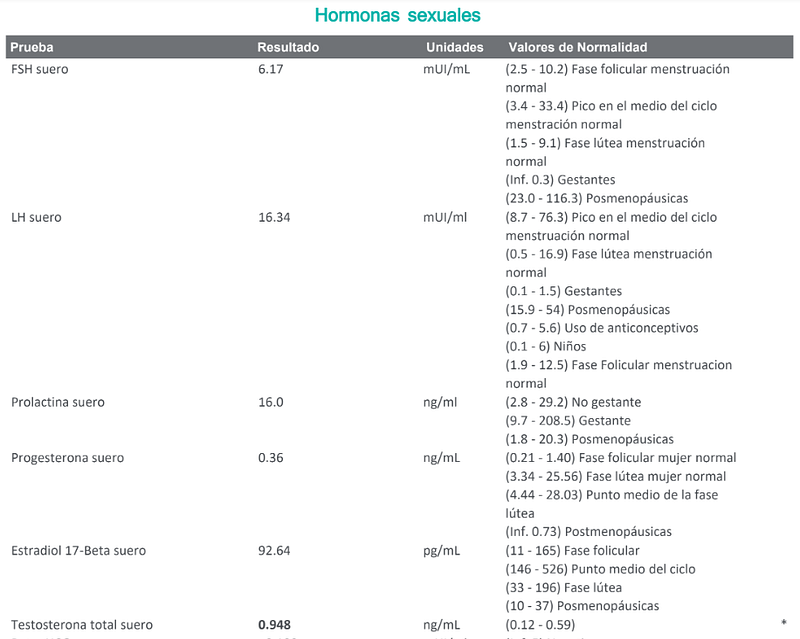
Screenshot of my sister’s hormone profile in early 2021. It’s in Spanish because we live in Spain. The hormones included are FSH, LH, Prolactin, Progesterone, Estradiol, and Testosterone. [Images courtesy of author’s sister]

As you can see, my sister’s testosterone was off the charts. Moreover, her sex hormones — FSG and HSG — were inverted when her bloodwork was done.

These results, combined with her polycystic ovaries (she had an ultrasound done), unnatural weight gain, and acne, made her condition clear: PCOS (Polycystic ovary syndrome.)

My sister was crushed.

The 8–13% of women who suffer PCOS struggle with infertility and are at a higher risk of developing type 2 diabetes. Cause yet unknown, it’s a hormonal imbalance that stays with you for life. There’s no cure.

But — and this is an extremely important but — symptoms can be managed through diet, lifestyle, and medication.

In my sister’s case, the doctor recommended she take contraceptive pills, which help regulate sexual hormones, but my sister preferred to work on her diet and lifestyle first. Her previous experiences with the pill hadn’t been too great.

Determined, she contacted a registered dietitian, who prescribed the dietary plan my sister has graciously allowed me to share.

And boy did it work.

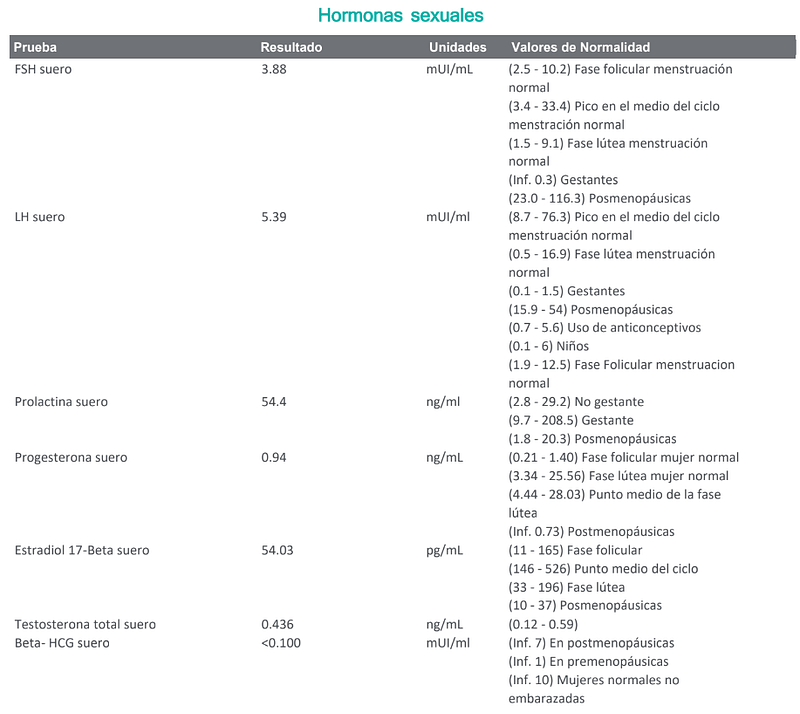
Combined with the other habits I’ll mention at the end of this post, my sister’s new dietary plan helped her lose the weight she’d gained and, most importantly, rebalance her hormones, as seen below.


Before (left) vs after (right) pictures of my sister, which she gave me full permission to share. The dietary plan and powerful habits allowed her to lose those stubborn 20 pounds. [Images courtesy of author’s sister]
Screenshot of my sister’s hormone profile in early 2022. It’s in Spanish because we live in Spain. The hormones included are FSH, LH, Prolactin, Progesterone, Estradiol, and Testosterone. [Images courtesy of author’s sister]

Moreover, my sister’s acne has vanished. Though she’ll have to be mindful of her habits and diet for the rest of her life — to keep PCOS at bay — she has regained control of her body and life.

That said, please remember every person is different. This dietary plan and other lifestyle changes were enough to help my sister regulate her hormones, but that isn’t the case for everyone.

I simply hope to inspire you to make small, helpful changes to your life if you’re also struggling with a hormonal imbalance. Or, better yet, encourage you to reach out to a registered dietitian or other health professional who can offer a more personalized approach.

With that out of the way, here’s the dietary plan that helped my sister balance her hormones and lose stubborn fat.

The 3 Key Ingredients That Make the Dietary Plan Work

According to my sister’s registered dietitian, the dietary plan she prescribed works for three main reasons:

  1. It keeps your healthy cholesterol up. Your body needs cholesterol to produce any hormone. Without it, you’d likely suffer from low levels of the three main sex hormones (estrogen, progesterone, and testosterone). This is why my sister’s dietary plan includes foods rich in good fats like fatty fish, avocado, coconut oil, and nuts.
  2. It has a low glycemic index. This index measures how quickly our blood sugar levels increase after consuming a carbohydrate. This is key for people with PCOS as they often also suffer from insulin resistance, which is why they struggle to lose weight. That’s why my sister’s dietary plan includes little-to-no refined carbs and focuses on vegetables.
  3. It eliminates the intake of trans fats. These types of fat are pro-inflammatory. Their repeated consumption leads to insulin resistance and ovulation problems (a clear issue for those struggling with PCOS). This is why my sister’s dietary plan avoids ultra-processed foods at all costs.

In a nutshell, the dietary plan works because it promotes the healthy production of hormones while reducing blood sugar spikes and pro-inflammatory states, both of which negatively impact the health of people with PCOS.

What My Sister Eats in a Day To Balance Her Hormones and Lose Stubborn Fat

This is what my sister eats on an average day:
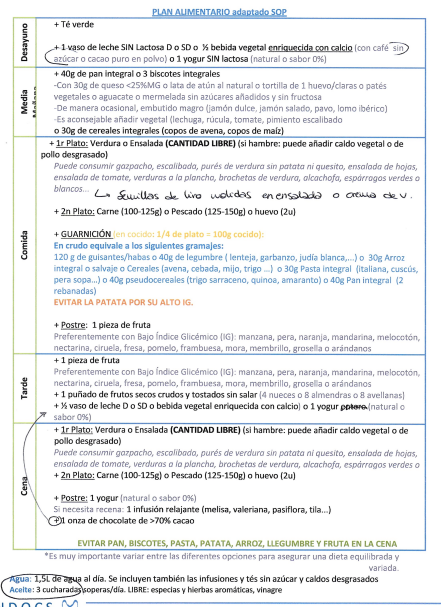
My sister’s dietary plan. It’s in Spanish as we live in Spain. [Images courtesy of author’s sister]

Breakfast

To start the day, my sister usually has lactose-free, unsweetened yogurt (around 120 grams) with unsweetened green tea. She could also have a coffee with lactose-free milk or calcium-enriched vegetable milk, but she usually sticks to yogurt.

Note: In the mornings my sister wakes ravenous, she combines her breakfast and mid-morning snack to have a bigger meal that carries her to lunch. Sometimes, she’ll also have her yogurt with homemade granola and then have her mid-morning snack (when she’s feeling especially hungry).

Mid-morning snack

Two to three hours after breakfast, my sister has a whole-wheat bread toast (around 40 gr) with either:

  • 30 grams of cheese (lower than 25% fat).
  • One can of tuna in water.
  • One egg (cooked in whatever way she prefers)
  • Avocado
  • Turkey slices (occasionally)

She’ll also add vegetables on top, like arugula, tomato, red pepper, and lettuce.

Lunch

For lunch, my sister always follows these guidelines:

  • Protein: 100–125 grams of meat, 125–150 grams of fish, two eggs (if she didn’t have any for breakfast), or 125–150 grams of vegetable protein.
  • Vegetables: Free amount. The only requirement is to ensure that at least half of the plate is filled with a mix of cooked and raw veggies. For example, a salad and steamed broccoli. No juices allowed.
  • Carbohydrates (raw quantities): 120 grams of peas; 40 grams of legumes (lentils, chickpeas, red beans); 30 grams of whole-grain rice, pasta, or other cereals (100 grams cooked); 40 grams of whole-wheat bread (2 toasts approx.); or 40 grams of quinoa. No potatoes, as they have a high glycemic index.
  • Fats: No specific guidelines, except that she shouldn’t have more than three tablespoons of olive oil (or whatever oil she’s using to cook) per day.
  • Dessert: a piece of fruit, preferably a low-glycemic option (unrestricted amount of lime or lemon; 300 grams of strawberry, watermelon, cantaloupe, grapefruit, blackberry, apricot, currant, papaya, and raspberry; or 200 grams of apple, blueberry, orange, tangerine, kiwi, pineapple, pear, peach, cherry, nectarine, mango, fig, and passion fruit).

Mid-afternoon snack

For her mid-afternoon snack, my sister has another piece of fruit, an unsweetened yogurt (around 120 grams) or a glass of lactose-free milk, and a handful of nuts (4 walnuts, 8 almonds, or 8 hazelnuts).

Dinner

Like at lunch, my sister’s dinners follow some guidelines:

  • Protein: Same as lunchtime.
  • Vegetables: Same as lunchtime.
  • No carbohydrates.
  • Fats: Same as lunchtime.
  • Dessert: unsweetened yogurt (120 grams approx.) plus one ounce of dark chocolate (at least 70%).

Some examples are:

  • Dark leafy salad with canned natural tuna and assorted veggies (chopped tomatoes, pepper, and cucumber).
  • Vegetable soup with a two-egg omelet with mushrooms on the side.
  • Pureed zucchini with feta cheese.

Important note

This is what an average day — a day of “perfect” eating — looks like for my sister, but this isn’t how she eats every day. Like everyone, my sister has birthday parties and celebrations.

The key to my sister’s success lies in her approach. 85% of her meals will look something like the ones mentioned here, keeping her consistent. But the other 15% is for her to do as she pleases, even if she now does it more mindfully.

Why?

Because now my sister knows what works and what doesn’t for her. Now she knows that when having chocolate on her “break the rules” days, she will opt for the dark variety or choose lactose-free dairy.

This dietary plan has armed her with knowledge and a plan to get back on track whenever she veers off course.

Other Helpful Habits

Besides the dietary plan, the registered dietitian gave my sister some valuable tips to rebalance her hormones and lose weight.

  • Eat in a comfortable and quiet environment — not in front of the TV — and take at least 20 minutes.
  • Opt for five smaller meals throughout the day instead of three hearty ones. In other words, eat every three hours at most — and no intermittent fasting. My sister now usually “fasts” for 12 hours between dinner and breakfast. She never lets herself go 16 or 18 hours without food.
  • Opt for simple cooking techniques like boiling, grilling, steaming, and microwaving — and avoid frying or any cooking style that favors excess oil.
  • Remove the visible fat of meats and fish and the skin of poultry.
  • Drink at least 1,5 liters of water per day.
  • Exercise lightly every day for 30 minutes (walking, climbing stairs, cycling) and exercise moderately or intensely three times per week (cycling, running, trekking).
  • Engage in regular resistance training (at least twice per week). And this doesn’t necessarily mean hitting the gym. My sister despises that environment, so instead, she’s taken up yoga.
  • Drink herbal tea throughout the day.
  • Add three supplements that have been shown to be beneficial for those struggling with PCOS: Inositol, berberine, and evening primrose oil. Note: If you want to add any supplements, I highly encourage you to seek professional supervision.
  • If losing too much weight, add more fats or complex carbs to your diet. Being both overweight and underweight can be detrimental to hormonal health.

These habits, combined with the dietary plan, have helped my sister rebalance her hormones and lose weight.

The Last Tip: Seek Professional Help if Something’s Off

My sister struggled for years before she finally saw any improvements in her acne, weight, and hormonal health. As her symptoms were mild and confusing, she never thought that she might benefit from seeking professional help.

Now, though, when asked what she would’ve done differently, her answer is instantaneous: “I would’ve reached out to my gynecologist and dietitian sooner.”

So if you feel something’s off, If you’re struggling with stubborn fat that won’t come off no matter how good your methods are, don’t be afraid to ask for help.

It can massively change your life.

Fat Loss
Diet
Health
Fitness
Nutrition
Recommended from ReadMedium