avatarWill Lockett

Free AI web copilot to create summaries, insights and extended knowledge, download it at here

4166

Abstract

/a>, which is 19% shorter. If we apply this same ratio to the BYD Seagull, we find the smaller battery has a range of 153 miles, and the larger pack has a range of 203 miles.</p><p id="427b">But a 14,000 EV with 203 miles of range is still utterly revolutionary!</p><p id="9ec6">I mean, take the upcoming VW ID.2 and Tesla Model 2 (read more <a href="https://readmedium.com/volkswagens-id-2-is-a-game-changer-374160899e1f">here</a>). Both of these EVs are slightly bigger than the Seagull, are set to launch in 2025 for 25,000, and are being hailed as EVs that will take automotive electrification to the next level. The base ID.2 is expected to only have around 200 miles of WLTP range, and the Model 2 is touted as receiving 250 miles of WLTP range from a charge. Both of these cars will also charge to 80% in around 25 minutes.</p><p id="5c3a">With this in mind, why would you wait two years and spend an extra 11,000 on VW’s or Tesla’s offering? You wouldn’t. As such, the Seagull, despite its atrocious name, is set to completely dominate the affordable EV market and make life for Tesla and any other company hoping to produce affordable EVs very hard indeed.</p><p id="a429">So, how is BYD able to sell a car for so little? Are they losing money? Well, no. Let me explain.</p><p id="6c2a">The battery pack inside the Seagull is BYD’s own Blade Battery (read more <a href="https://readmedium.com/byds-blade-battery-has-changed-the-ev-game-ff3cf5d1d4c7">here</a>), and in many ways, it is far superior to Tesla’s in-house battery, the 4680. The Blade Battery uses LFP chemistry, which is inherently cheaper, far safer, and substantially longer-lasting than lithium-ion packs, though they are also slower charging and less energy dense. To circumvent these issues and make their packs even cheaper, each cell of the Blade Battery is massive, long, and thin, like a blade. The complete pack is made of a sandwich of these blades with cooling systems nestled between them. This means there are fewer cells per pack, reducing complexity and cost even further while dramatically increasing energy density. For example, the BYD Blade Battery is 50% more energy dense than the cylindrical LFP cells Tesla uses in their base Model 3. The high surface area of the blades also means they can be cooled far more efficiently. This, combined with higher voltage architectures, means the Blade Battery can charge just as quickly as an equivalent lithium-ion pack.</p><p id="748b">Now, a modern lithium-ion battery costs around <a href="https://readmedium.com/teslas-revolutionary-4680-has-a-massive-problem-8e89c18a59c8">138 per kWh</a>. <a href="https://readmedium.com/teslas-revolutionary-4680-has-a-massive-problem-8e89c18a59c8">Tesla’s 4680 battery currently costs around 104 per kWh</a>, but once Musk has finally figured out how to manufacture it properly, the price could go as low as around <a href="https://readmedium.com/teslas-revolutionary-4680-has-a-massive-problem-8e89c18a59c8">60 per kWh</a>, though that won’t happen any time soon. BYD’s Blade Battery, on the other hand, will cost 55.40 per kWh once production is scaled (read more <a href="https://readmedium.com/byds-blade-battery-has-changed-the-ev-game-ff3cf5d1d4c7">here</a>), which it nearly is.</p><p id="a0e3">This means that BYD is spending literally half that of Tesla on the most expensive component in an EV, allowing them to undercut them dramatically.</p><p id="4e24">In fact, BYD’s Blade Battery has such an excellent price-to-performance ratio that <a href="https://thedriven.io/2022/08/15/tesla-model-y-to-get-byd-blade-batteries-in-europe/#:~:text=BYD%20LFP%20batteries%20in%20Tesla,at%20the%20Giga%20Berlin%20factory.">Tesla uses it over its own 4680 in its Model Y</a> and <a href="https://cleantechnica.com/2021/08/07/rumor-chinese-made-tesla-model-2-will-use-byd-blade-battery/">could even be using it in the upcoming Model 2</a>. However, it will undoubtedly cost Tesla more than 55.40 per kWh to buy this incredible technology, as BYD will want to make a nice little profit from this deal.</p><p id="a1e9">The other reason BYD can offer their cars so cheaply is that they are

Options

n’t developing self-driving technology. They see this as a waste of time and money, as AI is still many years away from being able to offer mass-market fully autonomous vehicles. Furthermore, there are also a plethora of third-party companies developing self-driving technology that is on par with, or better than, that being developed by automakers. This saves BYD billions of dollars in development each year, allowing them to make EVs even cheaper.</p><p id="2431">All of these factors combined explain why BYD’s EVs are about 10,000 cheaper than Tesla’s equivalent models with similar or better specs. Take their Model 3 killer, the Seal (read more <a href="https://readmedium.com/byd-seal-a-true-tesla-killer-407ed5e6c6f2">here</a>), which has <a href="https://www.autocar.co.uk/car-news/new-cars/new-byd-seal-electric-saloon-launch-uk-2023">354 miles of range (WLTP)</a> for only 30,000. Meanwhile, the base Model 3 is currently <a href="https://www.tesla.com/model3/design#overview">$40,240</a> with only <a href="https://ev-database.org/uk/car/1555/Tesla-Model-3">305 miles of range (WLTP)</a>.</p><p id="0231">With this in mind, it’s no wonder BYD has outsold Tesla and why Tesla has had to start cutting its prices back, particularly in China, to compete.</p><p id="af56">But it isn’t just the prices and specs that should worry Tesla. Instead, it is BYD’s profit margin. For years, Tesla has had one of the largest profit margins in the automotive industry, which has not only fueled their growth but given them literally billions of dollars in reserve cash. But <a href="https://www.notebookcheck.net/BYD-nears-Tesla-gross-profit-margin-as-it-launches-cheap-Seagull-mass-market-EV.711216.0.html">BYD’s profits have grown by 400% since last year</a>, and their <a href="https://www.notebookcheck.net/BYD-nears-Tesla-gross-profit-margin-as-it-launches-cheap-Seagull-mass-market-EV.711216.0.html">overall profit margin is 17.86%, which is just a shade below Tesla’s 19.3%</a>.</p><p id="e53e">This means that Tesla can’t compete with BYD on price, and BYD could make far more money per vehicle if they wanted to, which is the issue that Musk should<i> really</i> be worried about. While Musk’s 4680 is still not fully developed and Tesla is messing around with an EV price war, BYD is using already proven technology intelligently and is focused on dominating the mass-market EV world without being greedy. Because of that, I can’t see how Tesla could fully compete.</p><p id="892e">There is one saving grace for Tesla, though. <a href="https://www.moveelectric.com/e-cars/byd-seagull-brilliantly-named-electric-supermini-china#:~:text=Fresh%20off%20the%20UK%20launch,intended%20for%20the%20Chinese%20market.">The Seagull will only be sold in China for now</a>. BYD understands that the political landscape between China and the West is a little on edge right now, so it makes no sense to focus on expanding Westward. After all, another trade war could render the entire endeavour pointless. Instead, they seem to be mainly focused on perfecting their offering, ready for when the time is right to push sales in the rest of the world. That being said, they are already selling EVs in Europe. So the clock is ticking for Tesla, as sooner or later, BYD will become a global brand, and Tesla won’t be able to hide anywhere. Will Musk be able to rise to this challenge? Only time will tell.</p><p id="28fa"><i>Enjoyed this article? <b>Get articles & ad-free video articles 24 hours before anyone</b> else on <a href="https://planetearthandbeyond.substack.com/publish?embeddedPostPublications=&amp;scheduledFor=Tue%20May%2002%202023%2020%3A30%3A00%20GMT%2B0100%20%28British%20Summer%20Time%29&amp;audience=only_paid">Substack</a> or check out my <a href="https://www.youtube.com/channel/UClnY1J4ZzDfWTIb0PTPBEog">YouTube</a> channel for daily video articles.</i></p><p id="84ab">Article originally published on <a href="https://planetearthandbeyond.substack.com/publish?embeddedPostPublications=&amp;scheduledFor=Tue%20May%2002%202023%2020%3A30%3A00%20GMT%2B0100%20%28British%20Summer%20Time%29&amp;audience=only_paid">Substack</a></p></article></body>

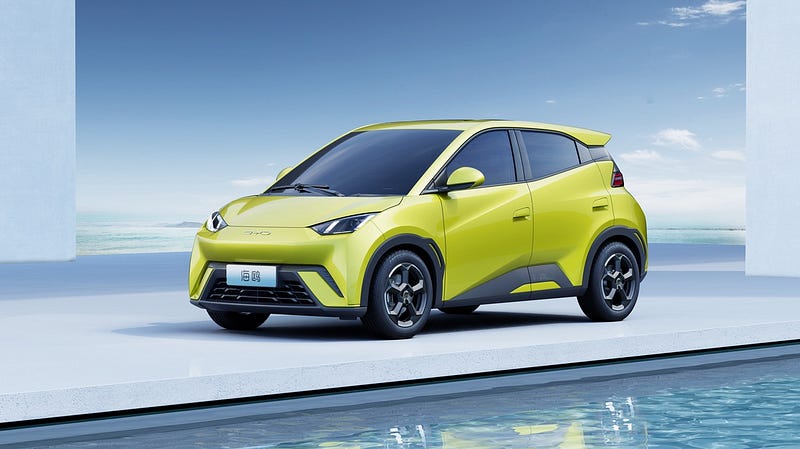
BYD Seagull — BYD

Tesla Should Be Worried About BYD

Can Musk compete with this?

Who do you think is the world leader in EV sales? You almost inevitably think of Musk’s trail-blazing Tesla and its headline-grabbing, industry-worrying growth over the past ten years. But in actuality, they are currently being beaten by BYD. The Warren Buffett-backed Chinese firm sold 1.62 million EVs in 2022, while Tesla sold 15% less at 1.37 million. Yet Musk has far more to worry about than BYD outselling them. You see, BYD is just as profitable as Tesla, is proactively expanding outside of China, and their latest model is a 100 horsepower, 251-mile range, $14,000 EV that promises to revolutionise the EV market in ways Tesla’s upcoming Model 2 can only dream of. So how has BYD pulled this off? And should Musk be worried?

Firstly, let’s look at this new car. The BYD Seagull is a four-seater hatchback launched at the 2023 Shanghai Auto Show that is a similar size to a modern Fiat 500, with deliveries ready in only a few months time. While the name itself might be utterly terrible, the specs of this car are astonishing. It has two motor options: a 74- or 100-horsepower unit, both of which are front-wheel-drive. That might not sound like a lot, but because this car is tiny and light, there should be plenty of power for some spirited driving. There is also a choice of two battery sizes: a 30 kWh pack with a range of 190 miles CLTC or a larger 38 kWh pack with a range of 251 miles CLTC. Both packs use BYD’s incredible Blade Battery, but more on that soon. Similarly, both packs can rapid charge to 80% in only 30 minutes, putting them on par with many $40k+ EVs.

But the big headline here is the cost. The smaller 30 kWh pack variant costs the equivalent of $11,400, while the 38 kWh version is the equivalent of $14,000! This is insanely cheap and puts many upcoming affordable long-range EVs, like the Tesla Model 2 and VW ID.2, in serious trouble.

Before getting into these competitors, we must address how these ranges are displayed. As it happens, BYD is quoting their CLTC range, which is typical for the Chinese market but tends to be far more optimistic than the Western standards of WLTP or NEDC. For example, a Tesla Model 3 Performance has a CLTC range of 419 miles, whereas it has a WLTP rating of 339 miles, which is 19% shorter. If we apply this same ratio to the BYD Seagull, we find the smaller battery has a range of 153 miles, and the larger pack has a range of 203 miles.

But a $14,000 EV with 203 miles of range is still utterly revolutionary!

I mean, take the upcoming VW ID.2 and Tesla Model 2 (read more here). Both of these EVs are slightly bigger than the Seagull, are set to launch in 2025 for $25,000, and are being hailed as EVs that will take automotive electrification to the next level. The base ID.2 is expected to only have around 200 miles of WLTP range, and the Model 2 is touted as receiving 250 miles of WLTP range from a charge. Both of these cars will also charge to 80% in around 25 minutes.

With this in mind, why would you wait two years and spend an extra $11,000 on VW’s or Tesla’s offering? You wouldn’t. As such, the Seagull, despite its atrocious name, is set to completely dominate the affordable EV market and make life for Tesla and any other company hoping to produce affordable EVs very hard indeed.

So, how is BYD able to sell a car for so little? Are they losing money? Well, no. Let me explain.

The battery pack inside the Seagull is BYD’s own Blade Battery (read more here), and in many ways, it is far superior to Tesla’s in-house battery, the 4680. The Blade Battery uses LFP chemistry, which is inherently cheaper, far safer, and substantially longer-lasting than lithium-ion packs, though they are also slower charging and less energy dense. To circumvent these issues and make their packs even cheaper, each cell of the Blade Battery is massive, long, and thin, like a blade. The complete pack is made of a sandwich of these blades with cooling systems nestled between them. This means there are fewer cells per pack, reducing complexity and cost even further while dramatically increasing energy density. For example, the BYD Blade Battery is 50% more energy dense than the cylindrical LFP cells Tesla uses in their base Model 3. The high surface area of the blades also means they can be cooled far more efficiently. This, combined with higher voltage architectures, means the Blade Battery can charge just as quickly as an equivalent lithium-ion pack.

Now, a modern lithium-ion battery costs around $138 per kWh. Tesla’s 4680 battery currently costs around $104 per kWh, but once Musk has finally figured out how to manufacture it properly, the price could go as low as around $60 per kWh, though that won’t happen any time soon. BYD’s Blade Battery, on the other hand, will cost $55.40 per kWh once production is scaled (read more here), which it nearly is.

This means that BYD is spending literally half that of Tesla on the most expensive component in an EV, allowing them to undercut them dramatically.

In fact, BYD’s Blade Battery has such an excellent price-to-performance ratio that Tesla uses it over its own 4680 in its Model Y and could even be using it in the upcoming Model 2. However, it will undoubtedly cost Tesla more than $55.40 per kWh to buy this incredible technology, as BYD will want to make a nice little profit from this deal.

The other reason BYD can offer their cars so cheaply is that they aren’t developing self-driving technology. They see this as a waste of time and money, as AI is still many years away from being able to offer mass-market fully autonomous vehicles. Furthermore, there are also a plethora of third-party companies developing self-driving technology that is on par with, or better than, that being developed by automakers. This saves BYD billions of dollars in development each year, allowing them to make EVs even cheaper.

All of these factors combined explain why BYD’s EVs are about $10,000 cheaper than Tesla’s equivalent models with similar or better specs. Take their Model 3 killer, the Seal (read more here), which has 354 miles of range (WLTP) for only $30,000. Meanwhile, the base Model 3 is currently $40,240 with only 305 miles of range (WLTP).

With this in mind, it’s no wonder BYD has outsold Tesla and why Tesla has had to start cutting its prices back, particularly in China, to compete.

But it isn’t just the prices and specs that should worry Tesla. Instead, it is BYD’s profit margin. For years, Tesla has had one of the largest profit margins in the automotive industry, which has not only fueled their growth but given them literally billions of dollars in reserve cash. But BYD’s profits have grown by 400% since last year, and their overall profit margin is 17.86%, which is just a shade below Tesla’s 19.3%.

This means that Tesla can’t compete with BYD on price, and BYD could make far more money per vehicle if they wanted to, which is the issue that Musk should really be worried about. While Musk’s 4680 is still not fully developed and Tesla is messing around with an EV price war, BYD is using already proven technology intelligently and is focused on dominating the mass-market EV world without being greedy. Because of that, I can’t see how Tesla could fully compete.

There is one saving grace for Tesla, though. The Seagull will only be sold in China for now. BYD understands that the political landscape between China and the West is a little on edge right now, so it makes no sense to focus on expanding Westward. After all, another trade war could render the entire endeavour pointless. Instead, they seem to be mainly focused on perfecting their offering, ready for when the time is right to push sales in the rest of the world. That being said, they are already selling EVs in Europe. So the clock is ticking for Tesla, as sooner or later, BYD will become a global brand, and Tesla won’t be able to hide anywhere. Will Musk be able to rise to this challenge? Only time will tell.

Enjoyed this article? Get articles & ad-free video articles 24 hours before anyone else on Substack or check out my YouTube channel for daily video articles.

**Article originally published on Substack**

Technology
Tech
Artificial Intelligence
Sustainability
Innovation
Recommended from ReadMedium