
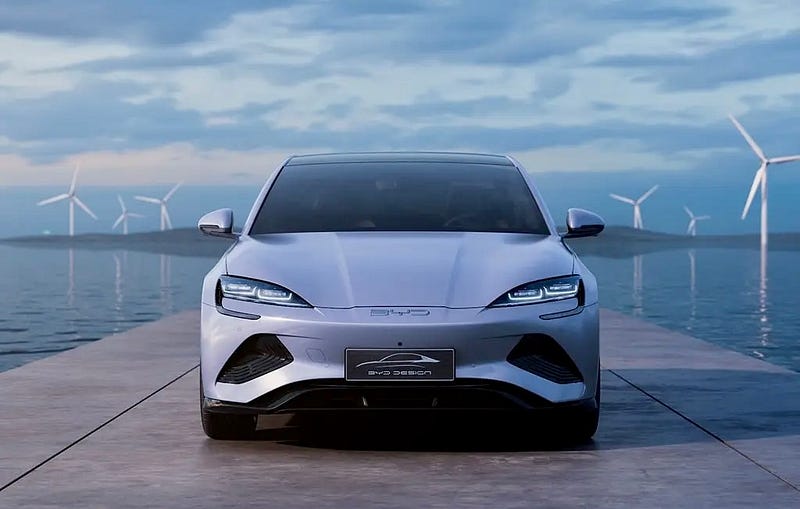
BYD Seal: A True Tesla Killer
Thanks to its unique approach, BYD is poised to give Musk a serious headache!
Who is the biggest EV manufacturer in the world? You might think it’s Tesla, but you’d be wrong. Last year, BYD took the crown from Tesla, despite only really selling cars in China. So, even though you may have never heard of them, BYD is already a behemoth in the EV game. However, it appears that BYD isn’t satisfied with this success and is hungry for more. Their latest model, the Seal, is a Model 3 killer! What’s more, this model is coming West, encroaching on Tesla’s territory. So how good is the Seal? And should Musk be worried?
The Seal is already for sale in China, and its specs read like a wishlist. The range starts at a bargain $30,000 (equivalent). For your money, you get 341 miles of range (CLTC), a 30% to 80% charge time of 30 minutes (around 40 for 10%-80%), and a decent 0–60 time of 5.9 seconds. If you splash a bit more cash on the $42,000 equivalent long-range version, you get a gigantic range of 435 miles (CLTC) and a blistering 0–60 time of only 3.8 seconds! Just for a sense of how fast that is, the $72,000 BMW M3 achieves the same time in 4.1 seconds.
The Seal is also coming to Europe sometime this year. BYD is so committed to moving into Western markets that they are looking to build factories in the EU. There is even the possibility of the Seal making its way over to the US. As such, BYD has invited Western car journalists to review the Seal, and their feedback is glowing — from reports of great fit and finish to great Western-oriented looks to brilliant onboard tech and engaging driving dynamics.
So, how does the European-bound EV match up to the Model 3?
In the West, the base Model 3 costs $46,990 (or thereabouts, depending on the market), but in China, Tesla has had to slash its prices to compete with cars like the Seal, meaning it only costs the equivalent of $33,500 (read more here). For that price, you get a range of 346 miles (CLTC), a 10% to 80% charge in 30 minutes, and a 5.3-second 0–60 mph time.
The BYD will likely cost close to its Chinese dollar equivalent price in Europe. So over here, the Seal will utterly destroy the Model 3, at least in terms of value for money. Over in China, the two are very closely matched, but the BYD likely has a higher profit margin than the Tesla. (Read more about Tesla’s profit margins here).
So how has BYD managed to pull this off? Well, it’s all down to its brilliant battery pack. You see, like Tesla, BYD designs and builds its own in-house battery packs. But unlike Tesla’s struggling 4680, the BYD Blade Battery is a runaway success.
I have written about the Blade Battery before (click here). It is a prismatic-cell rack-stacked structural LFP pack. LFP is an alternative chemistry to the more common lithium-ion, but it is cheaper, safer, slightly less energy dense, and slower to charge. BYD has optimised the pack using a unique and ultra-safe (i.e., non-flammable) internal chemistry and an 800v architecture to boost charge times to 10% to 80% in only 30 minutes, which suggests the Seal could be capable of this rate later down the line for no extra cost. LFP cells are inherently long-lasting, but BYD has doubled down on that, and the Blade Battery is rated for 3,000+ charge cycles. That is the equivalent of driving 745,000+ miles before the battery gives out, far more than any other EV battery out there.
The cells of the Blade Battery are packaged into large, blade-like prismatic cells (as opposed to the more common cylindrical cells) and then stacked together with cooling in between each cell. This gives the Blade Battery fantastic thermal management, allowing it to eke out every last mile of range. But this setup also makes the Blade Battery 50% more energy dense than the CATL M3P LFP pack that is in the Tesla Model 3 SR+.
The Blade Battery costs around $85 per kWh, making it one of the cheapest batteries out there by some margin.
What’s more, the safety of the Blade Battery means less shielding is needed to isolate the cabin from the battery pack. Plus, the battery pack is structural, meaning it is load-bearing and replaces a part of the chassis, making the car more rigid. Together, these ensure the vehicle is more efficient, safer, easier, and cheaper to manufacture. Combine that with the ultra-low cost of the Blade Battery, and you have yourself a fantastic EV that is cheaper than a Tesla.
But BYD isn’t satisfied with that. You see, as the production of the Blade Battery scales up, the cost to manufacture will drop significantly. As such, they predict the price will go as low as $55.40 per kWh! Such a battery would enable a $25,000 3 EV, and BYD should reach this milestone in the next few years.
With competition like this, the Model 3 will either have to get much better or significantly cheaper to keep its profitability and best-seller position. But BYD isn’t just limited to the Seal. They have a whole plethora of similarly priced and equipped vehicles, all ready to go West. It is clear that BYD will cause a massive upset in the EV world and could dominate Tesla if Musk doesn’t do anything about it. But he isn’t out of options. He could adopt a similarly excellent third-party battery, such as the CATL sodium-ion packs, or he could finally get his 4680 battery sorted out. Either way, the near future of EV is looking damn exciting.
Enjoyed this article? Then check out my latest book on Amazon here or my YouTube channel here!


