
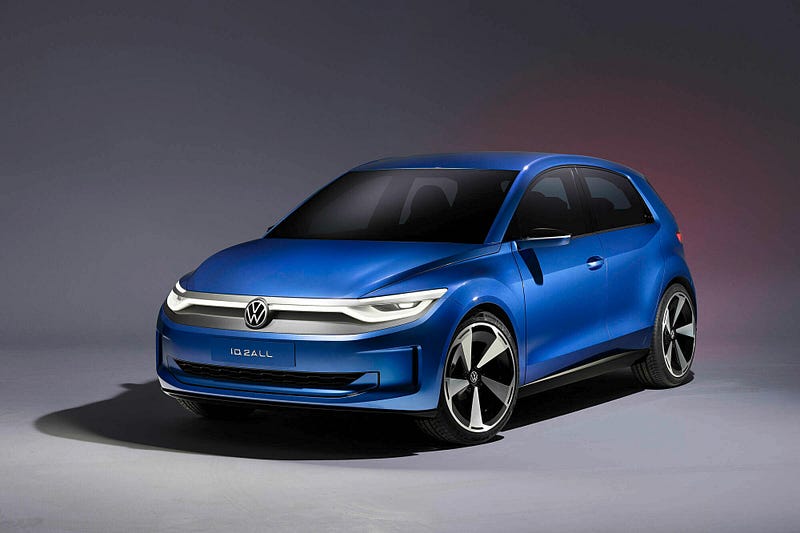
Volkswagen’s ID.2 Is A Game Changer
Can Tesla match this?
It may feel like, over the past few years, EVs have taken over the automotive industry! You can’t go outside without seeing a sea of shiny Teslas. But these futuristic vehicles haven’t had as big of an impact as you might think. In 2022, only 5.8% of new cars sold in the US were EVs, with the rest being hybrids or combustion vehicles. This means the electric revolution is far from overthrowing the fossil-fuel-guzzling status quo. Why? Well, an EV with a genuinely usable range, fast charging, and reasonable practicality is just far, far too expensive for the average Joe — an unfortunate fact that is choking EV growth. But VW’s $25,000, 280-mile-range ID.2 seems to not only solve this affordability issue but also threatens to be better than Tesla’s upcoming budget EV.
The ID.2 is a similar size to the current VW Polo but a bit taller, yet it packs a huge punch for such a small EV. Its 56 kWh battery provides 280 miles of range (WLTP target) and can charge from 10% to 80% in only 20 minutes! The base model gets a 38 kWh battery pack, meaning it will likely get around 200 miles of WLTP range and an even quicker charge time. The front wheels are powered by a 223 horsepower motor, which can send the ID.2 from 0 to 62 mph in less than 7 seconds, making it incredibly speedy for such a small car. To top it all off, it has an utterly massive 490 litres of cargo space.
With specs like this, you’d expect to pay well over $30,000. But the ID.2 will launch in 2025 for less than $25,000! With that price point, the top-of-the-line 280-mile, 56-kWh variants will likely be around $27,000.
Just compare that to a $39,990 base Tesla Model 3. The Model 3 only has 25 miles more range and takes 5 minutes longer to charge from 10% to 80%. It is slightly more powerful and quicker, with 279 horsepower and a 0–62 mph time of 6.1 seconds. But bizarrely, despite being a much larger car than the ID.2, the Tesla is less practical, with only 425 litres of cargo space.
However, in the interests of being fair to Tesla, the Model 3 was never meant to be their budget vehicle. Tesla has confirmed they are currently working on a smaller, cheaper ‘Model 2’. We don’t yet know the exact specs or price of this car, but there have been some consistent rumours that give us an idea of what to expect.
Firstly, we know that Tesla won’t use the name ‘Model 2’ though that is what everyone refers to it as. Apparently, it will be a $25,000 high-riding hatchback, much like the ID.2. One thing we know for sure is the battery size, as it will use a 53 kWh LFP pack, which should give it around 250 miles of range and charge times of around 25 minutes for 10% to 80%. The Model 2 is also slated for the same 2025 launch date as the ID.2.
So the ID.2 and the Tesla Model 2 seem like very close rivals. This isn’t surprising as both companies are using the same approach to decrease production costs: vertical integration (read more here). By bringing everything from lithium-mining battery manufacturing to motor production in-house (or having a vertically integrated production line), Tesla and VW can cut out the middleman, increase profits, and dramatically reduce overall costs. Both companies are pushing this style of production to the limit, so it isn’t surprising that they have ended up with very similar specs at a very similar price.
But there are two significant things going for the ID.2 over the Model 2.
Firstly, practicality: it makes very little sense for Tesla to sell a cheaper, more practical EV than the Model 3, as you will end up cannibalising sales of the Model 3. Indeed, rumours support this theory, as the Model 2 is set to be 15% shorter and 30% lighter than the Model 3. So the Model 2 will likely end up being far less practical than the ID.2.
Secondly, VW has a track record of keeping deadlines and promised prices, even with EVs. Just look at the ID.3, ID.4, and the Porsche Taycan. While the initial sales of the ID.3 were delayed, they have ordinarily delivered new models on time and at the promised price. Meanwhile, Tesla has a habit of massively delaying new models, as I’m sure Cybertruck and Roadster customers can attest to. They also have a history of egregiouslyoverpromising on price, such as the $35,000 Model 3, which was guaranteed way back in 2017 but has yet to see the light of day (though Tesla did sell it for a few months back in 2019 and quickly moved away from the variant). So don’t be surprised if the ID.2 comes out a few years before the Model 2, and the Model 2 costs a good chunk more than $25,000.
In the end, my money is on the VW ID.2 beating the Tesla Model 2 to market and to overall success. This opinion might change over time as we learn more about Tesla’s and VW’s progress, and you are more than welcome to have a different opinion. But one thing is for sure: the age of affordable, genuinely usable EVs is about to materialise. I can see both the ID.2 and Model 2 being massive sales successes. Is this enough to make EVs outsell combustion vehicles and bring us closer to a far more sustainable automotive world? We will have to see.
Enjoyed this article? Check out my latest book, “50 Ways To Save The World,” on Amazon here.