
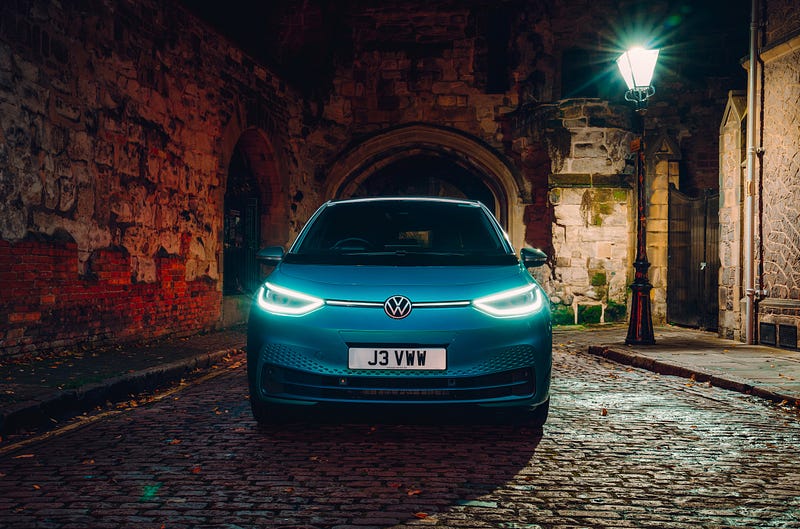
Volkswagen Takes A Leaf From Tesla’s Book
Imitation is the highest form of flattery.
It doesn’t matter if you love or loathe Musk; you can’t deny that Tesla has shaken the automotive world to its core. Not only has Elon shown the world how incredible EVs can be, but he has also reinvented how a car company can operate as part of his dual-pronged strategy. Sure, the company isn’t perfect, and there are still some serious hurdles in their way, but this meteoric rise to the top hasn’t gone unnoticed, and VW wants a slice of that action. As a result, the Germans have decided to straight-up copy Tesla. But how? And how much of an impact will this have on VW and Tesla’s rivalry?
Firstly, let’s look at how Tesla has pioneered its way to success. There are numerous ways the company has achieved its reputation, including through their cutting-edge technology, charging infrastructure, and even use of a direct-to-customer sales model. But by far the most significant advantage is their manufacturing setup. From day one, they focused on building as much as possible in-house. Almost every aspect of the car, from the motors and ECU to the interior and chassis components, is built in-house. Admittedly, some of their cars still use third-party batteries, but Tesla is in the process of switching to their own 4680 battery packs. Musk has even gone so far as to say that he wants to become a lithium miner and for Tesla to become its own raw material supplier. Setting up a manufacturing company like this is known as “vertical integration.”
Almost no other automakers operate this way. Instead, they use third-party components throughout the entire vehicle, which is known as “horizontal integration.”
Tesla’s vertical integration has some brilliant advantages. Firstly, it helps lower costs and increase profits, as it is cheaper overall to build the components yourself. It can massively increase the synergy of the vehicle’s design, as all the components can be optimised to work together rather than modified to work together. It can also open the door to more radical and progressive designs that the wider industry cannot deliver, with the 4680 being a prime example of that concept. In contrast, horizontal integration costs more overall and tends to have a less efficient design.
But vertical integration also has some massive disadvantages. There are astronomical upfront costs to develop, refine, and scale the manufacturing of these in-house components. Moreover, for this cost to be worthwhile, the vehicles have to be produced for a long time and in vast numbers ; otherwise, the economies of scale work against you. In contrast, horizontal integration has far fewer up-front costs, and it allows the overall design to be far more flexible, as you can swap out components for newer, better ones, should they come around.
Now, Tesla began investing in its vertical integration years ago. In fact, this was one of the reasons why the Model 3’s initial production was such hell for Musk. Apart from its 4680 battery, it has now paid off its initial investment and can enjoy the benefits of vertical integration. Hence, their EVs tend to be cheaper and more efficient (i.e., have longer ranges) than those of their competitors.
But VW needed to catch up, and fast. So they adopted horizontal integration with their first EVs. This enabled them to design and build them quicker and for less. It also allowed for design flexibility, as they weren’t confident about which technologies were the best to lock into their designs. For example, they didn’t want to pour billions into LFP batteries if it turns out the sodium-ion ones are far better. So using off-the-shelf components allows them to quickly switch between the two if needed.
However, they now have a strong selection of EVs, from the daily-driver ID.3 to the monstrous Porsche Taycan. Not only that, but they now have the experience and knowledge of which technologies work and which don’t. So it makes sense to make this entire endeavour more efficient and bring everything in-house.
VW recently announced that critical components of their drivetrain would be brought in-house. Mostly, pulse converters, which take the DC power of the battery pack and turn it into the three-phase electricity needed for the brushless motors, as well as a motor controller, which is the EV version of a throttle. This enables them to better design these components to fit the layout of their EV platform and increase thermal efficiency, which VW estimates will increase overall efficiency by 20%! Not only that, but these in-house components will be cheaper and allow for 670-horsepower EVs!
And it doesn’t just end there. VW has invested billions of dollars and become a significant shareholder in 24M, Umicore, and QuantumScape, each of which is developing cutting-edge high-performance or ultra-low-cost batteries. As the largest — or, at the very least, a significant — shareholder in these companies, VW has effectively taken them in-house, as they can lock in trade contracts and easily barter for cheaper battery prices. If that isn’t good enough, VW has also spent $20 billion to start its own battery manufacturing company, which will likely be able to licence technology developed by 24M, QuantumScape, and Umicore.
VW has also undergone this with a lithium miner called Vulcan Energy Resources, as well as other Canadian mines that produce nickel, lithium, and cobalt. Again, this will enable them to negotiate better supply deals for their battery companies.
It seems like VW has copied Tesla’s playbook line for line. The only difference is that they used the advantages of horizontal integration to catch up to Tesla as much as possible before switching to vertical.
So what does this mean for VW and Tesla? Well, this won’t make VW overtake Tesla, at least not alone. But it does mean that the next generation of VW EVs will be far more efficient and cheaper than their current models. It also means that they are locking into their EV plan, as trying to change the direction of EV development after going vertical will cost a tonne. But overall, this means that Tesla has set a new standard for how a car company is set up. So not only have they started an EV revolution but also a vertical integration revolution. However, it also shows that the establishment is adapting quickly and is poised to close the gap fast. It is going to be incredibly interesting to see what happens with VW over the next few years.
Enjoyed this article? Then check out my latest book, “50 Ways To Save The World,” on Amazon here or my YouTube channel here!


