
BUSINESS STRATEGY
Strategic Planning Is Crucial for Businesses in the New World
This article explores the elements of strategic planning as organizations across the globe emerge from lockdown

Johnson and Scholes said: “Strategy is the direction and scope of an organization over the long term, which achieves advantage in a changing environment through its configuration of resources and competences with the aim of fulfilling stakeholder expectations.” (Johnson et al, 2001)
“Strategic Planning is worthless unless there is first a strategic vision”, a plan.
— John Naisbitt
Strategic decisions are likely to:
- Be complex and simple in nature at the same time
- Be formulated with a high degree of ambiguity today
- Have an impact on operational decision-making
- Require a more diverse internal and external approach
- Be agile to pivot for considerable change
This article will discuss the importance of strategic planning today.
The Strategy Challenge
We are in danger of overlooking the real challenge of strategy. The need to pinpoint and implement tough choices in an uncertain world, and do so with limited data at hand.
Leaders must face the complexities and challenges of strategic decisions, with robust confidence, and the courage to change as required.
The questions that a strategy must aspire to answer is grounded in competitive advantage, for example:
- What are the options now?
- What has changed?
- Where are the opportunities?
- How can the organization cope with limited data?
- How can the organization frame strategic issues?
- How can the organization generate an array of options?
- How will the organization choose between each option?
To comprehensively answer these questions, a high level of strategic thinking is required. A whole new approach for many organizations.
“We always plan too much and always think too little.”
— Joseph A. Schumpeter
The CEO of Mercedes said in an interview that in the future our competitors will “no longer” be “other car companies but Tesla, Google, Apple, Amazon.”
Basically, tech companies are leaping market boundaries, disrupting the motor industry. (Techusiat.com, 2017)

Strategic Management
Strategic thinking is core to strategic management. A precursor to strategic planning to execute, control and pivot strategy going forward.
Strategic management = Strategic planning + implementation + control.
Planning
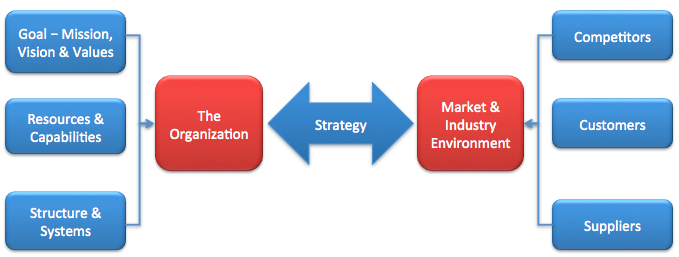
Strategic planning is the process that evaluates the environment, internal strengths, and weaknesses of an organization.
Planning defines the mission fabric, with long and short-range objectives in mind for implementation in order to attain goals.
The output of the planning process will:
- Define the organization's value proposition
- Identify the core competencies of the organization
- Rapid responses to market trends
- Rapid service or product development
- Rapid production
- Rapid delivery
- Effective cost management
- Continuous improvement of processes — incremental innovation
- Resources — Hiring, training, and rewarding of talent
- Enhanced operational agility
The benefits of strategic planning are eight-fold:
- It encourages leaders to systematically think ahead
- It leads to better coordination, companywide
- It forces leaders to clarify vision objectives and policy
- It clarifies performance standards and control metrics
- It enables an organization to anticipate, and rapidly react to market or sudden environmental changes developments
- It encourages organizational adaptation
- It encourages change management and monitoring
- Timely resource planning and allocation
Planning is only the starting point, but without it, an organization is navigating unchartered waters with nobody at the wheel or blindfolded at best.
“If you fail to plan, you are planning to fail!”
― Benjamin Franklin

Final Thoughts
There are no guarantees. The fact is that many industry sectors will be changed permanently from this point forward. Some will fail due to monumental economic forces or paradigm shifts in consumer behavior.
As far as strategy is concerned though, failure is a result of:
- Poor communication
- Lack of urgency
- Failure to gain commitment from all stakeholders
- Failure to co-ordinate key objectives
- Failure to follow the roadmap
- Failure to implement and manage change
- Failure to share small wins
- External interference like political influence
That said, any brand can pivot, leap market boundaries, or create entirely new markets. A crisis is brimming opportunity, all we have to do is look.
“Never waste a good crisis.”
— Winston Churchill
Failure is possible, but certain if planning is ignored.


