
BUSINESS GROWTH FOR ENTREPRENEURS
Transformation And Strategic Leadership At Startups
Soft Skill Insights From A Business Change Perspective

Innovation, flexibility, responsiveness and creative redefinition of markets are dimensions that underpin the ability of a ‘New Entrant’ to exploit opportunities by tapping the well of competitive advantage in the global economy.
Needless to say, Leadership challenges for Startups are considerable as they scale.

In a rapidly changing world, Startups need be highly agile and willing to change and adapt rapidly. Leaders with the self-confidence to create the future while keeping a keen eye on shifting trends. In the article Power and Leadership: An Influence Process, Lunenburg noted:
“Great leaders have the following in common: they have a vision to achieve large-scale ideas that they dream of accomplishing, and they have the personal power to enact it (Gibson, Ivancevich, Donnelly, & Konopaske, 2012). For example, such business leaders as the late Steve Jobs of Apple Computer, Bill Gates of Microsoft, Mark Zuckerberg of Facebook, Jeff Bezos of Amazon.com, Phil Knight of Nike, and Sam Walton of Wal-Mart had strong visions of the future. They were able to transform their visions into reality, because they had acquired and used the necessary power to do so. Great leaders make things happen by utilizing personal power (Pfeffer, 2011)” — Lunenburg, 2012
Change Is The Only Constant
Change has been a constant factor in business since the industrial revolution, however in recent years the rate of change has accelerated exponentially, caused ironically by the very force that resists it. This force is disguised in many forms but manifests in the shape of consumer demand, innovation, remuneration and working conditions, to name but a few.
The fact is change is a symptom of human behaviour yet resistance, a symptom of change, originates from the same human desires that fuel the need for change to begin with. Resistance camouflages a misguided effort to defend basic needs (Maslow) to survive, when change is actually about survival. For reference Patrice shared an unique view on Maslow’s Hierarchy.
Such contradictions are fundamental to the challenges required to implement a change management ethos; nonetheless, as humans we must continuously strive to navigate the barriers, born out of our own flaws and shortcomings, for the benefit of communal development and progress.
“Change is the only constant.” — Heraclitus, Greek philosopher
One of the most difficult responsibilities of leadership in a Startup today is to effectively guide and facilitate the process of continuous change in an organisation that’s learning every day.
Understanding Organisations
Charles Handy advised us in his book Understanding Organisations that “organisations are not machines”, rather “they are communities of people and therefore behave just like other communities” (Handy 2006).

This observation by Handy captures the complexity associated with change management with respect to the situational relationship exchange between leadership and followership in a Startup.
Change Management
The significance of Leadership and Management in implementing a ‘change management’ environment has become ever more challenging with the backdrop of an insatiable demand in consumer appetite. Paralleled by leaps in technological advancement this challenge is compounded even further at an ever increasing frequency each passing year. As a result, time is no longer a luxury for those at the top — especially in a Startup.
An example of this fact in the public domain is played out every week in the Premier League in England. In many ways the sporting arena is simply a reflection of society and the sheer rate of change that exists as sporting clubs jostle for effective leadership to realise lucrative financial gains to satisfy stakeholder demands.
Beckhard and Harris presented a formula in 1997 to establish the probability of change in an organisation. Their formula: (Dissatisfaction) x (Vision) x (First Step) > Resistance, applies a simple metric tool to guide, derive and qualify if change is actually possible i.e. is the sum of the first three elements greater than the last, resistance.
Interestingly the importance of a vision is evident (mission, vision and values), deemed to be a crucial element in the process and implies that in its absence change cannot actually happen. This represents a significant challenge for leadership and management, whereby their vision must be realistic while communicated effectively across the organisation.
Communication
This concept aligns with Kotter’s assertion that communicating a sense of urgency is the first step on the journey. In contrast, he argues that by “not establishing a great enough sense of urgency” an organisation is heading towards transformational failure (Kotter).

In 1968 Peter Drucker coined the phrase the “age of discontinuity”, predicting the onset of constant change in our lives. In 2001 he stated that “the most important thing in communication is to hear what isn’t being said” (Peter Drucker).
This profound statement links to Kruger’s iceberg concept with respect to communication (within change) insofar as that we only ever see the tip of the iceberg whereas 90% is beneath the surface.
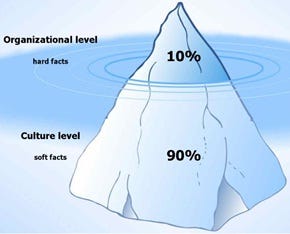
Communication is in effect the submersible that empowers a ‘top-down’ and ‘bottom up’ approach, breaching the surface unilaterally. In fact a ‘bottom-up’ approach indicates a higher level of communication because it means leaders are listening to their followers.
“Developing excellent communication skills is absolutely essential in effective leadership. The leader must be able to share knowledge and ideas to transmit a sense of urgency and enthusiasm to others. If a leader can’t get a message across clearly and motivate others to act on it, then having a message doesn’t even matter” — Gilbert Amelio, CEO National Semiconductor Corp
Culture
Startups must be flexible to adapt in a constantly changing environment by developing a cultural dynamism in order to uncover new opportunities.
Culture is to an organisation as personality is to an individual so “failure of change is because the fundamental culture of the organisation remains the same” (Cameron 1995).
Continuously driving cultural evolution is similar to the school of thought from Japan that spawned in the 1960’s, Kaizen; otherwise known as ‘Continuous Improvement’. The underlying message is that a complacent culture increases the risk of demise or extinction.

People
Human capital is an integral part of any organisation, but developing it is a major challenge for leaders in formulating competitive strategies. The role of human capital is greater than ever before in achieving competitive advantage, now considered to be the underlying success factor and a major source of competitive advantage.
There are models for acquiring, maintaining and sustaining human capital with systems to recruit, reward and develop people now forming a major part of an organization's’ value, more so than other assets such as property, cash, equipment and machinery.
According to Jim Pinto “people are also assets and must be valued as such, measured, and developed”. They are not hard assets per se that depreciate in value and written off in time but rather dynamic assets with huge potential to increase in value over time. People are therefore primary assets and a key source of competitive advantage.
Extinction
Kodak, Polaroid and Bethlehem Steel are stark reminders of corporate casualties who failed to recognise extrinsic change and now occupy the graveyard of fortune 500 companies, where only 13.4% of those listed in 1955 exist today (www.cnn.com).
So what is the significance of this statistic?
Well, if we look at Apple (in 1998), Harley Davidson (from 1980–84) and Nucor group (in 1965), who not only reversed their fortunes under similar challenges to survive, but went on to flourish beyond expectations.
Simon Sinek wrote about this in “Start with Why” (Sinek 2011).
- What did Polaroid lack that Apple cracked?
- How did Nucor surpass Bethlehem Steel, who in 1955 were 100 times bigger than Nucor?
The evidence is compelling. The only difference between each of these organisations was their leaders’ vision, mind-set and the way they thought. They saw the world differently — not as it was then but how it could be and set about creating that reality.
Mission
A Startups’ mission, vision and values should not impede its ability to change, but rather embrace a change culture, knowing that the “failure of change is because the fundamental culture of the organisation remains the same” (Cameron 1999).

History has proven that resistance is a predictable bi-product of organisational change therefore the true gauge of effective change management can only be measured by the approach deployed by its leaders and managers to meet this anticipated conflict and resistance. They view this discomfort as an emotional indicator that they’re on the right track.
“Think of discomfort as short and sharp shocks, but with massive gains.” — George J. Ziogas
A significant skill is the ability to adapt. Fundamentally change can present in two forms, planned and unplanned, but in either situation, leaders and managers must be equipped to recognise and deal with both in order to succeed.
It’s no longer a question of whether to change or not but rather how to implement change appropriately and as effectively and efficiently as possible, no matter how it presents, or not as the case maybe (Grundy); thus avoiding the unenviable cynicism-spiral towards mediocrity or extinction.
Intelligence
In 1998 Daniel Goleman published an article in the Harvard Business review, in which he identified common traits associated with management and leadership such as intelligence, toughness, vision and determination.
Goleman concluded however that these traits alone are insufficient for modern organisations by proposing the emergence of emotional intelligence as the most essential tool in an effective leaders’ repertoire of skill sets.

Goleman cited that emotional intelligence encompasses five skills, which he specified as motivation, self-awareness, self-regulation, empathy and social skills. The significance of these competencies equips leaders and managers to inspire those around them during transformational journeys.
Kotter proposed that communicating a sense of urgency is the first step towards organisational transformation arguing that by “not establishing a great enough sense of urgency” an organisation is heading towards transformational failure (Kotter, 1995).
A Sixth Force
Former Intel CEO, Andrew Grove, argued that Porter’s five forces model ignores a sixth force, one of power, vigour, and competence, namely complementors.
“Complementors are companies that sell products that add value (complement) to the products of companies in an industry because when used together, the products better satisfy customer demand. For example, the complementors to personal computer industry are the companies that make software applications to run on personal computers.” (Hill et al, 2019).
In the E-commerce world complementors are the fulfilment centres and software companies like Shopify. Often ecommerce innovators are ‘new entrants’, one of Porter’s forces; however their impact as game-changing disruptors can be traced back to strategic complementors.
Final Thoughts
The next chapter for any Business is unwritten.
An organisations destiny is truly in its own hands. As it enters each new phase, navigating through uncharted territory in organisational change, it will encounter numerous problems along the way. That’s guaranteed. But problems are often opportunities in disguise. With the right approach, mind-set and people a Startup company can revolutionise an industry.
“Do not be conformed to this world, but be transformed by the renewal of your mind”
— The Bible, Romans 12:2
The key to change is to let go of fear. By unshackling the chains of fear the human spirit can achieve the impossible.
“Our deepest fear is not that we are inadequate, our deepest fear is that we are powerful beyond measure. It is our light, not our darkness that most frightens us.”
— Williamson.
In a Startup, adopting continuous transformation while empowering an innovative culture will light the way for the journey ahead.

References
Marianne Williamson (1992), A Return To Love: Reflections on the Principles of A Course in Miracles, Harper Collins, 1992. Chapter 7, Section 3 (Pg. 190–191).
Handy, C.B. (2006). Understanding organizations. London: Penguin Books.
Hill, C.W.L., Jones, G.R. and Schilling, M.A. (2019). Strategic management : an integrated approach : theory et cases. Boston, Ma Cengage Learning.
Simon Sinek (2011), Start With Why: How Great Leaders Inspire Everyone To Take Action. Penguin
The Bible.
Barbara Kellerman (2004) “Leadership: Warts and all” Harvard Business Review (January) (pp. 1–18)
Derek F Abell, (1978). “Strategic Windows“, Journal of Marketing, (July) 21–6
George Friedman (2010) “The next 100 years — A forecast for the 21st Century”. Allison & Busby; POLS edition (p. 325–350).
Michael Porter (2008) “Five Forces”, Harvard Business Review (February) (pp. 2–8)
Griffin, Ricky W., and Gregory Moorehead (2011). Organisational behaviour: Managing people and organisation s. CengageBrain. com, 2011. (p.292–322)
John P. Kotter (1995) “Leading Change: Why Transformation Efforts Fail”. Harvard Business Review (March-April) (pp.59–67)
Daniel Goleman (1999) “What Makes A Leader”. Harvard Business Review (November-December) (pp.93–102)
Jim Collins (2005) “Level 5 Leadership: The Triumph of Humility and Fierce Resolve”. Harvard Business Review (July-August) (pp.136–139)
Denison, D. and Mishra, A. (1995) Organizational Culture and Effectiveness, Organization Science, 6(2)
Grundy, T. (1996). Valuing business change. Strategic Change, 5(5), pp.287–298.
Lunenburg, F.C. (2012). Power and Leadership: An Influence Process. [online] 15(1). Available here.
Dent, E. and Goldberg, S. (1999). Challenging resistance to change, Journal of Applied Behavioral Science
Drucker, P. (1999) Management challenges for the 21st century, New York: Harper Collins.
Peter F. Drucker (1991), Essential Drucker: Management, the Individual and Society, Routledge
Daniel Goleman (1998), What makes a leader? Harvard Business Review
Cameron, K.S. and Quinn, R.E., (1999) Diagnosing and changing Organisational Culture, Upper Saddle River, NJ: Prentice Hall Series in Organisational Development.


