
BUSINESS
Is the BCG Matrix Still Relevant?
A discussion about a matrix devised by the Boston Consulting Group over 40 years ago

In diverse organizations, it's increasingly important for leaders to use portfolio management techniques to stay on top of their strategy.
What is Portfolio Management?
Portfolio management is used by multi-national organizations to identify which business units to invest in and engage with to maximize performance (Griffen, 2005).
According to Bruce Henderson, an employee at the Boston Consultancy Group in the 1970s, “one long-standing way to strike a balance with a portfolio of businesses is prioritized by the relationship between market share and growth.”
Henderson’s proposition spawned the BCG Matrix.
The BCG Matrix is a constant fixture in business schools around the world. This article will explain the concept and how it applies.
The Matrix
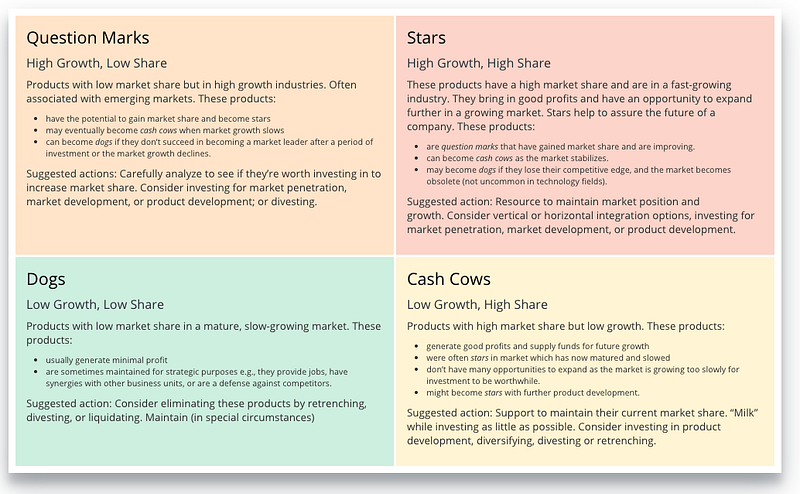
The BCG matrix classifies four different types of businesses:
- Dogs
- Cash cows
- Question marks, and
- Stars
Let’s walk through each one:
№1 — Dogs
These are business units with a small market share and not expected to grow.
Given that ‘Dogs’ display little economic promise the matrix recommends that organizations should either “not invest” in them or “consider selling” them off as soon as possible (Griffen, 2005).
Dogs tend to have aged assets (Hambrick et al, 1982). This equates to high inventory, medium capital, low R&D spend, moderate marketing expenses due to low presence, low value-add, and a competitive advantage that trails that of ‘Cash Cows’ (below) competitors on all fronts.

№2 — Cash Cows
These units have a large market share but are unlikely to grow substantially. Businesses that generate high profits that Griffen proposed should be invested in ‘Question Marks’ and ‘Stars’.
In effect ‘Cash Cows’ are milked. Pure and simple. For their cash to support business units in markets with greater growth potential.
‘Cash Cows’ tend to have high capacity utilization but aged assets. Low capital, low sales per head, R&D, and marketing (Hambrick et al, 1982).

№3 — Question Marks
These have a small share of a fast-growing market. While highly attractive, their future performance is uncertain. Hence the question mark. That said if they can capture a bigger chunk of a growing market they have the potential to be very profitable in the future.

№4 — Stars
Stars are the golden child of the group. Businesses with a sizeable share of a fast-growing market.
As a business unit, Stars invest heavily to increase market share.
The BCG Matrix proposes that funds accrued by ‘Cash Cows’ should be invested in ‘Stars’ to protect and expand their position (Griffen, 2005).
With new assets, ‘Stars’ come with high costs — sales, marketing, R&D, capacity utilization, value add — in exchange for superiority over their “competitors” (Hambrick et al, 1982).

Final Thoughts
The BCG matrix is a useful tool. It’s flexible, agile and offers descriptive insights, guiding strategists to think longer-term across business units.
Although it's not without its weaknesses.
- Tends to focus heavily on balancing cash flow
- Not always clear which market is relevant and why
- Not clear on how to estimate market share for each cell
- It assumes a disconnect between ROI and market share
- It overlooks USPs of an organization versus direct competitors
- It offers little for Startups
- While it offers a broad strategy recommendation it lacks a how-to roadmap for effective implementation
- Also, it offers little guidance as to which Question Marks should be disposed of and those that should be developed
The BCG Matrix is beneficial in identifying an investment-worthy business unit — where to allocate resources and what performance characteristics should be expected from each.
For example, ‘Dogs’, the low share/low growth players are seen as cash vampires and should be liquidated or disposed of.
Whereas high share/low growth ‘Cash Cows’ should be used as cash generators, and the profits from which invested in higher growth potential units, like ‘Question Marks’ or ‘Stars’.
Every ‘Dog’ has its day
Unfortunately, no real data exists to validate the effectiveness of the BCG matrix, so use it in parallel with the model described in the article below.


