avatarPaul Myers MBA

Free AI web copilot to create summaries, insights and extended knowledge, download it at here

4690

Abstract

0/1*jFax3XhfV9mam-k4kI_NSQ.png"><figcaption>A paragraph is summarized into one sentence</figcaption></figure><p id="2e04">Another use of text summarization is to present a user with a auto summarized dialog, with a <i>read more </i>option, which can then expand into the longer un-summarized version.</p><figure id="82f1"><img src="https://cdn-images-1.readmedium.com/v2/resize:fit:800/1*mlG74R9ZBY7NQcvQ2C8dMw.png"><figcaption></figcaption></figure><h2 id="58c0">Keywords</h2><p id="4f31">Keywords can be extracted from a block of text. You can configure the environment to be conservative and select only keywords from the text. Or a higher <i>temperature </i>can be set to where related words or keywords are generated.</p><figure id="286e"><img src="https://cdn-images-1.readmedium.com/v2/resize:fit:800/1*FGE3OBMcMyDDcpgKRQb9AQ.png"><figcaption>Key words generated from a Wikipedia paragraph.</figcaption></figure><p id="3a5c">This is very helpful to categorize text and create a search index. In the image above a extract on soccer was taken from Wikipedia. GPT-3 converted this quite large paragraph into six key words or themes.</p><figure id="93e7"><img src="https://cdn-images-1.readmedium.com/v2/resize:fit:800/1*mlG74R9ZBY7NQcvQ2C8dMw.png"><figcaption></figcaption></figure><h2 id="e562">Parse Unstructured Data</h2><p id="3191">Create tables from long form text by specifying a structure and supplying some examples.</p><figure id="6942"><img src="https://cdn-images-1.readmedium.com/v2/resize:fit:800/1*X9YWrg_wlpg3hbKCmoq62A.png"><figcaption></figcaption></figure><p id="6984">Here you can see the first entry is directly related to the sentence. The subsequent entries are somehow related and still relevant and applicable.</p><figure id="90e7"><img src="https://cdn-images-1.readmedium.com/v2/resize:fit:800/1*mlG74R9ZBY7NQcvQ2C8dMw.png"><figcaption></figcaption></figure><h2 id="7585">Classification</h2><p id="72fe">Classify items into categories via example inputs. Companies are named with categories defined. A new company can be mentioned and auto classified.</p><figure id="2265"><img src="https://cdn-images-1.readmedium.com/v2/resize:fit:800/1*IOkqXlAV2ZCxFpMNaeL2XA.png"><figcaption>With limited training data a new company can be mentioned and auto classified.</figcaption></figure><figure id="9feb"><img src="https://cdn-images-1.readmedium.com/v2/resize:fit:800/1*mlG74R9ZBY7NQcvQ2C8dMw.png"><figcaption></figcaption></figure><h2 id="281c">Extract Contact Information</h2><p id="0f31">Extract contact information from a block of text. In this case, an address.</p><figure id="8a87"><img src="https://cdn-images-1.readmedium.com/v2/resize:fit:800/1*5imfXfm2gvrGbA1uRTOkiQ.png"><figcaption>A complete address from the free text message.</figcaption></figure><figure id="ea15"><img src="https://cdn-images-1.readmedium.com/v2/resize:fit:800/1*mlG74R9ZBY7NQcvQ2C8dMw.png"><figcaption></figcaption></figure><h2 id="95b2">Summarize For A Second Grader</h2><p id="9a5d">This functionality takes a complex and relatively long piece, summarize and simplifies it into a sentence or two.</p><figure id="0da8"><img src="https://cdn-images-1.readmedium.com/v2/resize:fit:800/1*ReUEmdf0XZ3r54rcYqibfA.png"><figcaption>A large and complex piece of text is summarized and simplified.</figcaption></figure><figure id="d85e"><img src="https://cdn-images-1.readmedium.com/v2/resize:fit:800/1*mlG74R9ZBY7NQcvQ2C8dMw.png"><figcaption></figcaption></figure><h1 id="e7ec">Conclusion</h1><p id="3c79">There are definitely good implementation opportunities for the Conversational AI aspect of GPT-3.</p><figure id="6f46"><img src="https://cdn-images-1.readmedium.com/v2/resize:fit:800/1*5m48Qw7hRcbi7gsL5ZoRAQ.png"><figcaption>Restaurant review is created from a few key words and the restaurant name.</figcaption></figure><p id="2f01">As a support API where text can be processed to assist existing NLU functionality, there is a very real use case.</p><p id="25d7">As mentioned, GPT-3 can be a great help in pre-processing user input as a help for the NLU engine. The challenge is that GPT-3 seems very well positioned to write reviews, compile questions and have a general conversation. This could lead to a proliferation of bots writing reviews, online adds and general copywriting tasks.</p><figure id="b3c1"><img src="https://cdn-images-1.readmedium.com/v2/resize:fit:800/1*26A6H7nHUvLW10CkKSlaCQ.png"><figcaption>An apple pie review based on four generic words.</figcaption></figure><p id="4fae">This automation does not need to be malicious in principle. Open AI is seemingly making every effort to ensure the responsible use of the API’s.</p><p id="99a2">The fact the extensive

Options

training is not required, and a few key words or phrases can <i>point </i>the API in the right direction, is astounding.</p><p id="a28c">There are however opensource alternatives for most of the functionality available.</p><figure id="04a8"><img src="https://cdn-images-1.readmedium.com/v2/resize:fit:800/1*mlG74R9ZBY7NQcvQ2C8dMw.png"><figcaption></figcaption></figure><h2 id="3cbc">Positives</h2><ul><li>GPT-3 has quite a bit of functionality which can serve to augment a current chatbot.</li><li>Dialog can be diversified with the NLG capability.</li><li>General chit-chat can easily be created.</li><li>Copywriting is made easy for slogans, headlines, reviews etc.</li><li>Text transformation</li><li>Text generation</li><li>Creating a general purpose bot to chat to.</li><li>With their underlying processing power and data, creating flexible Machine Learning stories should be a good fit.</li></ul><figure id="a4fc"><img src="https://cdn-images-1.readmedium.com/v2/resize:fit:800/1*mlG74R9ZBY7NQcvQ2C8dMw.png"><figcaption></figcaption></figure><h2 id="b03c">Not-so Positives</h2><ul><li>The API is cloud hosted</li><li>Cost</li><li>Social media bot content generation</li><li>Not a framework for sustainable chatbot scaling; <i>yet</i>.</li><li>Possible over and under steering with training data.</li></ul><figure id="bfc0"><img src="https://cdn-images-1.readmedium.com/v2/resize:fit:800/1*mlG74R9ZBY7NQcvQ2C8dMw.png"><figcaption></figcaption></figure><div id="9145" class="link-block"> <a href="https://cobusgreyling.me/thank-you-for-subscribing/"> <div> <div> <h2>Subscribe to my newsletter.</h2> <div><h3>NLP/NLU, Chatbots, Voice, Conversational UI/UX, CX Designer, Developer, Ubiquitous User Interfaces, Ambient…</h3></div> <div><p>cobusgreyling.me</p></div> </div> <div> <div style="background-image: url(https://miro.readmedium.com/v2/resize:fit:320/0*sxVx6IgC_6AZXIX-)"></div> </div> </div> </a> </div><div id="1141" class="link-block"> <a href="https://cobusgreyling.medium.com"> <div> <div> <h2>Cobus Greyling - Medium</h2> <div><h3>Read writing from Cobus Greyling on Medium. NLP/NLU, Chatbots, Voice, Conversational UI/UX, CX Designer, Developer…</h3></div> <div><p>cobusgreyling.medium.com</p></div> </div> <div> <div style="background-image: url(https://miro.readmedium.com/v2/resize:fit:320/0*e6KH9V073Egac4ua)"></div> </div> </div> </a> </div><div id="2e0e" class="link-block"> <a href="https://cobusgreyling.medium.com/gpt-3-conversational-ai-chatbots-3fb1cfb99942"> <div> <div> <h2>GPT-3: Conversational AI & Chatbots</h2> <div><h3>What Will The Impact Be On Chatbot Design & Development</h3></div> <div><p>cobusgreyling.medium.com</p></div> </div> <div> <div style="background-image: url(https://miro.readmedium.com/v2/resize:fit:320/1*VKDfysUcdNJtCEQwmxSE-w.jpeg)"></div> </div> </div> </a> </div><div id="59bc" class="link-block"> <a href="https://openai.com/"> <div> <div> <h2>OpenAI</h2> <div><h3>OpenAI is an AI research and deployment company. Our mission is to ensure that artificial general intelligence benefits…</h3></div> <div><p>openai.com</p></div> </div> <div> <div style="background-image: url(https://miro.readmedium.com/v2/resize:fit:320/0*SzqTQqBlnX8UOa8A)"></div> </div> </div> </a> </div><div id="47a1" class="link-block"> <a href="https://openai.com/blog/openai-api/"> <div> <div> <h2>OpenAI API</h2> <div><h3>We're releasing an API for accessing new AI models developed by OpenAI. Unlike most AI systems which are designed for…</h3></div> <div><p>openai.com</p></div> </div> <div> <div style="background-image: url(https://miro.readmedium.com/v2/resize:fit:320/0*iD7cRdNC9EDQkZQ2)"></div> </div> </div> </a> </div><figure id="f7c7"><img src="https://cdn-images-1.readmedium.com/v2/resize:fit:800/1*mlG74R9ZBY7NQcvQ2C8dMw.png"><figcaption></figcaption></figure></article></body>

STARTUPS

How to Develop a Business Model for Your Startup

A step-by-step guide for creating a business model canvas

Image by Alexas_Fotos from Pixabay

Recently I wrote a piece about a 40-year old business model developed by a revered business expert, Michael Porter. You can read this article below.

Porter’s five forces model is a tool that I use today along with another contemporary model — the Business Model Canvas (BMC).

This article is about the BMC, a practical walkthrough with examples.

The Business Model Canvas

The BMC was created by Alexander Osterwalder and Yves Pigneur. Designed to be an innovative tool for leadership, strategy management, and entrepreneurs. The tool visualizes all the building blocks of a new business venture.

A business model describes how an organization creates, captures, and delivers value.

Dr. Alexander (Alex) Osterwalder is a leading innovation expert. An Author, leader, speaker, and entrepreneur. His work has influenced the way Startups and established companies “do business and how new ventures get started.” (Strategyzer, 2020).

Dr. Yves Pigneur, a professor at the University of Lausanne, earned his Ph.D. at the University of Namur in Belgium. He invented the Business Model Canvas with Osterwalder and authored an international bestseller in 2010 “Business Model Generation”, selling over 10 million copies.

In 2012, Ted Greenwald said in Forbes that “your business model can make the difference between world-leading success and dismal failure”, in his article about the Business Model Canvas (Greenwald, 2012).

The Building Blocks

There are nine building blocks that make up the BMC, as illustrated below. Blocks that Pigneur and Osterwalder identified as critical dimensions for every business venture today.
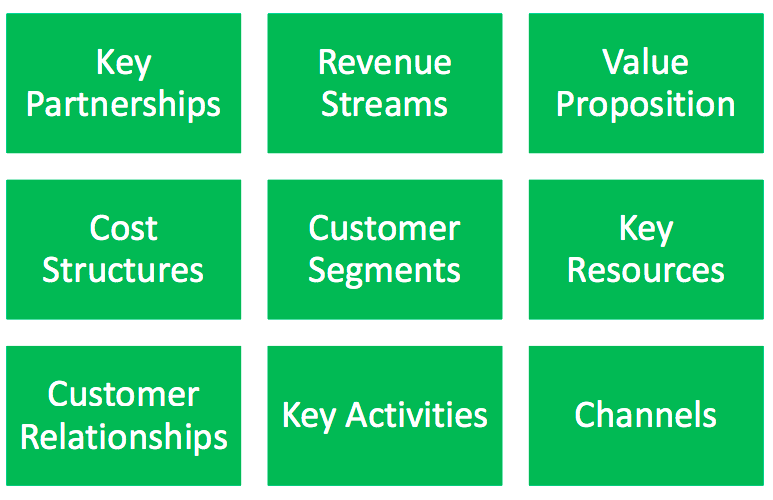
Image Source

Using the BMC is a wonderful way to brainstorm multiple elements of your new or existing venture.

How to Play

Let me describe how I use this tool. First, make sure you have the following items to hand:

  • A printout out of the BMC, ideally an A1 copy
  • A stack of post-it notes, different colors work best
  • A selection of pens or markers, again different colors work best

I’d highly recommend doing this physically, but you can also use a digital template. Personally I start with a blank BMC template, post-its, and pens before transcribing to a digital template to share virtually, see copy below.
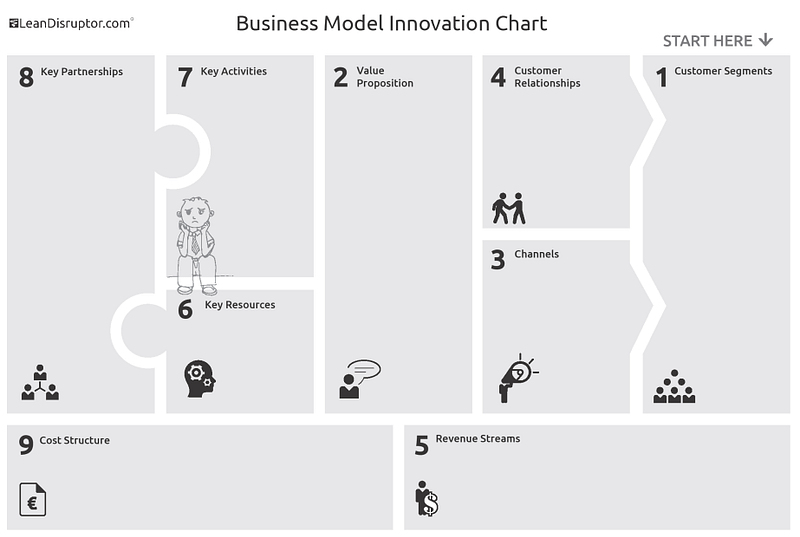
Image source

Once everything is in place, I follow these steps:

  1. I place 9 different color post-its in front of me
  2. Then I write a different building block heading on each of the 9 post-its, corresponding to the headings of the BMC, from 1 to 9
  3. I brainstorm each building block and play around with them until I have an initial list for each
  4. I then take each post-it and expand on each point listed, transcribing one by one onto its own post-it, with more detail, before attaching it to the relevant block on the BMC template as shown below
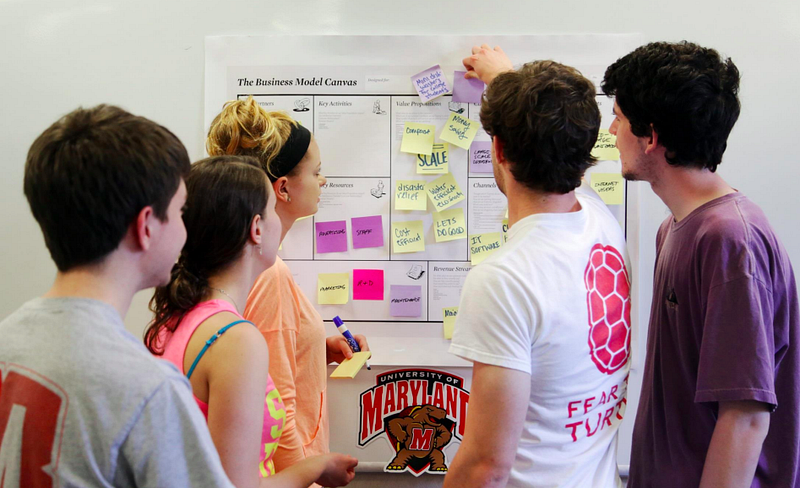
Image by Fergal Brophy

Creating your own BMC works best in a team environment unless you’re a solo-preneur. As you work on each block it's important to ask lots of questions. Here are some examples:

№1 — Customers Segment

  1. Which consumer segments are you planning to create value for?
  2. Who are your most important customers, your ideal persona?

№2 — Value Proposition

  1. What is your core value(s)?
  2. What do you deliver to the consumer?
  3. What customer needs are you meeting or exceeding?

№3 — Distribution Channel

  1. What channels do you need to reach your customers?
  2. What channels does your customer prefer or reside in?
  3. What channels work best?
  4. What do they cost? and,
  5. How can they be integrated into your customers’ routines?

№4 — Customer Relationships

  1. What relationship does your target customer/audience expect from you?
  2. How can you integrate this into your business cost and format?

№5 — Revenue Stream

  1. What value are your customers willing to pay for?
  2. Where, what and how can they pay?
  3. How do your customers prefer to pay?
  4. How much does each revenue stream contribute to your overall revenues?

№6 — Key Resources

  1. What resources do you need to deliver your value proposition?
  2. What resources are the most important in customer relationships, distribution channels, revenue streams, and so on?

№7 — Key Activities

  1. What are your key activities to deliver your value proposition?
  2. What activities are the most important in customer relationships, distribution channels, revenue streams, and so on?

№8 — Key Partners

  1. Who are your partners or key suppliers?
  2. What’s the motivation for this relationship/partnership?

№9 — Cost Structure

  1. What are the most costs of your business?
  2. What activities and key resources are the most expensive?

As you walk through each block new ideas and connections unfold. It’s a dynamic process that can evolve over time, best described by Osterwalder in his video tutorial below.

BMC Examples

To better understand the Business Model Canvas I’ve put together a selection of three examples:

  1. A well known social media brand
  2. A Successful Startup
  3. A new business venture

1. Social Media Brand

The LinkedIn platform is used by millions of professionals across the globe. Thanks to Strategyzer, below is an example of what their BMC might look like for LinkedIn.
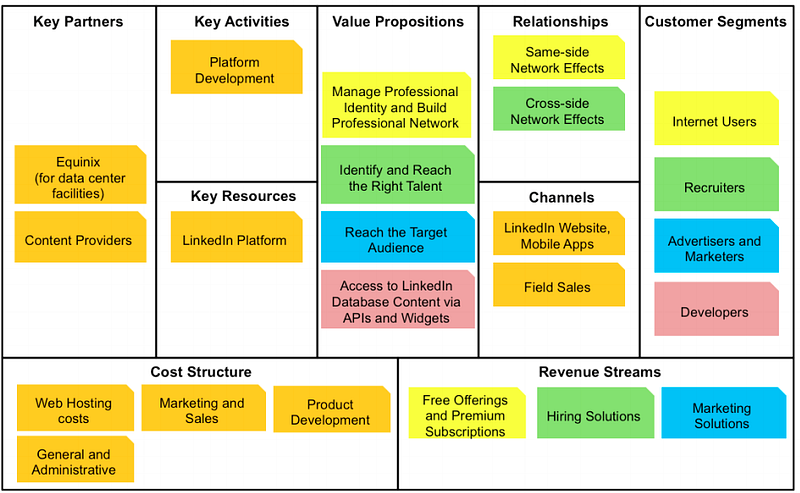
Image source

Although this example was shared by Strategyzer, existing companies have adopted the BMC as a tool to explore new ventures.

2. Successful Startup

The example below is one that I created for a growing business in the eCommerce space. The approach taken for this canvas was from a Sales and Marketing perspective, demonstrating the BMC’s flexibility.
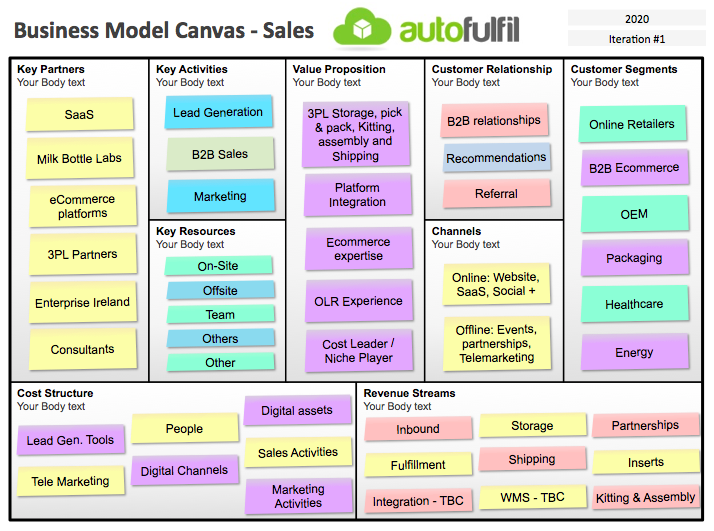
Image by Author

The BMC can be used across different business verticals or departments. In effect, it becomes a single source of truth that everyone understands.

3. New Venture

This was shared with me by a friend, Phil Winston. While working on a college project, Phil mapped out his idea for a digital press MVP with his team.
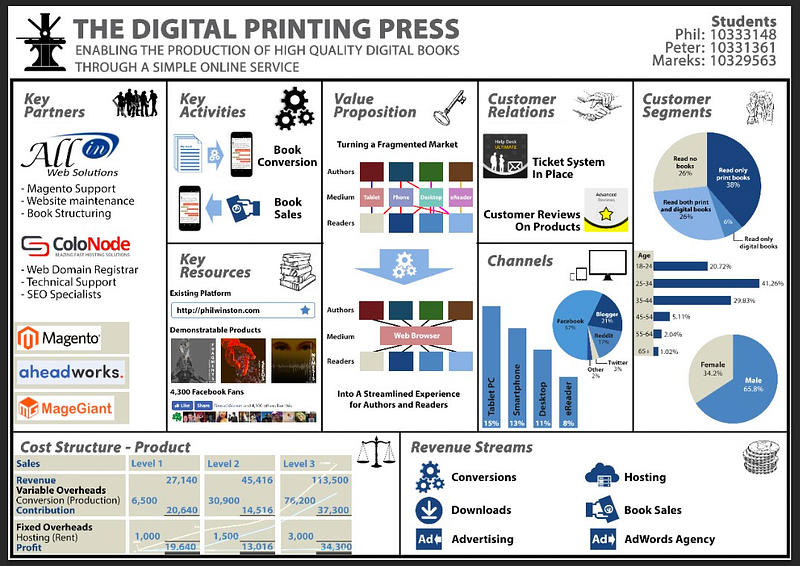
Image Source

As you can see Phil took a different approach, adding lots of images and colors to his BMC as apposed to post-its. Which is fine, but I’d recommend starting out with post-its before pimping up your digital version.

Final Thoughts

Since its inception, the BMC has since spawned variations, extensions with an array of tools that Osterwalder and Pigneur put together. All of which are available on Strategyzer.

“Your customers are the judge, jury, and executioner of your value proposition. They will be merciless if you don’t find fit!” — Alexander Osterwalder

Writers can also use the BMC. Whether you’re a founder like Dr Mehmet or Niklas, or a prolific writer like Julia, Nicole, George, Sean, Jun Wu, Brian, or Sinem, its adaptability is endless.

On that note, allow me to recap on the benefits of the Business Model Canvas. So here are five reasons to use the BMC for your venture:

  1. Clear visual — The BMC captures your business model, plan, and strategy all in one place, in a single visual.
  2. Simplifies your Startup — Steve Jobs said: “simplicity is the ultimate sophistication.” The BMC reflects that ethos, breaking down every element into simple bite-size chunks.
  3. Captures crucial business dimensions— The BMC forces founders, leaders, and entrepreneurs to cover each block, in the context of all the others, in great detail.
  4. Reduces the risk of failure — Benjamin Franklin said: “If you fail to plan, you plan to fail”. Therefore, having a plan is the starting point for any Startup or business venture. If nothing else it weeds out what works and what doesn't, saving money and time down the line.
  5. Dynamic and flexible — Bruce Lee said: “Be like water”, nothing is fixed, the business world is no different. It’s fluent, ebbs and flows just like a river. The BMC means that you can quickly adapt to economic changes, adding or removing elements so you can pivot with ease.

The Business Model Canvas covers key elements of any business model and does so on a single page. With nine functional building blocks, the canvas clearly highlights the interrelationships between each element.

Anyone can use this incredible tool, regardless of whether you’re a Fortune 500 company with thousands of employees, or simply testing the feasibility of a Startup with one or two employees.

That said, it’s just a tool. Nothing will replace people, you, the creative minds that bring ideas to life. Ideas followed by hard work.

References

  • AG, S., 2020. Strategyzer | Corporate Innovation Strategy, Tools & Training. [online] Strategyzer.com. Available at: [Accessed 25 April 2020].
  • Greenwald, T., 2012. Business Model Canvas: A Simple Tool For Designing Innovative Business Models. [online] Forbes. Available at: [Accessed 25 April 2020].
  • Winston, P., 2020. Read Books Online For Free. [online] Readomain.com. Available at: [Accessed 25 April 2020].
Image by Gerd Altmann from Pixabay
Startup
Business
Entrepreneurship
Business Models
Personal Development
Recommended from ReadMedium