Story Templating: 8 Questions to Think Before Using a Template
Story templating is a technique to write first drafts 2x faster
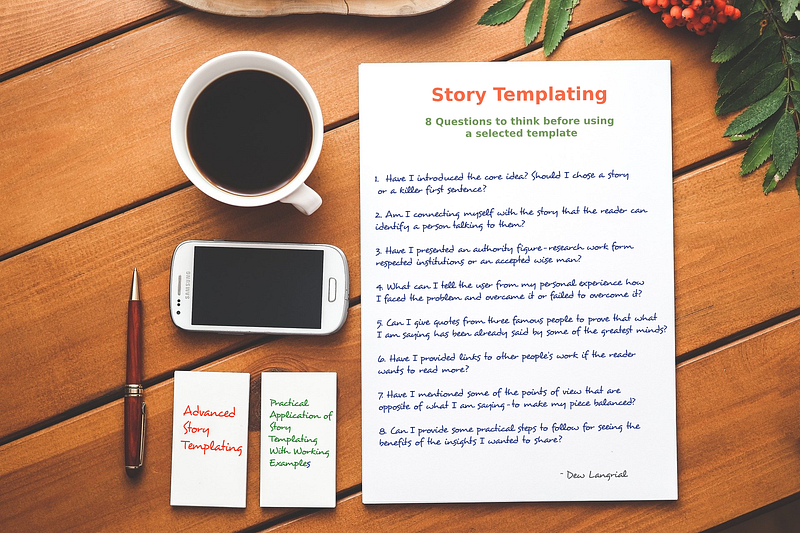
I have written two articles about story-templating. One explains the theory and the other explains the implementation of the techniques with a working example — that got further distributed.
Storytemplating is used by professional writers and authors to write high-quality first drafts in a short time. Sebastian Purcell, Ph.D. — he is an accomplished writer, and a happiness researcher — responded to the story-templating article:
“This is so clear and detailed that I can use it to teach my students how to write.
What is here called the template format is what I’ve always called modeling…but I never developed the steps so clearly. That’s the part I’m going to use (literally send the article to my students to read it).
Also, though my work been curated by Medium quite a bit, I never understood the process or the why part.
Thank you for explaining an opaque process.”
I have provided links to these two articles at the end of this story.
If you are a new writer, you must understand the importance of these techniques. You can imagine the stories written by successful writers are your templates. Follow the basic principles and writing will become a little less hard.
Once you start getting the hang of these methods, it’ll become your natural style. These are the questions you must ask — before you finish implementing your template (read them and let them sink into your subconscious mind):
1. How to introduce the core idea? Should I choose a story or a killer first sentence?
Mostly I use a story to introduce my core idea. In an article about becoming a better writer, I chose this story:
“Ray Bradbury, the author of Zen in the Art of Writing, was enraged at Harper’s Bazaar — a women’s fashion magazine — photographers for their perverted sense of equality. “The photographs so enraged me I ran, did not walk, to my machine, and wrote ‘Sun and Shadow,’ the story of an old Puerto Rican who ruins the Bazaar photographer’s afternoon by sneaking into each picture and dropping his pants.” ”
But sometimes I like killer first sentences. In a story about writing 10 times engaging stuff, I chose these words:
“When we don’t have sex for a long time, anything remotely sexy feels exciting. When we are hungry, every food looks tasty.”
2. How to connect the story with myself so that the reader can identify a person talking to them?
In a story about facing our biggest fears, I used these words to connect with my reader:
“My biggest fear is a life scenario, “If I say something and the other person misinterprets me, implying that I have a secret motive for what I said.” I feel vulnerable if anybody even remotely implies that.”
In another story about how self-criticism can stop your progress in life, I share a story to connect with my reader:
“When I was in school, if I did not know the answer to a question, I buried my head in the desk as if I wanted to disappear. My heart rate would increase, and I would decide that I would never want to feel like that again. That was what made me study and do my homework with full focus. It taught me how to pay attention to something important — for the people around me.
I think we learn self-criticism as we grow up, and when the teacher is not there to ask a question, we start questioning ourselves. We become frightened as if we are not challenging ourselves enough.”
3. Will I be able to support my ideas with research work from credible sources?
Since I want to write about the most important issues facing most of us, I can find other articles about the problem. Google often shows many scientific researches related to my topic.
In one of my stories about why we act irrationally when we are thinking about our favorite politicians, I found research showing how cognitive dissonance makes us act like morons:
“For example, think about the 2004 elections. In a study of people who were being observed by magnetic resonance imaging (MRI) while they were trying to process information about George Bush or John Kerry, Drew Westen and his team found that the reasoning areas of the brain virtually shut down when participants were confronted with information that conflicted with their political opinions. However, the emotional circuits of the brain lit up happily when the information presented was in favor of their chosen candidate.”
4. Can my personal experiences help me explain the idea in a better manner?
When I could not find a perfect style of writing, I started exploring the writing styles of other writers.
But I found a perfect writing style does not exist, and I shared my results:
“I read a critical essay that exposed the flaws of Harry Potter and talked of 13 big plot holes. “As obsessive fans will tell you, I do slip up!” Rowling admitted on her fan-site. “Several classrooms move floors mysteriously between books, and these are the least serious continuity errors! Most of the fan sites will point you in the direction of my mistakes.”
But the beauty of style is hidden in your originality. Despite the imperfect characters, plot holes, and errors, writing Harry Potter is an accomplishment no other writer has paralleled.
If your style is readable and you can use it to convey your ideas to your reader, it is your writing style — no matter what anybody else says.”
5. Can I quote three great minds to support my argument?
If you are writing about wisdom that we take for granted and ignore, you’ll be able to find many quotes. We need the words of great people to convey our idea forcefully.
In one of my stories, explaining how big things have to start small, I chose three great quotes to emphasize my points:
“Many smart people have said things that mirror this mantra — as it helped them in reaching their daily targets. For example, Helen Keller said, “I long to accomplish a great and noble task, but it is my chief duty to accomplish small tasks as if they were great and noble.” Robert Louis Stevenson had a similar message, “Don’t judge each day by the harvest you reap, but by the seeds you plant.” Oprah Winfrey expressed her mind using these words, “The key to realizing a dream is to focus not on success but on significance — and then even the small steps and little victories along your path will take on greater meanings.” ”
6. Can I provide links for further reading?
If a reader is stuck in a thought pattern, they would like to read until they understand every aspect of the problem.
If you can provide links for further reading, your readers will bookmark your story for reference.
In one of my most successful stories — it’s about thinking without words — I have provided links to all major researches the readers can read later.
7. Did I mention the opposite point of view — to make my piece balanced?
In a story about police reforms — A violent police is no police — I mentioned the points of view of the police officers as well:
“When confronting criminals, the officer has to decide and act in a split-second. In such a situation, the officer can make a wrong judgment call.
Approximately 400 police officers have been injured so far during the protests, and two have died. The remaining officers must be feeling angry or anxious at this time. Seven Minneapolis police officers have quit their job.”
8. Can I suggest practical steps to implement the insights?
Never ignore the practical steps.
Your online writing career depends on inventing practical steps others can follow to become better.
When you are researching your material, write a practical step for every insight you want to mention. The practical steps have to be relevant and directed — not flimsy or lame.
If you make it a priority to include practical steps at the end of your article, your mind will always come up with actionable points.
In one of my stories about taking small steps to succeed in life, I came up with these steps:
- “Develop a bias toward action. Keep pushing yourself to do something related to your goals.
- Set a minimum daily target of significant activities that you must accomplish.
- Mark those days with red color on a calendar when you could not reach your daily target.
- Read and learn new things related to your daily tasks.
- Try to break your own records by improving your performance with enhanced focus and commitment.
- Celebrate every small successful step.
- Avoid doing things that will work against your goals and dreams. ”
Final Thoughts
I started this article with a story — how I wrote about story templating and what my readers thought about it. Then I inspired you to read the work of successful writers. We can emotionally connect with the writers we like.
When I am unable to write, I read my favorite writers. Their writing makes me energetic. Generally, even before I finish reading their story, I have plenty of ideas bouncing in my head.
Once you have a draft, you’d want to edit it — without mercy.
I don’t like to edit my stories. I want them to magically correct themselves — like the programmable matter video I was watching yesterday. I have tried tens of software programs but none of them can do what I want.
When I am editing, my mind wanders off to another story. I start chasing the second story and when I finish it, I realize: now I have two stories to edit.
But when I am editing — by paying attention to details — that is when I craft most of my smart sentences.
Writing first drafts may be faster — using story templating — but the quality of your story depends on your editing success.
Story Templating Can Help You Write First Drafts 2x More Efficiently
Practical Application of Story Templating With Working Examples
If you are interested in further distribution of your stories, please read this highly recommended guide:
Curation Guidelines — In Simple Words
Curation Guidelines — In Simple Words
A step-by-step guide to ensure further distribution
medium.com
Hoping to see you in my Top 10 series:


