avatarDew Langrial

Free AI web copilot to create summaries, insights and extended knowledge, download it at here

3268

Abstract

n engaged. The writer tries to <b>connect with the reader</b> on an emotional level. A <b>relevant saying </b>nudges the reader to a <b>solution</b>. Then the writer offers the <b>takeaway</b>.</p><p id="ea45">You must <i>read the template story twice</i> to get a mental picture of the flow of the piece. You can take notes as well.</p><p id="ca92">Now, it is time to <b>write a new piece </b>based on the idea of <i>story templating</i>.</p><h1 id="2e8e">New story based on the above template</h1><p id="3d18">Choose a topic that is not related to the template story.</p><ul><li><b>Match the heading:</b> The new headline is: <a href="https://readmedium.com/ask-yourself-what-is-your-biggest-fear-206d9078af86"><b><i>Ask Yourself, “What is Your Biggest Fear.”</i></b></a><b> </b>Note that the story you selected is about “Writing,” but this piece is about “Self.”</li><li><b>Match the subtitle: </b>The new subtitle was:<b> <i>Facing your fears can lead you to your success. </i></b>But during final editing, I changed it to:<b> <i>“You’re flying, there’s zero fear.”</i></b></li><li><b>How to write the main content of the story: </b>I started the new article with Will Smith telling a story in an interview.</li><li><b>See how logic flows: </b>After Will Smith’s account of events, I describe the main <b>problem</b>. Then, I <b>agitate </b>the reader’s mind with ‘Why were you scared in the bed the night before?’</li></ul><figure id="0f37"><img src="https://cdn-images-1.readmedium.com/v2/resize:fit:800/1*KxCdZ8pHdLPi1DoOKVyYjA.png"><figcaption><a href="https://readmedium.com/ask-yourself-what-is-your-biggest-fear-206d9078af86">screenshot by author</a></figcaption></figure><p id="816a">In this new story, I am trying to connect with the reader — <i>again and again </i>— on an emotional level. The rest of the flow is very similar to the template. Once the first draft is ready, you are free to follow your intuition to make any changes.</p><p id="ed54">The template does not restrict you in any way. It only helps you present your insights in an easy to read manner.</p><p id="ae6f"><b><i>(The proof — that these methods work — is that <a href="https://readmedium.com/ask-yourself-what-is-your-biggest-fear-206d9078af86">this new story was published and the curators distributed it in ‘Self.’</a>)</i></b></p><h1 id="1453">How to write a good story using this technique</h1><p id="1fae">You can see that I did not copy the ideas, or the sentences, of the template story. I tried to match the<b><i> flow of logic</i></b> abstractly<i>.</i> I used my intuition and creativity to write a new article.</p><blockquote id="afdf"><p>“Immature poets imitate; mature poets steal; bad poets deface what they take, and good poets make it into something better, or at least something different. The good poet welds his theft into a whole of feeling which is unique, utterly different than that from which it is torn.” ~ T. S. Eliot</p></blockquote><p id="400b">You can feel the potential of a sentence to express meaning — every good writer can do that. In the new story, you craft new powerful sentences that match the sentences in the template story. You may not be able to emulate good writers. In such a case, you can use quotes from well-known authors.</p><p id="0

Options

43e">If you do the following, you can write a good story using templating to write a first draft based on a firm foundation:</p><ol><li>Relate the anecdote to the problem in a creative way.</li><li>Successfully connect with the reader on an emotional level.</li><li>Ask questions that agitate the reader and then satisfactorily answer those questions.</li><li>Provide a solution and actionable takeaways.</li></ol><h1 id="a531">How to write a bad story using this technique</h1><p id="230c">If you follow this technique but do not take care of the following, you may end up writing a bad story:</p><ol><li>You select less fun anecdotes.</li><li>You do not correctly present the problem.</li><li>Your quotes are not well-knit into the flow of your piece.</li><li>Your questions do not agitate the reader.</li><li>You fail to connect with your reader because you fail to select the appropriate words for the job.</li><li>You do not provide a solution to the problem.</li><li>You lack editing skills, and the story is a disconnected collection of questions, quotes, and anecdotes.</li></ol><p id="b094">Following story templating techniques does not guarantee success if you do not follow the flow of the <i>template story.</i></p><div id="62f1" class="link-block"> <a href="https://readmedium.com/steps-in-submission-process-in-simple-words-ef7800e4b5ce"> <div> <div> <h2>Steps in Submission Process and FAQs — In Simple Words</h2> <div><h3>You can read the answers to frequently asked questions (FAQs) as well</h3></div> <div><p>medium.com</p></div> </div> <div> <div style="background-image: url(https://miro.readmedium.com/v2/resize:fit:320/1*L891KHE9-8QpgHjizx9r1g.jpeg)"></div> </div> </div> </a> </div><h1 id="9a66">Takeaway</h1><p id="6877">These techniques go beyond a simple outline. You will have to practice with different template stories — written by various writers — to master the above methods.</p><p id="c215">Story templating helps you by allowing you to write in a structured way. Once you have the first draft, you can fashion the flow of the story according to your liking.</p><p id="f39b">Story templating can help all, but good writers are more likely to benefit from these methods. The world of social publishing platforms is different from magazines and research journals, and the curated templates can guide you to success in a particular content market.</p><div id="4f72" class="link-block"> <a href="https://readmedium.com/my-curated-stories-on-medium-that-encourage-me-to-keep-on-writing-8520435e81f"> <div> <div> <h2>My Long List of Curated Stories on Medium That Encourages Me to Keep Writing— Updated</h2> <div><h3>These stories were curated and distributed into different topics</h3></div> <div><p>medium.com</p></div> </div> <div> <div style="background-image: url(https://miro.readmedium.com/v2/resize:fit:320/1*em-WnC8Go2HslZgGmuGhRg.jpeg)"></div> </div> </div> </a> </div></article></body>

Practical Application of Story Templating With Working Examples

Learning and testing these techniques is necessary for improving your writing skills
Image by Gerd Altmann

Is it possible to develop reliable curation techniques? How effective would these methods be?

Introducing story templating

Story templating means that you have the freedom to pick any story or article and make it your template. If you would want to emulate your favorite writer’s style, this is your starting point.

Generally, most of the fiction writers employ story templating techniques for their writing. The writers start with a problem that gets worse with time. The main characters, owing to their relentless efforts, solve the problem or die trying.

If you are a nonfiction writer, you can use these techniques as well. You can start with a story — or question — that presents an issue. You can explain how this problem may be related to the reader’s life. To investigate the dilemma, you can provide anecdotes, research, quotes, and insights about how the reader can resolve the issue.

When you implement story templating methods, try not to use the exact words of your favorite writer or her original ideas in your writing. But you must pay attention to the flow of the story.

Choose a template story

You can use a story for this exercise that you particularly loved reading. We instinctively want to write like our favorite writers.

I chose this story: Ask Yourself ‘What Makes You A Good Writer?’

Notice how the story flows. It starts with an anecdote and then describes an issue. Then, the writer tries to agitate the reader’s mind:
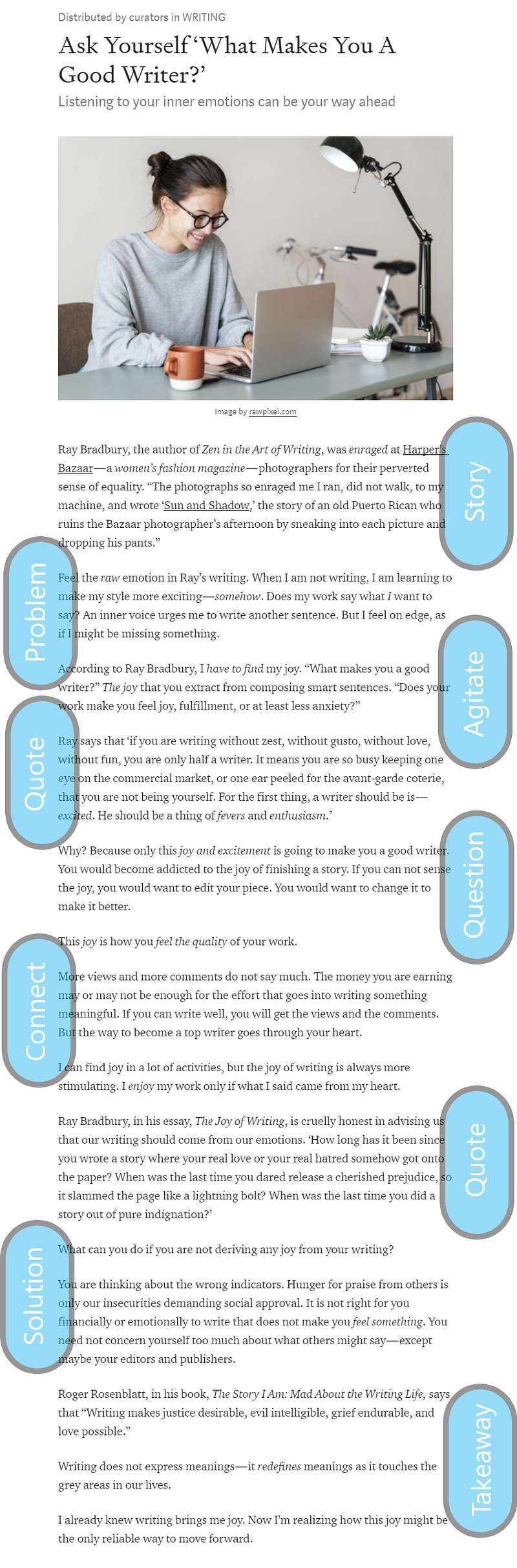
screenshot by author

Then some quotes and a question helps the reader to remain engaged. The writer tries to connect with the reader on an emotional level. A relevant saying nudges the reader to a solution. Then the writer offers the takeaway.

You must read the template story twice to get a mental picture of the flow of the piece. You can take notes as well.

Now, it is time to write a new piece based on the idea of story templating.

New story based on the above template

Choose a topic that is not related to the template story.

  • Match the heading: The new headline is: Ask Yourself, “What is Your Biggest Fear.” Note that the story you selected is about “Writing,” but this piece is about “Self.”
  • Match the subtitle: The new subtitle was: Facing your fears can lead you to your success. But during final editing, I changed it to: “You’re flying, there’s zero fear.”
  • How to write the main content of the story: I started the new article with Will Smith telling a story in an interview.
  • See how logic flows: After Will Smith’s account of events, I describe the main problem. Then, I agitate the reader’s mind with ‘Why were you scared in the bed the night before?’
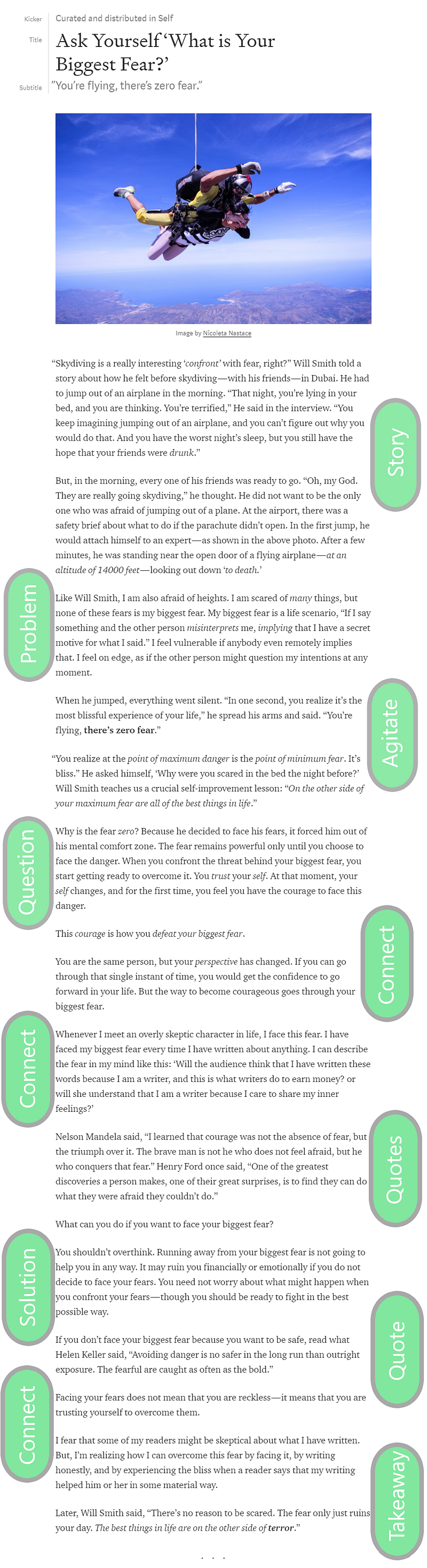
screenshot by author

In this new story, I am trying to connect with the reader — again and again — on an emotional level. The rest of the flow is very similar to the template. Once the first draft is ready, you are free to follow your intuition to make any changes.

The template does not restrict you in any way. It only helps you present your insights in an easy to read manner.

(The proof — that these methods work — is that this new story was published and the curators distributed it in ‘Self.’)

How to write a good story using this technique

You can see that I did not copy the ideas, or the sentences, of the template story. I tried to match the flow of logic abstractly. I used my intuition and creativity to write a new article.

“Immature poets imitate; mature poets steal; bad poets deface what they take, and good poets make it into something better, or at least something different. The good poet welds his theft into a whole of feeling which is unique, utterly different than that from which it is torn.” ~ T. S. Eliot

You can feel the potential of a sentence to express meaning — every good writer can do that. In the new story, you craft new powerful sentences that match the sentences in the template story. You may not be able to emulate good writers. In such a case, you can use quotes from well-known authors.

If you do the following, you can write a good story using templating to write a first draft based on a firm foundation:

  1. Relate the anecdote to the problem in a creative way.
  2. Successfully connect with the reader on an emotional level.
  3. Ask questions that agitate the reader and then satisfactorily answer those questions.
  4. Provide a solution and actionable takeaways.

How to write a bad story using this technique

If you follow this technique but do not take care of the following, you may end up writing a bad story:

  1. You select less fun anecdotes.
  2. You do not correctly present the problem.
  3. Your quotes are not well-knit into the flow of your piece.
  4. Your questions do not agitate the reader.
  5. You fail to connect with your reader because you fail to select the appropriate words for the job.
  6. You do not provide a solution to the problem.
  7. You lack editing skills, and the story is a disconnected collection of questions, quotes, and anecdotes.

Following story templating techniques does not guarantee success if you do not follow the flow of the template story.

Takeaway

These techniques go beyond a simple outline. You will have to practice with different template stories — written by various writers — to master the above methods.

Story templating helps you by allowing you to write in a structured way. Once you have the first draft, you can fashion the flow of the story according to your liking.

Story templating can help all, but good writers are more likely to benefit from these methods. The world of social publishing platforms is different from magazines and research journals, and the curated templates can guide you to success in a particular content market.

Writing
Reading
Writing Tips
Curation
Creativity
Recommended from ReadMedium