
Curated and distributed in Self
Ask Yourself ‘What is Your Biggest Fear?’
“You’re flying, there’s zero fear.”
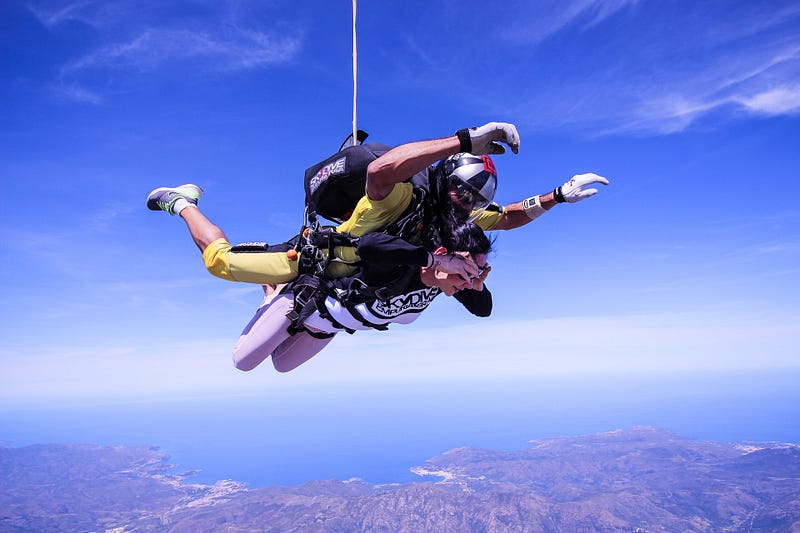
“Skydiving is a really interesting ‘confront’ with fear, right?” Will Smith told a story about how he felt before skydiving — with his friends — in Dubai.
He had to jump out of an airplane in the morning.
“That night, you’re lying in your bed, and you are thinking. You’re terrified,” He said in the interview. “You keep imagining jumping out of an airplane, and you can’t figure out why you would do that. And you have the worst night’s sleep, but you still have the hope that your friends were drunk.”
But, in the morning, every one of his friends was ready to go.
“Oh, my God. They are really going skydiving,” he thought. He did not want to be the only one who was afraid of jumping out of a plane.
At the airport, there was a safety brief about what to do if the parachute didn’t open. In the first jump, he would attach himself to an expert — as shown in the above photo. After a few minutes, he was standing near the open door of a flying airplane — at an altitude of 14000 feet — looking out down ‘to death.’
Like Will Smith, I am also afraid of heights. I am scared of many things, but none of these fears is my biggest fear. My biggest fear is a life scenario, “If I say something and the other person misinterprets me, implying that I have a secret motive for what I said.” I feel vulnerable if anybody even remotely implies that. I feel on edge, as if the other person might question my intentions at any moment.
When he jumped, everything went silent. “In one second, you realize it’s the most blissful experience of your life,” he spread his arms and said. “You’re flying, there’s zero fear.”
“You realize at the point of maximum danger is the point of minimum fear. It’s bliss.” He asked himself, ‘Why were you scared in the bed the night before?’
Will Smith teaches us a crucial self-improvement lesson: “On the other side of your maximum fear are all of the best things in life.”
Why is the fear zero? Because he decided to face his fears, it forced him out of his mental comfort zone.
The fear remains powerful only until you choose to face the danger. When you confront the threat behind your biggest fear, you start getting ready to overcome it.
You trust your self.
At that moment, your self changes, and for the first time, you feel you have the courage to face this danger.
This courage is how you defeat your biggest fear.
You are the same person, but your perspective has changed. If you can go through that single instant of time, you would get the confidence to go forward in your life.
But the way to become courageous always goes through your biggest fear.
Whenever I meet an overly skeptic character in life, I face this fear. I have faced my biggest fear every time I have written about anything.
I can describe the fear in my mind like this: ‘Will the audience think that I have written these words because I am a writer, and this is what writers do to earn money? or will she understand that I am a writer because I care to share my inner feelings?’
Nelson Mandela said, “I learned that courage was not the absence of fear, but the triumph over it. The brave man is not he who does not feel afraid, but he who conquers that fear.” Henry Ford once said, “One of the greatest discoveries a person makes, one of their great surprises, is to find they can do what they were afraid they couldn’t do.”
What can you do if you want to face your biggest fear?
You shouldn’t overthink.
Running away from your biggest fear is not going to help you in any way. It may ruin you financially or emotionally if you do not decide to face your fears.
You need not worry about what might happen when you confront your fears — though you should be ready to fight in the best possible way.
If you don’t face your biggest fear because you want to be safe, read what Helen Keller said, “Avoiding danger is no safer in the long run than outright exposure. The fearful are caught as often as the bold.”
Facing your fears does not mean that you are reckless — it means that you are trusting yourself to overcome them.
I fear that some of my readers might be skeptical about what I have written. But, I’m realizing how I can overcome this fear by facing it, by writing honestly, and by experiencing the bliss when a reader says that my writing helped him or her in some material way.
Later, Will Smith said, “There’s no reason to be scared. The fear only just ruins your day. The best things in life are on the other side of terror.”


