
Stop Punishing Kids For Being Kids
Especially when we adults aren’t exactly setting a fine example

Before we talk about kids, let’s talk about us
Have you ever gotten a speeding ticket? Especially one that was borderline, or you felt was unfair? Especially when you were a younger driver, between 16–25?
How did you feel about the police officer afterward?
Did you blame other drivers (“Well, they were going too slow, so I sped up to pass!”)?
Did you blame the cop (“Damn cop, I was only going 7 over!”)
How much introspection and self-reflection did you do afterward?
Did it help you learn not to speed, or did it make you angry? Did it make make you speed more selectively (i.e. sneakier), so as to better avoid a ticket in the future?
Okay, I’ll go first
Yes, I have received a speeding ticket, one which was well-deserved.
I was driving from Ontario to Manitoba for the first time in 2007. I was 24 years old and was going 130 KM/hr. in a 100 KM/hr. zone, typical speeds for driving on the highway in Toronto, where I was from.
I sort of blamed myself, but not really. I partially blamed the fact that there was no traffic on the highway, I had only just crossed over the border from Ontario into Manitoba, and driving in Ontario I would not likely have been stopped because I wasn’t driving aggressively.
I am not a patient person. Typically if I speed to pass someone, I blame the other driver for going too slow, rather than accepting responsibility for my own lack of patience. I do this even when I’m not in a rush or late for an appointment.
As I get older, I am becoming slightly more patient, but only slightly. I am becoming better at accepting responsibility for my own choices, but in the heat of the moment I am most certainly annoyed with slow drivers and mentally shaking my fist at them (I don’t do it for real… anymore!).
What changed?
A significant reason for this is neurological development. Our Prefrontal Cortex (PFC), or forebrain — the most cognitively advanced part of our brain — is the last area to mature. The PFC is responsible for complex decision-making, impulse control, and plays a significant role in the regulation of our emotions and behaviour.
Essentially, I’m getting older and wiser.
Well, older and more mature, at least.
Well… older, anyway.
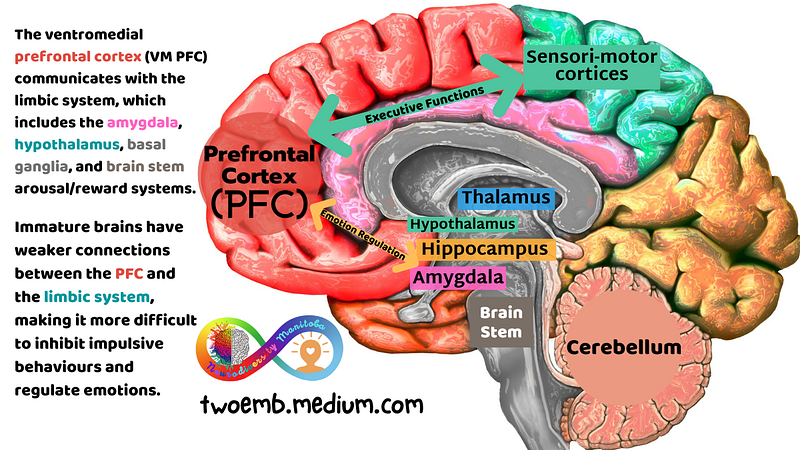
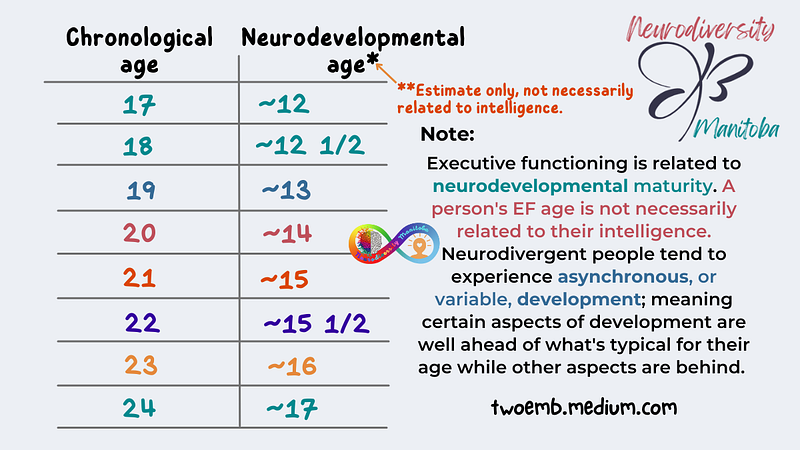
When I say immature, I am referring to anyone who is neurodevelopmentally under 30. Our brains do not reach full maturity until somewhere between 25–30. Those of us with neurodevelopmental disabilities (i.e. ADHD, autism, learning disabilities, FASD, etc.) will mature slower than neurotypical peers.
To be absolutely clear: neurological maturity and intelligence are not necessarily related. For example, my son and I are both twice exceptional (gifted with ADHD). This means we both have IQs in the top 2% of our peer groups, yet our neurological development is delayed in some ways, including the PFC region.
Where am I going with this?
This illustrates four points.
- When we are punished, or punish someone else, for unwanted behaviour, we are more likely to harm the relationship than we are to actually teach anyone a lesson.
- When we punish children for impulsive and emotion-based behaviours, we’re essentially punishing them for having an under-developed brain.
- People habituate (get used to) punishments, or the treat of punishment, so their efficacy wanes over time.
- Once people adapt, they learn ways to avoid punishment, not necessarily by stopping the unwanted behaviour.
Unsurprisingly, research has revealed that people develop a tolerance for speeding tickets and fines, and those threats also lose their effectiveness over time.
Also not surprising is research shows younger drivers are more likely to speed and engage in dangerous driving. Knowing what we do about neurodevelopment, we understand this is not because young adults are jerks (although some probably are), it’s because their PFCs are under-developed.
Final thoughts
The final point I wish to make is this: When we become angry or upset by someone’s behaviour (especially children), it is more often about our ego than it is about anything else (like safety or boundaries).
When my son was in grade one, I got a call home because of an incident in his phys ed class. Apparently it was time to clean up and he was not listening. He was playing with a toy bowling set and would not put away the plastic bowling pins.
The teacher approached my son and directed him to put away the toys, but my son refused. Rather than walking away and continuing to clean up, thus setting the example, this teacher chose to engage in a power-struggle.
Had the teacher simply walked away, my son likely would have noticed all the kids lining up to leave, then put his toys away and hurried to join his classmates. Instead, the teacher physically took the toy out of my son’s hands, thus escalating the situation.
My son (a small six year old boy at the time) hit the teacher, and was suspended for three days as a result. I am certainly not saying it is ever okay to hit, and I would want my son to accept responsibility for his actions and make amends to the teacher.
However, it was the teacher’s poor handling of the situation which led to the escalation. Suspending a six year old for three days for acting like a six year old is a little ridiculous.
Teachers, don’t @ me: I’m not blaming the teacher. For one thing, the teacher probably did not have adequate support for the needs of their class. Secondly, their training likely did not include learning positive, skillful ways to avoid power struggles and de-escalate situations like these.
Lastly, I have certainly engaged in power-struggles rather than approaching a situation with skill and finesse. Maybe I was tired and cranky that day, or low on patience for some other reason (as perhaps this teacher was).
None of us are on our game all the time, we’re human.
We just need to remember that children are human too. We must extend them some grace, patience, and room to make mistakes.
© Jillian Enright, Neurodiversity MB

When you join medium, as a member you’ll have access to unlimited reads for only $5 per month. If you use my referral link, I’ll earn a small commission, and you’ll earn my undying gratitude.
Related Stories
References
Peterson, C. M. & Gaugler, J. E. (2021). To speed or not to speed: Thematic analysis of American driving narratives. Journal of Safety Research, 78, 129–137. https://doi.org/10.1016/j.jsr.2021.04.005
Suzuki, K., Tang, K., Alhajyaseen, W., Suzuki, K., Nakamura, H. (2022). An international comparative study on driving attitudes and behaviors based on questionnaire surveys. IATSS Research, 46(1), 26–35. https://doi.org/10.1016/j.iatssr.2021.10.002


