
Steel Thyself, Traveler, for Egypt
You may not be ready for Egypt, but Egypt is always ready for YOU
Sitting in a budget hostel common area, the couple says to me, “We consider ourselves experienced travelers, but Egypt just, well, it was just so hard.” It sounds like an admission of defeat.
Why do people pick on Egypt this way? I am excluding full package tourists who get whisked from the Sheraton Cairo Hotel to Giza to Luxor to a Nile cruise to Elephantine Island. Diarrhea and a few mosquitos are not the issues at play. Rather, I refer to the DIY people who are striving for the full-on experience of the country and its people, along with all the mandatory archaeology.
I’m guessing it is a confluence of several factors. One is the large number of foreigners visiting, compared with other places in the Middle East or Africa. Cairo International Airport sits within a few hours of Athens and Istanbul, and less than five hours from London. And it hosts some of the most famous and mind-blowing ancient monuments of all time. Anyone who claims to know anything about travel would be obliged to go there at some point. For some percentage of those people, Egypt is the first place they’ve gone to that is hot, noisy, crowded, incredibly dusty, and full of hustlers, all at the same time. Of course, it isn’t really that way, but it can seem like it. All the normal coping mechanisms may not be enough, day after day, to retain that sense of wonder. But if one feels that way, they are not alone: Nationals from other parts of the Middle East also sometimes express disorientation and confusion upon entering the country for the first time.
Cairo is usually the first place one experiences in Egypt, after stepping off their flight. It is the largest metropolitan area in the Middle East and sixth in the world (depending on how you define it), with a population of over 21 million. The tangled web of overpasses and roundabouts in the downtown area never seems to end as you crawl along in bumper-to-bumper traffic. Side streets turn into densely packed markets and cafés at night, defying your need to just get from point A to B. “Walk like an Egyptian,” smiles the man standing next to me at the intersection, as I wonder how the hell I’m going to cross the street and live. He shows me how, by stepping out in front of a swarm of taxis. Will they really stop for me? If Allah wills it!
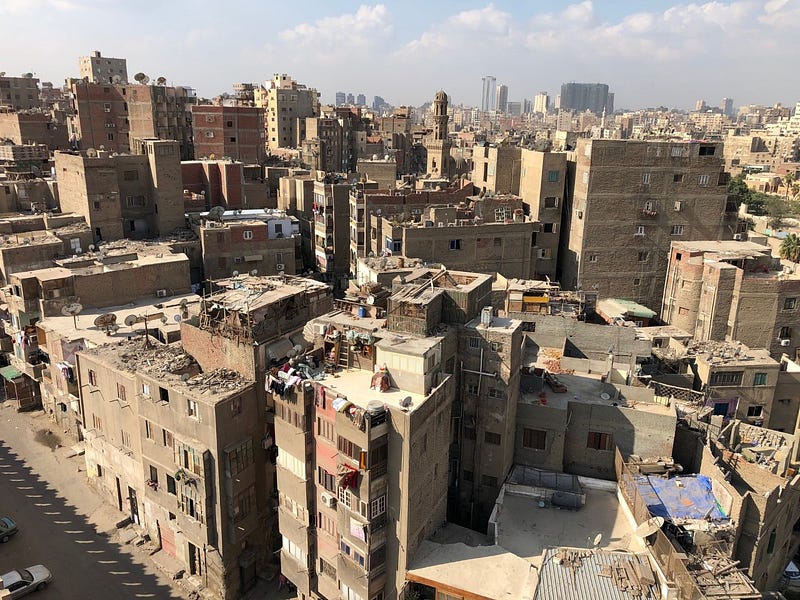
Add to this the random road closures thought up by the cops, apparently as a strategy to keep the general public guessing about where they can drive on any given day. Cairo is so compressed that buildings have just gotten higher and higher, concrete apartment blocks reaching into the sky like the pharaohs yearned to do with the pyramids 4500 years ago.
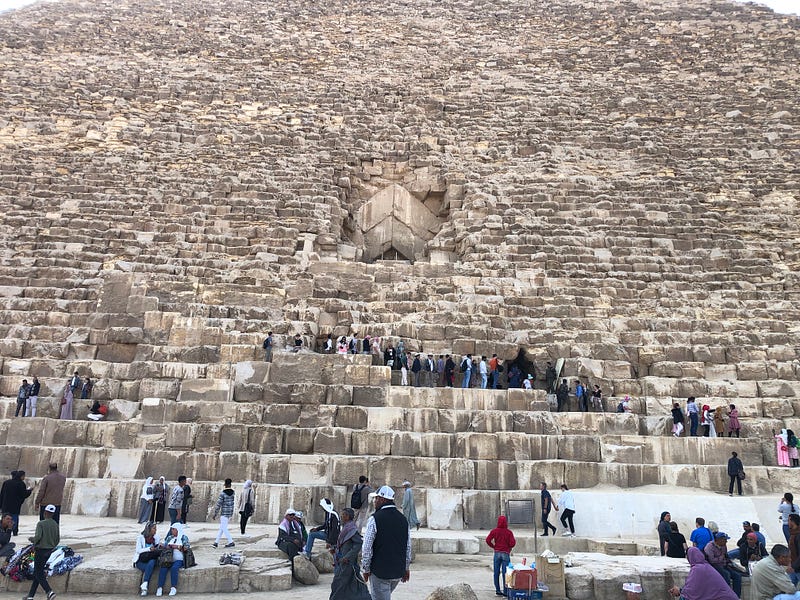
Of course, you must visit the great archaeological sites. But they are spread out and take a bit of logistics. There are always people around who will help you sort that out, but you need to ask a lot of questions about what is included. Places like the Giza pyramids and the Temple of Karnak in Luxor, being contiguous with urban development, invite the greatest distraction of people wanting your attention. Why would you spend time gazing up at the pyramid of Khufu when you can ride my disgruntled camel instead? Or horde after horde of Egyptian schoolgirls mobs you, demanding selfies. It takes fortitude to brush it all off and focus on what you came there to see.
It helps to bear in mind the cultural particularities of Egyptians. There is a wry, sometimes self-deprecating humor to the way they converse. Egypt spent almost 2000 years under foreign rule until 1952, when Gamal Abdel Nasser led a revolution, broke the cycle of colonial powers and local puppets, and replaced it with his own iron fist rule. There is so much oppression to be unhappy about that people develop subtle ways to shrug it off. And Cairo has grown so uncontrollably that jokes and the hustling mentality have become the elixir to living in a place governed by a combination of chaos and the pedantic hand of the Egyptian National Police.
As for the latter, a quick example will suffice. I am waiting, at Tahrir Square, for a friend to emerge from the Cairo Metro. There are a few armored vehicles parked on the next block, but at this exit, there is just one police officer, sitting in a chair. There are masses of people surging up and down the metro exit, too many for me to stand by the stairs, so I look for a place less crowded. I go to the edge of the sidewalk, where there is a fence separating it from the street, and lean against it. The police officer is up and in my face within a minute, quick to berate me for standing there. Something about security. I argue for a bit because it seems so petty, and then move away. Now annoyed, I stand nearby and watch as others try the same thing, leaning against the fence with their cellphones, only to be tapped on the shoulder by the officer. It is almost a relief to see everyone being treated equally, like fellow criminals. It provides shared humor.
Seeing how cheap it is to eat on the street, one might think that a taxi ride or buying a souvenir must also be equally economical. But more likely it isn’t, because you are sized up by your fantasized financial capacity rather than any other economic metric, or they are just throwing numbers out to see what sticks. The second guy you ask may well quote half the price of the first. This game gets played all day long. You feel like everyone is on the make, putting you off balance in the hope that you just give up and hand over the cash. In the end, it may not matter whether the bargaining was contentious or not, the potential to have an interesting and jovial conversation with the driver or vendor is about the same. Maybe you can share a laugh at the expense of Abdel Al-Sisi, the current president. But check to see if his photo is hanging reverently from the rearview mirror first.
One aspect of Egypt that is often difficult for visitors is the magnitude of garbage produced. It leaks out from every urban area and spreads like malignant bacteria to every corner of the country. It isn’t possible to miss the stagnant canals, opaque and fetid, that parallel the roads going to the Dahshur or Saqqara archaeological sites. Even way out in the desert, a thorny bush may well be adorned with flapping plastic bags. There is a suburb of Cairo named Garbage City. This is where the Coptic Christian population lives, and works, with the mountains of refuse produced by over 20 million people every day. They fan out into the city, collect it, and bring it home. Here, they sort it into piles according to what parts of it can be resold or recycled, and the trucks piled high with sacks of plastic bottles, tin cans, copper, and whatever else spread back out across the city to be sold. It is a fascinating place to visit but the smell is overwhelming.
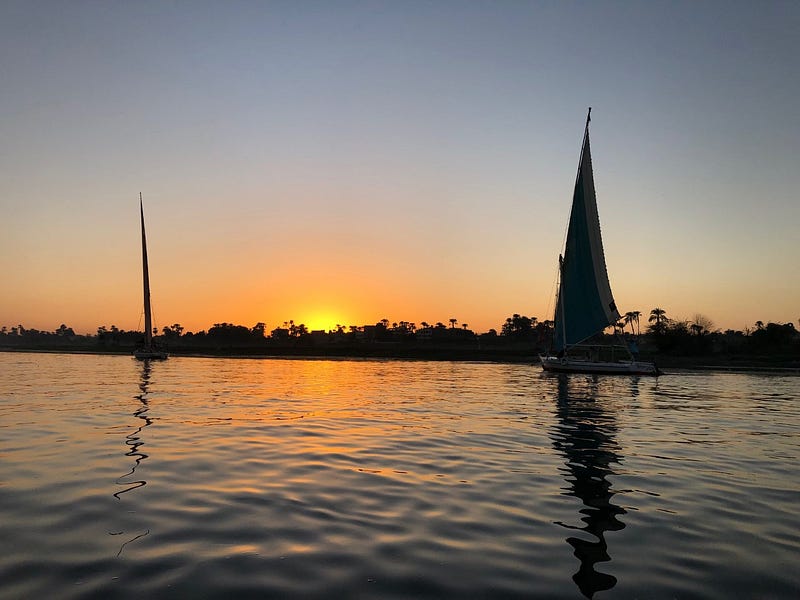
You can expect to constantly have a layer of dust on your clothes and sand in your hair (unless you are bald). It blows everywhere and offers up some great sunsets. Any surface, given a day without cleaning, becomes thick with grit.
The Egyptian language is not your standard Arabic. It has a thousand particularities that separate it from what is spoken in other parts of the Middle East. If it weren’t for the fact that other Arabic-speaking people have been watching Egyptian soap operas for decades, it would sound strange to them. It is also full of colorful, seemingly carefully thought-out insults, like “He wants to be hit with sixty shoes!” I have used Egyptian Arabic phrases and intonation in other Arab countries, to break the ice or draw a laugh.
Riding around in rural Egypt can be a game of hide and seek. Police and military checkpoints abound, and various travel restrictions can impair the movement of foreigners. All the taxis know this but are sometimes less than forthcoming about what lies ahead. You may only know when they suddenly veer off the main highway onto a dirt track, bump along for five kilometers, and just as suddenly return to the main highway as though nothing unusual just happened. They do this to avoid the checkpoints, where a policeman may well jump out and tell them the road isn’t safe for foreigners.
Is that true? It would be lying to say that there have never been safety issues in the past. Islamic terrorist groups have occasionally targeted weak spots, where police protection is scanty, in hopes of cratering Egypt’s tourist industry and fomenting a fundamentalist Islamic revolution. But the incessant vigilance of today’s road checkpoints is predominantly a shakedown for bribes. The good news is that after you’ve sneaked past one, you feel like you’re one up on The Man.
There is a lot to see in Egypt. It is a crazy, wonderful, exhausting experience. You meet Egyptians who are genuinely curious about the world and have a lot to say. The ensuing conversations can be very enriching. Egypt’s seemingly ironic tradition of having a (relatively) free press has given people plenty to talk about. The country automatically makes the top ten in the list of anyone interested in the history and diversity of people who inhabit this planet. If you, the reader, have already been and enjoyed it thoroughly, then that’s awesome.
My real purpose here is just to give a heads-up to those who maybe aren’t quite as prepared for the experience.
Like what you might feel while walking down the street in the hot sun with a heavy backpack, as the driver of a horse carriage taxi dogs you from behind, taunting you for not using his services. If you are ready for its peculiar humor, Egypt will find its way into your heart and grow on you like a fungus.
Earlier articles of mine also about travel in the Middle Eastern region:
Please check my profile for other travel-related articles at Brad Yonaka, and consider joining Medium to read many great stories by using my referral link. I receive a portion of your subscription fee.


