
It is a Pity that Petra Isn’t More Like Wadi Rum
It makes for a very different experience.
It is difficult to see photos of the Wadi Rum Protected Area in Jordan, showing towering mountains and deep red sandy valleys, all nearly devoid of vegetation, and not want to visit this unearthly landscape. Films about Mars take inspiration, if not footage, of this region. And the (mostly mythical) romance of Lawrence of Arabia is tied into it.
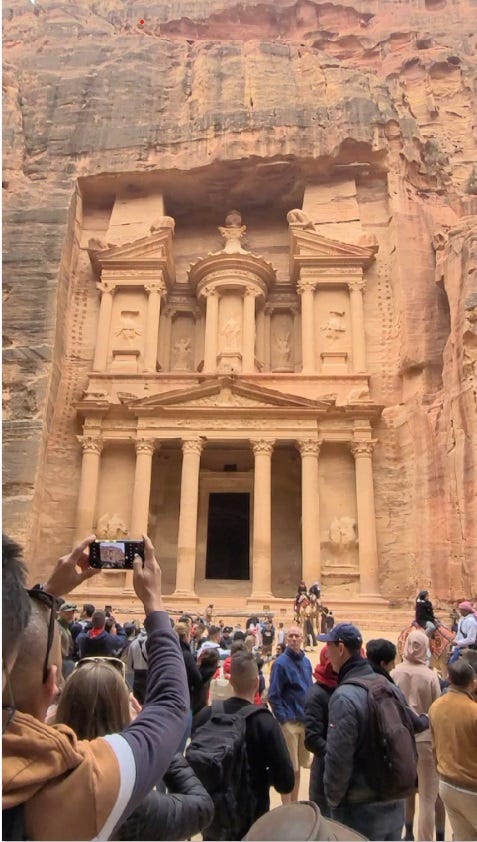
And only an hour north of this is Petra. Two thousand years ago it was the capital of the Nabataean Kingdom, and the city is almost completely carved straight out of the sandstone bedrock. There aren’t many places in the world where one can see buildings made in this way. Again, photos immediately capture the uniqueness of this archaeological site. The stroll through the narrow cleft in the sandstone cliffs that acts as today’s main tourist entry point is well worth the trip itself, watching the sliver of the royal tomb now called The Treasury grow and then tower over the viewer upon emerging from the gorge.
Both are desert wonderlands that use dramatic landforms as their canvas, both have local populations obliged to square their livelihoods with the economic needs of Jordan, and both are easily accessible from the country’s capital, Amman. But for me, visiting them recently, one after the other, induced nearly opposing emotions.
Tourism is huge in Jordan. In 2019, before international travel tourism went on temporary hold, it contributed roughly 20% of the nation’s GDP. It makes sense that, especially in the newly ‘post-pandemic’ world, that every effort will be made to maximize those earnings again. Here, as with everywhere else in the world that attracts tourists, the devil is in the details of how it is managed.
First, my family and I went to Wadi Rum. We arrived at its namesake village by taxi. This is as far as outside transport can go, and from here on we were in the hands of a representative of the tent camp I had booked. We bumped our way out through the impossibly scenic valleys in the back of a Toyota Landcruiser and landed in a small camp with ten sleeping tents, one large dining tent, and a bathroom/shower facility made of stone, set directly against the cliff. Most of the camps are like this, we passed at least thirty on the way here, but it was easy to ignore them. The simple cloth structures, made of goat and camel hair, look like ants set against the 200-meter cliffs behind them. And there is traffic here, plenty of pickup trucks darting up and down the valleys ferrying tourists and camp supplies, but even this activity gets lost in the sheer scale of the landscape. We sat in the huge dining tent with the sides propped open, and listened for an hour, just to the silence. Typically, the tent camps of Wadi Rum are very cheap places to stay the night. The money they make from tourists is in the form of big, elaborate Bedouin-style dinners served nightly, and the various jeep and camel tours offered to fill your days in the park. Some of the more popular natural and archaeological wonders can be crowded in the high season (winter), and yes, I did sometimes feel like there were a lot of people milling around. But then we would move on and enjoy a spot where we were alone.
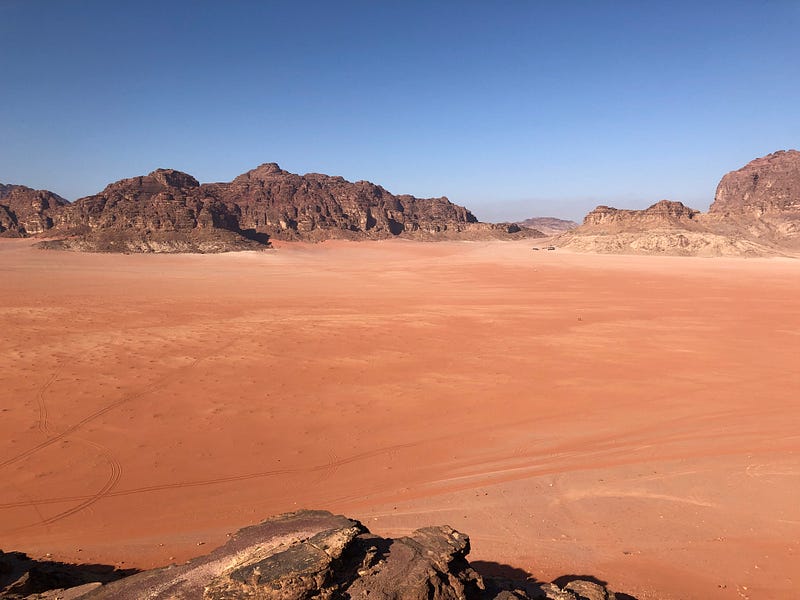
Historically, Wadi Rum has been the home of the Zalabia Bedouin, among some other Bedouin tribes who play lesser roles in the tourist trade. It is with these inhabitants that the responsibility for preserving the region has been left, and in turn they have been granted an exclusive market of tourist dollars. Their approach has been to provide basic but decent accommodation, and a bevy of simple, fun entertainment. There is nowhere in Wadi Rum that I saw a large building, tour bus, or an ATV chewing up a sand dune. After being there for three days, I reflected on how rare it is to see a place of this beauty, readily accessible from large cities and international airports, that has not been parceled out to big business or under the master control of some state entity.
To be fair, its not all a paradise. The pickup trucks go everywhere rather than along a few designated tracks, and plastic trash can be encountered, wherever it happens to get blown by the wind. Considering the number of visitors coming through here, and the ambivalence to trash omnipresent in the Middle East, I was unsurprised to see it.
A few days later we made a day trip to Petra. I had been here before, many years ago, so my impressions had to compete with personal memory. But before we even reached Wadi Musa, the taxi driving us stopped at an overlook with a large souvenir shop. I knew we were in trouble when we walked in and were offered free pita with hummus, and tea. A sales attendant assigned herself to us and would not leave us alone as we moved around the store. A simple bracelet, with a few grams of silver, that my wife picked up and decided to buy, would ‘only’ have cost $140 had I been sufficiently pressured to buy it.
The towns up the hill from Petra have grown enormously in recent years. They form a chaotic jumble of structures, up and down the steep hills that bracket the eastern side of the archaeological site. The businesses here have become a huge support system for the torrent of tourists coming down from Amman. Among them, the B’Doul tribe claim to be the true descendants of the Nabataeans, and were only encouraged to vacate the ancient city in 1987 when Petra was declared a UNESCO World Heritage Site. They were offered relocation to the nearby town of Umm Sayhoun. Some of them resisted, and were granted permission to remain in the caves. They now constitute the finely tuned machine that chugs away daily among the ruins, offering services and merchandise to tourists.
It is not easy in Petra to feel alone with the tombs. Part of this is just the sheer number of visitors trudging by, all obliged to channel through a few paths. But you also get the feeling that every corner is occupied by a souvenir stand, and coming up behind you is yet another ‘donkey taxi’, ready to relieve your weary legs for a few dinar. The pressure to spend was everywhere. The long, tiring walk up the stone path to Ad-Deir (The Monastery) was as much a test of patience with touts as physical endurance. I was also a bit taken aback with the merchandise. Among the other trinkets were piles of broken pottery and ancient coins. Most of the coins were fake, but even so, it seems highly counterproductive, from a conservation standpoint, to allow monetary gain from selling potentially ancient artifacts.
I mentioned earlier that Bedouin tribes are granted a measure of control over both Wadi Rum and Petra. It does give one pause to wonder why that is, in a country with a relatively large share of its wealth tied up in tourism. Put simply, Jordan is a country drawn up on a map by European powers, looking to parcel out the corpse of the Ottoman Empire in the early 20th century. The Bedouin, arguably the most ‘ancient’ inhabitants of the rural parts of the country, do possess a lot of power, by virtue of their independence from state control. The current borders of Jordan, Saudi Arabia, Iraq, and Syria don’t mean much to them historically, and they still move across these boundaries when they need to. The king of Jordan has basically struck a deal with the Bedouin, in that they are allowed a great deal of liberty, as long as they hold allegiance to him.
This liberty has translated into two very different modes of operation. Granted, Wadi Rum is a vast area with no central focus, and collects, on an annual basis, only a small fraction of the money spent by visitors in Petra. The Zalabia Bedouin seem to have conquered the logistical complexity of transporting, feeding, and entertaining tourists, without becoming completely jaded by it. So it seems to have escaped, at least for now, what the latter has become.
To be fair, the history of the B’Doul tribe of Petra is an interesting one, and I can’t blame them any more for marketing their circumstance any more than the modern-day residents of many other archaeological wonders I have visited. And with sufficient time, one can wander back trails that do coax a sense of silent grandeur. But it takes a lot of work, and walking, to shake first impressions.
While touring the Hashemite Kingdom of Jordan, as with anywhere you’ve sunk your vacation days and dollars, it is important to see as much as time allows. And as a visitor, I would never begrudge my first glimpse of a national treasure just because the experience is expected to be sub-optimal. But our lasting impression, as a family, is that we would go back to Wadi Rum in a heartbeat, and for longer. Its just a pity we don’t have the same feelings for Petra.