
‘Spiritual but not religious’ — the catchphrase for the latter days of the West
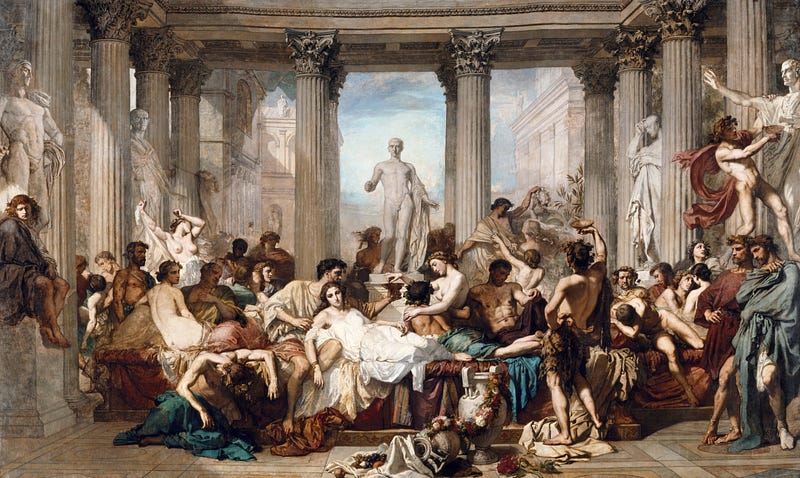
We live in an age of peculiar category errors. Modernism with its scientific worldview has literalised and objectified the world, condemned the religious for not living up to its standards of objective proof, and left us in a strange place of exile. We are human, we still long for transcendence, meaning, eternity still presses upon our shoulders. But when it comes to the forms through which mankind has encountered these things since we first woke dewy eyed to look upon the stars, the way has become barred. Religion is, apparently, full of cliches, irrationality and moral tropes we have long since risen above. So we have abandoned its structures, flooded our world with the hedonism that has followed, pornography, a culture of superficial sensationalism and gratification, and all of the benefits that come with the apparent freedom of iconoclasm.
One way we have come to justify this apparent incongruity between the materialism of our world and our longing for the transcendent is found in the phrase ‘spiritual but not religious’. A kind of have your cake and eat it reflection of a desire to integrate subjective kinds of spiritual experience and self-observation into the objective world in which we live.
What the ‘spiritual’ constitutes is a fairly broad phenomenon. It can include everything from a general sense of feeling, a desire reflective of the sense that there is something more, but that can’t entirely be expressed. It also refers to kinds of spiritual practice such as meditation, mindfulness or yoga that have become integrated into the West under the dual banners of ‘spirituality’ and ‘optimisation’.
These practices are not without merit, all have shown benefits for a variety of things from physical to mental health. But the way they have become incorporated into the west makes the banner of ‘spiritual’ somewhat questionable. Take yoga for example — it’s hard to clearly seperate yoga from, say, running or lifting weights — which is to say it has become somewhat integrated into the category of ‘exercise’ or at the very least self improvement. If you look at the most popular Yoga practitioner on youtube ‘Yoga with Adrienne’, an indisputably positive and wholesome teacher of yoga you find videos with titles such as yoga for gut health, yoga for vertigo, yoga for nurses, yoga for teachers, yoga for chefs, yoga for your butt and thighs, yoga for skaters, yoga for manual labour (I swear I’m not making these up), yoga for risk takers, yoga for brain power, yoga for when you’re in a bad mood, you for writers, yoga for actors, yoga for gardeners, yoga for hangovers, yoga for surfers, and on and on and on and on.
Yes, these things are conditioned by SEO and algorithms and may have been somewhat of a necessity to her success, but if these things are what yoga is ‘for’, then how is yoga spiritual? What does it actually mean other than the discovery that meditative breathing, stretching and dynamic movement make you feel relaxed? It’s hard to look back through the Upanishads or the Vedas or the Bhagavad Gita and sense that the goal of their religious interpretations was to produce ‘yoga for your butt and thighs’.
Mindfulness too can be looked at similarly. While there is no doubt something profound to the observation that there is something about consciousness moment to moment that is just at peace, and that a step back from identifying with your rambling monkey brain thoughts can give you some perspective, this has a limited field of use. Many people who have mental health issues also have to deal with the fact that while ‘you are not your thoughts’ has some use, you also paradoxically are your thoughts, and there has to be some point of return into a world of selfhood and events, and retracting into the abstraction of consciousness may provide moments of refuge or perspective, but it does not provide meaning or interpretation.
The problem remains that if ‘spiritual’ practices are not integrated into a symbolic system of meaning, they remain fragmented and isolated experiences. They have their benefits, and there is no merit in calling them ‘bad’, but they are fundamentally reflective of a Western world in which things do not mean things. Increasing political divides, polarisation and fragmentation are the products of a society where shared meanings and values have broken down to such an extent that we do not even agree on basic categories of what it means to be a person, to have a gender or to have value from before birth.
In the Old Testament book of Jeremiah, God says to the prophet that the people have committed two sins — “They have forsaken me, the spring of living water, and have dug their own cisterns, broken cisterns that cannot hold water.” Recovering what it means to ‘believe’ the system of metaphors and symbols that constitutes the mythology of wholeness is not an easy task. ‘Faith’ seems a long way back for many of us. But the facile separation of the ‘spiritual’ from its religious vessels is clearly not a route to serious transcendence, and it’s easy to see how they simply collapse into banal categories of optimisation, self-help or exercise. Such practices have their use, like any self-help or exercise does, but they remain partakers in a commodified system of meaningless artefacts in an atomised internet age. What the route is back remains for us to decide, and maybe no hope remains in collective ideals. We each have to ourselves become the woman at the well, find the peculiar response to our banal desires for optimisation, self help, our profane appetites — “whoever drinks the water I give them will never thirst”. What a thing. Did we forget?
Thanks for reading, for more on the subject see: Why I still believe in God Valley of Vision: Why an old puritan prayer book might change how you think about religion Psychedelics and the modern world Psychedelics and the modern world II — shamanism, prophecy and the unconscious mind