
Psychedelics and the modern world
The sacred, the modern and the realm of meaning
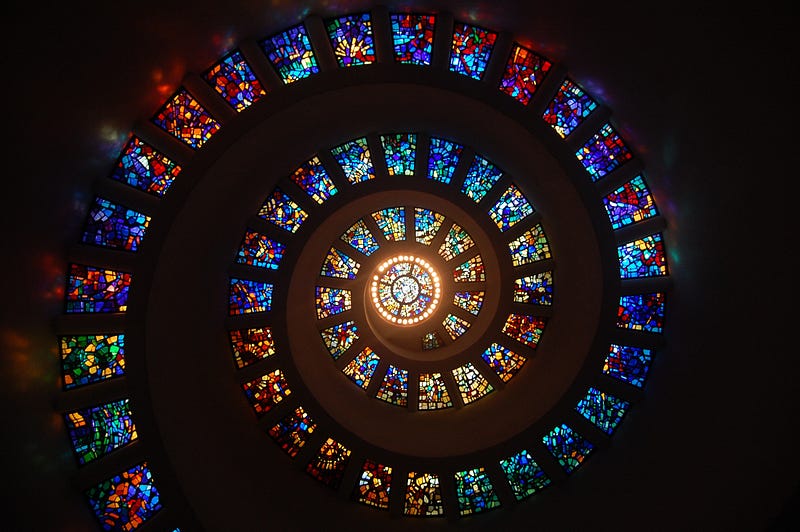
There are certain categories of experience a scientific model just doesn’t have a clue what to do with. When ingested, the realm of substances we call psychedelics produces, to our modern mentality, realms of experience beyond what every day existence seems able to begin comprehend. So much so that during their rediscovery in the twentieth century most governments quickly made them illegal. You can spend your life an alcoholic without going further than your corner shop, but the vast experience of psychedelics are only for most people to read about.
The atheist philosopher Sam Harris said after an experience taking psilocybin “the fact that there are landscapes of mind this vast lurking on the other side of a mushroom is simply preposterous. I mean how could that make any sense? The scale of the thing is all wrong. It violates every intuition you have about what it is to have a mind and a body in a world. It’s as though we’ve lived in a universe where if you just reached into your right pocket with your left hand, rather than pull out your wallet you’d pull out the Andromeda galaxy. So the experience is altogether too much, it’s like a reductio ad absurdum of one’s desire for experience itself.”
It’s hard to know what to do with such experiences, or to understand why on earth such scale of vision is even possible in the human mind. Why would we have a capacity to produce encounters that obliterate our sense of what our mind is, that can produce experience so expansive we cannot describe them. Sam Harris again, described words as “all but useless” to describe it: “We have a word for love, for instance, but what’s the word for all the love you can possibly feel, and all the love you recognise you have failed to feel at every moment in your life up until this moment. What do we call the experience of having that ocean of feeling invade you, and fill every empty space in your mind? There really are no words to describe this experience.” The writer Aldous Huxley experimented throughout his life with psychedelics, first mescaline and later LSD and would write: “One never loves enough. . . for what came through the open door was the realisation of Love as the primary and fundamental cosmic fact.”
What should we do with such experience? One approach has been to conduct research into the possibility to ‘medicalise’ these drugs, to use them as ‘treatments’ for mental health conditions, or avenues to general wellbeing within current medical establishment. The ‘compass pathways’ Mental health institution is about to begin conducting the world's first phase three trials in psilocybin use for mental health, and research on the potential benefits of psychedelics is being conducted more widely including at Johns Hopkins.
The problems with this are numerous, for one thing it subsumes such mind shattering experiences under the banal bracket of ‘medicine’, and in doing so feels as if it somewhat robs them of meaning. Psychopharmacologist Roland Griffiths in a TED talk referred to them merely as ‘mystical-type experiences associated with enduring changes in attitudes mood and behaviour’.
Which sounds great, but the trouble is it involves a simple reductionist view of the human person. The actual phenomenology of ‘mystical’ experience becomes irrelevant in favour of the overarching view that you are a bundle of chemicals that needs ‘optimising’, rather than a meaning seeking being in need of the transcendent. While such a view is not strictly wrong it seems frustratingly premature and presumptive to seek to encompass such vastness within the domain of science and medicine, to cordon it off from a phenomenal world of meaning. Should such experiences ever be subsumed under the establishments of our modern world? Substituting a Shaman or a mystic for a doctor or researcher seems bordering on dystopian.
Again Roland Griffiths referred to research cases in which volunteers experienced increases of “a sense of unity, a feeling that all people and things are connected, accompanied by a sense of sacredness… love, joy, and a deeply felt sense of encountering ultimate reality. These experiences are felt to be more real and more true than everyday waking consciousness.” He then goes on to describe the research into the benefits in mental health and addiction.
The frustration again is that the questions here go far beyond merely researching whether such drugs could produce risk-reduced benefits. It seems unbearably reflective of our listless modern world that we aren’t interested in how staggering it is that the mind would even have the capacity for “love, joy, and a deeply felt sense of encountering ultimate reality”. Isn’t that what we should be interested in? Our obsession with optimisation and mechanism seems to leave us unable to allow such drugs to awaken us to how limited our modern world view really is, and how facile an endeavour it is to subsume it under these categories. Whatever these kinds of experiences are, calling them ‘therapeutics’ doesn’t seem to quite do it.
Roland Griffiths does, however, add at the end of his Ted talk that mystical type experiences produced by these drugs are ‘biologically normal’ and that it raises the question of ‘why are we wired to have these salient, felt to be sacred experience encountering ultimate reality of the interconnectedness of all people and all things, experiences that arguably provide the basis for our moral and ethical codes, common to all the world’s religions’.
The author and professor of religion Mircea Eliade in his book ‘The Sacred and the Profane’, speaks about the condition of modernity as being defined by an absence of ‘sacred spaces’, collective and communal rituals and places that connect us to a felt sense of the transcendent, connected to unifying myths of meaning and community. He says “there are only fragments of a shattered universe, an amorphous mass consisting of an infinite number of more or less neutral places in which man moves, governed and driven by the obligations of an existence incorporated into an industrial society”. In his poem ‘The Waste Land’, T. S. Eliot also foresaw the condition of the modern world as without proper meaning, “a heap of broken images”, a kind of living death composed of people unable to awaken or properly house a moral reality, a transcendent world.
Whatever psilocybin does it seems clear that it’s effects are not pathology. They are as Roland Griffiths says ‘biologically normal’, something our mind contains the capacity to experience. Such a sense seems to contain the very possibility of reimagining reality, again as Griffiths says they reinforce ethics ‘common to all the world’s religions’. For us as a modern world who are unreligious, proudly secular and without meaning, what is required is remembrance and awakening from the listlessness of materialism. Michael Pollan, a journalist who has written about psychedelics and self described ‘philosophical materialist’ said “we all know love is important, but we forget every day how important love is, and that it is the most important thing in the world, and to be reminded of that with the authority of the psychedelic experience is a very healing thing.”
It seems extraordinary to become aware that an actual belief in such an ethical ontological reality is the very foundations of our western society, a theme throughout religious traditions, and peculiar how we need to find kinds of backdoor or experiential ways of re-possessing such beliefs without really admitting we actually believe them. We need these things to be novel, scientific, unattached to doctrine or structures of metaphorical or mythic belief because we have no way of stepping into them ourselves, we have no place for them. Such a need tells us something about how adrift and unable to locate ourselves we are as a society, how much we need collective myths and beliefs that house such experiences not as mere therapies, but as part of a phenomenological world of shared meaning.
Psychedelics and the modern world II — Shamanism, prophecy and the unconscious mind.


