
Valley of Vision: Why an old puritan prayer book might change how you think about religion
Fun fact: the word ‘tunnel’ was once a word for a net used to trap birds. Some distant speaker used the word as a metaphor for a hole in the ground, presumably to indicate its dangerousness, and so dangerous holes likely to trap you were called ‘tunnels’, until every hole in the ground was called a tunnel, and eventually we invented the underground train, left the bird net in our forgotten past and now tunnels are just tunnels. Our language is a graveyard of dead metaphors.
The word ‘puritan’ or as we would use it ‘puritanical’ has a similar lacuna of meaning in our use of the word. For us Puritans are the great party poopers, the repressive, thou-shalt-not-ers who walked around tutting if they could see, say, a woman’s exposed ankle or raised their finger to scold if someone stubbed their toe and went “oh fu…”
This of course is one aspect of one part of Puritanism. There are many reasons why this aspect has remained in our language, for one thing the various elements of Christian history and theology which Puritans stood for or against has long been forgotten, so its meaning is no more significant than say ‘anabaptist’, a word most people wouldn’t even have heard of. It’s also a convenient reflection of the way we have come to see religion and the idea of moral society as a whole, its metaphorical use as an accusation has stuck because it serves as a reflection of the view that any religion telling you what you should or shouldn’t do, especially with your body, doesn’t chime with the sexual revolution or the hedonism of our post-religious freedoms.
So, in many ways now the word Puritan is just a word. You could read their wikipedia page and consider their theological positions and the reasons for their existence, but in reality that still puts us within the category of a bunch of religious viewpoints, some of which are good, some of which are bad, some of which, even as a society of non-believers still inform our ethics in a strange vestigial sense. However, what you find when you engage with their writing throws a door open to the realisation of how wrong we are when we just see ‘religion’, as opposed to our favoured ‘spirituality’ through the prism of theological squabbles and moral society. We might find that the two are not so far apart.
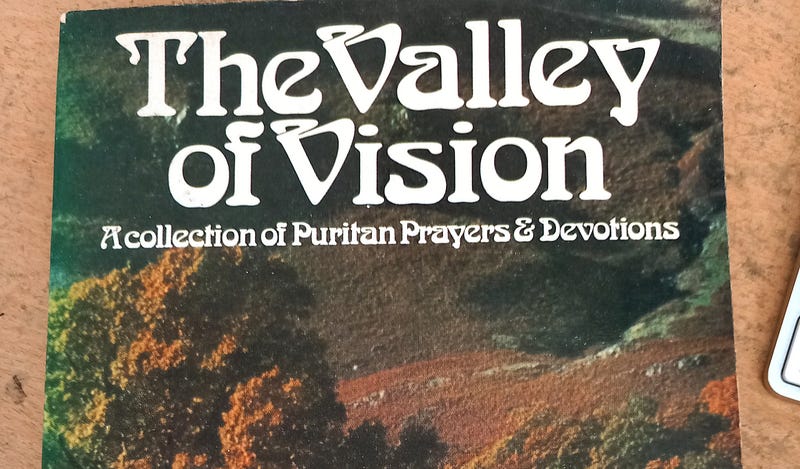
A good place to start is a collection of Puritan prayers called “The Valley of Vision”. The book is split into ten sections, each with a set of page long prayers. They contain expected elements of garden variety Christianity, but what strikes you when you read them is a sincerity of earnestness and an approach to God that borders on mysticism, luminous with a desire for an experience of God as total and absolute love.
The first prayer frames the entire book with its approach, one that reads like the most sincere religious mysticism. “Let me learn by paradox / that the way down is the way up / that to be low is to be high / that the broken heart is the healed heart / that the contrite spirit is the rejoicing spirit / that the repenting soul is the victorious soul / that to have nothing is to possess all / that to bear the cross is to wear the crown / that to give is to receive / that the valley is the place of vision.”
Here we find the unique Christianity expressed by Puritanism, and the importance of understanding that the piety in the most cliched sense was a reflection of piety in its most religious sense, which is to say a genuine desire to live a moral life reflective of the love of God. We live in a time where ‘spirituality’ is just another way of approaching the question “how do I get what I want?” Reflected in catchphrases such as ‘Yoga with Adriene’s’ “find what feels good”. Yet for the religious person spirituality is always intrinsically moral, and if any religious or spiritual practice does not result in genuine moral transformation in your life, it is worthless.
The reflections in this prayer relate to the paradoxes of humility, that the love of God expressed in the real world looks like service, goodness and lowliness, found in the identification in the New Testament of Christ with the ‘least of these’, and in the beatitudes. To be moral is to be humble, to seek a God who is “near to the brokenhearted”.
The concept of sin is often something that grates with us in the modern world, and the idea of moral society and judgmental religion is something we associate with Puritanism. But throughout these prayers we find that sin is not something tutted at or arbitrarily disapproved of, but that which is genuinely desired to be shed in order to approach nearer to a God of love. They reflect a recognition of our own inclination to wander and stray, to contradict ourselves and a need for a constant humility and turning towards what is good, in order that our fragmented and disintegrated selves might become integrated and whole. One prayer asks “give me a broken heart that yet carries home the water of grace”.
The paradox of the modern approach to such areas is summarised in a final line from a prayer called ‘contrition’ that says: “In all my affairs may I distinguish between duty and anxiety, and may my character and not my circumstances chiefly engage me.”
How much of our world is geared towards perfecting our own circumstances? How much of our obsession is with who we really are rather than what we look like on social media? The concept of prayer, at its very root, is the idea that love is not an abstract but something we can constantly make ourselves accountable to, a behind closed doors, inward movement towards a wholeness of character and an actual experience and encounter with love as the only thing in this world worth wanting.


