
The meaning crisis and language II — Do we need to ‘believe’ myth and metaphor in order to understand ourselves?
What does it mean to ‘believe’ myth and metaphor?
In the last essay I established several premises. Firstly that myth and metaphor are kinds of truth, but the truth that they contain is not the same thing-for-thing literal language of science, and that because we have insisted the latter is a total epistemology and for the most part excluded myth from society, we are mired in numerous linguistic category errors based around an inability to unite subject and object. Hence scientific category problems such as the ‘hard problem of consciousness’ or societal category problems such as the absurdity of literal body vs feeling-of-self gender debates.
The question we are moving on to, is how do we relate myth and metaphor to the realm of belief? If we assume that religion primarily uses the metaphorical mode of language, (which questions about whether that language might also map onto the literal aside, it almost certainly does), how can we understand its truth in an age of cynicism?
Much of science is by necessity detail orientated. Detail, or resolution, requires a literal language structure. Metaphors have little use in areas of precision, because language has to relate to things via direct specificity using terms that have exact relations and parameters, are not abstract and are clearly defined. Science is, then, by definition a ‘lower level’ enterprise, an enterprise of detail. Reducing things to precise terms means to quite literally reduce them in size, hence why we believe epistemology increases as we move towards the smallest level of operation, or physics. As we move away from this words become increasingly symbolically broad in their operation, and are scientifically reliant on a subset of definitions. Hence a statement attributed to Ernest Rutherford that “all science is either physics or stamp collecting”. Above the lowest level you are simply naming phenomena that are reducible themselves to smaller phenomena of operation. So history is explainable by biology, biology by chemistry, chemistry by physics. To move in the opposite direction would take us away from precision to abstractions and metaphors.
In our time this scientific language structure has become an entire epistemological worldview. In other words, all truth is seen as having to first go through such a language structure or else it is said to be either unprovable and thus a meaningless fancy, or provable as false. This is a large part of how we have come to abandon religious structures of language.
How might myth and religion be ‘true’?
The early texts of bible are very old. They have outlived people, empires and cultures. In spite of the fact that we have come to see the texts themselves as disproven scientific theories, clearly their language structure is not literal. If it is not literal it presents itself as a different kind of truth. It doesn’t mean it never relates to the provable, it is clearly about something, which might involve historical or metaphysical claims, but its language structure is not strictly literal. Treating Genesis as a scientific proposition is a facile reflection of the epistemological quagmire we remain in.
Nonetheless it remains a peculiar fact of religion that a proper fulfilment of the meaning of these texts requires you to believe them. Part of the reason we have abandoned them is because of a loss of our ability to do so. The bemoaners of religion that were the generation of ‘new atheists’ are not a total representation, and many thinkers have come to observe how dependant we are on their structures of language, and how much meaning is missing without them. But such an observation does not solve the problem of literalism and unbelief.
As T. S. Eliot observed, the surface reading of a poem is like “meat thrown to a guard dog by a burglar”. The observation is an important recognition of the fact that things are going on in metaphorical language structures that go beyond our direct conscious awareness. Part of this is, perhaps obviously, because their meaning is not literal. This means you can’t ‘say’ what a line in a poem means in any way better than the line itself does because its meaning is as dependant on the particular arrangement of words as it is on an actual meaning. To say ‘Life is a journey’ to use a banal everyday metaphor, is to evoke a set of meanings, interpretations, implications or even feelings that are both subjective and objective. You can perhaps distill it into central axioms, but still much of it remains with a degree of interpretive fluidity.
To flesh this out I am going to pick up from an example used in the last essay:
“The difference between metaphorical and literal language is important. Let’s say a traffic reporter describes the movement of traffic, and says ‘the traffic is flowing like a river after rain’. On the same day someone reports on the traffic in strictly literal language, so will say ‘the roads are very busy, the traffic is moving steadily, there are no accidents’. The latter might be more specific and importantly more undeniable falsifiable. The former requires the imaginative participation of the listener. The listener, perhaps unconsciously, has to imagine a river after a rain, connect it to traffic flow and follow the bundle of things that emerge from the connection of the two. This means the latter involves elements of subjectivity and interpretation. It is not, however, strictly or only subjective, there are things it obviously can’t mean. It’s on a specific traffic report, so you can’t say the reporter was using it as a metaphor for the days political events, and it’s unlikely to mean ‘there is no traffic on the road’. Just like the metaphor ‘time is a river’ can’t mean ‘time sits still and doesn’t do anything’, the metaphor implies concepts of flow, movement and changeability. It is not reducible to objective statements bit vitally, not arbitrarily subjective.”
Mistaking a text such as the bible as the latter kind of language is to ignore its entire use in Christian history. Everything from Chartres Cathedral, Dante’s Divine Comedy to Bach’s B Minor Mass to Handel’s Messiah to T. S. Eliot’s Four Quartets is the imaginative response to the language and meaning system of the bible. Preachers speak from the bible not as a scientific text reducible to literal meanings but as texts to be ‘exposited’ collectively and personally as if their meanings continue to unfold reading after reading. It is not subjective, it has things it cannot mean, it’s heresies, but is not objective either, as much as it might be insisted upon being so.
However even interpretively the tug of war between subjective and objective views of metaphorical and mythic language has always been a tension within religious traditions. On one hand there are the more fundamentalist inclined followers who believe the language should be taken as objectively as possible, interpretations made as limited as possible. On the other hand are those who see the interpretations of the text as subjective and personal, that it can mean what you feel it means in any given moment. The former is the ground of creationists, literalists and all of the aspects of church or religion that put many rational people off but rather ironically the latter, which in our time may be a response to the former, has more effect on the church emptying. After all, if a text can mean anything, then it means nothing.
This distinction may seem obvious but it is the core of the category problem that defines our entire meaning crisis. Ask a question like why does poetry have no significant role in society? The substantial reason, besides being outcompeted by passive stimulative forms of entertainment, is that we have lost the ability to hold together its form of language as both objective and subjective. It either has to be reducible to a meaning, which subordinates it to another form of language, or else it can mean whatever you want it to mean, in which case it means nothing of worth outside of the personal. This is almost a mirroring of the absence of meaning in society in general. Meaning is either seen as purely a subjective epiphenomenon or else has to be reducible to some kind of objective principle, like an evolutionary drive or an underlying physical mechanism.
Take some examples: how do you know your gender in 2022? Either it is seen as a purely subjective quality of experience or it is an objective fact of biology and both political sides come to fury declaring that never the twain shall meet. Take abortion: is a human life within a womb significant based on an objective fact or a subjective decision? Left leaning news articles will talk about the pain of a miscarriage and the necessity of the choice for abortion without seeing a contradiction because the significance of life is purely subjective, right leaning ones will talk about human life within the womb as if the idea of its value from conception is a kind of irrefutable objective fact.
You might sense the thread of the argument here: in language, subject and object are poles that reflect the overarching tension in every guiding principle aspect of our lives. Political left and right, religious liberalism and conservatives, the disorder/order, subject/object extremes are fundamentally what constitutes divides between these two ways of looking at the structures of meaning that orient us, and as meaning has become more absent in society, or ability to unite these two poles is collapsing.
The question is what holds these things together? How are they properly united? Let’s look at something that seems abstract: the idea of America. America, perhaps obviously, is not a thing. That is, it is a land within a set of borders, a group of people by residence, a history, a governmental structure, a constitution, a flag, an anthem, and numerous other things you could describe. But is also none of those things. America doesn’t exist, the difference at the border between Canada and America is arbitrary, it is not reducible to a set of things, and all of them put together don’t make it. Rather, in the most important times of it’s history America constitutes a set of values tied together by a sense of personal and collective identity. America, then, is like the self. It both exists and does not exist, it is an emergent but not reducible phenomenon, held together by a set of symbols and stories that constitute the myth and metaphors of collective identity. Like religious systems, these things, the flag, the constitution, the American ideals, have to be believed in. To a larger or smaller extent, every society has these sets of shared meanings, they have historically been inseparable from religion, and are traceable all the way from personal and family meanings up to government and national ideals. I am going to define this set of symbols and stories as principle metaphors.
Principle metaphors
One way to observe this is to think about the extent to which the political divide reaches into the individual lives of Americans. Republican principles tend to relate to fundamental constitutional or religious truths, a more serious, bordering on religious allegiance to symbols (the flag, the national anthem), and an interpretation of history that creates justification for America’s existence and goodness. The political left, increasingly has become iconoclastic towards America’s symbols, begun to interpret its history as a pathological narrative of patriarchy, racism and exploitation, and has an indifferent view towards the upholding of rights simply because they are in the constitution.
What you can see here is that it is none of the specific elements themselves that constitute the unity between these two sides. The flag or the anthem, the constitution, etc — taken to a literal calcified extreme forbid change or moral collective self-examination (take gun rights), but iconoclasm towards these things creates a chaotic and destructive environment, and both sides devolve into pathological forms of power. Rather what must animate these things is a kind of collective sentiment, a feeling of identity and meaning that allows a set of symbols to uphold a moral centre. Because even America with it’s endless faults, crimes and failings, is moral when it really fully exists at its centre. Civil rights is such an example, the appeal made by those demanding equality were not claims that America is pathological or racist, but that by forbidding forms of equality is not actually being itself. That is, it is not living up to the principles by which it claims to exist. I am not being idealistic here, no symbol is ever perfect least of all a country such as America, or ever near it, only the collective self that it represents has to in some sense have a relational, moral centre-point. What animates, upholds and to some extent creates principle metaphors is a moral centre. So while principle metaphors are fundamental to collective and personal meaning, the metaphors themselves are not enough, they remain a vessel for something.
Part of a fundamental idea of stories that involve a moral God, are that they look upwards from a material world to a moral world, and in doing so provide a kind of sense and interpretation to the chaos of the human condition. So, here I am going to make a proposition about what principle metaphors are doing. Metaphors, stories, myths, are forms of language concerned with identity and relation that mediate between two sides of reality, the material and the physical, and the conscious and the moral. I am doing two things here, firstly equating language structures with the self, and secondly equating consciousness with moral reality. The former is not a large step, self-identity is a part of the brain that has a large relation to language, ‘I am’ is a linguistic thought. Animals may have consciousness of some kind, we don’t and probably will never know, but they don’t have reflective self consciousness because they do not use language. The second, that there is a connection between consciousness and moral reality is an ancient idea although one somewhat abandoned or forgotten in modern times, although there is some intuition of this in modern forms of ‘spiritual’ practice. In mindfulness or yoga for example attention to the fact of conscious awareness in each present moment produces a recognition that something about consciousness in each moment is akin to a kind of gratitude and givenness, even love. The atheist philosopher Sam Harris, an advocate of mindfulness and meditation said “simply paying attention to experience is an antidote to the feeling of dissatisfaction, of seeking happiness… you can uncover in merely witnessing experience the fact that consciousness itself has an intrinsic quality of wellbeing, that which is aware of sadness isn’t truly sad and that which is aware of joy is the same thing which is aware of sadness… you can keep falling back into that position of merely witnessing and that can become very expansive and that can become the context of a kind of self transcending love and happiness.”
The foundation of moral reality
We are going to begin this section with a stream of propositions:
We have abandoned (if somewhat unconsciously), an idea required in order to sustain belief: that we live in a real moral world, as real as the physical world. It then follows that that moral order is related to forms of truth and language not reducible to objective things. This world is connected to forms of identity, which are moral because they are relational. The sequence that history is explainable by biology, biology by chemistry, chemistry by physics, can go the other way, that history is explainable by morality. Morality is connected not to literal or material things but rather the aspect of egoless consciousness that is part of each of us and all of us. Because we are also selves existing in the world, and the physical world is the order in which we exist, we require myths, stories, and forms of language that mediate between these two halves and take us beyond profane reality. We also require ritual and community structures which house these things. Not only that but the metaphors of religion are metaphors that represent this reality in the entire cosmos, like mandala patterns throughout ancient cultures have represented both the self, the deity and the cosmos, a text such as the bible becomes an entire repository of a societal and individual self. This is why there is a constant metaphorical overlap in the bible between the King as an individual, the nation of Israel, the people of the church in the New Testament, and the individual Christian reader. Texts written to address the people of Israel three thousand years ago can for example be seen as speaking to both the church or an individual reader, today.
It is worth looking at this division of material and moral through the two hemispheres of the brain. In a Ted Talk the neuroscientist Jill Bolte Taylor accounts her experience of having a stroke, experiencing haemorrhaging in the left hemisphere of her brain. Being both conscious during the experience, and having spend her life studying the brain she was uniquely poised to analyse the event. She describes it: “Light burned my brain like wildfire and sounds were so loud and chaotic that I could not pick a voice out from the background noise and I just wanted to escape. Because I could not identify the position of my body in space, I felt enormous and expensive, like a genie just liberated from her bottle. And my spirit soared free like a great whale gliding through the sea of silent euphoria. Harmonic. I remember thinking there’s no way I would ever be able to squeeze the enormousness of myself back inside this tiny little body. But I realised “But I’m still alive! I’m still alive and I have found Nirvana. And if I have found Nirvana and I’m still a’live, then everyone who is alive can find Nirvana.” I picture a world filled with beautiful, peaceful, compassionate, loving people who knew that they could come to this space at any time. And that they could purposely choose to step to the right of their left hemispheres and find this peace. And then I realised what a tremendous gift this experience could be, what a stroke of insight this could be to how we live our lives. And it motivated me to recover.”
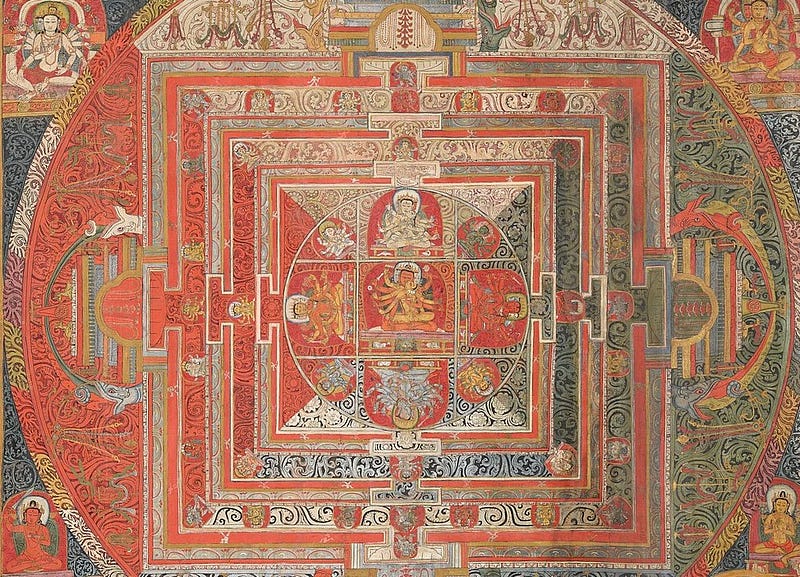
In his book ‘The Matter with things’ Dr Iain McGilchrist describes the two hemispheres of the brain as relating to big picture and small picture attention. The left brain focuses on a small task, the right on the context and meaning, the left on an immediate problem the right on large scale threats. The oceanic experience of Dr Jill Bolte Taylor describes an image of the right brain as connected to a kind of egoless, loving reality that she called ‘Nirvana’. McGilchrist in his earlier book ‘The Master and His Emissary’ makes the proposition that the western world has come over recent times to be dominated by the left hemisphere, by science and rationality rather than creativity, intuition, or broader meaning. What seems to mediate between these various capabilities for experience is what we represent as the self. Like our example of America, the self is not a thing. The self is a set of emergent identifications and relations, narratives and images that we put together into the sense of a whole, an image represented by the mandala structure, such as the one at the beginning of this article. What is needed is not a swing to the other side, but forms of mediation that allow us to ‘step to the right of our left hemispheres’ as Dr Jill Bolte Taylor put it, to commune with the oceanic.
The somewhat obvious but rather difficult final part of this thread to follow is the idea of God. The fact that moral reality can be represented by the images and stories of God in the bible, and that this finds its apex in the actual death and resurrection of Jesus is not unimportant, and the central claim of christianity is not just a mythic truth but that all the metaphors become one in the living person of Christ. Some points can be made in the defence of the idea, but I do not believe this is a threshold that can be crossed by mere argument. Only to say that moral reality by it’s meaningful existence contains in it the personification of a judge. That is, if right and wrong and goodness and love really are realities, then our ‘disobeying’ without a sense that at the very least psychologically it has real effects, is akin to punching a wall and expecting to not get a sore fist. I believe the highest level of collective myth or metaphor is the religious, and that while forms of ‘self’ such as family, nation or all of the other numerous corporate entities that we are ,can be and are moral. However, the highest moral self is the sacred, the forms of tradition, architecture, literature and narrative that allow us to find the liminal space between us and the absolute. There is collective belief and emergent self, and there is personal faith where the self both dies and lives forever, because you identify with the love that exists beyond every metaphor.
This essay continues in part three