
Service Registry Design Pattern in Microservices Explained
Discover, Load Balance, and Scale: Understanding the Service Registry Pattern in Microservices Architecture
Hello folks, if you are wondering What is Service Registry pattern in Microservices and how does it work then you have come to the right place. In past articles, we have seen popular Microservice design patterns like Event Sourcing, CQRS, SAGA, Database Per Microservices, API Gateway, Circuit-Breaker and also best practices to design Microservices and in this article, we will learn about Service registry pattern.
Service Registry Pattern is a design pattern commonly used in microservices architecture to enable service discovery and dynamic load balancing. In this pattern, microservices register themselves with a service registry, which acts as a central repository for service metadata.
This metadata includes information such as service endpoint URLs, version numbers, and other configuration details.
When a microservice needs to interact with another microservice, it queries the service registry to obtain the location and configuration of the target service. This allows microservices to dynamically discover and communicate with each other without hard-coding service endpoint URLs or configuration details in their code.
The Service Registry Pattern provides several benefits in a microservices architecture, including:
- Dynamic Service Discovery: Microservices can discover the location and configuration of other services at runtime, allowing for flexible and dynamic communication between services without the need for static configuration.
- Load Balancing: Service registry can also implement load balancing strategies, such as round-robin, to distribute requests across multiple instances of the same service, improving performance and scalability.
- Fault Tolerance: Service registry can detect and remove failed or unavailable services from the registry, allowing microservices to automatically adapt to changes in the availability of services.
- Scalability: Service registry can handle a large number of services and instances, making it suitable for large-scale microservices architectures.
However, there are also some considerations to keep in mind when using the Service Registry Pattern, such as potential single point of failure, increased complexity in managing and monitoring the service registry, and potential performance overhead in querying the registry.
Now, that we have learned what is Service registry pattern and what benefits it provide, let’s deep dive into it and understand how it works and how we can setup a service registry in Java Microservices using Spring Cloud Eureka Server and Eureka client.
By the way, if you are new to Microservice architecture or just want to revise key Microservice concepts and looking for resources then here are few online courses you can join:
- Master Microservices with Spring Boot and Spring Cloud [Udemy]
- Building Scalable Java Microservices with Spring Boot [Coursera]
- Developing Microservices with Spring Boot [Educative]
- Master Microservices with Java, Spring, Docker, Kubernetes [Udemy]
This list includes both video and text-based courses as well as project based courses for hands-on learning, you can join one or a couple of them to revise Microservices concepts. If you need more choices, you can see the below articles:
And, if you need more choices, you can also checkout following resources:
How does Service Registry design pattern works?
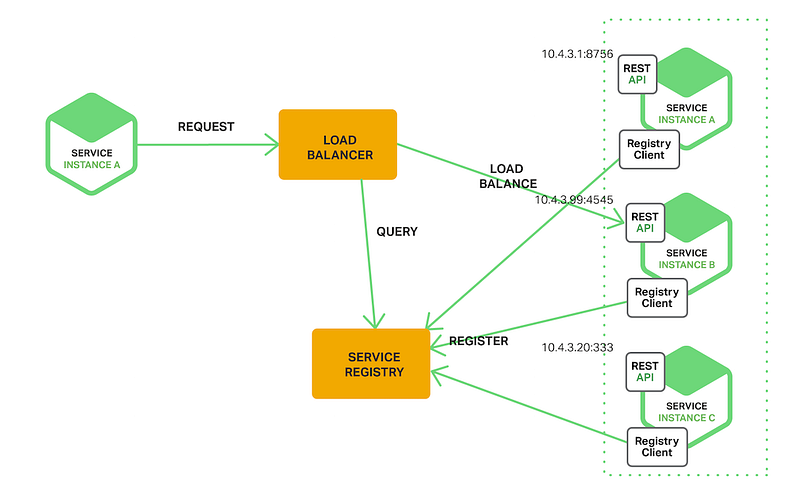
The Service Registry pattern, a central registry or service registry acts as a directory for all the services in the system, providing a way for services to register themselves and for clients to discover and locate the available services.
Here’s how the Service Registry pattern typically works:
- Service Registration: When a microservice starts, it registers itself with the Service Registry by providing its metadata, such as service name, endpoint URL, version, and other relevant information.
- Service Discovery: Clients, which are other microservices or applications, can then query the Service Registry to discover the available services and their respective endpoints. This allows services to dynamically discover and locate other services without hard-coding their endpoints, enabling flexibility and scalability in a distributed system.
- Load Balancing: The Service Registry can also be used for load balancing. It can keep track of the health status of registered services and distribute incoming requests to available and healthy instances of the service. This helps in achieving load balancing across multiple instances of a service, ensuring optimal utilization of resources and high availability.
- Dynamic Updates: The Service Registry allows services to dynamically update their registration information, such as IP address, port, or health status, so that clients always have up-to-date information about the available services.
- Fault Tolerance: The Service Registry can also provide fault tolerance by monitoring the health of registered services and automatically removing failed or unresponsive services from the registry. This ensures that clients do not attempt to communicate with unavailable or unhealthy services.
Overall, the Service Registry pattern plays a crucial role in enabling dynamic discovery, load balancing, and fault tolerance in a microservices architecture, making it a key component for building scalable and resilient microservices-based applications.
Here is a nice diagram which shows how Service registry pattern works in Microservice architecture:

How to use Service Registry Pattern in Java Microservice using Spring cloud? Example
Here’s an example of implementing the Service Registry pattern using Spring Cloud and Netflix Eureka, which is a popular service registry and discovery solution for building microservices-based applications in Spring
In this example, the Eureka server acts as the service registry, and microservices can register themselves with the Eureka server by using the @EnableDiscoveryClient annotation.
Clients can then discover the available services by querying the Eureka server, which provides the necessary metadata, such as service name and endpoint URL, for locating the services.
Here are the steps to setup Eureka Server as Service Registry in Java Microservices with Spring Boot and Spring Cloud:
- Add the required dependencies to your Spring Boot project’s
pom.xmlfile:
<!-- Spring Cloud Eureka Server -->
<dependency>
    <groupId>org.springframework.cloud</groupId>
    <artifactId>spring-cloud-starter-netflix-eureka-server</artifactId>
</dependency>
2. Add the @EnableEurekaServer annotation to your Spring Boot application's main class to enable the Eureka server:
@SpringBootApplication
@EnableEurekaServer
public class ServiceRegistryApplication {
    public static void main(String[] args) {
        SpringApplication.run(ServiceRegistryApplication.class, args);
    }
}
3. Configure the Eureka server properties in the application.properties or application.yml file:
spring.application.name=service-registry
server.port=8761
eureka.client.register-with-eureka=false
eureka.client.fetch-registry=false
4. Register your microservices with the Eureka server using the @EnableDiscoveryClient annotation in your microservices' main classes:
@SpringBootApplication
@EnableDiscoveryClient
public class MyMicroserviceApplication {
    public static void main(String[] args) {
        SpringApplication.run(MyMicroserviceApplication.class, args);
    }
}
5. Access the Eureka server’s dashboard to view the registered services and their endpoints. The dashboard is typically available at http://localhost:8761 by default.

Btw, This is just a simple example, and there are many other configurations and features available in Spring Cloud and Netflix Eureka for advanced use cases, such as load balancing, service health monitoring, and security. Please refer to the official documentation for more information.
Pros and Cons of Service Registry Design Pattern in Microservice Architecture
The Service Registry pattern in microservices architecture has several pros and cons:
Here are the pros and key benefits of using Service Registry pattern in Microservices:
- Dynamic Service Discovery: Services can register and un-register themselves with the service registry at runtime, allowing for dynamic service discovery. This makes it easier to add, remove, or update services without having to manually configure and update service endpoints in clients.
- Load Balancing: Service registry can provide load balancing capabilities by distributing requests among multiple instances of the same service. This can improve the scalability and availability of microservices, as well as optimize resource utilization.
- Fault Tolerance: Service registry can detect and automatically remove failed or unresponsive services from its registry, reducing the impact of service failures and improving the overall fault tolerance of the system.
- Scalability: Service registry can be scaled horizontally to handle large numbers of services and clients, making it suitable for large-scale microservices architectures.
- Centralized Configuration: Service registry can store metadata and configuration information about services, allowing for centralized configuration management and reducing the need for duplicating configuration in each microservice.
Now that we have seen all the pros, its time to look into compromises you need to make and all the cons which comes with Service registry pattern in Microservice architecture:
- Additional Infrastructure: Service registry introduces additional infrastructure components, such as the service registry server, that need to be deployed, managed, and maintained. This may add complexity to the overall system architecture and operational overhead.
- Single Point of Failure: This is probably the biggest risk when you use Service registry pattern in Microservices. If the service registry server becomes unavailable, it can impact the availability of the entire system, as clients may not be able to discover services or perform load balancing. This requires careful design and configuration to ensure high availability and fault tolerance of the service registry.
- Increased Latency: Service discovery through a service registry may introduce additional network latency, as clients need to query the service registry to discover the location of services. This may impact the performance of the system, especially in high-traffic scenarios.
- Coupling to Service Registry: Clients need to be aware of the service registry and use its APIs to discover services, which may introduce coupling between clients and the service registry. This can make it harder to switch to a different service registry or change the discovery mechanism in the future.
- Complexity: Implementing and managing a service registry adds complexity to the microservices architecture, and requires additional development efforts, testing, and operational considerations. It may not be necessary for small or simple microservices architectures where service discovery can be achieved through other means, such as static configurations or DNS-based approaches.
Overall, the Service Registry pattern provides dynamic service discovery, load balancing, and fault tolerance benefits in microservices architectures, but also introduces additional complexity and operational overhead.
You need to take a call whether to us this pattern or not depending upon the specific requirements and trade-offs of the system architecture before adopting the Service Registry pattern.

Java and Spring Interview Preparation Material
Before any Java and Spring Developer interview, I always read the below two resources
Grokking the Java Interview: click here
I have personally bought these books to speed up my preparation.
You can get your sample copy here, check the content of it and go for it
Grokking the Java Interview [Free Sample Copy]: click here

If you want to prepare for the Spring Boot interview you follow this consolidated eBook, it also contains microservice questions from spring boot interviews.
Grokking the Spring Boot Interview
You can get your copy here — Grokking the Spring Boot Interview

Conclusion
In conclusion, the Service Registry pattern is a popular approach in microservices architecture for dynamic service discovery, load balancing, and fault tolerance. It provides several benefits, such as enabling services to register and un-register themselves at runtime, distributing requests among multiple service instances, and automatically detecting and removing failed services.
However, it also introduces additional complexity, operational overhead, and potential single points of failure. It is important to carefully consider the specific requirements and trade-offs of the system architecture before adopting the Service Registry pattern.
Proper configuration, monitoring, and maintenance of the service registry are also critical to ensure high availability and reliability of the microservices ecosystem.
Overall, the Service Registry pattern can be a powerful tool in building scalable and resilient microservices architectures, but it should be used judiciously and in alignment with the overall system design and requirements.
By the way, if you are new to Microservice architecture or just want to revise key Microservice concepts and looking for resources then here are few online courses you can join:
- Master Microservices with Spring Boot and Spring Cloud [Udemy]
- Building Scalable Java Microservices with Spring Boot [Coursera]
- Developing Microservices with Spring Boot [Educative]
- Master Microservices with Java, Spring, Docker, Kubernetes [Udemy]
This list includes both video and text-based courses as well as project based courses for hands-on learning, you can join one or a couple of them to revise Microservices concepts. If you need more choices, you can see the below articles:
And, if you need more choices, you can also checkout following resources:
Other Microservices articles you may like:


