
Scientists Confirm the Discovery of Australia’s Largest Dinosaur
Australotitan is among the largest dinosaurs to have ever existed worldwide...
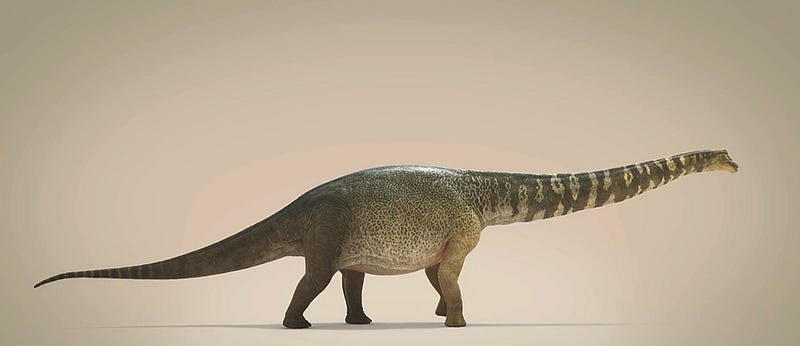
Paleontologists from the Queensland and Eromanga Natural History Museum discovered a new species of a long-necked dinosaur in southwest Queensland that has been officially recognized as the largest ever found in Australia and among the biggest in the world.
The name of the new dinosaur accurately reflects its enormous size: Australotitan cooperensis meaning the “titan of the south”. The specific name cooperensis refers to Cooper Creek, the area near the town of Eromanga in western Queensland where the fossils were originally discovered in 2007.
Description
Australotitan belongs to the iconic group of dinosaurs known as sauropods. These creatures had very long necks, long tails, small heads, and four thick, pillar-like legs. Sauropods are notable for their enormous sizes, and the group includes the largest animals to have ever lived on land. Well-known sauropod genera include Brachiosaurus, Diplodocus, and Brontosaurus.
Australotitan was enormous even by sauropod standards. Scientists estimate it could have grown to around 25–30 meters (82–98 ft) in length and could have easily reached the height of a two-story house. Its mass is a little harder to estimate, but scientists say it could have weighed up to 74 tonnes — or about 9 African elephants!
Those impressive statistics put the “southern titan” in the top 10 to 15 biggest dinosaurs ever found across the world. As far as Australia goes, the new dinosaur is well beyond the middling species previously found in the continent.
Discovery
Australotitan remains were first uncovered near Cooper Creek in the Eromanga Basin in 2007. The original specimen includes the dinosaur’s shoulder blades, limb, and pelvic bones, many of them intact. The remote location, size, and fragility of the dinosaur bones contributed to a delay in officially determining that the remains belonged to a previously unknown species.
“Such big, fragile bones literally took years to prepare and clean,” said Robyn Mackenzie, a field paleontologist who helped unearth the valuable fossil. Mackenzie and colleagues nicknamed the original specimen Cooper and noticed crush marks on some of its bones. After close examination they suggested Cooper had been trampled by other sauropods after its death.
“We came across a trample zone, which is basically trampled mud that has solidified and hardened into a rock shelf,” said Dr. Scott Hocknull, a paleontologist at the Queensland Museum. The finding indicated the area was either a walkway for dinosaurs or more likely the edge of a billabong where dinosaurs came to drink — similar to a modern waterhole, he said.
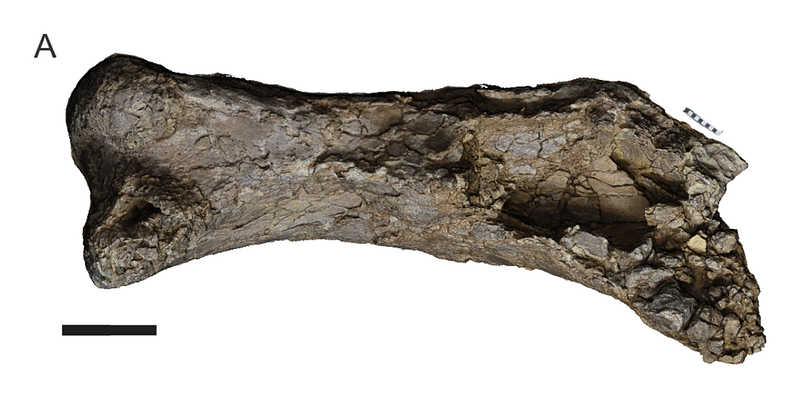
A second Australotitan specimen has also been discovered at Eromanga. Nicknamed George it was significantly larger than Cooper: the estimated size of its femur was 2.2m (7.2 ft) long, compared to Cooper’s 1.9m (6.2 ft). George’s bones, however, are more fragmented, making them more difficult to study.
Classification
Phylogenetic analysis showed Australotitan was a titanosaur. Titanosaurs were the most successful and diverse group of sauropods that conquered all continents, including Antarctica.They were also the last surviving family of sauropods with members existing right till the end of the Cretaceous Period 66 million years ago.
Australotitan itself lived between 92 and 96 million years ago and was closely related to three smaller Australian titanosaurs found from the nearby Winton Formation.
“We compared the three species found to the north, near Winton, to our new Eromanga giant and it looks like Australia’s largest dinosaurs were all part of one big happy family,” says Dr. Hocknull.
“Australotitan was the largest in the family, followed by Wintonotitan with big hips and long legs, whilst the two smaller sauropods, Diamantinasaurus and Savannasaurus were shorter in stature and heavily-set.”
Dr. Hocknull suggests it was possible the four species evolved from each other, and into different habitats. “At the time the dinosaurs were moving around in this Eromanga area, it was the last of the great inland sea, which had covered parts of Australia for tens of millions of years,” he said.
Epilogue
Australotitan is the largest dinosaur yet found in Australia. According to Dr. Hocknull, the latest discovery will help better understand the changing story of Queensland, hundreds of millions of years in the making.
The Queensland state government also welcomed Australotitan’s discovery, calling it a boon for local paleontological research. In the words of Dr. Jim Thompson, chief executive of the Queensland Museum Network:
“Australia is one of the last frontiers for dinosaur discovery and Queensland is quickly cementing itself as the palaeo-capital of the nation — there is still plenty more to discover.”
The paper describing Australotitan was published in the journal PeerJ on June 7, 2021.
Relevant Reads
References
Hocknull SA, Wilkinson M, Lawrence RA, Konstantinov V, Mackenzie S, Mackenzie R (2021). “A new giant sauropod, Australotitan cooperensis gen. et sp. nov., from the mid-Cretaceous of Australia”. PeerJ. 9: e11317. doi:10.7717/peerj.11317
“Scientists say new dinosaur species is largest found in Australia”. BBC News. Retrieved 8 June 2021.


