avatarNima Torabi

Free AI web copilot to create summaries, insights and extended knowledge, download it at here

18843

Abstract

rkets or industries. <b>3) </b>Strengthening brand presence and competitiveness. <b>iv) Harvesting Phase: Objective: </b>Sustain product-market fit and maximize profitability. <b>Key Focus Areas: 1) </b>Optimizing product performance and efficiency. <b>2) </b>Retaining existing customers through superior service and support. <b>3) </b>Extracting maximum value from the product’s existing customer base. <b>v) End-of-Life Phase: Objective: </b>Sunset the product gracefully while minimizing disruption to stakeholders. <b>Key Focus Areas: 1) </b>Communicating product discontinuation plans to customers and stakeholders. 2) Providing transition support and migration pathways for users. <b>3) </b>Preserving brand reputation and goodwill through transparent and respectful closure processes.</i></li></ul><figure id="cc38"><img src="https://cdn-images-1.readmedium.com/v2/resize:fit:800/1*2A1k5c9b-2gOBEGW5temwA.png"><figcaption><b>Efficient Resource Allocation Across Product Lifecycle Phases — </b>Resource allocation across different phases of the product lifecycle, ensuring alignment with strategic objectives and maximizing value delivery to customers and stakeholders.</figcaption></figure><ul><li><b>Resource Allocation: </b>The resources available for product development and marketing may vary depending on the lifecycle stage. A roadmap must allocate resources efficiently, considering factors like <b>budget constraints, market demand</b>, and <b>competitive landscape</b> specific to each phase of the lifecycle. <i>Here’s how resource allocation could look like in each phase of the Product Lifecycle: <b>i) New Product Phase: Focus: </b>Rapid prototyping, market research, and initial product development. <b>Resource Allocation:</b> Allocate resources primarily to research and development, user testing, and building the core product features. Marketing efforts may be limited initially but should focus on creating awareness among early adopters. <b>ii) Growth Phase: Focus: </b>Scaling the product to reach a broader customer base and maximize revenue generation. <b>Resource Allocation: </b>Increase resources for product development to enhance scalability, improve user experience, and introduce new features based on customer feedback. Marketing efforts should be intensified to capitalize on market momentum and drive customer acquisition. <b>iii) Product Expansion Phase: Focus: </b>Broadening the product’s horizons and exploring new market segments. <b>Resource Allocation: </b>Allocate resources to research and development for expanding product functionality and addressing emerging market needs. Marketing efforts should focus on promoting new features and targeting niche customer segments. <b>iv) Harvesting Phase: Focus: </b>Sustaining product-market fit and delivering ongoing value to existing customers. <b>Resource Allocation: </b>Prioritize resources for continuous product improvements based on customer feedback and market trends. Marketing efforts should emphasize customer retention strategies, such as loyalty programs and personalized communication. <b>v) End-of-Life Phase: Focus: </b>Sunsetting the product and facilitating a smooth transition for customers and stakeholders. <b>Resource Allocation: </b>Allocate resources to manage the end-of-life process, including customer communication, data migration, and product discontinuation. Marketing efforts should focus on managing the brand’s reputation and providing support to affected customers.</i></li></ul><figure id="d191"><img src="https://cdn-images-1.readmedium.com/v2/resize:fit:800/1*oUVxOaztVNYbJcfQfZn9Yw.png"><figcaption><b>Risk Management Strategies Across Product Lifecycle Phases — </b>Risk management strategies are tailored to each phase of the product lifecycle, empowering product managers to proactively mitigate risks and capitalize on opportunities inherent to each stage.</figcaption></figure><ul><li><b>Risk Management: </b>The level of risk associated with product development and market acceptance fluctuates throughout the lifecycle. A roadmap should account for these risks by <b>prioritizing initiatives that mitigate uncertainty</b> and <b>capitalize on opportunities presented by the current stage of the lifecycle</b>. <i>Here’s how risk management could manifest in each phase of the Product Lifecycle (PLC): <b>i) New Product Phase: Risk: </b>Uncertainty regarding product-market fit and acceptance. <b>Mitigation Strategy: </b>Focus on rapid prototyping and customer validation to test assumptions and iterate quickly. <b>Opportunity: </b>Capitalize on early adopters’ feedback to refine the product and establish a strong market foothold. <b>ii) Growth Phase: Risk: </b>Scaling challenges, increased competition, and changing market dynamics. <b>Mitigation Strategy: </b>Invest in scalability, infrastructure, and customer support to sustain growth momentum. <b>Opportunity: </b>Expand market reach, penetrate new segments, and enhance product features to capture a larger share of the market. <b>iii) Product Expansion Phase: Risk: </b>Market saturation, dilution of brand identity, and diversification challenges. <b>Mitigation Strategy: </b>Conduct thorough market research to identify untapped opportunities and ensure alignment with core product objectives. <b>Opportunity: </b>Introduce innovative features or extensions to address emerging needs in adjacent markets while leveraging existing brand equity. <b>iv) Harvesting Phase: Risk: </b>Declining market demand, customer churn, and technological obsolescence. <b>Mitigation Strategy: </b>Prioritize customer retention, product optimization, and cost efficiency to maximize profitability. <b>Opportunity: </b>Focus on delivering exceptional customer value, streamlining operations, and extending the product’s lifecycle through incremental improvements. <b>v) End-of-Life Phase: Risk: </b>Negative impact on brand reputation, customer dissatisfaction, and legal/regulatory compliance issues. <b>Mitigation Strategy: </b>Develop a comprehensive end-of-life plan, including communication strategies, customer transition assistance, and asset disposal procedures. <b>Opportunity: </b>Extract remaining value from the product through asset monetization, brand legacy preservation, and seamless customer transition to alternative solutions.</i></li></ul><figure id="a004"><img src="https://cdn-images-1.readmedium.com/v2/resize:fit:800/1*A7CzXJ4r7vN1yNlGph2o_w.png"><figcaption><b>Adaptability and Flexibility Strategies Across Product Lifecycle Phases — </b>Roadmap and product adaptability and flexibility tailored to each phase of the product lifecycle, enabling teams to effectively respond to changing market dynamics and evolving customer needs.</figcaption></figure><ul><li><b>Adaptability and Flexibility: </b>Products evolve, and roadmaps must be adaptable to accommodate changes in customer preferences, technological advancements, and competitive dynamics. By aligning roadmap initiatives with the product lifecycle stage, <b>teams can remain agile and responsive to market shifts</b>. <i>Here’s how adaptability and flexibility could manifest in each phase of the Product Lifecycle: <b>i) New Product Phase: Adaptability: </b>Rapidly iterate on prototypes and gather feedback to pivot direction based on early validation results. <b>Flexibility: </b>Adjust the roadmap frequently based on emerging insights and market feedback, allowing for quick adaptation to changing circumstances.<b> ii) Growth Phase: Adaptability: </b>Scale resources and infrastructure to accommodate increasing demand, responding promptly to user feedback and market trends. <b>Flexibility: </b>Prioritize features and enhancements that drive user acquisition and retention, while remaining open to pivoting strategies based on evolving customer needs. <b>iii) Product Expansion Phase: Adaptability: </b>Explore new market segments and customer demographics, adjusting product features and marketing strategies accordingly. <b>Flexibility: </b>Experiment with innovative functionalities and partnerships to capitalize on emerging opportunities, while staying nimble in response to competitive pressures. <b>iv) Harvesting Phase: Adaptability: </b>Continuously refine existing features based on customer feedback and usage data, optimizing for user satisfaction and retention. <b>Flexibility: </b>Consider diversifying revenue streams or repackaging existing features to prolong product relevance, while also preparing for a graceful exit if necessary. <b>v) End-of-Life Phase: Adaptability: </b>Wind down operations gradually, while providing support and migration options for remaining customers. <b>Flexibility: </b>Communicate transparently with stakeholders about the product’s sunset process, allowing for adjustments in plans and strategies as needed to ensure a smooth transition out of the market.</i></li></ul><p id="5004" type="7">In essence, the product lifecycle serves as a guiding framework for building effective product roadmaps by providing context, setting priorities, and informing strategic decision-making throughout the product’s journey from inception to retirement.</p><p id="d4ab" type="7">Understanding where a product resides within its lifecycle enables product managers to create roadmaps that maximize value delivery, drive growth, and ensure long-term success in the marketplace.</p><figure id="43a5"><img src="https://cdn-images-1.readmedium.com/v2/resize:fit:800/1*NfJD7EgDM2wSt84bs3xFrQ.png"><figcaption></figcaption></figure><h1 id="bb48">Finding this article useful?</h1><p id="c9f5" type="7">For more insights like this, be sure to follow me on Medium and subscribe to get my updates in your email.</p><div id="7787" class="link-block"> <a href="https://neemz.medium.com/subscribe"> <div> <div> <h2>Get an email whenever Nima Torabi publishes.</h2> <div><h3>Get an email whenever Nima Torabi publishes. By signing up, you will create a Medium account if you don’t already have…</h3></div> <div><p>neemz.medium.com</p></div> </div> <div> <div style="background-image: url(https://miro.readmedium.com/v2/resize:fit:320/0*pGAdl_xK7Grrr4eZ)"></div> </div> </div> </a> </div><figure id="a963"><img src="https://cdn-images-1.readmedium.com/v2/resize:fit:800/1*NfJD7EgDM2wSt84bs3xFrQ.png"><figcaption></figcaption></figure><figure id="b3ce"><img src="https://cdn-images-1.readmedium.com/v2/resize:fit:800/0*gfTbLrGqc5c3OUY5"><figcaption>Photo by <a href="https://unsplash.com/@productschool?utm_source=medium&amp;utm_medium=referral">Product School</a> on <a href="https://unsplash.com?utm_source=medium&amp;utm_medium=referral">Unsplash</a></figcaption></figure><h1 id="30d2">The Crucial Role of Understanding the External Business Ecosystem in Effective Roadmapping</h1><p id="2068">Effective product development and roadmapping are more than feature ideation. They require a deep grasp of the ecosystem surrounding your product, including industry dynamics, competitor landscapes, and emerging trends. Success lies in understanding external factors, prioritizing problem-solving approaches, and harnessing customer insights for validation and growth.</p><h2 id="db5f">The Significance of Understanding Your Ecosystem</h2><p id="276e">At the core of effective roadmapping lies a deep understanding of the business ecosystem. This entails comprehending <b>not only your immediate market but also the broader industry dynamics</b>, <b>competitor landscape</b>, and <b>emerging trends</b>. By gaining insights into these aspects, product teams can make informed decisions, anticipate market shifts, and align their roadmap with strategic objectives.</p><h2 id="75cb">Shared Knowledge and Responsibility</h2><p id="083d">Contrary to the misconception that understanding the business landscape is solely the responsibility of the product manager, effective roadmapping requires a <b>collective effort</b> from the entire team. <b>Each member should possess a basic understanding of the business environment</b>, enabling them to contribute valuable insights and perspectives to the roadmap. <b>Fostering a culture of shared knowledge ensures alignment and empowers teams to make data-driven decisions</b>.</p><h2 id="1221">Tools and Techniques for Gathering Business Knowledge</h2><p id="8bf6">An array of tools and techniques exists to gather data and insights for effective roadmapping. Business model canvases, such as the Lean Canvas and Business Model Canvas, serve as invaluable frameworks for analyzing key aspects of your business, including problem-solution fit, value proposition, customer segments, and revenue model. Additionally, market research, competitor analysis, and customer feedback mechanisms provide rich sources of data to inform roadmap decisions.</p><figure id="9870"><img src="https://cdn-images-1.readmedium.com/v2/resize:fit:800/0*pTnXikOZfRbQ0ECc.png"><figcaption>The Business Model for Ecosystem Analysis</figcaption></figure><figure id="28b1"><img src="https://cdn-images-1.readmedium.com/v2/resize:fit:800/0*jSJH0X92iMDk14Dx.png"><figcaption>The Lean Canvas for Ecosystem Analysis</figcaption></figure><h2 id="f5b3">Conducting Business Model Analysis</h2><p id="fc4c">Central to understanding your business ecosystem is conducting a thorough business model analysis. This involves<b> dissecting the various components of your business model</b> and <b>identifying strengths, weaknesses, opportunities</b>, and <b>threats</b>. By scrutinizing elements such as <b>problem-solution fit</b>, <b>customer segments</b>, and <b>revenue streams</b>, product teams can uncover insights to drive roadmap prioritization and strategic planning.</p><h2 id="f37e">Selecting the Right Tools for the Job</h2><p id="1eb3">The choice of tools for gathering data and insights depends on the stage of your product or business. For startups, Lean Canvas offers a lightweight framework to iterate quickly and validate hypotheses. Conversely, established products may benefit from the comprehensive approach of the Business Model Canvas to refine existing strategies and explore new opportunities. Evaluating the unique needs and constraints of your business guides the selection of the most suitable tools.</p><h2 id="85ee">The Importance of Understanding</h2><p id="5646">Ultimately, the success of your product roadmap hinges on a fundamental understanding of the business landscape. Without this foundation, <b>roadmapping becomes an exercise in guesswork</b>, fraught with risks and uncertainties. By investing time and effort into gathering data and insights, product teams equip themselves with the knowledge needed to navigate challenges, seize opportunities, and steer their product toward success.</p><h2 id="f655">Shifting Focus from Features to Problems</h2><p id="a4c4">Effective roadmapping practices stay away from fixating on features rather than addressing underlying problems and recognize the <b>importance of identifying and solving customer pain points</b>. By prioritizing problems over features, product teams ensure that their solutions are <b>aligned with real-world needs</b>, fostering greater user satisfaction and product success.</p><h2 id="34c4">Understanding the Customer and the Significance of Customer Discovery</h2><p id="3e94">At the heart of problem-centric solutions lies a deep understanding of the customer. By <b>empathizing with their needs, challenges</b>, and<b> aspirations,</b> product teams can craft solutions that resonate on a profound level, especially when product teams gather <b>validated learning through continuous customer feedback</b>. This iterative approach allows teams to refine their solutions based on real-world outcomes, ensuring relevance and effectiveness.</p><div id="c0a7" class="link-block"> <a href="https://neemz.medium.com/customer-development-a-product-managers-top-priority-6fa6b948464"> <div> <div> <h2>Customer Development: a product manager’s top priority</h2> <div><h3>A guide to customer discovery, customer validation, customer creation, and customer building</h3></div> <div><p>neemz.medium.com</p></div> </div> <div> <div style="background-image: url(https://miro.readmedium.com/v2/resize:fit:320/0*nN5SQsPE89tXqkuK.png)"></div> </div> </div> </a> </div><p id="0f09">Steve Blank’s renowned Customer Development Model provides a structured framework for gathering insights and validating solutions.</p><ul><li>The journey begins with <b>Customer Discovery</b>, where teams seek to understand customer problems and needs through direct interaction.</li><li>This phase is followed by <b>Customer Validation</b>, where the viability of the solution is tested by gauging customer willingness to pay.</li><li>Subsequent stages, including <b>Customer Creation </b>and <b>Company Building</b>, focus on scaling success and formalizing the product-market fit.</li></ul><p id="c301">The cornerstone of effective roadmapping is a thorough understanding of customer problems and needs. Through methods such as <b>interviews, surveys</b>, and<b> observational research</b>, product teams gain valuable insights into the pain points that drive user behavior. By empathizing with customers and uncovering latent needs, teams lay the groundwork for crafting solutions that deliver tangible value.</p><h2 id="8d92">Validating Solutions through Customer Feedback</h2><p id="005f">Customer Validation serves as a critical checkpoint in the roadmapping process, where teams seek to validate the viability of their solutions. By presenting prototypes or MVPs to target customers and gauging their willingness to pay, teams gain valuable feedback that informs subsequent iterations. This iterative approach fosters a culture of continuous improvement, driving product evolution in line with customer expectations.</p><h2 id="508f">Driving Growth through Customer Creation</h2><p id="f7d2">Building on validated solutions, the Customer Creation phase focuses on driving demand and nurturing a sustained sales pipeline. By leveraging early successes and customer testimonials, product teams demonstrate the value proposition of their solutions, attracting new users and fostering loyalty. This phase marks the transition from product validation to market expansion, laying the foundation for sustainable growth.</p><h2 id="9080">Impact on the Roadmap</h2><p id="de54">Understanding the external business ecosystem plays a crucial role in effective roadmapping by providing essential insights and guiding strategic decisions. He

Options

re’s how it aids in effective roadmapping and how it should be reflected on the roadmap:</p><ul><li><b>Informed Decision-Making: </b>Understanding the broader industry dynamics, competitor landscape, and emerging trends allows product teams to make informed decisions when <b>prioritizing features </b>and<b> setting strategic objectives on the roadmap</b>. Reflecting this understanding on the roadmap ensures that development efforts are aligned with the current market landscape and strategic goals.</li><li><b>Anticipation of Market Shifts: </b>By comprehending the external business ecosystem, product teams can anticipate market shifts and trends, enabling them to proactively <b>adjust their roadmap to capitalize on emerging opportunities or mitigate potential threats</b>. This proactive approach ensures that the product remains competitive and relevant in a rapidly evolving market environment.</li><li><b>Alignment with Strategic Objectives: </b>Reflecting the understanding of the external business ecosystem on the roadmap helps <b>ensure alignment with strategic objectives</b>. By considering factors such as <i>market demand, competitor activities</i>, and<i> industry trends</i>, product teams can prioritize features and initiatives that contribute directly to the achievement of overarching business goals.</li><li><b>Risk Mitigation: </b>Understanding the external business ecosystem allows product teams to identify potential risks and uncertainties that may impact the product roadmap. By acknowledging these risks on the roadmap and developing contingency plans, teams can mitigate the negative impact of external factors on product development and ensure smoother execution of the roadmap.</li><li><b>Enhanced Stakeholder Communication: </b>Transparently reflecting the understanding of the external business ecosystem on the roadmap enhances communication with stakeholders. It provides stakeholders with a comprehensive view of the factors influencing product development decisions and instills confidence in the roadmap’s strategic direction.</li></ul><p id="4ff4" type="7">Incorporating an understanding of the external business ecosystem into the product roadmap ensures that development efforts are strategically aligned, risks are mitigated, and opportunities are capitalized upon. It empowers product teams to navigate the complexities of the market landscape with clarity and purpose, driving sustained success and growth for the product and the organization.</p><figure id="477c"><img src="https://cdn-images-1.readmedium.com/v2/resize:fit:800/1*NfJD7EgDM2wSt84bs3xFrQ.png"><figcaption></figcaption></figure><h1 id="ff52">I’d love to hear your thoughts!</h1><p id="4a48" type="7">Share your insights and feedback in the comments below and let’s continue this discussion.</p><figure id="a944"><img src="https://cdn-images-1.readmedium.com/v2/resize:fit:800/1*NfJD7EgDM2wSt84bs3xFrQ.png"><figcaption></figcaption></figure><figure id="deb4"><img src="https://cdn-images-1.readmedium.com/v2/resize:fit:800/0*iQrLtk6smSF3xt2M"><figcaption>Photo by <a href="https://unsplash.com/@blakewisz?utm_source=medium&amp;utm_medium=referral">Blake Wisz</a> on <a href="https://unsplash.com?utm_source=medium&amp;utm_medium=referral">Unsplash</a></figcaption></figure><h1 id="b406">Customer-Centric Product Roadmapping</h1><p id="d9cc">Product roadmapping success hinges not only on innovative features or cutting-edge technology but also on a deep understanding of the customers for whom the product is intended by delving deep into their world and empathizing with their needs, frustrations, and aspirations.</p><h2 id="a2ed">Importance of Understanding Customers</h2><p id="6e5f">At the heart of any successful product development endeavor lies a profound understanding of the target customers. This understanding goes beyond mere demographics; it entails <b>grasping customers’ jobs</b>, <b>wants</b>, <b>needs, obstacles, frustrations</b>, and <b>emotions</b>.</p><p id="e444" type="7">Every item on the product roadmap should be aligned with addressing an actual customer need, emphasizing the paramount importance of customer-centricity in the development process.</p><p id="81ec">The product roadmap should clearly outline the types of value that each feature is expected to create. A highly effective framework for articulating this value is Bain’s Elements of Value, which applies to both <a href="https://www.bain.com/insights/elements-of-value-interactive/">B2C</a> and <a href="https://www.bain.com/insights/explore-the-b2b-elements-of-value-interactive/">B2B</a> products. This framework provides a comprehensive set of elements that customers perceive as valuable, ranging from functional benefits to emotional rewards. By aligning each feature with specific elements of value, product managers can ensure that they are addressing diverse customer needs and preferences. This not only enhances the attractiveness of the product but also strengthens customer satisfaction and loyalty.</p><div id="a0ea" class="link-block"> <a href="https://www.bain.com/insights/elements-of-value-interactive/"> <div> <div> <h2>Explore the B2C Elements of Value</h2> <div><h3>What do consumers value? Bain research has identified 30 Elements of Value in four categories.</h3></div> <div><p>www.bain.com</p></div> </div> <div> <div style="background-image: url(https://miro.readmedium.com/v2/resize:fit:320/0*MwVnhnERfK4JlDK2)"></div> </div> </div> </a> </div><div id="be1a" class="link-block"> <a href="https://www.bain.com/insights/explore-the-b2b-elements-of-value-interactive/"> <div> <div> <h2>Explore the B2B Elements of Value</h2> <div><h3>What do your B2B customers value? Bain has identified 40 Elements of Value across five categories that can help…</h3></div> <div><p>www.bain.com</p></div> </div> <div> <div style="background-image: url(https://miro.readmedium.com/v2/resize:fit:320/0*gMzNzzKVL_NnvJ6C)"></div> </div> </div> </a> </div><h2 id="cbc8">Customer Roles</h2><p id="23b9">One fundamental aspect of understanding customers is identifying their roles within the product ecosystem. User roles delineate the specific jobs and functions performed by different individuals. For instance, platforms like Lynda.com exemplify how recognizing user roles, such as students and instructors, facilitates the creation of a product that caters to the diverse needs of all stakeholders.</p><p id="31c0">On the product roadmap, the identification of customer roles should be reflected by <b>clearly delineating the features or functionalities that cater to each role within the product ecosystem</b>. This can be achieved through <b>categorization or tagging of features</b> based on the primary user roles they serve. For example:</p><ul><li><b>Feature Categorization: </b>Features can be grouped or categorized on the roadmap according to the primary user roles they address. Each category can represent a distinct user role, such as “Student Features” and “Instructor Features” in the case of Lynda.com. This allows stakeholders to easily identify which features are relevant to specific user segments.</li><li><b>Tagging or Labeling: </b>Alternatively, individual features on the roadmap can be tagged or labeled with the corresponding user roles they cater to. This approach provides more granular detail, allowing stakeholders to understand the user role implications of each feature at a glance.</li><li><b>User Persona Integration: </b>If user personas have been developed as part of the product development process, the identified customer roles can be linked to these personas on the roadmap. For example, a feature benefiting “Professional Paul” may be associated with the “Student” user role. This integration provides a deeper context regarding the target audience and their needs.</li><li><b>Visual Representation: </b>Visual aids such as color-coding or icons can be used to visually represent different user roles and their associated features on the roadmap. This enhances clarity and comprehension, enabling stakeholders to quickly grasp how the product serves various user segments.</li></ul><p id="adf8">By incorporating customer roles on the product roadmap clearly and systematically, product teams can ensure alignment with user needs and facilitate informed decision-making throughout the development process.</p><h2 id="c6b8">User Types</h2><p id="68d9">Understanding user types is equally crucial, as it elucidates how individuals interact with the product and defines their permissions. Common user types, including end users, administrators, managers, and viewers, aid in categorizing users’ roles and tailoring product features accordingly. <b>Similar to user roles, user types should be presented on the product roadmap.</b></p><h2 id="c572">Users Versus Buyers</h2><p id="9b83">It is essential to distinguish between users and buyers, as they may not always be the same entity.</p><ul><li><b>While users utilize the product</b></li><li><b>Buyers make the purchasing decisions</b></li></ul><p id="fae8">This dichotomy becomes particularly pronounced in B2B2C contexts, where the buyer-user relationship varies significantly.</p><h2 id="27d2">Roles Versus Personas</h2><p id="d809">Differentiating between user roles and personas is instrumental in gaining a comprehensive understanding of customers.</p><ul><li><b>While user roles focus on categorizing customers based on their jobs and functions</b></li><li><b>Personas delve deeper into their characteristics, feelings, and preferences</b></li></ul><p id="a5ff">Integrating personas into the roadmap development process enables product teams to<b> empathize with customers on a more profound level</b> and design solutions that resonate with their needs and motivations. <b>Similar to user roles, user types should be presented on the product roadmap.</b></p><p id="12a3" type="7">By identifying customer roles, delineating user types, distinguishing users from buyers, and leveraging personas, product teams can gain invaluable insights that drive informed roadmap decisions. Ultimately, prioritizing customer-centricity empowers organizations to create products that not only meet but exceed the expectations of their target audience, fostering long-term success and customer satisfaction.</p><figure id="58c7"><img src="https://cdn-images-1.readmedium.com/v2/resize:fit:800/0*rt7WX0DGKrOcRgCx"><figcaption>Photo by <a href="https://unsplash.com/@varpap?utm_source=medium&amp;utm_medium=referral">Vardan Papikyan</a> on <a href="https://unsplash.com?utm_source=medium&amp;utm_medium=referral">Unsplash</a></figcaption></figure><h1 id="a232">Stakeholder Engagement and Effective Product Roadmapping</h1><p id="3b68">The success of a product hinges not only on its features and functionalities but also on the collaborative efforts of various stakeholders. From customers to executives, each stakeholder brings unique perspectives and expertise to the table, contributing to the formulation of a comprehensive product roadmap.</p><figure id="9017"><img src="https://cdn-images-1.readmedium.com/v2/resize:fit:800/1*7rdoyXBuiyiI_6DqgvQMYw.png"><figcaption><b>Stakeholders and Their Roles in Product Roadmapping — </b>The diverse stakeholders involved in product roadmapping and their specific roles in shaping the direction and priorities of product development, and the feedback they provide to inform roadmap decisions.</figcaption></figure><h2 id="414a">Understanding Stakeholder Roles and Contributions</h2><p id="068d">Before diving into the intricacies of stakeholder engagement, it’s crucial to identify the key players involved in the product development process. At its core, <b>the product core team</b> — comprising <b><i>product managers, designers</i></b>, and <b><i>engineers </i></b>— takes charge of designing, building, shipping, and maintaining the product. However, throughout the product lifecycle, additional stakeholders come into play, each with their roles and contributions.</p><ul><li><b>Customer-Centric Engagement: </b>As described in the previous section,<b> </b>customers lie at the heart of every successful product. Engaging with customers not only helps in understanding their needs and preferences but also fosters excitement about future product enhancements. By soliciting feedback on value propositions and priorities, product teams can ensure that their roadmap aligns with customer expectations and market demands.</li><li><b>Executive Alignment and Strategic Direction: </b>Executives play a pivotal role in shaping the strategic direction of the product. They seek to understand how resources are utilized and evaluate potential returns on investment (ROI). By providing strategic context and insights into customer acquisition and retention, executives guide product managers in making informed decisions that drive business growth.</li><li><b>Sales and Marketing Collaboration: </b>Sales and marketing teams act as bridges between the product and its target audience. Sales teams must be equipped to address inquiries about future product directions, while marketing teams prepare for product launches and promotions. By gathering feedback on customer motivations and market trends, these teams ensure that product messaging resonates with the target market.</li><li><b>Supporting Roles — Research, Operations, Finance, and more: </b>Beyond the core product team, various supporting roles contribute to the roadmap in diverse ways. Research teams provide valuable market insights to inform roadmap themes, while operations teams synchronize technical approaches and release schedules. Finance teams offer insights into planned spending and ROI targets, ensuring alignment with budgetary constraints.</li></ul><h2 id="aabe">Building a Collaborative Culture</h2><p id="758c">Creating a culture of collaboration is essential for effective stakeholder engagement and product roadmapping. By involving stakeholders at different stages of the roadmapping process, product teams foster alignment and shared ownership of the product vision. Regular communication channels and feedback mechanisms facilitate transparent decision-making and ensure that all stakeholders are heard and valued.</p><p id="9e2c" type="7">By embracing stakeholder engagement as a core principle, product teams can leverage the expertise and insights of various stakeholders to craft roadmaps that drive innovation, meet customer needs, and propel business growth. Through open communication, mutual respect, and a shared commitment to excellence, stakeholders can collaborate effectively toward a common goal of delivering exceptional products and experiences.</p><figure id="dddb"><img src="https://cdn-images-1.readmedium.com/v2/resize:fit:800/1*NfJD7EgDM2wSt84bs3xFrQ.png"><figcaption></figcaption></figure><h1 id="c55c">Finding this article useful?</h1><p id="4835" type="7">For more insights like this, be sure to follow me on Medium and subscribe to get my updates in your email.</p><div id="796a" class="link-block"> <a href="https://neemz.medium.com/subscribe"> <div> <div> <h2>Get an email whenever Nima Torabi publishes.</h2> <div><h3>Get an email whenever Nima Torabi publishes. By signing up, you will create a Medium account if you don’t already have…</h3></div> <div><p>neemz.medium.com</p></div> </div> <div> <div style="background-image: url(https://miro.readmedium.com/v2/resize:fit:320/0*pGAdl_xK7Grrr4eZ)"></div> </div> </div> </a> </div><figure id="9c44"><img src="https://cdn-images-1.readmedium.com/v2/resize:fit:800/1*NfJD7EgDM2wSt84bs3xFrQ.png"><figcaption></figcaption></figure><figure id="b555"><img src="https://cdn-images-1.readmedium.com/v2/resize:fit:800/0*75L0gTCc9mjUlXeH"><figcaption>Photo by <a href="https://unsplash.com/@raminix?utm_source=medium&amp;utm_medium=referral">Ramin Khatibi</a> on <a href="https://unsplash.com?utm_source=medium&amp;utm_medium=referral">Unsplash</a></figcaption></figure><h1 id="78ab">The Foundation of Effective Product Roadmapping</h1><p id="94f8">At the heart of every successful product roadmap lies a fundamental understanding of the product’s domain and its users. Ignoring this crucial aspect can lead to perilous pitfalls, wasting valuable time, effort, resources, and money.</p><p id="0e24" type="7">The path to a successful product roadmap begins with a solid understanding of the product domain and its users.</p><h2 id="dc02">Understanding the Product Domain and Users</h2><p id="f290">Creating a product roadmap without delving deep into the product’s domain and its users is a costly practice. Without a clear grasp of who the users are and what challenges they face, the roadmap risks being built on fictional scenarios and biased assumptions. This approach not only undermines the efficacy of the roadmap but also poses significant risks to the success of the product itself.</p><h2 id="d847">The Need for Up-Front Work</h2><p id="4e88">To lay a strong foundation for a successful product roadmap, thorough up-front work is critical. This involves <b>gathering or updating key inputs</b>, including understanding the <b>intricacies of the product domain, identifying user needs</b>, and<b> considering other relevant contextual factors</b>. Skipping this crucial step can leave the roadmap adrift, lacking direction and purpose.</p><h2 id="b141">Continuous Learning and Adaptation</h2><p id="2b65">In the fast-paced world of product development, learning is a continuous journey. As product leaders, it’s essential to embrace a mindset of continuous learning and adaptation.</p><p id="9afa" type="7">This involves gathering information, interpreting its impact on the product, and seamlessly integrating this knowledge into the roadmap. By adopting an iterative approach, product roadmaps remain agile, responsive, and aligned with organizational goals.</p><figure id="fc77"><img src="https://cdn-images-1.readmedium.com/v2/resize:fit:800/1*NfJD7EgDM2wSt84bs3xFrQ.png"><figcaption></figcaption></figure><h1 id="37d0">Thanks for reading!</h1><p id="4f28" type="7">To stay connected and get more insights like this, be sure to follow me on Medium.</p><p id="d2aa" type="7">As a fellow product enthusiast, be sure to connect with me on LinkedIn to continue this discussion, network, and access my professional network.</p></article></body>

BEYOND THE BUILD

Roadmapping Success: Data Gathering and EffectiveProduct Roadmaps

Building impactful and value-driven product roadmaps requires a multifaceted approach that encompasses gathering data and insights from various key elements. Beginning with understanding the external business ecosystem, product managers must grasp the intricate dynamics of the market landscape. This knowledge serves as the foundation for navigating the product life cycle strategically, ensuring that roadmapping efforts align with overarching business objectives. Customer-centricity is paramount in this process, necessitating a deep understanding of customer needs and behaviors to drive product development decisions. Moreover, stakeholder engagement plays a crucial role, as collaboration with internal teams and external partners ensures alignment and buy-in throughout the roadmapping journey. Ultimately, the role of gathering inputs becomes central, as it provides the data and insights necessary to craft roadmaps that drive innovation and success in today’s dynamic business environment.

Table of Contents

The Role of Gathering Inputs and Crafting Effective Product Roadmaps

Navigating the Product Life Cycle and Effective Roadmapping

The Crucial Role of Understanding the External Business Ecosystem in Effective Roadmapping

Customer-Centric Product Roadmapping

Stakeholder Engagement and Effective Product Roadmapping

The Foundation of Effective Product Roadmapping

Other reads related to Effective Product Roadmapping

Welcome!

If you found this article helpful, be sure to follow me on Medium to stay updated on and explore my publications..

The Role of Gathering Inputs and Crafting Effective Product Roadmaps

Creating a successful product roadmap is not merely about envisioning features or setting timelines.

It’s a comprehensive process that requires deep understanding, meticulous planning, and strategic alignment with various factors influencing product development.

One of the foundational steps in this process is gathering inputs from diverse sources including:

  • The Product and its Life Cycle Stage: Knowledge of the product life cycle stages provides crucial insights for roadmap planning. Anticipating the needs and challenges associated with each phase enables product managers to tailor their roadmap accordingly. For instance, during the growth phase, the roadmap may prioritize scaling efforts and feature enhancements to capitalize on market opportunities.
  • Market and Business Environment: Insights from the market and business environment serve as guiding lights for roadmap prioritization. Identifying market trends, competitor strategies, and emerging opportunities informs strategic decision-making. This information enables product managers to align the roadmap with market demands and stay ahead of competitors, ensuring the product’s relevance and competitiveness.
  • Customers: Customer input is invaluable for roadmap planning as it provides firsthand insights into user needs, preferences, and pain points. Integrating customer feedback into the roadmap ensures that product development efforts are customer-centric and aligned with real user problems. By understanding customer needs, product managers can prioritize features that deliver maximum value and enhance user satisfaction, fostering long-term loyalty and retention.
  • Stakeholders: Involving stakeholders in the roadmap creation process fosters alignment, collaboration, and buy-in across the organization. Stakeholders contribute diverse perspectives and expertise, enriching the roadmap with valuable insights and strategic direction. Their involvement helps product managers prioritize features, allocate resources effectively, and make decisions that align with organizational goals, driving overall success.

Gathering inputs from the sources above is indispensable for crafting effective product roadmaps.

These inputs provide the necessary context, insights, and direction needed to prioritize features, allocate resources, and make strategic decisions that drive product success and need to be reflected on the product roadmap.

These inputs provide the necessary context, insights, and direction needed to prioritize features, allocate resources, and make strategic decisions that drive product success. By incorporating diverse perspectives and aligning with market demands, product managers can navigate complexity with clarity and confidence, ultimately delivering products that meet user needs and exceed expectations.

Photo by Matt Duncan on Unsplash

Navigating the Product Life Cycle and Effective Roadmapping

There are five primary stages of the product life cycle and each phase presents unique challenges and opportunities, demanding careful planning and strategic roadmap navigation.
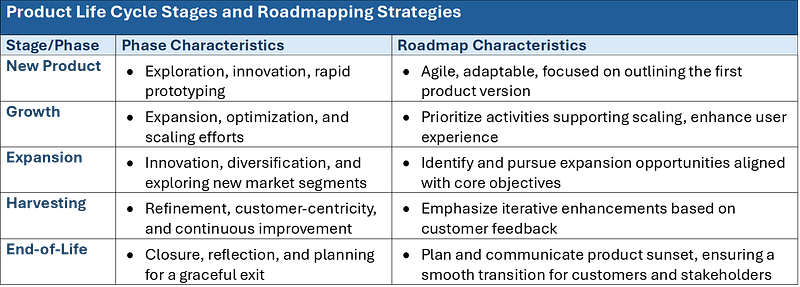
Product Life Cycle Stages and Roadmapping Strategies — From rapid prototyping in the New Product Phase to gracefully sunsetting the product in the End-of-Life Phase, each stage is characterized by specific objectives and roadmapping approaches aimed at maximizing product success and longevity.
  • New Product Phase [Development and Introduction/Launch]: The journey of a product begins with the inception of a new idea or concept. During the New Product Phase, product managers explore uncharted territory, making assumptions and rapidly prototyping to validate their concepts. Roadmapping in this phase is focused on outlining the creation of the product’s first version while remaining agile and adaptable to validation results. It’s a time of exploration, innovation, and experimentation, laying the foundation for future growth.
  • Growth Phase: As a product gains traction and establishes its presence in the market, it enters the Growth Phase. Here, the primary objective is to scale the product to reach a broader customer base and maximize revenue generation. Roadmapping during this phase prioritizes activities that support scaling efforts, such as enhancing user experience and addressing evolving customer needs. It’s a period of expansion and optimization, where strategic planning drives sustainable growth and market penetration.
  • Product Expansion Phase: In the Product Expansion Phase, opportunities arise to broaden the product’s horizons and explore new market segments. This phase involves introducing fresh functionality to address emerging needs while leveraging the success of the existing product. Roadmapping in this phase focuses on identifying expansion opportunities aligned with core product objectives, ensuring a seamless transition into new areas of growth. It’s a time of innovation and diversification, where strategic alignment drives product evolution and market leadership.
  • Harvesting [or Stabalization] Phase: With a mature product and a stable customer base, the focus shifts to sustaining the product-market fit and delivering ongoing value. The Harvesting Phase is characterized by continuous improvement based on customer feedback, ensuring the product remains relevant and useful. Roadmapping in this phase emphasizes iterative enhancements and optimizations, fostering customer loyalty and long-term sustainability. It’s a period of refinement and customer-centricity, where feedback drives product evolution and retention strategies.
  • End-of-Life [or Decline] Phase: Every product eventually reaches the end of its life cycle, necessitating careful planning and communication for a graceful exit. The End-of-Life Phase involves sunsetting the product with dignity and alignment across stakeholders. Roadmapping in this phase facilitates the closure process, ensuring a smooth transition for customers and stakeholders while preserving brand integrity. It’s a time of closure and reflection, where strategic planning guides the final stages of the product journey with integrity and professionalism.

The product lifecycle and building effective product roadmaps are closely intertwined because the stage of a product within its lifecycle dictates the priorities, objectives, and strategies that should be reflected in the roadmap.
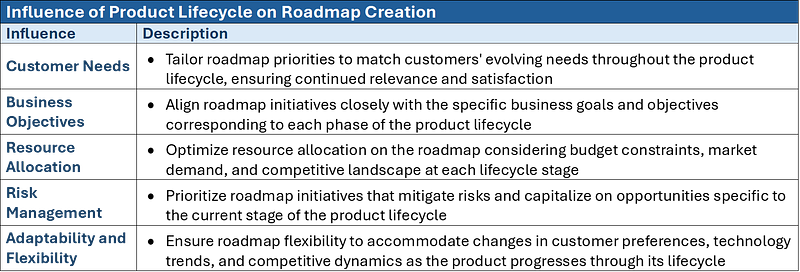
Influence of Product Lifecycle on Roadmap Creation — From understanding customer needs to ensuring adaptability and flexibility, these actions facilitate effective roadmap development tailored to the evolving stages of product maturity.

Here’s how the product lifecycle influences the creation of effective product roadmaps:
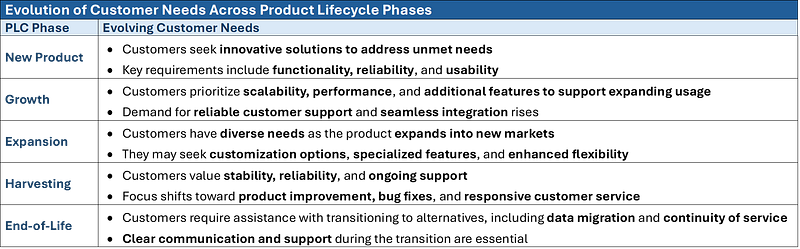
Evolution of Customer Needs Across Product Lifecycle Phases — How customer needs and preferences evolve across different phases of the product lifecycle, guiding roadmap planning and strategic decision-making to meet evolving customer expectations.
  • Understanding Customer Needs: Different stages of the product lifecycle correspond to varying levels of customer understanding and market penetration. A thorough comprehension of where the product stands in its lifecycle informs the prioritization of features and enhancements on the roadmap to meet evolving customer needs. Here’s how customer needs may evolve across different phases of the Product Lifecycle: i) New Product Phase: Customers in this phase often have unmet needs or pain points that the new product aims to address. They may seek innovative solutions or alternatives to existing products. Key needs include functionality, reliability, and usability as they explore new offerings in the market. ii) Growth Phase: Customers are increasingly adopting the product, indicating growing acceptance and satisfaction. Their needs may shift towards scalability, performance, and additional features to support their expanding usage. Demand for reliable customer support and seamless integration with other tools may also arise. iii) Product Expansion Phase: Customers in this phase may have diverse needs as the product expands into new markets or segments. They may seek customization options, specialized features, or integrations tailored to their specific requirements. Enhanced flexibility and scalability become essential to accommodate a broader range of user scenarios. iv) Harvesting Phase: Customers in the harvesting phase typically value stability, reliability, and ongoing support. Their needs may focus on continued product improvement, bug fixes, and responsive customer service. They may also seek cost-effective solutions and long-term partnerships with the vendor. v) End-of-Life Phase: Customers facing end-of-life products may have urgent needs related to transitioning to alternative solutions. Their primary concerns include data migration, continuity of service, and support during the transition period. Clear communication, assistance with migration efforts, and honoring existing commitments become critical to maintaining customer satisfaction during this phase.
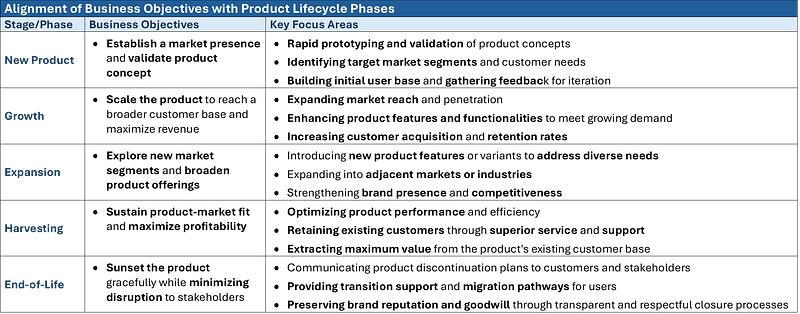
Alignment of Business Objectives with Product Lifecycle Phases — A structured approach for roadmap planning and strategic decision-making.
  • Aligning with Business Objectives: Each phase of the product lifecycle comes with its own set of business goals and objectives. A well-crafted roadmap should align closely with these objectives, whether it’s focusing on product innovation during the new product phase or maximizing revenue generation during the growth phase. Here’s what the business objectives may look like in each phase of the Product Lifecycle: i) New Product Phase: Objective: Establish a market presence and validate product concept. Key Focus Areas: 1) Rapid prototyping and validation of product concepts. 2) Identifying target market segments and customer needs. 3) Building initial user base and gathering feedback for iteration. ii) Growth Phase: Objective: Scale the product to reach a broader customer base and maximize revenue. Key Focus Areas: 1) Expanding market reach and penetration. 2) Enhancing product features and functionalities to meet growing demand. 3) Increasing customer acquisition and retention rates. iii) Product Expansion Phase: Objective: Explore new market segments and broaden product offerings. Key Focus Areas: 1) Introducing new product features or variants to address diverse customer needs. 2) Expanding into adjacent markets or industries. 3) Strengthening brand presence and competitiveness. iv) Harvesting Phase: Objective: Sustain product-market fit and maximize profitability. Key Focus Areas: 1) Optimizing product performance and efficiency. 2) Retaining existing customers through superior service and support. 3) Extracting maximum value from the product’s existing customer base. v) End-of-Life Phase: Objective: Sunset the product gracefully while minimizing disruption to stakeholders. Key Focus Areas: 1) Communicating product discontinuation plans to customers and stakeholders. 2) Providing transition support and migration pathways for users. 3) Preserving brand reputation and goodwill through transparent and respectful closure processes.
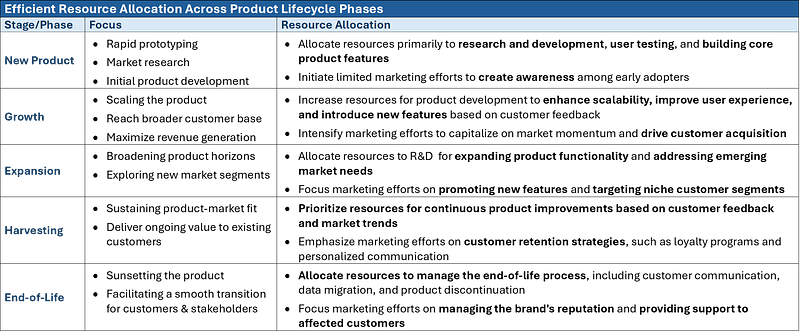
Efficient Resource Allocation Across Product Lifecycle Phases — Resource allocation across different phases of the product lifecycle, ensuring alignment with strategic objectives and maximizing value delivery to customers and stakeholders.
  • Resource Allocation: The resources available for product development and marketing may vary depending on the lifecycle stage. A roadmap must allocate resources efficiently, considering factors like budget constraints, market demand, and competitive landscape specific to each phase of the lifecycle. Here’s how resource allocation could look like in each phase of the Product Lifecycle: i) New Product Phase: Focus: Rapid prototyping, market research, and initial product development. Resource Allocation: Allocate resources primarily to research and development, user testing, and building the core product features. Marketing efforts may be limited initially but should focus on creating awareness among early adopters. ii) Growth Phase: Focus: Scaling the product to reach a broader customer base and maximize revenue generation. Resource Allocation: Increase resources for product development to enhance scalability, improve user experience, and introduce new features based on customer feedback. Marketing efforts should be intensified to capitalize on market momentum and drive customer acquisition. iii) Product Expansion Phase: Focus: Broadening the product’s horizons and exploring new market segments. Resource Allocation: Allocate resources to research and development for expanding product functionality and addressing emerging market needs. Marketing efforts should focus on promoting new features and targeting niche customer segments. iv) Harvesting Phase: Focus: Sustaining product-market fit and delivering ongoing value to existing customers. Resource Allocation: Prioritize resources for continuous product improvements based on customer feedback and market trends. Marketing efforts should emphasize customer retention strategies, such as loyalty programs and personalized communication. v) End-of-Life Phase: Focus: Sunsetting the product and facilitating a smooth transition for customers and stakeholders. Resource Allocation: Allocate resources to manage the end-of-life process, including customer communication, data migration, and product discontinuation. Marketing efforts should focus on managing the brand’s reputation and providing support to affected customers.
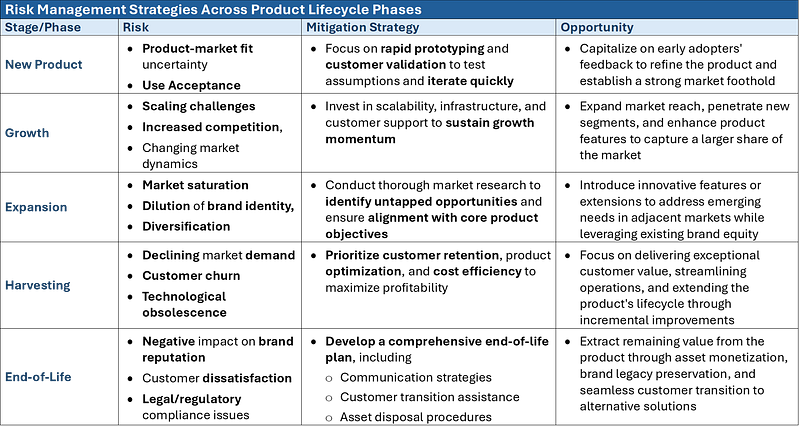
Risk Management Strategies Across Product Lifecycle Phases — Risk management strategies are tailored to each phase of the product lifecycle, empowering product managers to proactively mitigate risks and capitalize on opportunities inherent to each stage.
  • Risk Management: The level of risk associated with product development and market acceptance fluctuates throughout the lifecycle. A roadmap should account for these risks by prioritizing initiatives that mitigate uncertainty and capitalize on opportunities presented by the current stage of the lifecycle. Here’s how risk management could manifest in each phase of the Product Lifecycle (PLC): i) New Product Phase: Risk: Uncertainty regarding product-market fit and acceptance. Mitigation Strategy: Focus on rapid prototyping and customer validation to test assumptions and iterate quickly. Opportunity: Capitalize on early adopters’ feedback to refine the product and establish a strong market foothold. ii) Growth Phase: Risk: Scaling challenges, increased competition, and changing market dynamics. Mitigation Strategy: Invest in scalability, infrastructure, and customer support to sustain growth momentum. Opportunity: Expand market reach, penetrate new segments, and enhance product features to capture a larger share of the market. iii) Product Expansion Phase: Risk: Market saturation, dilution of brand identity, and diversification challenges. Mitigation Strategy: Conduct thorough market research to identify untapped opportunities and ensure alignment with core product objectives. Opportunity: Introduce innovative features or extensions to address emerging needs in adjacent markets while leveraging existing brand equity. iv) Harvesting Phase: Risk: Declining market demand, customer churn, and technological obsolescence. Mitigation Strategy: Prioritize customer retention, product optimization, and cost efficiency to maximize profitability. Opportunity: Focus on delivering exceptional customer value, streamlining operations, and extending the product’s lifecycle through incremental improvements. v) End-of-Life Phase: Risk: Negative impact on brand reputation, customer dissatisfaction, and legal/regulatory compliance issues. Mitigation Strategy: Develop a comprehensive end-of-life plan, including communication strategies, customer transition assistance, and asset disposal procedures. Opportunity: Extract remaining value from the product through asset monetization, brand legacy preservation, and seamless customer transition to alternative solutions.
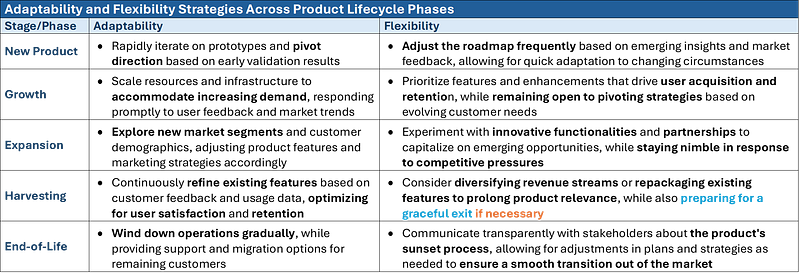
Adaptability and Flexibility Strategies Across Product Lifecycle Phases — Roadmap and product adaptability and flexibility tailored to each phase of the product lifecycle, enabling teams to effectively respond to changing market dynamics and evolving customer needs.
  • Adaptability and Flexibility: Products evolve, and roadmaps must be adaptable to accommodate changes in customer preferences, technological advancements, and competitive dynamics. By aligning roadmap initiatives with the product lifecycle stage, teams can remain agile and responsive to market shifts. Here’s how adaptability and flexibility could manifest in each phase of the Product Lifecycle: i) New Product Phase: Adaptability: Rapidly iterate on prototypes and gather feedback to pivot direction based on early validation results. Flexibility: Adjust the roadmap frequently based on emerging insights and market feedback, allowing for quick adaptation to changing circumstances. ii) Growth Phase: Adaptability: Scale resources and infrastructure to accommodate increasing demand, responding promptly to user feedback and market trends. Flexibility: Prioritize features and enhancements that drive user acquisition and retention, while remaining open to pivoting strategies based on evolving customer needs. iii) Product Expansion Phase: Adaptability: Explore new market segments and customer demographics, adjusting product features and marketing strategies accordingly. Flexibility: Experiment with innovative functionalities and partnerships to capitalize on emerging opportunities, while staying nimble in response to competitive pressures. iv) Harvesting Phase: Adaptability: Continuously refine existing features based on customer feedback and usage data, optimizing for user satisfaction and retention. Flexibility: Consider diversifying revenue streams or repackaging existing features to prolong product relevance, while also preparing for a graceful exit if necessary. v) End-of-Life Phase: Adaptability: Wind down operations gradually, while providing support and migration options for remaining customers. Flexibility: Communicate transparently with stakeholders about the product’s sunset process, allowing for adjustments in plans and strategies as needed to ensure a smooth transition out of the market.

In essence, the product lifecycle serves as a guiding framework for building effective product roadmaps by providing context, setting priorities, and informing strategic decision-making throughout the product’s journey from inception to retirement.

Understanding where a product resides within its lifecycle enables product managers to create roadmaps that maximize value delivery, drive growth, and ensure long-term success in the marketplace.

Finding this article useful?

For more insights like this, be sure to follow me on Medium and subscribe to get my updates in your email.

Photo by Product School on Unsplash

The Crucial Role of Understanding the External Business Ecosystem in Effective Roadmapping

Effective product development and roadmapping are more than feature ideation. They require a deep grasp of the ecosystem surrounding your product, including industry dynamics, competitor landscapes, and emerging trends. Success lies in understanding external factors, prioritizing problem-solving approaches, and harnessing customer insights for validation and growth.

The Significance of Understanding Your Ecosystem

At the core of effective roadmapping lies a deep understanding of the business ecosystem. This entails comprehending not only your immediate market but also the broader industry dynamics, competitor landscape, and emerging trends. By gaining insights into these aspects, product teams can make informed decisions, anticipate market shifts, and align their roadmap with strategic objectives.

Shared Knowledge and Responsibility

Contrary to the misconception that understanding the business landscape is solely the responsibility of the product manager, effective roadmapping requires a collective effort from the entire team. Each member should possess a basic understanding of the business environment, enabling them to contribute valuable insights and perspectives to the roadmap. Fostering a culture of shared knowledge ensures alignment and empowers teams to make data-driven decisions.

Tools and Techniques for Gathering Business Knowledge

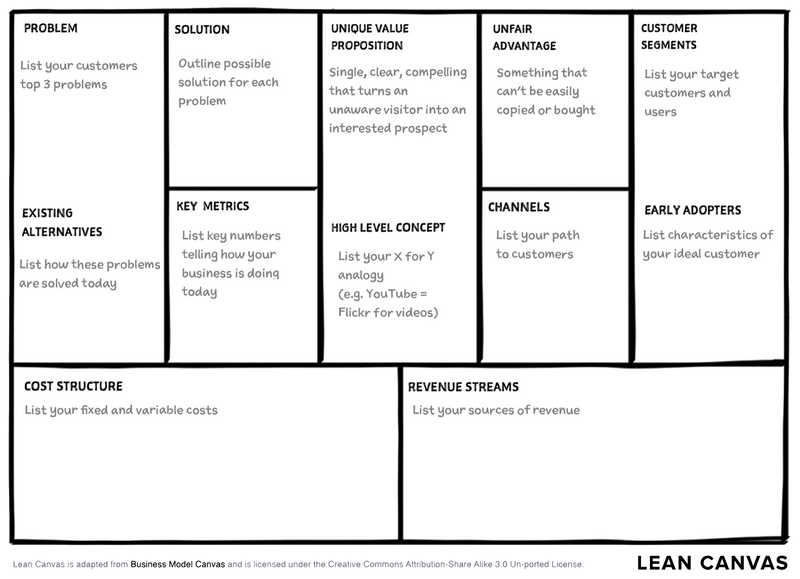
An array of tools and techniques exists to gather data and insights for effective roadmapping. Business model canvases, such as the Lean Canvas and Business Model Canvas, serve as invaluable frameworks for analyzing key aspects of your business, including problem-solution fit, value proposition, customer segments, and revenue model. Additionally, market research, competitor analysis, and customer feedback mechanisms provide rich sources of data to inform roadmap decisions.
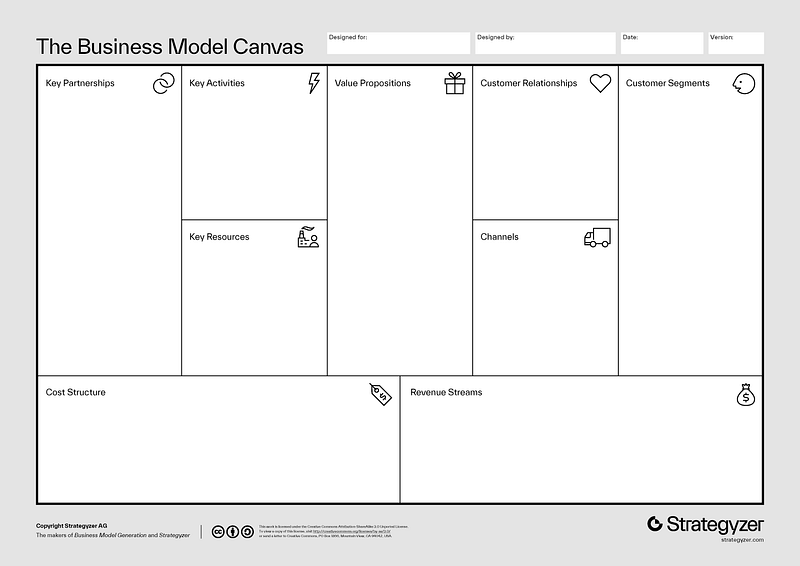
The Business Model for Ecosystem Analysis
The Lean Canvas for Ecosystem Analysis

Conducting Business Model Analysis

Central to understanding your business ecosystem is conducting a thorough business model analysis. This involves dissecting the various components of your business model and identifying strengths, weaknesses, opportunities, and threats. By scrutinizing elements such as problem-solution fit, customer segments, and revenue streams, product teams can uncover insights to drive roadmap prioritization and strategic planning.

Selecting the Right Tools for the Job

The choice of tools for gathering data and insights depends on the stage of your product or business. For startups, Lean Canvas offers a lightweight framework to iterate quickly and validate hypotheses. Conversely, established products may benefit from the comprehensive approach of the Business Model Canvas to refine existing strategies and explore new opportunities. Evaluating the unique needs and constraints of your business guides the selection of the most suitable tools.

The Importance of Understanding

Ultimately, the success of your product roadmap hinges on a fundamental understanding of the business landscape. Without this foundation, roadmapping becomes an exercise in guesswork, fraught with risks and uncertainties. By investing time and effort into gathering data and insights, product teams equip themselves with the knowledge needed to navigate challenges, seize opportunities, and steer their product toward success.

Shifting Focus from Features to Problems

Effective roadmapping practices stay away from fixating on features rather than addressing underlying problems and recognize the importance of identifying and solving customer pain points. By prioritizing problems over features, product teams ensure that their solutions are aligned with real-world needs, fostering greater user satisfaction and product success.

Understanding the Customer and the Significance of Customer Discovery

At the heart of problem-centric solutions lies a deep understanding of the customer. By empathizing with their needs, challenges, and aspirations, product teams can craft solutions that resonate on a profound level, especially when product teams gather validated learning through continuous customer feedback. This iterative approach allows teams to refine their solutions based on real-world outcomes, ensuring relevance and effectiveness.

Steve Blank’s renowned Customer Development Model provides a structured framework for gathering insights and validating solutions.

  • The journey begins with Customer Discovery, where teams seek to understand customer problems and needs through direct interaction.
  • This phase is followed by Customer Validation, where the viability of the solution is tested by gauging customer willingness to pay.
  • Subsequent stages, including Customer Creation and Company Building, focus on scaling success and formalizing the product-market fit.

The cornerstone of effective roadmapping is a thorough understanding of customer problems and needs. Through methods such as interviews, surveys, and observational research, product teams gain valuable insights into the pain points that drive user behavior. By empathizing with customers and uncovering latent needs, teams lay the groundwork for crafting solutions that deliver tangible value.

Validating Solutions through Customer Feedback

Customer Validation serves as a critical checkpoint in the roadmapping process, where teams seek to validate the viability of their solutions. By presenting prototypes or MVPs to target customers and gauging their willingness to pay, teams gain valuable feedback that informs subsequent iterations. This iterative approach fosters a culture of continuous improvement, driving product evolution in line with customer expectations.

Driving Growth through Customer Creation

Building on validated solutions, the Customer Creation phase focuses on driving demand and nurturing a sustained sales pipeline. By leveraging early successes and customer testimonials, product teams demonstrate the value proposition of their solutions, attracting new users and fostering loyalty. This phase marks the transition from product validation to market expansion, laying the foundation for sustainable growth.

Impact on the Roadmap

Understanding the external business ecosystem plays a crucial role in effective roadmapping by providing essential insights and guiding strategic decisions. Here’s how it aids in effective roadmapping and how it should be reflected on the roadmap:

  • Informed Decision-Making: Understanding the broader industry dynamics, competitor landscape, and emerging trends allows product teams to make informed decisions when prioritizing features and setting strategic objectives on the roadmap. Reflecting this understanding on the roadmap ensures that development efforts are aligned with the current market landscape and strategic goals.
  • Anticipation of Market Shifts: By comprehending the external business ecosystem, product teams can anticipate market shifts and trends, enabling them to proactively adjust their roadmap to capitalize on emerging opportunities or mitigate potential threats. This proactive approach ensures that the product remains competitive and relevant in a rapidly evolving market environment.
  • Alignment with Strategic Objectives: Reflecting the understanding of the external business ecosystem on the roadmap helps ensure alignment with strategic objectives. By considering factors such as market demand, competitor activities, and industry trends, product teams can prioritize features and initiatives that contribute directly to the achievement of overarching business goals.
  • Risk Mitigation: Understanding the external business ecosystem allows product teams to identify potential risks and uncertainties that may impact the product roadmap. By acknowledging these risks on the roadmap and developing contingency plans, teams can mitigate the negative impact of external factors on product development and ensure smoother execution of the roadmap.
  • Enhanced Stakeholder Communication: Transparently reflecting the understanding of the external business ecosystem on the roadmap enhances communication with stakeholders. It provides stakeholders with a comprehensive view of the factors influencing product development decisions and instills confidence in the roadmap’s strategic direction.

Incorporating an understanding of the external business ecosystem into the product roadmap ensures that development efforts are strategically aligned, risks are mitigated, and opportunities are capitalized upon. It empowers product teams to navigate the complexities of the market landscape with clarity and purpose, driving sustained success and growth for the product and the organization.

I’d love to hear your thoughts!

Share your insights and feedback in the comments below and let’s continue this discussion.

Photo by Blake Wisz on Unsplash

Customer-Centric Product Roadmapping

Product roadmapping success hinges not only on innovative features or cutting-edge technology but also on a deep understanding of the customers for whom the product is intended by delving deep into their world and empathizing with their needs, frustrations, and aspirations.

Importance of Understanding Customers

At the heart of any successful product development endeavor lies a profound understanding of the target customers. This understanding goes beyond mere demographics; it entails grasping customers’ jobs, wants, needs, obstacles, frustrations, and emotions.

Every item on the product roadmap should be aligned with addressing an actual customer need, emphasizing the paramount importance of customer-centricity in the development process.

The product roadmap should clearly outline the types of value that each feature is expected to create. A highly effective framework for articulating this value is Bain’s Elements of Value, which applies to both B2C and B2B products. This framework provides a comprehensive set of elements that customers perceive as valuable, ranging from functional benefits to emotional rewards. By aligning each feature with specific elements of value, product managers can ensure that they are addressing diverse customer needs and preferences. This not only enhances the attractiveness of the product but also strengthens customer satisfaction and loyalty.

Customer Roles

One fundamental aspect of understanding customers is identifying their roles within the product ecosystem. User roles delineate the specific jobs and functions performed by different individuals. For instance, platforms like Lynda.com exemplify how recognizing user roles, such as students and instructors, facilitates the creation of a product that caters to the diverse needs of all stakeholders.

On the product roadmap, the identification of customer roles should be reflected by clearly delineating the features or functionalities that cater to each role within the product ecosystem. This can be achieved through categorization or tagging of features based on the primary user roles they serve. For example:

  • Feature Categorization: Features can be grouped or categorized on the roadmap according to the primary user roles they address. Each category can represent a distinct user role, such as “Student Features” and “Instructor Features” in the case of Lynda.com. This allows stakeholders to easily identify which features are relevant to specific user segments.
  • Tagging or Labeling: Alternatively, individual features on the roadmap can be tagged or labeled with the corresponding user roles they cater to. This approach provides more granular detail, allowing stakeholders to understand the user role implications of each feature at a glance.
  • User Persona Integration: If user personas have been developed as part of the product development process, the identified customer roles can be linked to these personas on the roadmap. For example, a feature benefiting “Professional Paul” may be associated with the “Student” user role. This integration provides a deeper context regarding the target audience and their needs.
  • Visual Representation: Visual aids such as color-coding or icons can be used to visually represent different user roles and their associated features on the roadmap. This enhances clarity and comprehension, enabling stakeholders to quickly grasp how the product serves various user segments.

By incorporating customer roles on the product roadmap clearly and systematically, product teams can ensure alignment with user needs and facilitate informed decision-making throughout the development process.

User Types

Understanding user types is equally crucial, as it elucidates how individuals interact with the product and defines their permissions. Common user types, including end users, administrators, managers, and viewers, aid in categorizing users’ roles and tailoring product features accordingly. Similar to user roles, user types should be presented on the product roadmap.

Users Versus Buyers

It is essential to distinguish between users and buyers, as they may not always be the same entity.

  • While users utilize the product
  • Buyers make the purchasing decisions

This dichotomy becomes particularly pronounced in B2B2C contexts, where the buyer-user relationship varies significantly.

Roles Versus Personas

Differentiating between user roles and personas is instrumental in gaining a comprehensive understanding of customers.

  • While user roles focus on categorizing customers based on their jobs and functions
  • Personas delve deeper into their characteristics, feelings, and preferences

Integrating personas into the roadmap development process enables product teams to empathize with customers on a more profound level and design solutions that resonate with their needs and motivations. Similar to user roles, user types should be presented on the product roadmap.

By identifying customer roles, delineating user types, distinguishing users from buyers, and leveraging personas, product teams can gain invaluable insights that drive informed roadmap decisions. Ultimately, prioritizing customer-centricity empowers organizations to create products that not only meet but exceed the expectations of their target audience, fostering long-term success and customer satisfaction.

Photo by Vardan Papikyan on Unsplash

Stakeholder Engagement and Effective Product Roadmapping

The success of a product hinges not only on its features and functionalities but also on the collaborative efforts of various stakeholders. From customers to executives, each stakeholder brings unique perspectives and expertise to the table, contributing to the formulation of a comprehensive product roadmap.
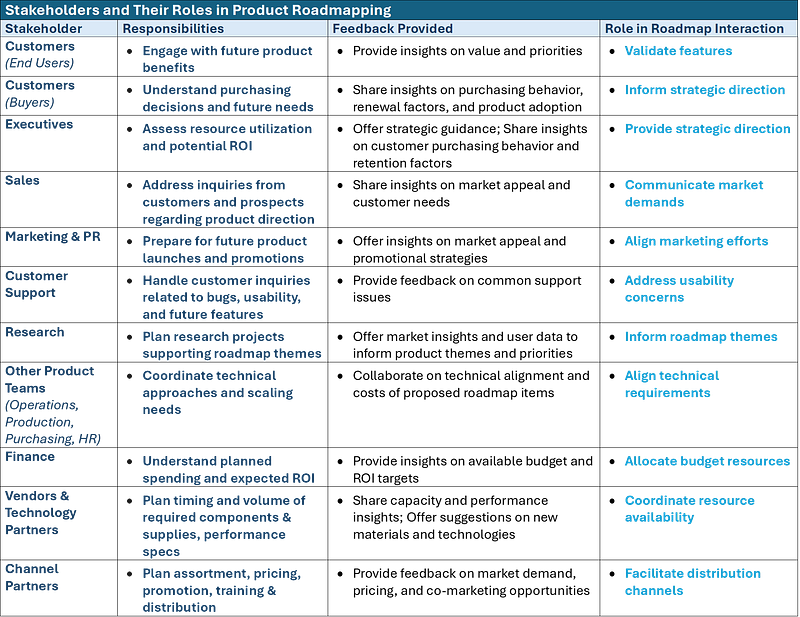
Stakeholders and Their Roles in Product Roadmapping — The diverse stakeholders involved in product roadmapping and their specific roles in shaping the direction and priorities of product development, and the feedback they provide to inform roadmap decisions.

Understanding Stakeholder Roles and Contributions

Before diving into the intricacies of stakeholder engagement, it’s crucial to identify the key players involved in the product development process. At its core, the product core team — comprising product managers, designers, and engineers — takes charge of designing, building, shipping, and maintaining the product. However, throughout the product lifecycle, additional stakeholders come into play, each with their roles and contributions.

  • Customer-Centric Engagement: As described in the previous section, customers lie at the heart of every successful product. Engaging with customers not only helps in understanding their needs and preferences but also fosters excitement about future product enhancements. By soliciting feedback on value propositions and priorities, product teams can ensure that their roadmap aligns with customer expectations and market demands.
  • Executive Alignment and Strategic Direction: Executives play a pivotal role in shaping the strategic direction of the product. They seek to understand how resources are utilized and evaluate potential returns on investment (ROI). By providing strategic context and insights into customer acquisition and retention, executives guide product managers in making informed decisions that drive business growth.
  • Sales and Marketing Collaboration: Sales and marketing teams act as bridges between the product and its target audience. Sales teams must be equipped to address inquiries about future product directions, while marketing teams prepare for product launches and promotions. By gathering feedback on customer motivations and market trends, these teams ensure that product messaging resonates with the target market.
  • Supporting Roles — Research, Operations, Finance, and more: Beyond the core product team, various supporting roles contribute to the roadmap in diverse ways. Research teams provide valuable market insights to inform roadmap themes, while operations teams synchronize technical approaches and release schedules. Finance teams offer insights into planned spending and ROI targets, ensuring alignment with budgetary constraints.

Building a Collaborative Culture

Creating a culture of collaboration is essential for effective stakeholder engagement and product roadmapping. By involving stakeholders at different stages of the roadmapping process, product teams foster alignment and shared ownership of the product vision. Regular communication channels and feedback mechanisms facilitate transparent decision-making and ensure that all stakeholders are heard and valued.

By embracing stakeholder engagement as a core principle, product teams can leverage the expertise and insights of various stakeholders to craft roadmaps that drive innovation, meet customer needs, and propel business growth. Through open communication, mutual respect, and a shared commitment to excellence, stakeholders can collaborate effectively toward a common goal of delivering exceptional products and experiences.

Finding this article useful?

For more insights like this, be sure to follow me on Medium and subscribe to get my updates in your email.

Photo by Ramin Khatibi on Unsplash

The Foundation of Effective Product Roadmapping

At the heart of every successful product roadmap lies a fundamental understanding of the product’s domain and its users. Ignoring this crucial aspect can lead to perilous pitfalls, wasting valuable time, effort, resources, and money.

The path to a successful product roadmap begins with a solid understanding of the product domain and its users.

Understanding the Product Domain and Users

Creating a product roadmap without delving deep into the product’s domain and its users is a costly practice. Without a clear grasp of who the users are and what challenges they face, the roadmap risks being built on fictional scenarios and biased assumptions. This approach not only undermines the efficacy of the roadmap but also poses significant risks to the success of the product itself.

The Need for Up-Front Work

To lay a strong foundation for a successful product roadmap, thorough up-front work is critical. This involves gathering or updating key inputs, including understanding the intricacies of the product domain, identifying user needs, and considering other relevant contextual factors. Skipping this crucial step can leave the roadmap adrift, lacking direction and purpose.

Continuous Learning and Adaptation

In the fast-paced world of product development, learning is a continuous journey. As product leaders, it’s essential to embrace a mindset of continuous learning and adaptation.

This involves gathering information, interpreting its impact on the product, and seamlessly integrating this knowledge into the roadmap. By adopting an iterative approach, product roadmaps remain agile, responsive, and aligned with organizational goals.

Thanks for reading!

To stay connected and get more insights like this, be sure to follow me on Medium.

As a fellow product enthusiast, be sure to connect with me on LinkedIn to continue this discussion, network, and access my professional network.

Product Management
Product
Product Development
Roadmaps
Recommended from ReadMedium