
BEYOND THE BUILD
Crafting Effective Roadmaps: The Role of Vision, Strategy, and Metrics
A successful product journey requires a comprehensive approach that integrates mission, vision, and values into effective roadmaps. Crafting compelling product vision statements lays the groundwork for aligning the team with overarching goals and aspirations. However, vision [and strategy] alone is not enough; the role of metrics in effective product roadmapping cannot be overstated. Metrics serve as the compass guiding product development efforts toward measurable outcomes that reflect the organization’s mission and vision. By leveraging metrics strategically, teams ensure that their roadmaps are not just visionary but also grounded in practicality and progress tracking and move away from “feature factories” to outcomes. Ultimately, it’s the synergy of vision, strategy, and metrics that empowers product roadmaps to chart a clear path toward success, driving meaningful impact and innovation in the ever-evolving landscape of product development.
Table of Contents
Guiding Your Product Journey: Integrating Mission, Vision, and Values into Effective Roadmaps
Crafting Compelling Product Vision Statements
The Role of Metrics and Effective Product Roadmapping
The Power of Vision, Strategy, and Metrics in Product Roadmapping

Other reads related to Effective Product Roadmapping

Welcome!
If you found this article helpful, be sure to follow me on Medium to stay updated on and explore my publications..


Guiding Your Product Journey: Integrating Mission, Vision, and Values into Effective Roadmaps
Building successful products goes beyond innovative ideas and efficient execution. It necessitates a profound sense of purpose, strategic vision, and alignment with the organization’s core values. Integrating the mission, vision, and values into product roadmaps is a crucial step, given that roadmaps serve as vital communication and alignment platforms for diverse teams within the organization, including engineering, design, marketing, sales, finance, and customer support.
By seamlessly incorporating these foundational elements into the product planning and development process, product leaders and managers can chart a trajectory that not only propels business success but also deeply connects with customers and stakeholders.
Mission Statement — Guiding Your Organization’s Intent
When it comes to organizational strategy and direction, a mission statement underscores the fundamental purpose and intent behind an organization’s existence. But what exactly does a mission statement entail, and why is it crucial for organizational success?
- Understanding the Purpose of Mission Statements: At its core, a mission statement serves as a compass, guiding the trajectory of an organization by articulating its present intent and raison d’être. It encapsulates the essence of what the organization aims to achieve and the impact it seeks to make on the world. Far more than a mere declaration of values, a well-crafted mission statement serves as a rallying cry, inspiring both internal stakeholders and external audiences alike.
- Key Elements of a Well-Crafted Mission Statement: A mission statement is not just a string of words; it is a carefully crafted narrative that embodies the organization’s aspirations and values. To be truly effective, a mission statement should possess several key elements: i) Value: At the heart of every mission statement lies the value proposition — the positive impact the organization seeks to bring to the world. Whether it’s enhancing quality of life, fostering innovation, or driving social change, the value proposition articulates the organization’s contribution to society. ii) Inspiration: A compelling mission statement goes beyond mere words; it ignites passion and stirs emotions, inspiring individuals to rally behind a shared vision. By instilling a sense of purpose and meaning, the mission statement galvanizes the team towards collective action and achievement. iii) Plausibility: While lofty aspirations may be admirable, a mission statement must also be grounded in reality. It should convey a sense of attainability, instilling confidence and commitment among stakeholders. A mission that feels within reach motivates individuals to go above and beyond in pursuit of the organization’s goals. iv) Specificity: Lastly, a mission statement should be tailored to the unique context and identity of the organization. It should succinctly capture the essence of what sets the organization apart, resonating with both internal stakeholders and external audiences.
To shed light on the practical application of these principles, let’s examine an iconic mission statement:
SpaceX Mission Statement: “to revolutionize space technology, with the ultimate goal of enabling people to live on other planets.”
This mission statement not only encapsulates the core values and aspirations of SpaceX but also reflects a deep commitment to serving its customers and communities.
The Role of Corporate Mission in Building Effective Product Roadmaps
At the heart of every successful product lies a clear and well-defined roadmap, guiding its journey from conception to market success. However, what many may overlook is the role played by the organization’s corporate mission in shaping this roadmap.
- Alignment with Organizational Goals: When crafting a product vision and strategy, alignment with this mission is paramount. A roadmap must reflect how each initiative contributes to fulfilling the broader mission, ensuring that every step taken by the product team is in sync with the company’s direction and aspirations.
- Setting Product Priorities: By understanding the nuances of the corporate mission and strategic priorities, product teams gain invaluable insight into setting product priorities. This framework helps identify which features and functionalities are most aligned with achieving organizational goals. Consequently, decisions about what to include in the product roadmap and what to prioritize for development become more informed and purposeful.
- Defining Product Value Proposition: The corporate mission often encapsulates the unique value proposition of the organization. When crafting a product vision, it’s imperative to consider how the product aligns with and enhances this proposition. Understanding the corporate mission aids in articulating the distinct value that the product brings to customers and stakeholders. Consequently, the product vision is shaped to resonate with the organization’s core identity and objectives.
- Driving Customer-Centricity: Many corporate missions emphasize customer-centric values and objectives. Integrating these values into the product vision and strategy ensures that the resulting roadmap prioritizes customer needs. By aligning product development efforts with the organization’s customer-centric goals, products are tailored to deliver solutions that resonate deeply with the target audience. This customer-centric approach not only enhances satisfaction but also fosters long-term loyalty and trust.
The Role and Components of Vision Statements
Vision statements create a vivid image of the future an organization aims to achieve, surpassing short-term goals to reveal a long-term outcome that resonates with stakeholders and society. They address the fundamental question:
Why does the organization exist?
Serving as a compass, vision statements guide long-term aspirations, encapsulating an organization’s purpose and its journey toward a desired future.
The key components that make up a compelling vision statement and how they contribute to organizational success are as follows:
- Target Customer: At the heart of every vision statement lies the target customer or audience. Identifying who stands to benefit from the envisioned outcome provides clarity and direction to the organization’s efforts.
- Benefits or Needs Addressed: A robust vision statement articulates the specific benefits or needs that the organization aims to fulfill. Whether it’s fostering a sense of belonging, advancing technological frontiers, or combating social injustices, the vision should clearly outline the positive impact it seeks to achieve.
- Uniqueness: Setting the organization apart from competitors, the uniqueness factor in a vision statement highlights what makes the envisioned future distinct and compelling. It underscores the organization’s commitment to innovation, differentiation, or disruptive change.
SpaceX Vision Statement: “to make life multi-planetary by establishing a self-sustaining city on Mars”
Mission vs. Vision Statement
The difference between a mission statement and a vision statement lies in their focus and scope.
- A mission statement typically describes the current purpose and intent of an organization, outlining its fundamental reason for existence and the actions it takes to fulfill its objectives.
- On the other hand, a vision statement portrays a desired future state or outcome that the organization aspires to achieve, articulating its long-term goals and aspirations.
Using SpaceX as an example:
- Mission Statement: SpaceX’s mission statement reflects its current intent and purpose, emphasizing its commitment to revolutionizing space technology and enabling humanity’s multi-planetary existence.
- Vision Statement: SpaceX’s vision statement, on the other hand, paints a future reality or world that the organization aims to create through its efforts. It envisions the long-term impact of its space exploration endeavors on both humanity and the broader universe.
The Power of Organizational Values
In modern workplaces, organizational values serve as more than just words on a wall or in a handbook. They are the guiding principles that shape the culture, behaviors, and decisions within a company.
- Definition: Organizational values encompass the beliefs and ideals that define the culture and character of a company. These values act as guides, steering employees towards behaviors aligned with the company’s mission and vision. They are not mere slogans but core principles that drive actions and decisions.
- The Importance of Organizational Values: Organizational values serve as a moral compass, providing employees with a clear sense of right and wrong, even in the absence of direct supervision, offering a framework for navigating such challenges with integrity and purpose.
- Values as a Compass for Decision-Making: In difficult decision-making scenarios, organizational values help define decision boundaries and the playing field, paving the path toward ethical and responsible choices. By embodying these values, employees can navigate through ambiguity and uncertainty, ensuring that their actions uphold the principles that define the organization’s identity.
- Aligning Values with Vision and Mission: Organizational values are not isolated concepts; they are intricately linked to an organization’s vision and mission. While the vision represents the ultimate destination — a future state to aspire to — the mission outlines the roadmap for achieving that vision. Values serve as the guiding principles that inform and align with both the vision and mission, ensuring coherence and unity of purpose.
To grasp the tangible impact of organizational values, let’s examine SpaceX. SpaceX, founded by Elon Musk, operates with a set of core values that deeply influence its operations and strategic decisions. While the specific values of SpaceX are not publicly disclosed, we can infer them based on the company’s actions and statements made by its leadership.
- Innovation: The company continuously pushes the boundaries of space exploration through groundbreaking technologies and ambitious projects like the development of reusable rockets. This commitment to innovation permeates every aspect of SpaceX’s operations, driving engineers and scientists to think outside the box and explore new possibilities.
- Perseverance and Resilience: The company has faced numerous setbacks and challenges in its quest to revolutionize space travel, but its unwavering determination to overcome obstacles has propelled it forward. This resilience is evident in SpaceX’s ability to recover from failed launches and setbacks, emerging stronger and more determined than ever.
- Safety and Reliability: Given the inherent risks associated with space exploration, ensuring the safety of astronauts and payloads is paramount. SpaceX’s relentless focus on safety standards and rigorous testing protocols underscores its commitment to upholding the highest levels of quality and reliability.
- Collaboration and Teamwork: The company fosters an environment where diverse perspectives are valued, and employees are encouraged to collaborate across departments to tackle complex challenges. This collaborative ethos enables SpaceX to leverage the collective expertise and creativity of its workforce to drive innovation and achieve its ambitious goals.
By aligning its actions with these core values, SpaceX has emerged as a trailblazer in the aerospace industry, revolutionizing space travel and inspiring the next generation of scientists, engineers, and explorers. The company’s adherence to its values serves as a testament to the profound impact that organizational values can have on shaping the trajectory of a company and driving it toward success in its mission.
Integrating the Corporate Mission, Vision, and Values into the Product Roadmap
Integrating the corporate mission, vision, and values into the product roadmap is essential for ensuring that product development aligns with the overarching goals and principles of the organization. Here’s how each component can be incorporated effectively:
- Mission Integration: i) Clarify Alignment: Begin by revisiting the organization’s mission statement and understanding how it relates to the product roadmap. Identify specific initiatives or features that directly contribute to fulfilling the mission. ii) Prioritization: Use the mission as a guiding principle for prioritizing features and initiatives. Focus on those that have the most significant impact on advancing the mission and delivering value to customers. iii) Communication: Communicate how each item on the roadmap supports the mission. This ensures that all team members understand the broader purpose behind their work and are aligned in their efforts.
- Vision Alignment: i) Long-Term Goals: Assess how each element of the product roadmap contributes to realizing the organization’s vision. Determine whether the planned initiatives align with the desired long-term outcomes outlined in the vision statement. ii) Strategic Direction: Use the vision as a strategic guidepost for decision-making during roadmap planning. Evaluate whether proposed features or projects move the organization closer to achieving its vision. iii) Adaptability: Ensure that the roadmap remains flexible enough to adapt to changes in the external environment while staying true to the overarching vision. Continuously reassess the roadmap to ensure alignment with evolving market dynamics and customer needs.
- Values Incorporation: i) Ethical Considerations: Evaluate proposed roadmap items against the organization’s core values to ensure ethical alignment. Avoid initiatives that conflict with or compromise the integrity of the company’s values. ii) Customer-Centricity: Use values such as customer focus, integrity, and transparency to inform product decisions. Prioritize features and enhancements that enhance the customer experience and demonstrate the organization’s commitment to its values. iii) Team Empowerment: Encourage team members to embody the organization’s values in their daily work. Foster a culture that values integrity, collaboration, and innovation, empowering employees to make decisions that reflect these principles.
- Holistic and Balanced Approach: Strive for a balanced approach that considers the interplay between mission, vision, and values. Ensure that the product roadmap reflects a cohesive strategy that addresses both short-term objectives and long-term aspirations.
- Iterative Improvement: Continuously evaluate the effectiveness of integrating mission, vision, and values into the product roadmap. Solicit feedback from stakeholders, monitor key metrics, and make adjustments as needed to optimize alignment and drive success.
By integrating mission, vision, and values into the product roadmap, organizations can foster a sense of purpose, drive strategic alignment, and ultimately deliver products that resonate with customers while staying true to their core principles.

Crafting Compelling Product Vision Statements
Defining a product vision statement stands as a pivotal task for any product leadership and team, as it not only charts the course for product development endeavors but also molds the company’s identity within the market landscape. However, achieving the right equilibrium between organizational aspirations and customer-centricity is paramount for the success of these vision statements. Effective product leaders and teams must grasp the essence of product vision, underscore the significance of effective communication, and discern the distinction between product and corporate visions. Furthermore, they must adeptly balance their focus between creating value for the company and catering to the needs of their customers.
The Essence of Product Vision
A clear and compelling product vision guides the direction of your efforts and serves as the driving force behind every decision you make. At its core, a product vision;
Articulates why you’re bringing a product to market and what its success will mean for both your organization and the world at large.
It’s the heartbeat of your entire product development effort, providing clarity and purpose to every stage of the journey.
Key Components of an Effective Product Vision
The key elements of a product vision typically include:
- Purpose and Impact: Clarifies why the product exists and the intended impact it will have on the world or its users. This element highlights the overarching goal or mission of the product.
- Target Audience: Identifies the specific demographic or market segment that the product aims to serve. Understanding the target audience helps in tailoring the product to meet their needs and preferences effectively.
- Problem Statement: Articulates the primary problem or challenge that the product seeks to address. This element provides context for the product’s development and underscores its relevance in solving real-world issues.
- Unique Value Proposition: Describes the unique value that the product offers compared to existing solutions or competitors. This element highlights the distinct features, benefits, or advantages that set the product apart in the market.
- Long-Term Goals: Outlines the desired outcomes or achievements that the product aims to accomplish over time. This element provides a sense of direction and guides strategic decision-making throughout the product lifecycle.
- Scope and Features: Defines the scope of the product and outlines the key features or functionalities it will offer. This element helps in prioritizing development efforts and aligning them with the overall vision.
- Brand Identity and Values: Reflects the brand identity and values of the organization, ensuring consistency and alignment with broader company objectives. This element contributes to building trust and loyalty among users.
- Measurable Success Metrics: Specifies the metrics or key performance indicators (KPIs) that will be used to measure the success and impact of the product. This element provides a means of evaluating progress and iterating based on feedback.
- Inspiration and Motivation: Inspires and motivates the team members working on the product by providing a compelling vision of what they are collectively striving to achieve. This element fosters enthusiasm and commitment toward realizing the product vision.
- Adaptability and Flexibility: Acknowledges the dynamic nature of the market and technology landscape, allowing for adaptability and flexibility in responding to changing customer needs and market conditions.
By incorporating these key elements into the product vision, organizations can articulate a clear and compelling direction for their product, driving alignment, innovation, and success.
The Importance of Communicating the Product Vision
Effective communication of the product vision is critical for organizational success, fostering alignment, cohesion, and commitment across all stakeholders. While formulating a compelling product vision is crucial, its effectiveness hinges on the ability to communicate it clearly and inclusively throughout the organization. Here’s why:
- Alignment: Sharing the product vision widely ensures that everyone within the organization understands and aligns with the overarching goals and direction. When every team member is on the same page regarding the desired outcomes and objectives, it minimizes the risk of conflicting priorities or divergent efforts. This alignment streamlines decision-making processes and fosters unity of purpose.
- Motivation: A well-communicated product vision has the power to inspire and motivate teams by providing a sense of purpose and direction. When employees grasp the broader significance of their work within the context of the product vision, they are more likely to feel invested in its success. This intrinsic motivation can fuel creativity, innovation, and commitment to achieving shared goals.
- Clarity: Effective communication eliminates ambiguity and ensures that stakeholders have a clear understanding of what the product aims to achieve and how it will impact the organization’s objectives. By articulating the vision concisely and understandably, leaders empower teams to make informed decisions and prioritize initiatives that are in alignment with the overarching vision.
- Buy-In: Transparent communication of the product vision cultivates buy-in and ownership among stakeholders at all levels of the organization. When employees feel that their input is valued and their roles are integral to realizing the vision, they are more likely to actively contribute and take ownership of their responsibilities. This sense of ownership fosters accountability and a shared commitment to driving the product’s success.
- Innovation: A shared product vision creates a fertile ground for innovation by encouraging collaboration, idea-sharing, and cross-functional problem-solving. When teams are united behind a common vision, they are more likely to leverage their diverse perspectives and expertise to explore new solutions and approaches. This collaborative environment promotes creativity and empowers teams to push the boundaries of what is possible.
By sharing the vision widely and ensuring that everyone is onboard, organizations can maximize their chances of success and drive meaningful impact with their products.
Distinction Between Product Vision and Corporate Vision
The relationship between product vision and corporate vision is crucial for aligning organizational goals and strategies. While they are interconnected, they serve distinct purposes and perspectives within the overarching framework of an organization’s vision.
- Corporate Vision Focus: The corporate vision represents the long-term aspirations and overarching goals of the entire organization. It articulates the fundamental purpose and direction of the company, often reflecting its values, core principles, and desired impact on the world. Corporate visions are broad and encompassing, guiding the organization’s overall strategy and decision-making across all products, services, and initiatives.
- Product Vision Focus: In contrast, the product vision focuses specifically on a particular product or service offered by the company. It defines the purpose, goals, and intended outcomes of the product, outlining its unique value proposition and target market. Product visions are more detailed and tailored to the specific characteristics and objectives of the individual product, guiding its development, marketing, and positioning strategies.
- Relationship: While product visions are derived from and aligned with the broader corporate vision, they provide a more granular and actionable framework for achieving the organization’s overall goals. Product visions contribute to realizing the corporate vision by addressing specific market needs, driving innovation, and creating value for customers. Conversely, the achievement of product vision contributes to the fulfillment of the corporate vision, as successful products collectively support the company’s overarching mission and objectives.
- Alignment: Product visions need to align with the values, goals, and strategic direction outlined in the corporate vision. Alignment ensures cohesion and consistency across all products and initiatives, maximizing the organization’s impact and effectiveness. While product visions may vary depending on the nature of the product and its target market, they should ultimately contribute to the realization of the broader corporate vision.
- Synergy: When product visions are effectively aligned with the corporate vision, they create synergy within the organization, fostering collaboration and cohesion among teams. This synergy enhances the organization’s ability to innovate, adapt to market changes, and deliver value to customers, ultimately driving sustainable growth and success.
Creating an Effective Product Vision
Creating a compelling product vision is essential for guiding product development efforts and ensuring alignment with organizational goals. Geoffrey Moore’s “Value Proposition template,” adapted for product vision creation, offers a practical and structured approach to articulate key elements effectively. The elements include:
- Identifying the Target Customer: The first step in crafting a product vision is to define the target customer or audience for the product. Product teams should conduct market research and analysis to understand the needs, preferences, and pain points of their target audience. By clearly defining the target customer, you can tailor your product vision to address specific market segments effectively.
- Defining the Product Category: Next, product teams need to articulate the product category or type to which their product belongs. This involves identifying the broader industry or market segment in which the product operates and understanding its unique characteristics and competitive landscape. Clearly defining the product category provides context and helps stakeholders understand the scope and purpose of the product.
- Outlining the Benefits or Value Proposition: Product teams should articulate the primary benefits or value proposition offered by the product to its target customers. This involves identifying the key problems or challenges faced by customers and explaining how the product addresses these issues. By highlighting the benefits or value proposition, organizations can communicate the unique value that their product delivers to customers.
- Highlighting Differentiation from Competitors: Finally, product teams should differentiate their products from competitors by identifying their unique features, attributes, or advantages. This may involve highlighting technological innovations, superior quality, cost-effectiveness, or other factors that set the product apart in the market. By clearly articulating the product’s differentiation, organizations can position it effectively and attract customers in a competitive marketplace.

Product teams can adapt Moore’s Value Proposition template to fit their specific product and business context. This may involve customizing the language, adding or removing elements, or incorporating additional details to better reflect the unique value proposition of the product.
By adapting the template, product teams can ensure that their product vision accurately reflects their strategic objectives and market positioning.
Driving Product Development and Strategic Planning
A well-crafted product vision serves as a guiding framework for product development and strategic planning. It aligns cross-functional teams around a common goal, facilitates decision-making, and helps prioritize initiatives and resources effectively. By integrating the product vision into the organization’s strategic planning process, organizations can ensure that their products are developed and positioned to meet the evolving needs of their target customers and achieve long-term success.
A well-defined product vision is the cornerstone of success in product development. By understanding its definition, significance, and practical applications, organizations can chart a course toward creating products that not only meet customer needs but also make a meaningful impact on the world.
Balancing Company and Customer Benefits in Your Product Vision Statements
Crafting a compelling vision statement requires a delicate balance between the aspirations of the company and the needs of its customers.
Product vision statements serve as North Stars for product teams, outlining their purpose and direction. However, product leaders must strike a balance between promoting organizational success and addressing customer needs. The interplay between these two facets is crucial for driving organizational greatness.
- Importance of Internal Vision: Internal vision statements are integral to shaping an organization’s identity, strategy, and overall direction. While external vision statements primarily communicate the company’s goals to external stakeholders, internal vision statements are equally crucial as they articulate the purpose and aspirations of the organization to its employees. These statements serve as guiding principles that align employees towards common objectives and foster a sense of shared purpose within the organization. Well-crafted internal vision statements bring various benefits including: i) Strategic Guidance: Internal vision statements clarify long-term goals, guiding decision-making. ii) Alignment: Internal visions foster unity among employees, ensuring everyone works towards shared goals. iii) Cultural Influence: Internal visions shape organizational culture by reflecting values and priorities. They promote customer-centricity, innovation, or operational excellence, fostering a supportive culture. iv) Employee Engagement: Connectedness to the vision boosts employee commitment and motivation. Internal visions inspire dedication, creating a positive workplace where employees feel valued and driven to contribute to success.
While internal visions are essential, there’s a risk of them becoming too company-focused, neglecting customer perspectives. Microsoft’s historic vision statement serves as a cautionary tale, demonstrating the pitfalls of overlooking customer-centricity in favor of internal objectives.
- Microsoft’s Vision Statement: Microsoft’s historic vision statement, famously coined in the 1980s, encapsulated the ambition of placing “a personal computer on every desk running Microsoft software.” At the time, this vision symbolized Microsoft’s aspirations to make computing accessible and ubiquitous, revolutionizing the way individuals interacted with technology. The statement reflected Microsoft’s commitment to driving the widespread adoption of personal computing, which aligned with its business objectives of developing software solutions for a growing market. However, while the vision was ambitious and forward-thinking for its time, it also had its limitations. By focusing primarily on proliferating Microsoft software, the vision may have overlooked broader customer-centric considerations and evolving technological trends. As technology evolved and computing devices diversified, the relevance of having a personal computer on every desk diminished. Today, computing has become more mobile and decentralized, with smartphones and tablets replacing traditional desktop setups and Microsoft missed out on that trend losing to companies such as Apple, Samsung, and Google.
Evolution of Vision Statements: The story of Microsoft’s historic vision statement serves as a reminder of the importance of adaptability and customer-centricity in vision formulation. While the statement was groundbreaking in its era, it also highlights the need for vision statements to evolve alongside changing market dynamics and customer preferences.
I’d love to hear your thoughts!
Share your insights and feedback in the comments below and let’s continue this discussion.

The Role of Metrics and Effective Product Roadmapping
In the intricate landscape of product development, the link between business objectives and product strategy is pivotal. A robust product strategy acts as the conduit between a product’s vision and the practical steps necessary to realize it. However, for this strategy to be effective, it must be intricately woven with clear and measurable business objectives.
This article explores the symbiotic relationship between business objectives and product strategy, dissecting how the two intersect to drive organizational success. We’ll delve into the importance of defining clear business objectives, integrating internal and external goals, and aligning product strategies with market needs. Moreover, we’ll uncover how leveraging Objectives and Key Results (OKRs) can empower teams to craft effective product roadmaps that align with overarching business objectives.
Join us on this journey as we unravel the intricacies of product development, navigating the convergence of business objectives and product strategy to chart a course toward sustainable success.
The Link Between Business Objectives and Product Strategy
Product strategy is the comprehensive plan that bridges the gap between a product’s high-level vision and the practical steps needed to achieve it. It serves as the guiding force that shapes the direction of product development efforts, ensuring that they are in line with the broader business objectives. But for a product strategy to be effective, it requires effective business goal setting.
- Defining Clear Business Objectives: Clear and measurable business objectives provide the foundation upon which a robust product strategy is built. These objectives articulate the desired outcomes that the organization aims to achieve, whether it’s increasing market share, improving profitability, or expanding into new markets. For instance, a business objective could be to “capture 20% market share in the next two years” or “achieve a 15% increase in customer retention.”
- Integration of Internal and External Objectives: Effective product strategy entails integrating both internal and external business objectives. Internal objectives may focus on organizational priorities and growth such as operational efficiency, cost reduction, or workforce development. External objectives, on the other hand, revolve around customer needs, market trends, and competitive positioning.
By aligning product strategy with a combination of internal and external objectives, organizations can achieve a balance between meeting internal goals and addressing market demands.
- Alignment with Market Needs: A crucial aspect of product strategy is its alignment with market needs and customer preferences. While internal objectives provide a framework for organizational growth, it’s essential to ensure that product development efforts resonate with target customers. By understanding market dynamics, consumer behavior, and emerging trends, product strategies can be tailored to address evolving market needs effectively.
- Staying True to Internal Goals: Despite the focus on external market dynamics, product strategies must remain rooted in the organization’s internal goals and capabilities. While pursuing market opportunities, it’s crucial to leverage internal strengths, resources, and competencies. This ensures that product initiatives are not only aligned with market demand but also feasible and sustainable from an internal perspective.
- Coherence and Effectiveness: When business objectives and product strategy are harmoniously aligned, they create coherence and effectiveness in driving organizational growth. A well-aligned product strategy ensures that every product decision, from feature prioritization to resource allocation, contributes to the fulfillment of broader business objectives. This alignment fosters synergy across departments and functions, maximizing the impact of product development efforts on overall organizational success.
Leveraging Objectives and Key Results (OKRs) for Effective Product Roadmapping
Integrating Objectives and Key Results (OKRs) into the product roadmapping process empowers teams to align their efforts with overarching business objectives, driving focus, accountability, and ultimately, success.
OKRs provide a structured approach to aligning business objectives with measurable success criteria. This framework pairs qualitative objectives with quantitative key results, creating a roadmap for success that is both ambitious and achievable. By adopting a structured approach to goal-setting and measurement, product teams can unlock their full potential and bring their vision to life with clarity and purpose.
- Guidelines for Applying OKRs to Product Roadmapping: i) Alignment with Business Objectives: The first guideline for integrating OKRs into the product roadmap is ensuring alignment with business objectives. Each roadmap item should be directly tied to at least one objective, ensuring that product development efforts are focused on driving outcomes that matter most to the organization. This alignment ensures that the product roadmap serves as a strategic tool for achieving broader business goals. ii) Maintaining Manageable Objectives: It’s crucial to maintain a manageable number of objectives to prevent overwhelm and maintain clarity of purpose. While OKRs are designed to focus efforts on key priorities, too many objectives can dilute focus and diminish effectiveness. Typically, fewer than five objectives are recommended, allowing teams to prioritize and allocate resources effectively. iii) Focus on Outcomes: A fundamental principle of OKRs is focusing on outcomes rather than outputs. This approach emphasizes the importance of driving tangible results that contribute to organizational success. When integrating OKRs into the product roadmap, it’s essential to frame roadmap items in terms of the outcomes they are intended to achieve. This ensures that product development efforts are aligned with the core principle of OKRs and are directed toward driving meaningful impact. iv) Continous Learning, Iteration, Feedback, and Best Practices: Drawing insights from interviews with product teams can reveal common patterns and best practices for leveraging OKRs effectively. While metrics may vary for each product team, recurring themes and approaches emerge, offering valuable guidance for implementing OKRs in product development initiatives.
Leveraging Universal Business Objectives for Building Out-Come Product Roadmaps
Streamlining the process of building effective roadmaps is facilitated by recognizing a set of universal (or commonly recurring) business objectives pursued by organizations across industries. These objectives serve as the bedrock of organizational aspirations, transcending sector or market specifics.
Essentially, these ubiquitous business objectives provide a foundational framework for understanding and aligning strategic priorities, guiding decision-making, and propelling organizational success across diverse industries and contexts. When applied to building product roadmaps, they offer invaluable insights into the overarching aims that drive product development initiatives. This alignment enables product teams to craft roadmaps that not only address immediate needs but also contribute to the long-term vision and objectives of the organization.
In essence, leveraging these universal business objectives enhances the efficacy of product roadmapping by fostering alignment with broader organizational goals, facilitating strategic decision-making, and ultimately driving sustainable success in the ever-evolving business landscape.
These universally recurring business objectives are:
- Supporting the product’s core value: Ensuring that the product maintains its fundamental value proposition and essence.
- Creating barriers to competition: Developing features or aspects of the product that make it difficult for competitors to replicate or enter the market.
- Growing market share: Increasing the percentage of total sales or revenue within a specific market held by the company’s product or service.
- Fulfilling more demand: Meeting increasing customer demand effectively by scaling production or services.
- Developing new markets: Expanding into untapped or underserved markets to diversify revenue streams and broaden the customer base.
- Improving recurring revenue: Enhancing revenue streams through subscriptions, add-ons, or other recurring purchases.
- Supporting higher prices: Establishing value propositions that justify premium pricing and maintaining profitability.
- Improving lifetime value: Enhancing customer loyalty and increasing the value derived from each customer over their entire lifecycle.
- Lowering costs: Identifying and implementing strategies to reduce production, operational, or overhead costs.
- Leveraging existing assets: Maximizing the utilization of existing resources, infrastructure, or capabilities to generate additional revenue or value.
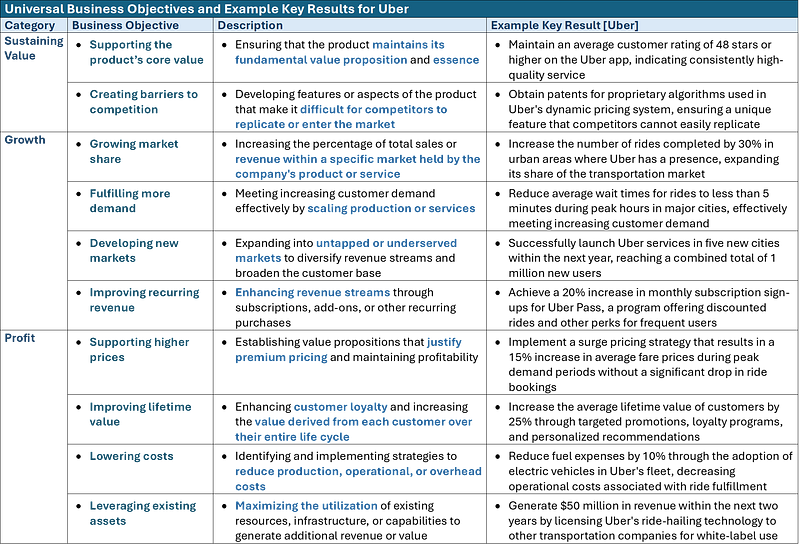
The objectives and examples of KRs and metrics above serve as indispensable tools for tracking progress toward organizational objectives and assessing the success of product initiatives. By leveraging metrics effectively, product teams gain valuable insights that inform resource allocation and prioritize initiatives for maximum impact. From customer acquisition and retention to revenue growth and cost optimization, metrics provide a comprehensive view of product performance and guide strategic decision-making.
Moreover, diverging from traditional methods that primarily tackle customer needs via feature-based roadmaps, and adopting business objectives and Key Results (KRs) facilitated the construction of outcome-based roadmaps. Such roadmaps pivot towards attaining measurable benefits for the organization. By aligning product development efforts with business objectives, this methodology guarantees strategic resource allocation to foster substantial impact and enduring success.
The Power of KPIs in Product Roadmapping
Before embarking on any product development initiative, it’s important to establish clear key performance indicators (KPIs) that act as yardsticks for success, serving as guiding principles, that provide direction and clarity to product roadmaps.
Without well-defined metrics, roadmaps lack focus and risk veering off course, hindering the team’s ability to prioritize tasks and allocate resources effectively.
By integrating KPIs into the roadmap, product teams can focus their efforts on initiatives that directly contribute to achieving key results, thereby driving alignment and coherence in their roadmap planning.
- Balancing Approach to Data Analysis: While data provides valuable insights, an overload of information can lead to analysis paralysis. It’s essential to prioritize and select the most relevant metrics that offer actionable insights without overwhelming the decision-making process. However, selecting too narrow of a set of metrics can jeopardize product success. It’s important to build a holistic view of the product and roadmap performance and its alignment with organizational objectives, guiding roadmap planning and strategic decision-making. By striking the right balance, product teams can focus on leveraging insights that drive meaningful outcomes and propel the product roadmap forward.
While data analysis is integral to informed decision-making, there’s a fine line between insightful analysis and data overload. Striking the right balance is paramount, as drowning in a sea of metrics can obscure rather than illuminate insights. Product professionals must exercise discretion in selecting and prioritizing metrics, focusing on those that offer the most actionable insights without overwhelming the decision-making process.
- Incorporating Customer Feedback: By integrating customer feedback alongside quantitative metrics, product teams gain deeper insights into user needs and preferences. This customer-centric approach ensures that roadmap initiatives are finely tuned to address real-world user needs, driving greater satisfaction and loyalty.
- Sophistication in Data Collection Methods: Building effective product roadmaps necessitates adopting sophisticated data collection methods to gain deeper insights into user behavior, market trends, and product performance. This refined understanding empowers product teams to make informed decisions and prioritize roadmap initiatives that align with user needs and market demands, ensuring the roadmap remains relevant and impactful.
Navigating Outcome Versus Output in Product Roadmapping
In product development, it’s crucial to distinguish between what is delivered (outputs) and the impact those deliveries have (outcomes).
- Outputs refer to the tangible deliverables produced, whether they are features, functionalities, or services.
- On the other hand, outcomes denote the real-world effects or changes brought about by those deliverables.
While outputs focus on what is created, outcomes highlight the difference made by those creations.
- Focus on Outcomes: In product roadmapping, it’s tempting to prioritize outputs — the tangible features and functionalities — as markers of progress. However, true success lies in the outcomes achieved by those outputs. By orienting roadmaps around desired outcomes, teams ensure alignment with overarching goals and objectives, fostering meaningful impact rather than just ticking off tasks. In action, output-focused roadmaps often prioritize the quantity of features released rather than the quality of outcomes achieved. Such roadmaps may include a laundry list of features without clear ties to desired results. For example, a roadmap filled with a plethora of new functionalities may overlook the overarching goal of increasing user engagement or retention.
- Risk of Feature Factories: A common pitfall of output-focused approaches is the emergence of what’s colloquially termed a “feature factory.” In such environments, teams churn out features incessantly, often without clear alignment with strategic objectives or customer needs. The result is a barrage of functionalities that fail to drive meaningful outcomes, leading to wasted resources and missed opportunities for genuine impact.
Incorporating metrics into the roadmaps and the features plays a crucial role in the transition from output-focused development to outcome-oriented product roadmapping by providing quantifiable measures of success and guiding decision-making throughout the process. Here’s how metrics contribute to this transition:
- Defining Success Criteria: Metrics help define clear success criteria for product initiatives by quantifying desired outcomes. Instead of simply measuring the number of features released, metrics define what success looks like in terms of user engagement, satisfaction, retention, or other relevant KPIs.
- Aligning Roadmap Items with Business Objectives: Metrics ensure that roadmap items are aligned with strategic objectives and desired outcomes. By establishing measurable goals tied to specific metrics, teams can prioritize features that are most likely to drive the desired results and contribute to overarching business objectives.
- Monitoring Progress: Metrics provide ongoing visibility into the progress of product initiatives and their impact on key outcomes. By regularly monitoring relevant metrics, teams can track progress, identify trends, and make data-driven adjustments to the roadmap as needed to stay on course toward achieving desired outcomes.
- Iterative Improvement: Metrics support iterative improvement by facilitating continuous feedback loops and experimentation. By measuring the impact of features on key metrics, teams can quickly identify what’s working well and what needs improvement, allowing for iterative refinement and optimization of the product roadmap over time.
- Driving Accountability and Transparency: Metrics create accountability by establishing clear benchmarks for success and holding teams accountable for achieving them. Transparently sharing metric data across the organization fosters a culture of accountability and collaboration, enabling teams to collectively work towards achieving common goals.
- Informing Strategic Decision-Making: Metrics inform strategic decision-making by providing actionable insights into user behavior, market trends, and product performance. By analyzing metric data, teams can make informed decisions about feature prioritization, resource allocation, and strategic direction, ensuring that product development efforts are aligned with broader organizational goals.
Overall, metrics play a pivotal role in guiding the transition from feature-focused to outcome-oriented product roadmapping by providing a data-driven framework for defining, monitoring, and optimizing the success of product initiatives.
Finding this article useful?
For more insights like this, be sure to follow me on Medium and subscribe to get my updates in your email.

The Power of Vision, Strategy, and Metrics in Product Roadmapping
In product development, success isn’t merely about delivering features; it’s about aligning efforts with a strategic vision, setting measurable outcomes, and focusing on what truly matters. Based on what we have discussed up to now, here’s how vision, strategy, and metrics play pivotal roles in building effective product roadmaps:
- Vision and Strategy are Essential: A roadmap is more than just a list of tasks; it’s a visual representation of the strategic vision for the product. By articulating both the future vision for customers and the organization, a roadmap provides a clear direction for product development efforts. It ensures that every initiative aligns with the overarching goals and objectives, guiding teams towards sustainable growth and success.
- Objectives and Key Results (OKRs): Integrating OKRs into the roadmap shifts the focus from delivering features to achieving measurable outcomes. OKRs help prioritize initiatives based on their potential impact on organizational goals. By setting clear objectives and defining key results, teams can stay aligned with strategic objectives and track progress effectively. This approach ensures that product development efforts are not just busywork but meaningful steps toward tangible results
- Focus on a Manageable Number of Measurable Outcomes: A key aspect of effective product roadmapping is concentrating measurement efforts on a manageable number of objectives. By focusing on measurable outcomes, roadmaps ensure that resources are allocated efficiently and efforts are directed towards what matters most to the organization and its customers. This focus facilitates better decision-making and resource management, driving impactful results and sustainable growth.
The synergy between vision, strategy, and metrics is essential for building product roadmaps that drive success. By aligning efforts with a strategic vision, setting measurable outcomes, and focusing on what truly matters, organizations can chart a clear path towards achieving their goals and delivering value to customers.
Thanks for reading!
To stay connected and get more insights like this, be sure to follow me on Medium.
As a fellow product enthusiast, be sure to connect with me on LinkedIn to continue this discussion, network, and access my professional network.