
BEYOND THE BUILD
Building Effective Product Roadmaps: Strategies, Evolution, and Essentials
Defining an effective product roadmap is crucial for steering product development efforts in the right direction. It serves as a strategic blueprint, aligning stakeholders and guiding teams towards achieving their objectives. Understanding the evolution of product roadmaps, from simple bicycle maps to agile navigation tools, highlights the need for adaptability and responsiveness in today’s dynamic market. The crucial role of elements of value, including considerations of product, stakeholder, and customer needs, underscores the importance of prioritizing value delivery in roadmap crafting. Recognizing the core essentials of an effective product roadmap, such as clear communication, measurable objectives, and prioritized initiatives, lays the foundation for success. However, navigating the pitfalls inherent in crafting effective product roadmaps is essential to avoid common challenges like making unrealistic promises or overemphasis on specific features. By unlocking success with effective roadmaps and implementing strategies to address challenges, product teams can ensure alignment, foster innovation, and drive toward their goals effectively.
Table of Contents
Defining an Effective Product Roadmap
The Evolution of Product Roadmaps: From Bicycle Maps to Agile Navigation
The Core Essentials of an Effective Product Roadmap
Navigating the Pitfalls of Crafting Effective Product Roadmaps
Unlocking Success with Effective Roadmaps: Essential Components, Challenges, and Solutions
Primary, Secondary, and Complementary Components of Effective Product Roadmaps

Other reads related to Effective Product Roadmapping

Welcome!
If you found this article helpful, be sure to follow me on Medium to stay updated on and explore my publications..

Defining an Effective Product Roadmap
For effective product development, a compass is essential to navigate complexities and uncertainties, and that’s where the product roadmap comes into the picture — a strategic tool designed to steer teams toward their destination and achieve or deliver on their product vision.
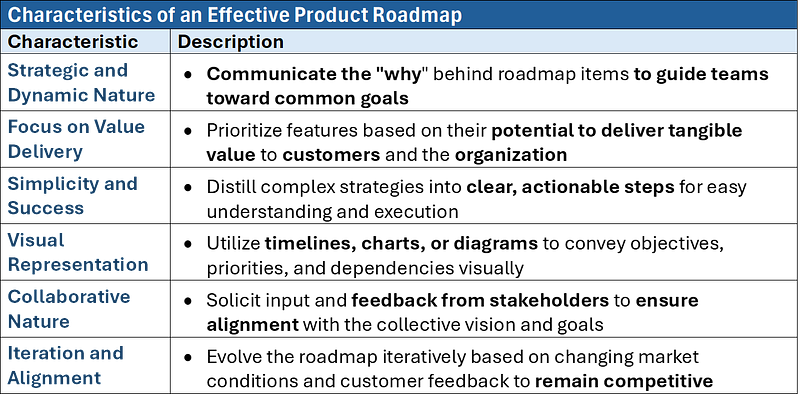
A product roadmap entails the following:
- Strategic and Dynamic Nature: A product roadmap is more than just a plan; it’s a dynamic blueprint outlining the journey toward realizing the product vision. It serves as a guiding light for teams, aligning efforts and resources toward common goals. At its core, a product roadmap is a strategic communication tool that communicates not just what needs to be done but why it matters.
- Focus on Value Delivery: Central to any product roadmap is the concept of value delivery. It’s not just about churning out features or hitting deadlines; it’s about delivering tangible value to both customers and the organization. By prioritizing features and initiatives based on their potential to create value, product roadmaps rally support from stakeholders and ensure alignment with overarching strategic objectives.
- Simplicity and Success: While the journey toward product success may be complex, the roadmap itself should embody simplicity. A cluttered, convoluted roadmap is more likely to confuse than to guide. Therefore, simplicity is key. A successful product roadmap distills complex strategies into clear, actionable steps, making it easy for teams to understand and execute.
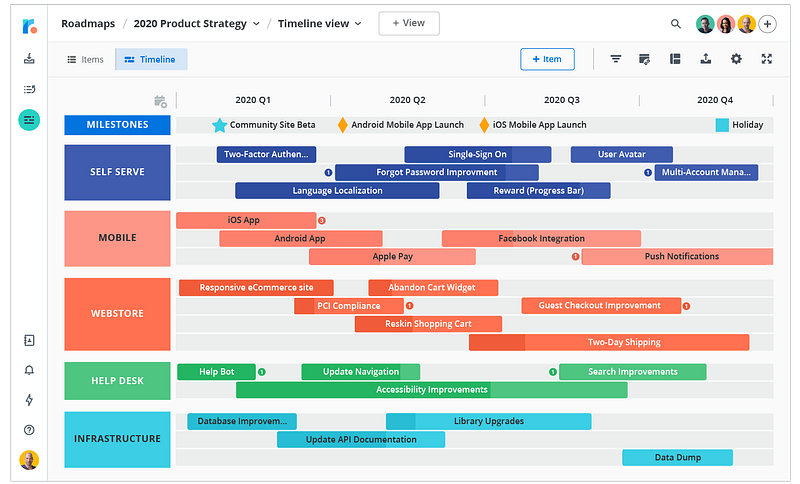
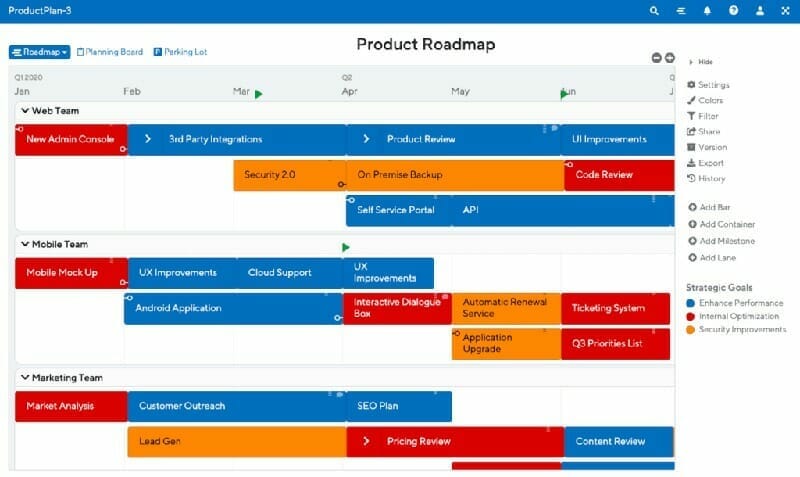
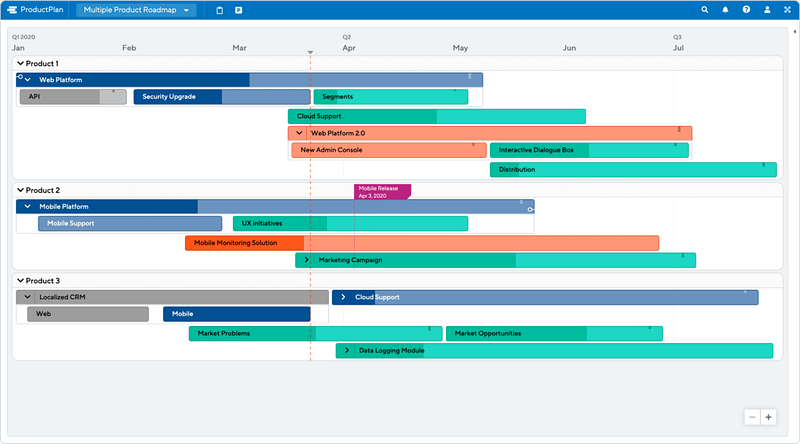
- Visual Representation: Product roadmaps come in various forms, from simple sketches to detailed documents. However, the essence of a roadmap lies not in its format but in its ability to facilitate shared understanding. Visual representations, such as timelines, charts, or diagrams, can effectively convey the roadmap’s objectives, priorities, and dependencies. By creating a visual narrative, teams can align around a common vision and track progress more effectively.
- Collaborative Nature: Creating effective roadmaps is about collaboration, which involves input and feedback from various stakeholders across the organization. Collaboration ensures that the roadmap reflects the collective vision and goals of the entire team.
- Iterative Approach and Alignment with Market Trends:: Product roadmaps are built iteratively, as they often evolve in response to changing market conditions, customer feedback, and internal priorities keeping the roadmap relevant and competitive in the marketplace. Iteration allows teams to adapt and refine their plans as they learn more throughout the development process.
- Measuring Success: Effective roadmaps define and illustrate clear metrics and key performance indicators (KPIs) to measure the success of key projects and initiatives. Monitoring progress against these metrics enables teams to track their performance and make data-driven decisions.
The Evolution of Product Roadmaps: From Bicycle Maps to Agile Navigation
Historical Context: The concept of roadmaps finds its roots in the humble bicycle maps of the 19th century. These early maps guided cyclists in navigating city streets, laying the foundation for modern-day navigation tools. Over time, roadmaps evolved alongside advancements in transportation, transitioning from paper-based guides to digital navigation systems.
Evolution in the Technology Industry: The adoption of roadmaps by technology-driven organizations marked a significant turning point in their evolution. Companies like Motorola, Google, and others recognized the need for strategic planning to align technology and product development. Technology roadmaps became invaluable tools for forecasting product releases, informing stakeholders, and planning long-term investments.
Challenges with Traditional Roadmaps: Despite their historical significance, traditional roadmaps have faced challenges in adapting to the rapid pace of technological change and agile methodologies. Fixed timelines and rigid plans often fail to accommodate shifting priorities, evolving customer needs, and emerging market trends. This disconnect between traditional roadmaps and modern product development practices has led to frustration and inefficiency among product teams.
Impact on Product Development: The mismatch between traditional roadmaps and agile methodologies has profound implications for product development. Delays, missed opportunities, and a lack of alignment with strategic objectives can hinder innovation and impede organizational growth. As product teams grapple with the limitations of traditional approaches, there is a growing recognition of the need for redefining roadmaps to better align with agile principles.
Need for Redefining Roadmaps: In response to these challenges, there is a pressing need to redefine roadmaps for the digital age. Agile methodologies emphasize flexibility, adaptability, and collaboration — qualities that traditional roadmaps often lack. By reimagining roadmaps as dynamic, living documents that evolve with the product discovery and development process, organizations can better respond to change, prioritize initiatives, and drive innovation.
The Crucial Role of Elements of Value in Crafting Effective Product Roadmaps — Product, Stakeholder, and Customers
When it comes to product management and development, clarity is paramount. From defining the product’s scope to identifying stakeholders and understanding the customer ecosystem, every aspect plays a pivotal role in shaping the trajectory of a project and its roadmap.

- Product: Traditionally, when we think of a product, we often envision tangible goods — a physical item that can be seen, touched, or held. While this definition certainly holds, especially in the realm of consumer goods, it’s crucial to recognize that products extend beyond physical artifacts. Today, products encompass a broader spectrum of offerings, including services, experiences, and intangible elements. For example, consider a software application: while the code itself may be intangible, the experience it provides to users, the services it offers, and the value it delivers is very much real and tangible to those who interact with it. Moreover, products are not just about fulfilling a need or solving a problem; they’re about creating meaningful experiences and delivering value to customers. This value can take various forms, from convenience and efficiency to delight and satisfaction. By embracing this broader definition of “product,” a product roadmap can effectively encapsulate all facets of the offering. It goes beyond simply outlining features or functionalities; it considers the entire ecosystem surrounding the product, including the user journey, customer support, and post-purchase experiences. Furthermore, by understanding the diverse elements that contribute to value delivery, the roadmap can ensure alignment with the overarching strategy of the organization. It becomes a strategic tool that guides teams not only in building and shipping products but also in creating exceptional experiences and fostering long-term customer relationships. In essence, a product roadmap is a reflection of the holistic understanding of what a “product” truly entails — a multifaceted offering that goes beyond the physical and embraces the intangible aspects of value creation. By embracing this broader perspective, teams can chart a course that not only meets but exceeds the expectations of customers and stakeholders alike.
In short, a product encompasses tangible goods, services, experiences, and intangible elements that deliver value to customers. It goes beyond fulfilling needs, focusing on creating meaningful experiences and fostering long-term customer relationships. A product roadmap reflects this holistic understanding, guiding teams in delivering value through features, functionalities, and the entire ecosystem surrounding the product.
- Stakeholder: Stakeholders form the intricate web of individuals and entities invested in the success of a product, contributing to its conception, development, and eventual market reception. Their influence spans both internal departments and external parties, encompassing a diverse array of perspectives and interests crucial to consider in the product lifecycle. Internally, stakeholders may include developers, designers, marketers, product managers, and executives, each wielding specialized expertise and insights. Externally, stakeholders extend beyond the confines of the organization, comprising end-users, customers, partners, suppliers, and investors. Identifying these stakeholders and understanding their respective roles is paramount for effective collaboration and support throughout the product lifecycle. Each stakeholder brings a unique perspective, priorities, and expectations to the table, which must be carefully considered in the roadmap’s formulation. By actively engaging stakeholders and soliciting their input, teams can ensure alignment with diverse interests and priorities, fostering a sense of ownership and buy-in among stakeholders, and cultivating a culture of inclusivity and transparency. When stakeholders feel heard and valued, they are more likely to champion the product’s success, contributing their expertise, resources, and networks to its advancement.
In the context of a roadmap, a stakeholder is any individual or entity — internally or externally — involved in or affected by the product’s development and success. They bring diverse perspectives and expectations, making their identification and engagement crucial for aligning the roadmap with various interests and priorities.
- Customer: At the core of every successful product roadmap lies a deep understanding of the customer — the driving force behind the product’s value proposition. However, the term “customer” extends beyond the end-user to encompass both buyers and users, each playing distinct yet interconnected roles in shaping the product’s journey. Buyers vs. Users: Buyers: Buyers are those individuals or entities responsible for making the purchasing decision. They hold the purse strings and often have specific criteria and objectives driving their buying behavior. For example, in a B2B scenario, buyers could include procurement managers, executives, or decision-makers within an organization. Understanding their needs and motivations is crucial for crafting a product roadmap that aligns with their purchasing criteria and organizational goals. Users: Users, on the other hand, are the individuals who interact directly with the product on a day-to-day basis. They may or may not have been involved in the purchasing decision but are essential stakeholders in the product’s success. Users could range from employees within an organization utilizing software tools to consumers engaging with a mobile application. Prioritizing initiatives that enhance user satisfaction and experience is key to driving adoption and long-term success. Tailoring Initiatives to Address Diverse Needs: By distinguishing between buyers and users, the product roadmap can tailor its initiatives to address the diverse needs of different customer segments. Buyer-Centric Initiatives: Initiatives targeted toward buyers may focus on factors such as cost-effectiveness, scalability, or integration capabilities. These initiatives aim to address the purchasing criteria and objectives of decision-makers, thereby increasing the likelihood of securing buy-in and investment. User-Centric Initiatives: Conversely, initiatives targeted towards users may prioritize features or enhancements that streamline workflows, improve usability, or enhance overall user experience. Adopting a User-Centric Approach: In today’s competitive landscape, where user experience often defines the success of a product, adopting a user-centric approach is paramount. A user-centric roadmap prioritizes initiatives that not only meet user needs but also exceed their expectations, delighting them at every touchpoint. By putting the user at the center of the roadmap, teams can create products that resonate with their target audience, driving adoption, retention, and ultimately, business success. Understanding the dynamics between buyers and users and incorporating this distinction into the product roadmap enables teams to craft strategies that address the diverse needs of their customer base. By prioritizing initiatives that deliver value to both buyers and users, while adopting a user-centric approach, product roadmaps can drive adoption, satisfaction, and long-term success in today’s ever-evolving marketplace.
In short, customers, within the context of a product roadmap, encompass both buyers and users. Buyers are those responsible for making purchasing decisions, while users are the individuals who directly interact with the product. Distinguishing between these roles allows the roadmap to tailor initiatives to address the diverse needs of different customer segments, ultimately driving adoption, satisfaction, and success.
These key terms — product, stakeholder, and customer — are foundational pillars upon which effective product roadmaps are built. By clarifying these definitions and understanding their relevance, product teams can create roadmaps that align with the overall product strategy, foster collaboration among stakeholders, and deliver value to customers and the organization.
I’d love to hear your thoughts!
Share your insights and feedback in the comments below and let’s continue this discussion.
The Core Essentials of an Effective Product Roadmap
Not all roadmaps are created equal, and many product teams find themselves grappling with challenges that render their roadmaps ineffective.
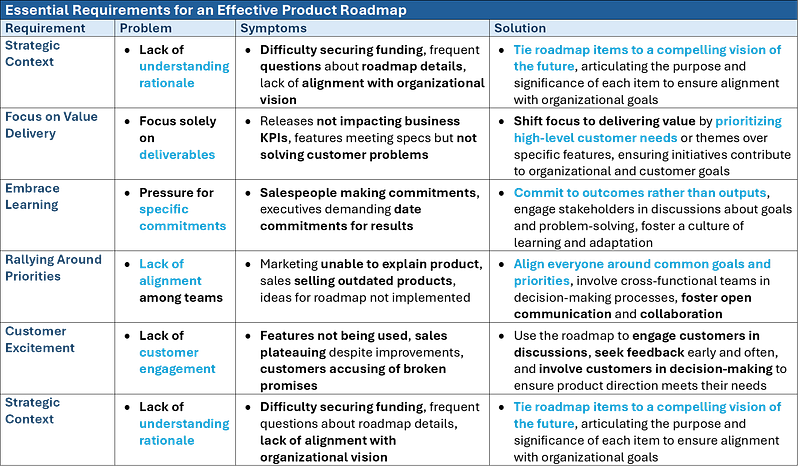
To address these issues and pave the way for a successful relaunch of your roadmap, consider these five essential requirements of an effective product roadmap:
- Strategic Context: Problem: One of the most common pitfalls of a roadmap is the lack of understanding regarding the rationale behind roadmap items. This disconnect can lead to difficulties in securing funding, frequent questions about roadmap details, and a general lack of alignment with the organizational vision. Symptoms: If your team is struggling to secure funding, facing an onslaught of questions about roadmap details, or finding it challenging to align with the organizational vision, it’s likely a symptom of a roadmap lacking strategic context. Solution: To overcome this challenge, tie your roadmap items to a compelling vision of the future. Articulate the purpose and significance of each item by clearly explaining why they are essential for achieving the overarching organizational goals. By providing strategic context, you can ensure that every roadmap item contributes meaningfully to the bigger picture.
- Focus on Value Delivery: Problem: Traditional roadmaps often focus solely on deliverables without considering their impact on customers and the organization. This approach can result in releases happening on time but failing to impact business KPIs, and features meeting specs but not solving customer problems. Symptoms: If your team is struggling to make a tangible impact despite delivering on time, or if features are meeting specifications but failing to address customer needs, it’s a clear indication that your roadmap lacks a focus on value delivery. Solution: Shift the focus of your roadmap to delivering value by prioritizing high-level customer needs or themes rather than specific features. Instead of just listing deliverables and deadlines, identify the core problems your product aims to solve and prioritize initiatives based on their potential to deliver value to both customers and the organization.
- Embrace Learning: Problem: Pressure from executives and customers for specific commitments can hinder adaptability and innovation. This pressure often leads to salespeople making commitments in contracts and executives demanding date commitments for results. Symptoms: If your team feels constrained by rigid commitments and struggles to adapt to changing circumstances, it’s a sign that your roadmap fails to embrace learning. Solution: Commit to outcomes rather than specific outputs by engaging stakeholders in discussions about goals and problem-solving instead of rigid commitments. Encourage a culture of learning and experimentation where the focus is on understanding customer needs and iterating based on feedback rather than sticking to a predefined plan.
- Rallying Around Priorities: Problem: Lack of alignment among marketing, sales, and engineering teams regarding product priorities can lead to confusion and inefficiency. This lack of alignment often results in marketing being unable to explain the product, sales selling outdated products, and numerous ideas for the roadmap not being implemented. Symptoms: If your team struggles to explain the product to the market, continues selling outdated products, or faces difficulty prioritizing ideas for the roadmap, it’s a clear indication of a lack of alignment around priorities. Solution: Align everyone around common goals and priorities by involving them in decision-making processes and gaining buy-in from stakeholders. Foster open communication and collaboration between cross-functional teams to ensure that everyone is working towards the same objectives.
- Customer Excitement: Problem: Despite delivering new features and updates, customers may not be enthusiastic about your product. This lack of excitement can lead to features not being used, sales plateauing despite improvements, and customers accusing you of breaking promises. Symptoms: If your team struggles to generate excitement among customers, experiences stagnant sales, or faces accusations of broken promises, it’s a sign that your roadmap fails to engage customers effectively. Solution: Use the roadmap as a tool to engage customers in discussions about business pain points and priorities. Seek feedback early and often, and involve customers in the decision-making process to ensure that your product direction aligns with their needs and expectations.
A successful roadmap requires a strategic approach that prioritizes value delivery, embraces learning, aligns stakeholders around common goals, and engages customers effectively. By having these five essential requirements, your roadmap can drive collaboration, innovation, and ultimately, success in product development.
Navigating the Pitfalls of Crafting Effective Product Roadmaps
Crafting an effective roadmap is not without its challenges and there are three critical pitfalls to avoid when developing product roadmaps:
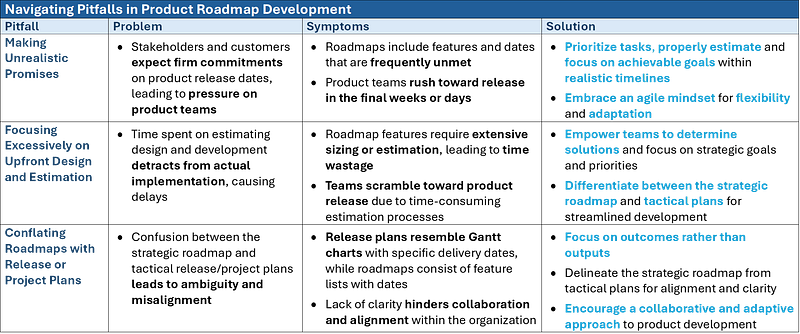
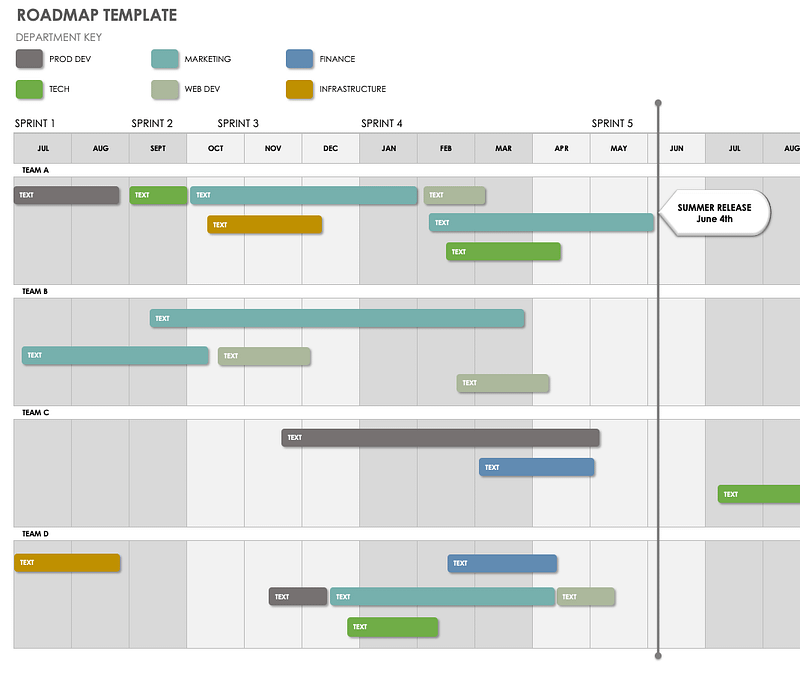
- A Roadmap Should Not Make Promises a Team Cannot Deliver On: Problem: Stakeholders and customers often expect firm commitments on product release dates, leading to pressure on product teams to adhere to strict timelines. Historically, roadmaps resembled Gantt charts with specific dates and feature commitments, which may not align with the iterative and adaptive nature of today’s agile world. Symptoms: Roadmaps may include features and dates that are frequently unmet, causing frustration among stakeholders. Product teams may find themselves rushing toward release in the final weeks or days, compromising quality and effectiveness. Solution: Prioritization is key to delivering on commitments. By properly estimating and prioritizing tasks, teams can focus on achievable goals within realistic timelines. Embracing an agile mindset allows for flexibility and adaptation as priorities shift, ensuring that the roadmap remains a dynamic tool rather than a rigid set of promises.
- A Roadmap Should Not Require Wasteful Up-Front Design and Estimation: Problem: Time spent on estimating design and development efforts can detract from actual implementation, leading to delays and inefficiencies. Roadmaps often include features that require upfront sizing or estimation, consuming valuable resources and causing unnecessary delays. Symptoms: Roadmap features may require extensive sizing or estimation, leading to time wastage and inefficiencies in the development process. Teams may find themselves scrambling toward product release as a result of time-consuming estimation processes, hindering overall progress. Solution: Empowering teams to determine solutions and solve problems allows for more efficient use of time and resources. Rather than focusing solely on upfront design and estimation, roadmaps should emphasize strategic goals and priorities, allowing teams the flexibility to adapt and iterate as needed. By differentiating between the strategic nature of a roadmap and the tactical nature of release or project plans, teams can streamline the development process and focus on delivering value.
- A Roadmap Should Not Be Conflated with a Release Plan or a Project Plan: Problem: There is often confusion between the strategic roadmap and tactical release or project plans, leading to ambiguity and misalignment within the organization. Teams may view the roadmap as a project plan detailing feature release dates, overlooking its strategic intent. Symptoms: Release plans may resemble Gantt charts with specific delivery dates, while roadmaps may consist of a feature list with dates, causing confusion and ambiguity. This lack of clarity can hinder collaboration and alignment within the organization. Solution: Focusing on outcomes rather than outputs allows teams to align around common goals and priorities. By clearly delineating the strategic nature of the roadmap from the tactical nature of release or project plans, teams can ensure alignment and clarity across the organization. This shift in mindset encourages a more collaborative and adaptive approach to product development, enabling teams to deliver value more effectively.
Navigating the pitfalls of product roadmap development requires a careful balance of prioritization, flexibility, and clarity. By avoiding the common pitfalls of making unrealistic promises, focusing too much on upfront design and estimation, and conflating roadmap with release or project plans, teams can develop roadmaps that effectively guide product development efforts and drive success.
Finding this article useful?
For more insights like this, be sure to follow me on Medium and subscribe to get my updates in your email.
Unlocking Success with Effective Roadmaps: Essential Components, Challenges, and Solutions
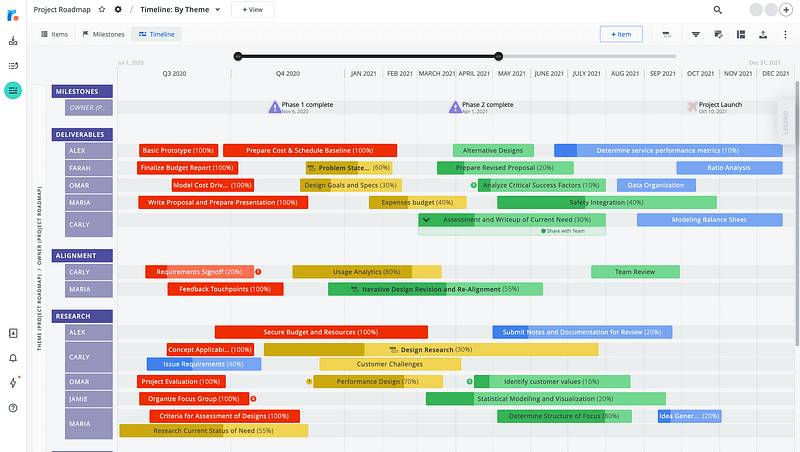
Crafting an effective roadmap is far more than charting a course with dates and features. It’s about strategic communication, agility, and alignment with organizational objectives.
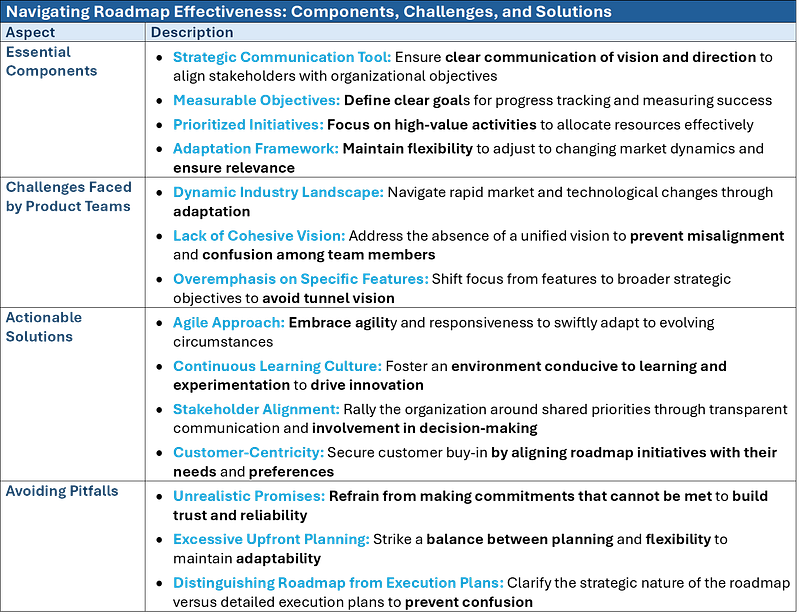
To build effective roadmaps, we need to understand its essential components, address the challenges faced by product teams, and avoid common pitfalls.
- Essential Components of Effective Roadmaps: A product roadmap serves as more than a project plan; it’s a strategic communication tool aligning stakeholders with organizational objectives. Key components include: i) Strategic Communication Tool: Clear communication of vision and direction ensures alignment towards common goals. ii) Measurable Objectives: Clearly defined goals provide a framework for progress tracking. iii) Prioritized Initiatives: Focus on high-value activities ensures resource allocation aligns with strategic priorities. iv) Adaptation Framework: Flexibility to adjust in response to changing market dynamics ensures relevance and effectiveness over time.
- Challenges Faced by Product Teams: Product teams encounter various obstacles that can hinder roadmap effectiveness: i) Dynamic Industry Landscape: Rapid changes in market trends and technology require constant adaptation. ii) Lack of Cohesive Vision: The absence of a unified vision leads to misalignment and confusion among team members. iii) Overemphasis on Specific Features: Focusing solely on features and timelines may overlook broader strategic objectives.
- Actionable Solutions: To overcome these challenges and build effective roadmaps, product teams can implement the following strategies: i) Agile Approach: Embrace agility and responsiveness to swiftly adapt to changing circumstances. ii) Continuous Learning Culture: Foster an environment of learning and experimentation to drive innovation. iii) Stakeholder Alignment: Rally the organization around shared priorities through transparent communication and involvement in decision-making. iv) Customer-Centricity: Secure customer buy-in by aligning roadmap initiatives with their needs and preferences.
- Avoiding Pitfalls: To ensure roadmap effectiveness, product teams must avoid common pitfalls: i) Unrealistic Promises: Refrain from making commitments that cannot be met, fostering trust and reliability. ii) Excessive Upfront Planning: Strike a balance between planning and flexibility to maintain adaptability. iii) Distinguishing Roadmap from Execution Plans: Clarify the strategic nature of the roadmap versus detailed execution plans to prevent confusion.
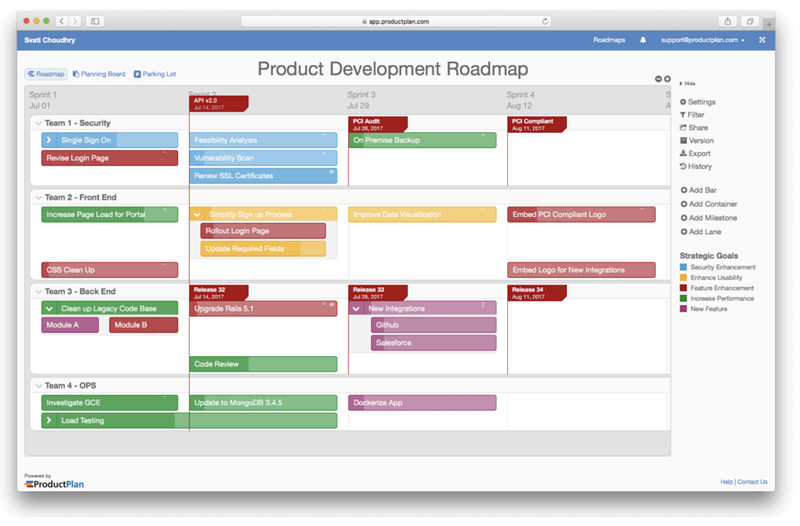
Primary, Secondary, and Complementary Components of Effective Product Roadmaps
Creating an effective product roadmap requires more than just plotting a course; it demands a deep understanding of the primary and secondary components that underpin its foundation, as well as an awareness of complementary factors that shape its trajectory.
What’s remarkable is that you don’t need sophisticated software to create an effective roadmap. A simple spreadsheet covering these components can work wonders in aligning teams and driving product success.

The Primary Components of an Effective Product Roadmap
An effective product roadmap is built upon several primary components, each serving a crucial role in guiding the roadmap’s development and ensuring alignment with organizational objectives. These components include:
- Product Vision: At the heart of every roadmap lies a clear product vision, delineating the desired outcomes and benefits for the target customer. This vision serves as a North Star, ensuring alignment across all initiatives with overarching goals. By articulating how the product will benefit specific customers, the vision unifies teams and stakeholders, driving focus and motivation toward a common goal.
- Business Objectives: Establishing clear business objectives is imperative for measuring progress and communicating the roadmap’s purpose effectively. By defining measurable goals and outcomes, teams can secure resources and focus on initiatives that drive business success. Clear business objectives are essential for ensuring alignment with organizational priorities and facilitating effective communication of the roadmap’s purpose.
- Broad Timeframes for Flexibility: Effective roadmaps utilize broad timeframes instead of rigid deadlines, allowing for flexibility and adaptation. This approach ensures the focus remains on innovation and iterative development, guiding priority initiatives while fostering responsiveness. By emphasizing broad timelines, teams maintain flexibility while working on priority initiatives and milestones.
- Themes: Themes play a pivotal role in shaping the organizational framework of a product roadmap, offering a comprehensive approach to guide the development journey. Beyond merely organizing initiatives, themes encapsulate the overarching strategic direction of the product, ensuring alignment with both the product vision and business objectives. They serve as a lens through which teams can prioritize efforts based on the desired outcomes rather than merely focusing on output metrics. By delineating key thematic areas, such as Enhanced User Experience, Platform Stability and Performance, Feature Expansion, Security and Compliance, Data Analytics and Insights, Customer Engagement and Retention, Localization and Internationalization, Integration and Interoperability, Performance Optimization, Innovation, and Experimentation, themes provide a holistic view of the product’s trajectory. This enables teams to focus on initiatives that are most closely aligned with achieving the desired outcomes and delivering value to both customers and the organization. Additionally, themes foster cohesion and clarity within the roadmap, allowing stakeholders to grasp the overarching strategy and understand how individual initiatives contribute to the larger goals. Moreover, themes facilitate adaptability, as they provide a flexible framework that can evolve in response to changing market dynamics or shifting organizational priorities. Overall, themes serve as a strategic anchor, guiding product development efforts and ensuring that resources are allocated effectively to drive meaningful outcomes.
- The Role of the Disclaimer: A disclaimer serves as a crucial component to protect both the organization and its customers by recognizing the dynamic nature of the roadmap. By establishing clear expectations and mitigating the risk of broken promises, the disclaimer fosters transparency and trust among stakeholders. For instance, an example of a disclaimer could be: “This roadmap is for informational purposes only and does not imply a commitment to deliver specific features or updates. We value your understanding and patience as we adjust our plans based on feedback and market conditions.” This disclaimer effectively acknowledges the roadmap’s potential changes and ensures stakeholders are well-informed and prepared for any adjustments.
An effective product roadmap integrates these primary components to provide clarity, alignment, and flexibility in driving product success. By emphasizing the product vision, defining clear objectives, utilizing flexible timeframes, organizing initiatives around themes, and acknowledging the dynamic nature of the roadmap, teams can navigate complexity and unlock success in product development.
The Secondary Components of an Effective Product Roadmap
With the primary elements captured, an effective product roadmap can be enhanced by having the following components:
- Features and Solutions: At the core of any roadmap are the features and solutions aimed at addressing user needs and enhancing product functionality. These deliverables, ranging from new features to optimizations, serve as tangible manifestations of the roadmap themes. However, it’s crucial to strike a balance between providing sufficient detail and maintaining flexibility to adapt to evolving requirements.
- Stage of Development: Labels indicating the stage of development, such as “discovery,” “design,” or “prototyping,” offer valuable insights to stakeholders regarding the product’s progress. These labels guide stakeholders on their level of involvement and set realistic expectations, ensuring alignment between the roadmap and stakeholder actions.
- Confidence: Indicating confidence levels in addressing roadmap items in the next release is a strategic move to manage stakeholder expectations. While specifics like percentages may not always be necessary, conveying the tentative nature of certain roadmap items helps offset the perception of firm commitments and fosters transparency in communication.
- Target Customers: In scenarios where the product serves multiple customer segments, specifying target customers on the roadmap provides clarity and context. By aligning roadmap items with specific customer segments, product managers can ensure that development efforts are tailored to meet the diverse needs of their user base.
- Product Areas: Annotating roadmap items by product area can be particularly beneficial for large or complex products with distinct functional areas. While not included in all roadmaps, this component offers granularity and clarity, facilitating better understanding and alignment among stakeholders. Examples of areas include mobile (iOS/Android), Desktop, Payments, Homepage, etc.
Complementary Components of an Effective Product Roadmap
With effective roadmapping, success hinges not only on the roadmap itself but also on the broader context within which it operates. While the product roadmap outlines the journey ahead, several complementary factors shape its trajectory and influence its outcomes.
- Project Information: This encompasses vital information such as project schedule, resource allocation, status updates, dependencies, and risks. For both the development team and executives, understanding these dynamics is paramount to ensure alignment and mitigate risks effectively. By navigating through the project’s intricacies, stakeholders can chart a course that optimizes resources, minimizes bottlenecks, and fosters seamless collaboration across teams.
- Platform Considerations: Beneath the surface of every product lies the foundation upon which it stands. Platform considerations delve into the technical realm, addressing scalability requirements, infrastructure needs, and platform specifications. This section serves as a compass for the development team, guiding decisions to ensure the product’s technical feasibility and long-term sustainability. By meticulously tending to these technical intricacies, stakeholders pave the way for a robust and resilient product architecture capable of withstanding the test of time.
- Financial Information: Beyond the realm of code and infrastructure, lies the terrain of financial viability. Financial information encompasses critical aspects such as market opportunities, profit projections, and financial performance metrics. For executives, investors, and the board of directors, this data serves as a compass, guiding decisions that shape the product’s business trajectory. By scrutinizing these financial metrics, stakeholders gain insights into the product’s market potential, revenue prospects, and return on investment, enabling informed strategic planning and resource allocation.
- External Drivers: External drivers encompass regulatory changes, competitive dynamics, and industry events, among others. Relevant for various stakeholders including marketing, sales, legal, and compliance teams, these external factors underscore the need for agility and adaptability in navigating the product roadmap. By remaining attuned to these external forces, stakeholders can anticipate market shifts, capitalize on emerging opportunities, and steer the product toward sustainable growth.
Thanks for reading!
To stay connected and get more insights like this, be sure to follow me on Medium.
As a fellow product enthusiast, be sure to connect with me on LinkedIn to continue this discussion, network, and access my professional network.