LESSONS LEARNED
Requiem for Room 215
The sights, sounds, and smells didn’t die when the wrecking ball arrived
I walked into Room 215 a neophyte, about two decades removed from my own high school experience. I was known as a “Career-Switcher” — school district lingo for one whose skills in the private sector are solid enough to wrangle high school kids.
I said goodbye to teaching 23 years later, proud to have taught a few children well with the support of my venue — a simple, cinder block classroom.
Room 215 helped me keep a group of more than two dozen 17-year-olds calm the morning of September 11, 2001.
No one knew where Flight 93 was headed and our suburban D.C. high school — 11 miles from the Pentagon — was on lockdown.
My classroom also enabled an assembly of grief-stricken kids to keep it together following alum Leslie Sherman’s death in the Virginia Tech Massacre; encouraged another group to celebrate the accomplishments of a classmate who perished unexpectedly; joined in to lament the deaths of teachers, the overdoses of friends and the passing of parents.
Room 215 was more than a place I taught kids what to read, how to write, and that arithmetic was for brains much broader than mine.
It was a home of sorts, which fostered contemplation; a clubhouse where my students could relax and enjoy one another’s company; a location for both hell-raising and serious stuff — like, gosh, learning.
A throwback director’s chair — the legs wobbly, the canvas tie-dyed hot pink to hide stains — parked by my desk. Countless students came by to talk to me over two-plus decades, sitting in the “Chair” and spilling about both real struggles and silly stuff. I tried not to pass judgment, nor render too many suggestions. I was just there to validate their need to be heard.
A senior once changed her schedule so that she could spend more time in my classroom; she said Room 215 helped her heal.
Her sophomore sister started coming by, too. They caught up on homework while I scratched through dozens of student essays with a green or purple felt-tip pen. No red pens in Room 215.
Both girls were at the Boston Marathon in 2013, standing with their mom and little sister on Boylston Street to cheer for Dad as he ran by. The second bomb exploded near them. Everyone survived — Mom’s leg broken in several places — but suffered a trauma I don’t think I ever could imagine.
The two high-schoolers — and soon their younger sib, who also became my student — told me over the years that Room 215 was their sanctuary. They considered just hanging out with me their “therapy”.
In Room 215, we learned to dress for the occasion, whether we were goofing off or bent on more serious pursuits.
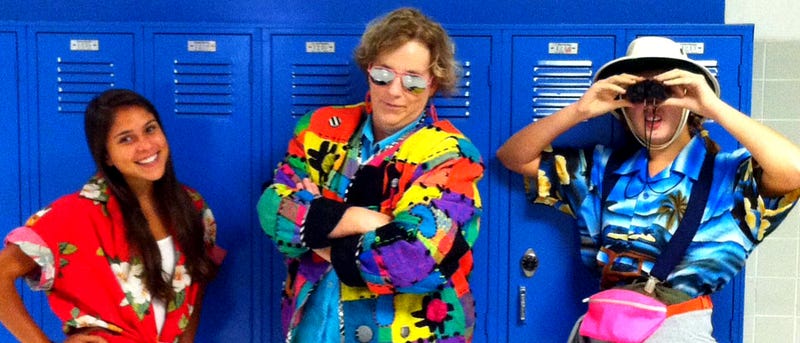
As the proprietor of this particular classroom — the kids, over the years, called me “Nelson”, “Nels”, and finally, I think, settled on “Nelly” — I was known to get gussied up for Spirit Days. These themed events occurred throughout the year. “Tacky Tourist Day”; “Ugly Sweater Day”; other times in the spring dedicated to just being goofy. Forgetting, for a split second, they were there to get an education and we were there to stuff their craniums full of knowledge.
And although I’ve never been known as a fashionista, one year I helped a young man pick out his first suit for a much more solemn occasion. We surfed the Web in Room 215 and decided on something for him to wear to the funeral of a classmate’s dad. He later sat behind me at the service, and as the sounds honoring a life well-lived filled the sanctuary, he reached over and grabbed my shoulder. A reaffirming touch, from one generation to another. I know how you feel, Nelly, and it’s OK to cry.
Room 215 was also Celebration Central. A perfect location for fiestas of all kinds, for any reason.
My classroom was near the back of the building — far, far away from most of the annoying adults who frowned on the fact that sometimes kids just need to let loose. To commemorate a deadline, students would often pass around a sign-up list, and we’d have a potluck. Or, they’d announce Friday was gonna be the best — Chipotle Burrito Day! — and take up a collection.
One year, someone in charge decided to ban eating in classrooms. My students, natch, organized a fiesta anyway; stashed food and beverages in my yearbook office on the appointed day, and used some ancient AV carts I had on hand to wheel the entire smorgasbord down to an outside breezeway during lunch.
Yes, they had tons of food, but didn’t consume it inside. Technically, no harm no foul. Turns out my boss was too busy disciplining real miscreants to pay attention to the get-together assembled by the residents of Room 215.
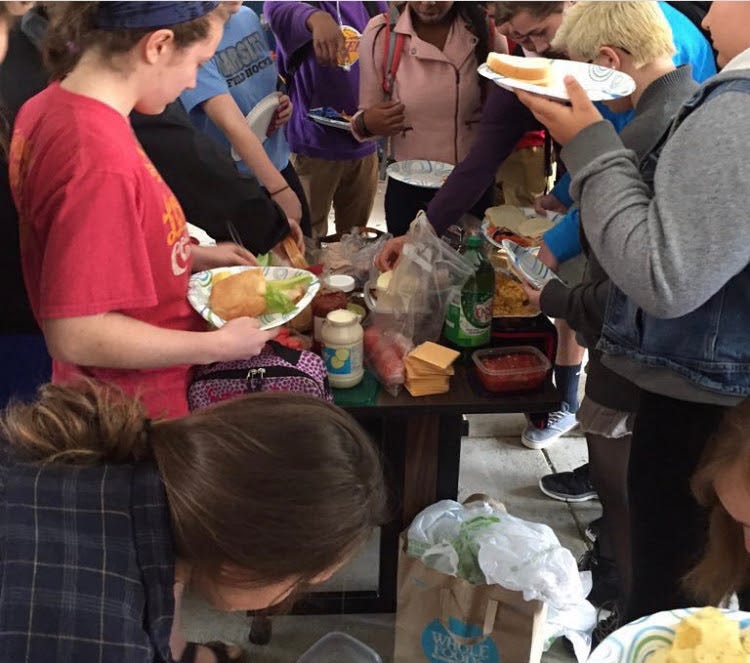
But I wasn’t even there for the biggest blowout of all time, hosted in — you guessed it — Room 215.
By this time my own girls were grown, and I had enlisted the youngest as a substitute teacher.
Trouble was, my students thought Ella Numera Dos would be as chill with all the shenanigans as her Mamasita.
I knew something was up, basically because teenagers aren’t very good at keeping secrets. I told them it wouldn’t be cool to host an epic celebration while I was gone.
But did they listen? You had to ask?
My daughter the sub showed up, as did lots of groceries, and devices upon which to cook the grub. Again, the kids buried the evidence in the back of the yearbook office.
The first of the texts lit up my phone about 11:30.
“Derek just went out to his car. He’s bringing back three of his dad’s tailgate tables.”
“Sydney just plugged in two bacon grills and a waffle griddle.”
“Calvin’s mom just dropped off more fruit salad than I have ever seen.”
My child followed those updates with a plaintive question: “What do I do?”
I told her to go with the flow. In a school district where it’s way more difficult to find a decent substitute teacher than to spit a decent loogie into a gale-force wind (and I know teenagers who’ve tried, as tropical storms approached), no one was gonna holler at her over a brekkie bash.
So my gal settled in with a plate of grub, and tried to control the cherubic cacophony.
The moral of this story? If you plan to host a fiesta of this magnitude in a high school classroom built in 1966, don’t use too many extension cords.
Did they lose power? Not just in Room 215, but in two whole classroom wings of the 50-year-old building. And, I’m told, the familiar fragrance of bacon wafted all the way down to the main office, a good 15-minute walk from Fiesta Central. But nobody in charge noticed. Of course.
All good things must come to an end, and we got the bad news at the beginning of the 2015–2016 school year.
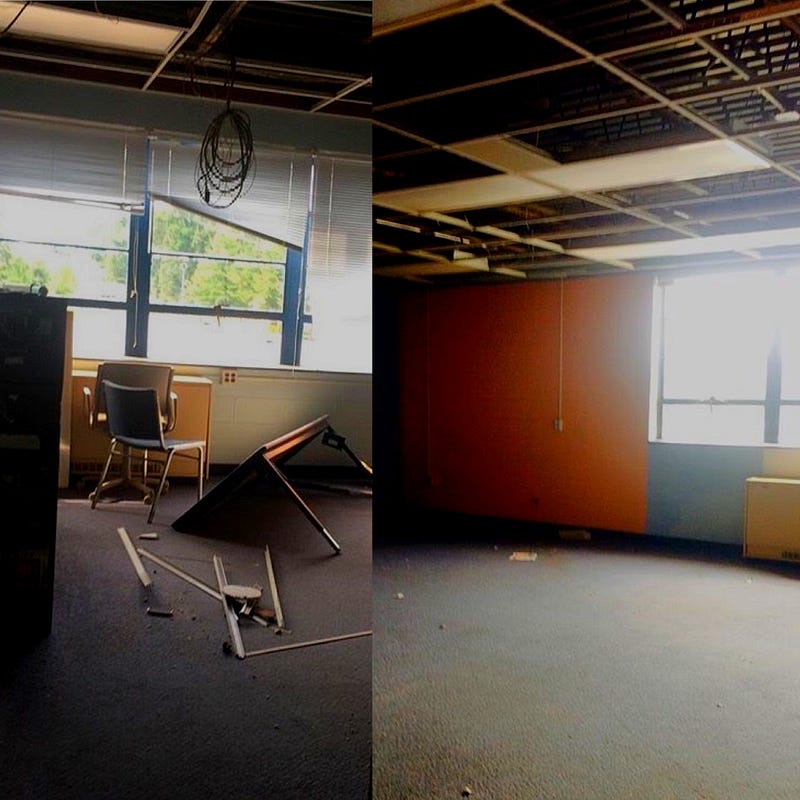
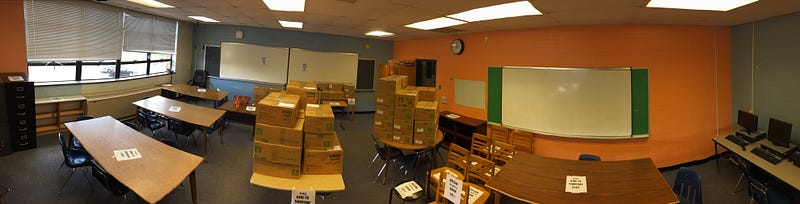
Our school had finally made the district’s renovation list. That meant packing up and moving. Adios, Room 215.
Goodbye to the place where I learned it was OK to giggle, or snort, or even shed a few tears, in front of one’s students. Farewell to the garish orange and blue walls — school colors — my then pint-sized daughters helped students paint 20 or so years before. Auf wiedersehen to the classroom where I had hosted close to 4,000 students over the years.
Because my relationship with Room 215 was so enduring, I had tons to throw on the trash heap of history, but even more to pack up for the next iteration. The students helped, and we loaded 76 boxes with books, binders, tchotchkes and supplies. Memories tend to weigh a lot.
We also learned Room 215 wasn’t going to make it through the renovation, at least in any form with which we were familiar. We watched as wrecking balls took apart the place that I’d called home for so long.
Talking it through with my students helped me realize the demise of Room 215 wasn’t a death, but rather an affirmation of something too strong to destroy.
Over the years I’d planted ideas that, I hope, helped some of those kids who hung out in my simple cinder block classroom face the joys and the challenges of life’s unfolding chapters.
A student framed this quote for me when the new school year started without Room 215. “Don’t cry because it’s over,” Dr. Seuss, aka Theodore Geisel, wrote. “Smile because it happened.”
I do. And I have Room 215 to thank for that.