Dr. Jill: Are You Ready for This?
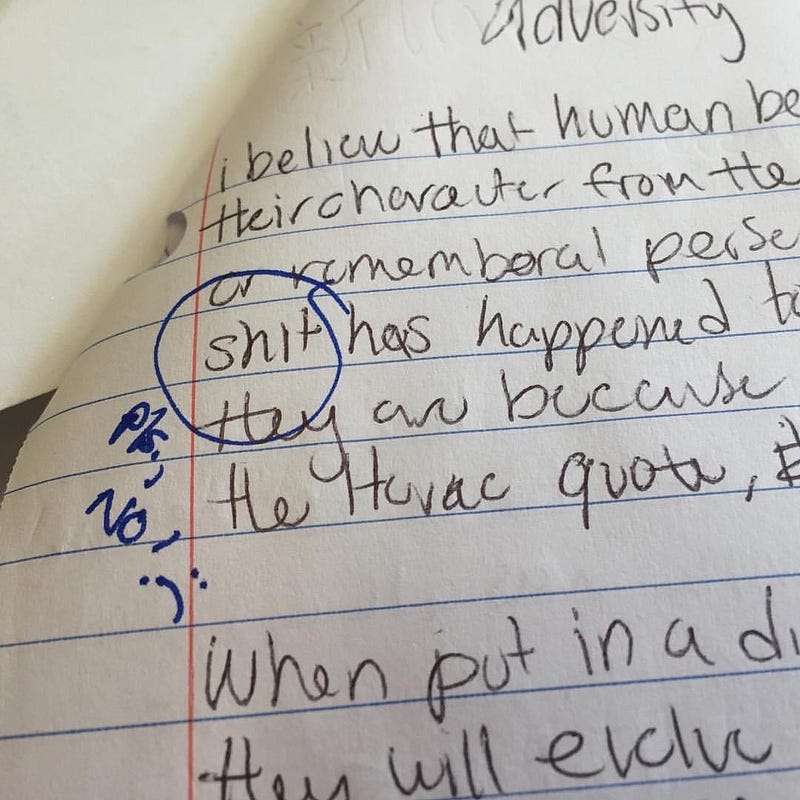
An avalanche of student papers buried me, but I’m prepared for you to be en fuego about your dual pursuits
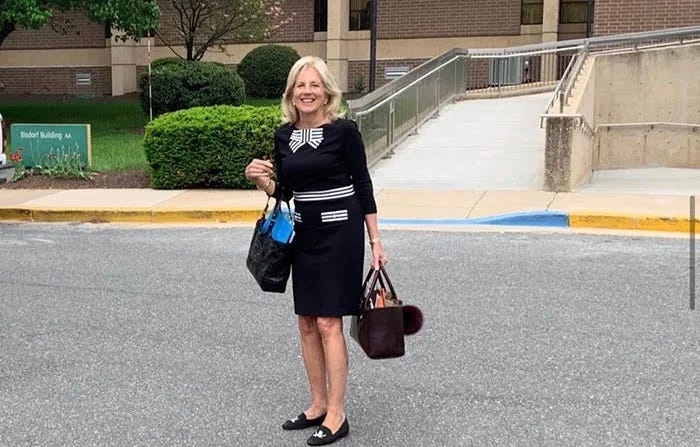
Dr. Jill Biden has a lot on her plate. And I’m not talking about just her duties as First Lady of the United States of America.
Dr. Jill, as you probably know, is a college professor. She says she plans to continue her job as an an English instructor at Northern Virginia Community College — which we in her neck of the woods always referred to as NOVA — the second-largest community college in the United States. Like all English teachers, FLOTUS spent an inordinate amount of time grading student papers during her previous 10-year stint at NOVA. For those who’ve forgotten, she also served as Second Lady for most of that time.
And now, after taking a year off from the pedagogic rank-and-file to help with Uncle Joe’s campaign, Dr. Jill is going back to the classroom, the first First Lady to hold both the honorary White House title and a professional position — known by some as a “day job” — outside 1600 Pennsylvania Ave. As a high school English teacher for 20+ years, I’m of two minds about this — proud because Dr. Jill is obviously en fuego, but I’m also dreading her upcoming journey. Because of all the papers. In other words, I feel her pain.
While she was Second Lady, Dr. Jill kept a busy schedule. She promoted the importance of community colleges in strengthening our shared American employment goals. She, along with then-First Lady Michelle Obama, worked on an initiative to support military families called “Joining Forces”. She continued to coordinate with the Biden Breast Health Initiative, a Delaware organization she founded in 1993. And she spent a good chunk of time immersed in the flotsam and jetsam of the college language arts curriculum.
I know, first-hand, the supreme maxim of the English teacher: You reap what you sow. You assign papers so your cherubs will learn. You grade those papers so that your kids will receive meaningful feedback. You return those papers (well, some of my colleagues don’t — that’s on them, though) in a timely fashion, so that your students will benefit from the feedback and plow their knowledge back into future assignments. And, voila! You’ve got an educated young person, just stuffed full of knowledge, on your hands. Always a good thing, in my opinion.
The Prophet Isaiah says it best: “He shall judge between the nations, and shall arbitrate for many peoples; they shall beat their swords into plowshares and their spears into pruning hooks; nation shall not lift up sword against nation, neither shall they learn war any more.” My interpretation of this Scripture? To retain peace in this world we must have an educated populace. That means students have to invest time in their own education. And teachers must invest time in their students.
That’s where the work of Dr. Jill Biden and — dare I say it? — teachers like me comes into play.
Not that I had a lot of time on my hands during my 23 years as a high school English teacher, but I once took some time out from my duties of talking and assigning and answering and grading to quantify my work.
On average, I taught three classes of AP English Language — the corollary to a college Freshman Comp class, in which Dr. Jill will soon invest countless hours — when she goes back this year — as a full-time instructor. My other two classes were as the adviser to the high school newspaper and yearbook.
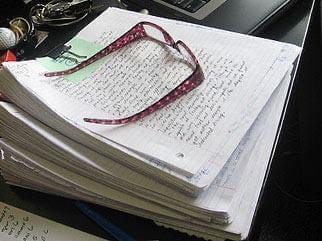
So, take three AP Lang classes, and multiply them by the average of 30 students per class. That’s 90 Lang students per year, yes? Then, factor in the writing assignments — timed, in-class essays; research papers and annotated bibliographies; personal essays, and the like. Conservatively, I’d say I assigned 25 hard-core writing projects such as these per year.
Take the 90 students and multiply them by 25 — that’s 2,250 writing assignments. Per year. And then multiply those times 23 years.
What do you get? I’d say 51,750 pieces of writing, give-or-take, over a teaching career. My particular teaching career, that is. And remember — I was what’s called a “career-switcher” — that means that I worked in another profession (in this case, journalism and politics) before I entered the classroom. If I’d made an entire full-time career out of teaching AP Lang — and taught only Lang, which would mean five classes per year — my grading load would have been much grander. Make that five classes of Lang times 30 students — 150 — per year, times all those assignments, times an average 30- to 35-year teaching career. Close to 132,000 student-written papers in a lifetime. You get the idea.
Of course, I could have taken the easy route. I’ve worked with teachers who assign little, and grade less. I’ve worked with those who assign a lot and grade nothing (like the 11th-grade Lit teacher who assigned a butt load of papers, then failed to grade — or return — any of them. When he left at the end of a few years in the trenches, those who cleaned out his classroom found student work stuffed into every corner of his desk, credenza, bookshelves, file cabinets and storage closets. Reckon he just “spit-balled” student grades?). I even worked with a fellow AP Lang teacher one year who decided to teach this college-level class through film. That’s right—something about Han Solo’s “quest”? I have no idea how his students scored on the end-of-year College Board exam, but I know for a fact they had a lot of fun.
Dr. Jill has already been in this game longer than I was — she has 30 years on the clock, and shows no desire to give it all up. She’s graded papers in the White House, in the Vice President’s Residence and aboard Air Force 2. Few of her NOVA students over the years knew she was a VIP — stories say they called her Dr. B., and just knew her as a fair and thoughtful teacher. But I give her props for wanting to get back in the game again. There’s nothing better, or more satisfying, than watching that “lightbulb” go off above a student’s head. I’d do it all again in a heartbeat — but maybe part-time, if I were younger, with way fewer papers to grade.
I’ve never critiqued student papers in such prestigious places. But I’ve graded those that have been soaked by a gully-washer (field hockey practice apparently continues — even if it’s raining the proverbial cats and dogs — and high school students do their homework wherever they can); dotted with blood (I’m told that the student became nervous and started picking at a cuticle on her writing hand — never resulting in a good outcome); covered in pizza droppings (kids eat — a lot); on Saturday mornings in Room 215 because I needed to get away from the shriekiness (A real word? Probably not.) that was my house when the kids were little; at all-day swim meets (in my humble opinion, the best place to get a lot done — you’re there six to eight hours, and you only have to get up four to five times over the course of the meet to watch your kid swim for 30 seconds), and in the lobby of the Bethesda Marriott one weekend morning when Ella Numera Una was interviewing for summer law internships (When she was done after however many hours, she encountered her Mama sound asleep and snoring in a comfy chair, with her feet up on a fancy table and the stuffed-to-overflowing book bag full of papers spilling out onto the floor. Those critters can be exhausting).
I’ve even let my daughters in on the act. I had an iron-clad rule when I taught my classroom cherubs how to write college admissions essays. Word limit: 500. Anything written after that would not be graded. I’d take the pile of papers and hand them to Ella Numera Dos — all of 12 or 13 years old at the time. She had a red pen and counted each word on each student essay — up to Word 500. Then she stopped and marked that spot with a red line. This technique kept the kids in check — and taught them that if they saved the best for last, it wouldn’t count.
Then there was the snow day when I was grading one set (that would be a stack of 30) of timed essays. I had a mug of hot chocolate on the table to my right, and a fire roaring in the grate to my left. I kept running into the same silly mistakes on each paper. I took that as a sign that a) the students weren’t paying very close attention to me, or b) I wasn’t a very good teacher. In frustration, I tossed the pile of student papers into the air. Always had a flair for the dramatic.
That turned out to be a big oopsies. Several of the essays ended up in the fireplace, singed beyond recognition. I threw the rest in there, too. Told the students I’d “recycled them by mistake” (which does happen sometimes — the recycling, not the singeing) and gave everyone an “A” on the assignment. These things happen.
My favorite story about the perils of grading papers comes from 2015. I had so many papers from my three Lang classes that they filled at least four of those fabric grocery bags so many were so partial to before the pandemic struck (I don’t know about you, but I’m back to plastic instead of paper or reusable. I’ve got it stuck in my mind that the Virus won’t stick to plastic — but who knows?).
I felt slightly overwhelmed (I know, hands feel; people think). Although I had a few choices — recycle those suckers, give everyone an “A” or maybe burn them beyond recognition — I decided upon the honorable route. I took the week before Spring Break off. My Lang cherubs were scheduled to suffer the eternal damnation that is the Virginia SOLs that particular week and I was fine just dipping out from proctoring. I scheduled a sub and told nobody where I was going.
I spent most of those two consecutive weeks grading student papers. I was thorough in my pursuits, giving meaningful feedback and suggestions for improvement. That was the period in my career when my students actually appreciated my hard work. And also the time known in the annals of Room 215 as the week “Mrs. Nelson Is Missing” made the rounds. Get it?
Oh, Dr. Jill. I wish I had some advice for you. But you know what you’re doing. I’m confident you won’t have to take a week off, nor schedule a sub, to get all your work done. Just don’t throw any of your student papers in one of the 28 fireplaces that grace the White House. You want to be remembered for the good en fuego, not the bad, right?