
When You’ve Gotta Go…
Classroom widget production and great expectations
OK. You’ve read about classroom content centered around Kumbaya Circles that high school students routinely schedule. The Mickey Mouse principal whose goofy demeanor didn’t do him any favors. You’ve raised an eyebrow or two over the amount of paperwork a teacher has to tackle just to get information to her students.
But have you ever considered the high-stakes testing in your local school district and the amount of time teachers spend “teaching to the test” so that students can pass the largely multiple choice nightmares that have become the law of the land since Congress enacted legislation 20 years ago?
A whole generation of American students has been shaped by a policy that made relatively little sense when first established and has become the gateway to changing lifelong learners into robotic recruits during their formative years.
It all started with President George W. Bush’s desire to leave “No Child Left Behind.” Instead of teaching kids how to read, write and do ’rithmetic, “W” and his Department of Education thought teachers — and thereby students — should be held accountable for their learning. If we could quantify how much Jill and Bill learned in the classroom, we could “produce” smarter students across the board. Sorta like they were widgets in a factory and we could “quantify” how much teachers were able to produce on the assembly line.
And then those in charge decided to expand the factory model to the Nth degree. Hold schools and school districts accountable for their pass rates by doling out special “Governor’s Certificates” (big whoop) to schools with an overall pass rate, and trumpeting the failure of those that haven’t yet produced the required amount of widgets. And tie testing pass rates to teachers’ salaries. That’s always been a popular move. The political one, too.
“W,” bless his ever-lovin’, pea-pickin’ heart, was never a teacher. I sometimes wonder, given his proclivity for malapropisms and other odd turns of phrase — in South Carolina remarks on the campaign trail in 2000, he famously said, “Rarely is the question asked: Is our children learning?” — if he ever attended school at all. The man born on “third base” and given every opportunity in life thought it would be a good idea to reform American education using an outdated business model. How did that turn out?
I can tell you. The first few years in the Old Dominion, Virginia’s “Standards of Learning” tests were “practice” exams. Welp, that didn’t work, because after kids found out the SOLs — as they’re known — “didn’t count”, they’d sign their names and then go to sleep for the remainder of the testing period. And once Virginia school districts started testing in earnest, and the tests “counted toward graduation,” we endured the proverbial “consequences” — students don’t “get” a certain kind of question? Remove it from the test. Virginia schools “performing “ at much lower levels of widget-production than the “experts” had originally planned? Make the tests a whole lot easier. Sad to say, these “high-stake” exams that were supposed to improve American education just dumbed it down even more.
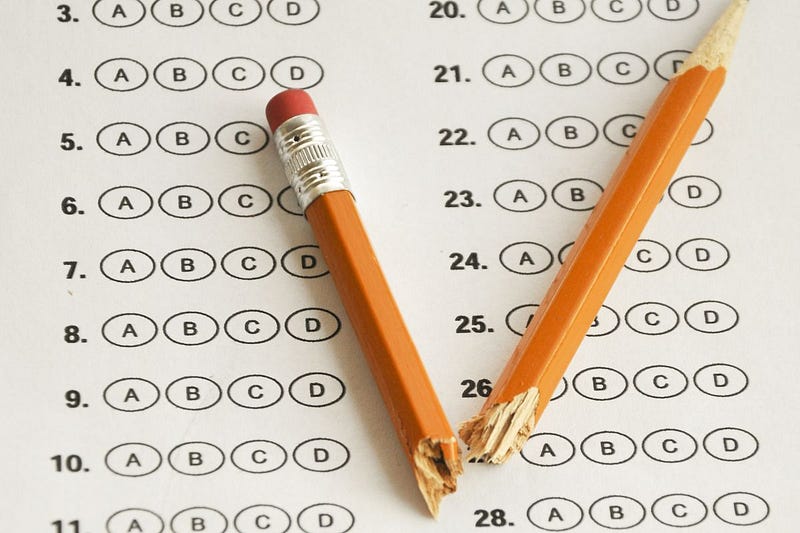
I swear, these dang “high-stakes tests” were revised downward so many times over the years that any random 3-year-old — had he possessed the fine-motor skills to bubble-in an answer sheet with a Number 2 pencil — would have passed with flying colors just by creating a pretty picture out of the bubbles on the page. And all bets were off once the tests went online. Everyone knows that most 3-year-olds these days are more tech-literate than their folks. I mean no disrespect to toddlers by saying that we were soon teaching to the lowest common denominator, but there you go.
Offered in all of the “core” courses — 8th grade through 12th, with a sprinkling in elementary years — the tests are designed to quantify that students have learned the “minimum” of what they need to know in English, Math, Science and Social Studies. And as soon as the kids all found out they weren’t supposed to shine on these assessments, but rather simply pass, they reverted to typical behavior. Why try when you don’t really have to?
Of course, there’s an alternative to taking these onerous and time-consuming examinations. Virginia state law says only that students are “expected” to take the tests. But, as in most of life, there’s a way to ditch these requirements. Parents of Virginia students through 8th grade are allowed to “opt out” from the testing program with no penalty. And if high school students — who “technically” are supposed to pass five of these so-called “subject tests” to graduate — choose not to test in a certain subject, they can take a higher level academic class in high school, such as AP English. If the student passes that class with a “C” or above (most do) that kid is exempt from the traditional junior year English SOL.
And then, of course, there’s the interminable “do-over” that exists in American public education. High school students may take any and all of the five subject SOL tests over and over again — until they get the passing score of 400 out of 600 points. For those who don’t want to do the math, that’s a 66 percent passing rate. Tough stuff. And you’d better believe the handful of kids who still don’t pass a test receive special remediation until they darn-well do.
Oh, I forgot one thing. High school kids who take the “private school” route — such as George W. Bush — don’t have to take the SOLs at all.
But OMG, this is a difficult — though pointless — exercise for those in charge, ranging from the teachers, who have to teach to the test, monitor the testing assembly line and are then held accountable for its output, to the principals and even school district superintendents, who are evaluated on school performance as well.
One thing all these “experts” didn’t account for, I guess, was human physiology. What about the bodily functions of those adults assigned to proctor so many lengthy (the tests are un-timed, so students have as much time as they need to wrack their brains) exercises in futility?
W and his cohorts threw a wrench into the widget-production business when they failed to take into account a well-known maxim in the education trade: “When you gotta go, you gotta go.”
As outlined above, high-stakes testing over the past couple of decades has made everyone — from students to parents to teachers to principals — pee their pants.
Literally? Almost.
One beautiful spring morning in what seems like a whole lifetime ago, I did my duty — proctoring a math SOL, of all things. There’s not much to this. Arrive at school at the crack of dawn. Pick up testing materials from the Standardized Testing Czar (these so-called School Testing Coordinators organize the assessment of the production of the widgets, and earn upward of $100,000 per year — far above any median teacher salary — for this work) before school starts. Administer said online test to 20+ sleepy 9th- & 10th-graders. Collect tests in numerical order (each is numbered). Turn materials back into Testing Coordinator.
Lots of paranoia surrounding these examinations, if one could call them that. So, lots and lots of rules surrounding the actual taking of the tests. No talking. No chewing gum. No use of any hand-held electronic devices. Backpacks parked at the front of the room. No food or drink. Mouths shut. Cellphones off and collected by the proctors.
Oh. And no potty breaks should be expected until the test is over. For either the kids or for the adults.
Things went smoothly during this particular several-hour exercise in tedium. But as the clock ticked away, my bladder began to beat time. One thing I had not checked off my list.
I shifted from one foot to another. Sat down and then stood up again, several times. Glanced at my water bottle and then regretted refilling it before arriving for my proctor duties. Strolled over to the front of the room; circled around to the back. Sat down again. Stood up.

A young man was shaking his right leg underneath one of the desks. A nervous tic, I suppose. But he was certainly keeping time with what was going on within my core. Let’s just say my bodily functions were on high alert. I was starting to do what my daughters used to call the “Pee-Pee” Dance. In earnest.
And then one of the many “shortcuts” instituted by the state testing administrators kicked in. I was never more pleased to work for an institution that liked to cut corners to make sure everyone could succeed.
The kid with the leg that kept cadence under the desk raised his hand. I walked over, thinking he was done with the test. No, he had a more urgent concern. Nature called.
Earlier I mentioned that no one was expected to take a “potty break” until the test was over. Key word here? “Expected.”
We put his online exam on pause. He stood up, and I followed him in the direction of the boys room. Proctors are required to do this to prevent cheating, I guess, but I never figured out how me following him almost to his destination would keep him from fishing a formula or some other verboten document out of his jeans pocket while he was ensconced in the Throne Room. No matter. There was a girls room next door.
No one had ever told me if I were allowed to make a pit-stop while a student was on a similar mission. But at that point I didn’t care. I finished my business, much relieved, and strolled out to the hallway a second before my young charge left the bathroom and headed back toward his test, me dutifully following. We re-started his assessment and everyone was good to go. Because we had gone, as it were.
Lessons learned? Don’t forget to make a pit stop. And try not to do the Pee-Pee Dance in front of the cherubs. You might scar them for life.


