Cold-Blooded Curriculum
Capote’s true-crime masterpiece is a good start for a discussion of capital punishment
It’s been 61 years since the prosperous farmer Herb Clutter and three of his family members were found dead in their rural farmhouse outside Holcomb, Kansas. Every year about this time, I think about the Clutters — and the two men who killed them. I never knew the family, except through the pages penned about their murder and the case that unfolded in the aftermath. Author Truman Capote is the one who introduced me to Herb, Bonnie, Nancy and Kenyon. And I spent two decades, more or less, introducing the Clutters and their killers to my high school English students.
About 30 years after its initial publication, I first taught Capote’s quintessential who-done-it, In Cold Blood, to my AP Lang cherubs in Room 215. This true-crime masterpiece had always been my Number 1, and I couldn’t wait to share my enthusiasm for Capote’s mammoth accomplishment — writing a non-fiction “novel” wherein the facts speak for themselves, as the author employs the drama of rising and falling action— with my students.
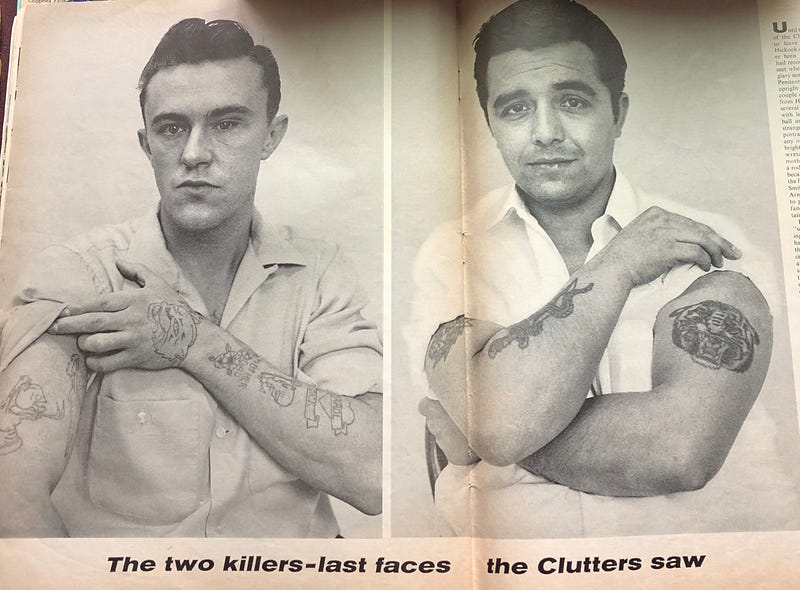
History will record the year 2020 as many things, but last month marked more than six decades since the Clutter family was terrorized and torn apart in their rural western Kansas farmhouse. The family died in cold blood at the hands of two drifters named Dick Hickock and Perry Smith.
In Cold Blood, in fact, although it takes place in 1959 and was published in 1965, would be a good starting point for a discussion of capital punishment today.
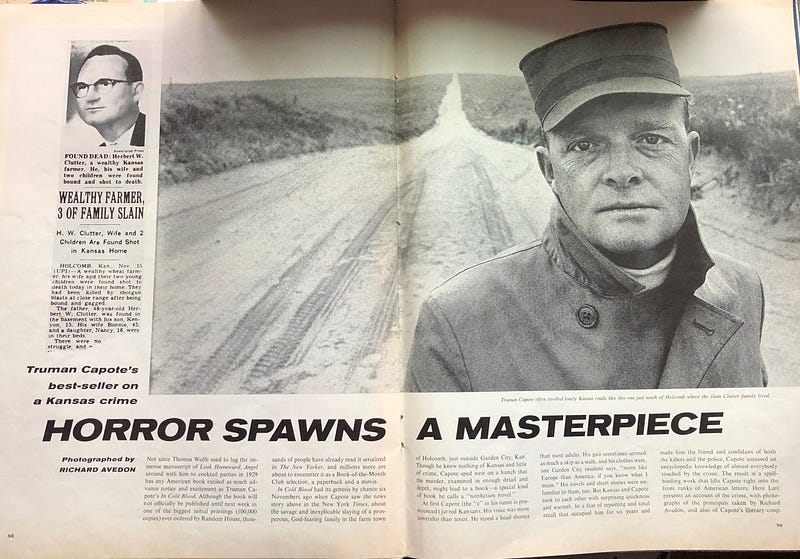
Capote, with the assistance of his childhood friend Harper Lee, spent six years interviewing the principals in the Clutter murder and its resulting investigation, poring over documents, living among the hardy Kansans in the tiny town of Holcomb, compiling thousands and thousands of pages of notes that helped him capture the essence of the events that occurred before, during and after the Clutter murders. He even succeeded in bringing the Clutters back to life and giving some semblance of humanity to their killers within the pages of his blockbuster.
If one were to look into Capote’s investigation of this gruesome crime and the reactions of those involved in the Clutter case — in retrospect — to his mammoth accomplishment, there could appear to be a few tears in the narrative, and objections to the way Capote laid the whole thing out. Bob (Bobby, as the teenage boyfriend of Nancy Clutter was known back then, and “last to see them alive,” as Capote characterized him in the book) Rupp continues to take issue with some of the author’s facts. No, he says, he didn’t run like a madman all the way over to the Clutters’ place after he heard about the deaths. After all, he told one interviewer, he owned a car. Why wouldn’t he drive?
Several Holcomb residents, who still live in the hamlet or in the nearby county seat Garden City all these years later say Capote was “flamboyant,” and might not have been interested in telling the truth. What some of these critics acknowledge, however, is that they also haven’t read the book, and only heard from other locals that Capote paints them in a less than favorable light.
“Fake News,” the clarion call of the year 2020, is nothing new. The bleats of those sheep who believe in disinformation campaigns were also loud and clear decades ago.
People are always going to pick, no matter what the subject. You see, Holcomb became the center of the literary map because of the deaths of six people — four out at Herb Clutter’s place and two at the hand of the State of Kansas 400 miles away at the State Penitentiary in Lansing. Herb, his wife and his two teenaged kids were considered upstanding citizens. Dick and Perry were a couple of no-account common criminals, looking for a “score” that they never got. A previous cellmate had told Dick that Herb kept a safe in his house, which could contain up to $10,000. Herb had no safe; in fact, he did all his business involving his substantial spread by check. Capote painted a gruesome account of a night filled with horror. He also pursued the psychological pathways that led the Clutter murderers to do what they did. And in the end, he captured the equally gastly execution of Dick Hickock and Perry Smith.
It turns out the fine people of Holcomb, for the most part, didn’t want their quaint little burg to be associated with the macabre in this fashion, so they spent a good deal of time denying the truth in the aftermath of In Cold Blood’s publication. The fact remains that all of the principals in the case — law enforcement who tracked down Dick and Perry; investigators who combed the crime scene, and the two drifters responsible for the Clutter deaths, say it’s a true account. I’m no expert, but after reading the “non-fiction novel” countless times, discussing its underlying currents over two decades in the classroom, and reading follow-ups and in-depth research about the case, I can attest that not only did Capote connect with the truth, but he hit it right out of the park.
I’ve digested dozens of news accounts, written after the murders, after the publication of In Cold Blood in 1965, after the movie of the same name, and starring several residents — playing either themselves or extras — came out in 1967, and after every important anniversary — the 10th, the 20th, the 30th, and so on — and not many close to the action have had a bad word to say about Capote and his coverage of the case. He and Ms. Lee did their homework — and by golly, they aced that project. So I tend to reject the occasional interview that criticizes Capote’s presentation of the facts or the way he captures his characters in the pages of this achievement. Or the intimation that his well-known “flamboyance” would have anything to do with him stretching the truth to sell a few books.
Capote claims he invented the genre in which his blockbuster is packaged — the so-called “non-fiction novel.” The idea was to do the “reportage,” as he calls his research, and then package the true story within the words of a novel-like setting. After years of running down leads — asking countless questions of residents, law enforcement, and the killers themselves — as well as those close to them (he spent hours interviewing Dick and Perry on Death Row); digging through courthouse reports, legal documents, and reams and reams of trial transcripts, the intrepid duo (childhood friends in Monroeville, Alabama, Ms. Lee modeled the character Dill in her classic, To Kill a Mockingbird, after her pal Truman) laid the foundation for an exceptional work of life and death. Capote ended up capturing both the disturbing and riveting details of a mass murder — while at the same time taking a deep dive below the surface of what makes such a killer the way he is.
Assigning In Cold Blood was always the peak of my school year. Students didn’t just read — they delved into the undercurrents of humanity. Were the Clutters the upstanding citizens everyone characterized them to be? Would Perry have had a chance if his upbringing hadn’t been so fraught with terror? Was Dick a good person who took a wrong turn? Was Capote too close to his subjects, and did he develop his thesis before he ever sat down and investigated the circumstances of the crime?
And after thoroughly exploring Capote’s story — his rising and falling action, his diction, his thought-provoking premises — as well as some of the psychological tenants the author touches on, my high school juniors were ready for the big time. In lieu of a research paper, they were required to do the research, sure, in the form of a thoroughly documented annotated bibliography — and come to class fully prepared to discuss the death penalty, and whether Dick Hickock and Perry Smith deserved to die.
After finishing the book and looking into capital punishment, Capote and the Clutter case, my students spent two full classroom days — that’s three hours, or hundreds in a teenager’s life — discussing the death penalty. Its history; how it has been applied in American courtrooms throughout the years; the reasons for sentencing; possible outcomes of the death penalty vs. life in prison, before meeting during the following class — that’s another 1.5 hours — to debate whether Dick and Perry deserved to die. The kids approached this assignment knowing the outcome of the case in advance — that the Clutter killers did meet the ultimate punishment. That’s all part of Capote’s book, and they had finished reading by the time we had our discussion. I asked them to apply their research, their thoughts on Capote’s conclusions, and their own developing beliefs — to our classroom debate as if they were the jury in Dick and Perry’s murder trial. And come to a conclusion on the fate of these two societal pariahs.
And boy oh boy, could those in charge of life and death in American life today learn something from these kids.
I’ve been told over the years that this was the first time most of my students had had to tackle an assignment so complex. One young man called the exercise “brutal, but in a good way.” A group of three young women — all friends, all with differing belief systems, at least when it came to capital punishment — spent the rest of the year debating Dick and Perry’s fate — and other implications in other cases they came across — among themselves. In fact, these former students, now in their mid-30s with families of their own, are still friends, and continue to discuss the Clutter case and its outcome when they get together.
And then there was Charlie, who wanted nothing more than to verbally pound his beliefs into his peers, without facing the consequences of going off the deep end.
You can imagine that any discussion like this — especially among high-schoolers who were still maturing, both intellectually and emotionally — had to have a modicum of rules. And yes, I laid all of that out before we began our discussion on the first day. No yelling; no ridiculing; let facts speak for themselves and support your argument; and anyone who couldn’t discuss the topic in a reasonable way would be exiled to the hallway and given a zero on this high-stakes assignment.
Charlie’s class started off on the side of calm and credibility. One student mentioned the cost of incarceration; another discussed the merits of a study on “nature vs. nurture,” and how it could well be applied in the brutal killer Perry Smith’s case; another talked about victims’ rights. And why, one of them wanted to know, did Capote refer to the murderers by their first names instead of the more clinical Hickock and Smith?
Charlie sat in the back right-hand corner of the classroom, apparently assessing the situation. I knew that he had a temper, and I was well aware of what he thought of Dick and Perry and what he believed their fates should be. His hands clasped tightly across this chest, Charlie was waiting for an opportunity to pounce, without getting called out for over-reacting and losing points on this assignment.
Emily sat in the center of the room. She had brought her Bible to class, and it was marked with what appeared to be dozens of sticky-notes. She raised her hand. I called on her.
She started out by reading a verse from the Book of John: “Let he who is without sin throw the first stone.” She talked about what the Apostle John meant, in the context of an anti-capital punishment stance. She followed up by explaining that when the Bible says “an eye for an eye,” that doesn’t necessarily mean retributive justice is a good thing. She included some information in her discussion that she had gathered from the Web site of an anti-capital punishment legal group.
Emily laid out her thoughts in a calm and collected manner. She was reasonable in her presentation. She closed her notebook, which contained her annotated bib, and then placed her Bible on the table in front of her. Her soon-to-be nemesis chose that moment to stand.
As he rose, Charlie looked at me and then at Emily, as if to gauge what my reaction might be to him interrupting our discussion. He pushed back his chair and walked toward the front of the room. Because Room 215 was populated with tables instead of desks, he had to take a circuitous route to get to his destination.
I thought he was headed toward me. Turns out he was headed toward Emily. Before I could react, or she could lift her face to confront him, Charlie — a large kid who played both football and basketball — placed both hands on the table in front of Emily, and leaned toward his classmate. And a primal rumble rose out of his chest and exploded out of his mouth.
“They killed those four innocent people. Period. That’s it. They’re guilty,” he started, attempting unsuccessfully to control his temper. “They need to fry!” It didn’t matter that the punishment for murder in the first degree in Kansas at the time of the Clutter case was death by hanging. Charlie was thinking electric chair, and a punishment — frying — that in his mind more than fit the crime. And his last exclamation was so loud it even made me jump.
I headed toward Charlie, more to interrupt his interaction with Emily than anything else. But he knew what he had to do. He stood up from his confrontational stance, faced the classroom door, and walked out.
Emily sat there for a beat or two. She opened her Bible, and read the following, from John 3:19–21:
“And this is the judgment: the light has come into the world, and people loved the darkness rather than the light because their works were evil. For everyone who does wicked things hates the light and does not come to the light, lest his works should be exposed. But whoever does what is true comes to the light, so that it may be clearly seen that his works have been carried out in God.”
Yes, I taught in a public high school. And no, I didn’t teach a religion class. But Emily schooled Charlie with the Word that day, even though he wasn’t around to hear it.
Charlie received a zero for this part of the assignment, as I’m pretty sure he knew he would. He failed to follow the rules, respect his peers, focus on the facts. But his annotated bibliography was practically flawless. I gave him a 95 percent on the research part of the project. He came out with a 50 percent on the assignment (I rounded up from 47.5), but I believe I learned more from his interaction with Emily that day than anyone in the classroom.
Charlie was not the first of my students to hold a strong opinion on capital punishment, but his dramatic pronouncement was certainly the most deliberate. We talked about In Cold Blood and the fates of Dick and Perry 20 times during my tenure in Room 215, and every year the discussion was different. But I discovered so much during those times, about the work and about myself; and, I’m happy to report, so did my students.
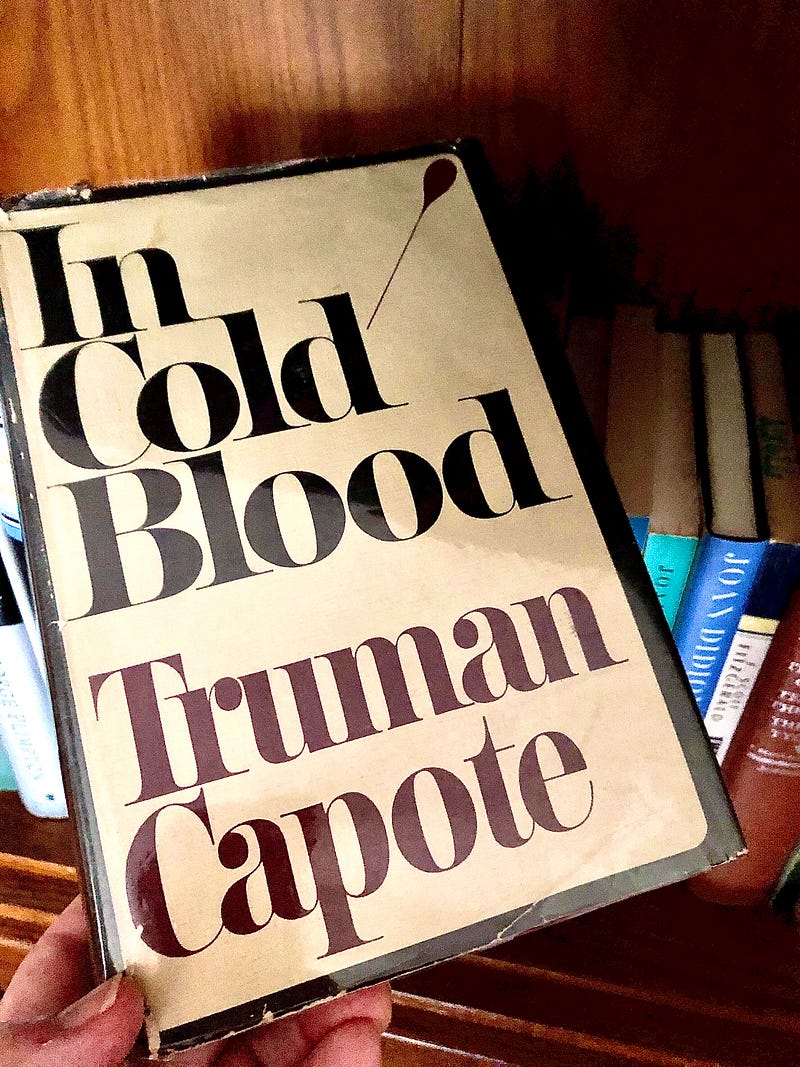
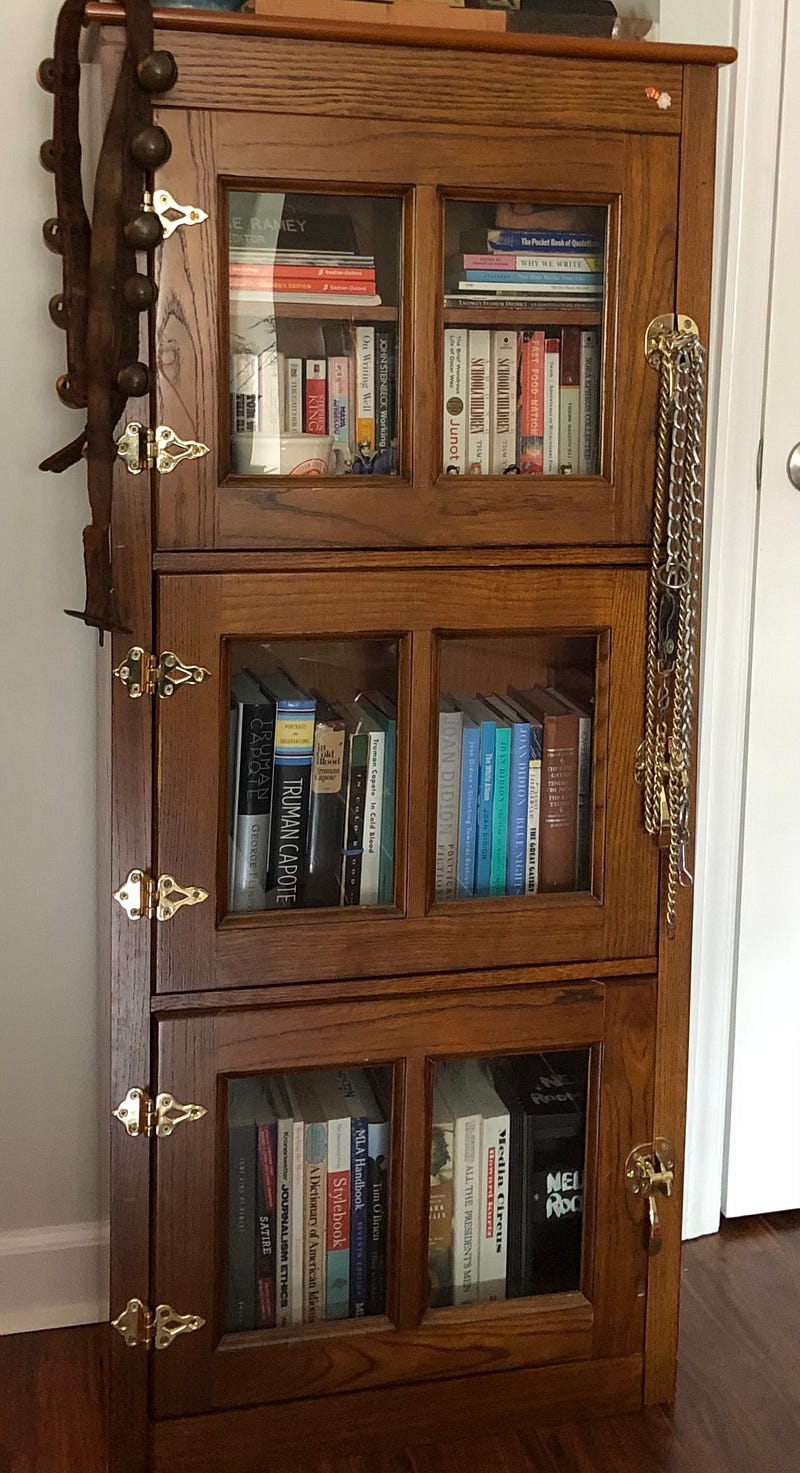
I have a glass-fronted bookshelf — it’s known, I’m told, as a “Barrister’s Bookcase”— that I acquired at the Salvation Army (always the best finds) years ago. It holds all of the books I taught in Room 215 over the years, and quite a few special volumes. Resting on one shelf is a prized possession of mine — a second-edition printing of In Cold Blood. I found it buried in the back of a used bookstore several years ago.
While this is a library copy that apparently had changed hands multiple times and cost me about $30, a first-edition, signed copy of In Cold Blood is available from some rare books purveyors for 1,000 times more. And it goes without saying that I can’t afford a copy of a book, no matter how close to my heart, which is more expensive than the car I drive today.
The worth of Capote’s work, though, is not in what one can charge online for those willing to pay. The value, I believe, is in the often troubling words of In Cold Blood — crafted by Capote with precision and, I know, with a strong desire to get us talking about so many crucial issues — life, death and even love. Charlie knew that when he erupted in my classroom that day. I don’t know what he’s doing all these years later, but I hope he remembers our discussion fondly. I know I do