avatarOliver Ding

Free AI web copilot to create summaries, insights and extended knowledge, download it at here

5050

Abstract

<img src="https://cdn-images-1.readmedium.com/v2/resize:fit:800/1*Feya_KzJm4SI01boseBQqA.png"><figcaption></figcaption></figure><p id="bc67">The above diagram is the WXMY diagram. You can find more details about the diagram <a href="https://readmedium.com/when-x-meet-y-wxmy-681e30e7a46e?sk=799ad1e8ab528d08fab3a702aa560320">here</a>.</p><h1 id="f69c">Re-engagement as “Form of Events”</h1><p id="cea0">I got the idea of Re-Engagement on March 7, 2020 and developed the Re-Engagement framework on March 18, 2020.</p><p id="6012">If we adopt Blunden’s Project-oriented Activity Theory, we could consider these actions as phase 1: Initialization. I developed a new concept “Re-Engagement” to help event curators to solve the problem of digital transformation of event experience.</p><p id="0241">While other people just directly move to online events such as Zoom meetings (at concrete level) from offline events such as conferences (at concrete level), I jump from the offline events such as conferences (at concrete level) to “form of events” (at an abstract level).</p><h1 id="7399">Re-engagement as “Content of Events”</h1><p id="8334">The next step is returning from the abstract level (a form of events) to the concrete level (the content of events). I designed several subforms of events for the concept “Re-Engagement”. See the picture below:</p><figure id="721e"><img src="https://cdn-images-1.readmedium.com/v2/resize:fit:800/0*MMb9dBty_t4VHXwy.png"><figcaption></figcaption></figure><p id="f434">I also applied these ideas to the SXSW case and designed a mini website as a demo of the concept. Since I was a member of the team of Doowit which is a new platform for curating challenge-based activities, I used the Doowit platform to build <a href="https://doowit.co/channel/y60x9jRq">a Doowit channel</a> to represent my ideas. The screenshot below is the homepage of the channel.</p><figure id="3cc4"><img src="https://cdn-images-1.readmedium.com/v2/resize:fit:800/0*6K1gqbRf7X96WumL.png"><figcaption>The homepage of <a href="https://doowit.co/channel/y60x9jRq">a demo channel</a> for representing the concept of “Re-Engagement”</figcaption></figure><h1 id="c679">Re-engagement as A “From of Activity”</h1><p id="f91b">Since then, I have been working on collecting cases in order to design innovative sub-formats of the concept. For instance, I found the concept of “Re-Engagement” can be applied to the academic field after reading the 2019 book <i>Perception as Information Detection: Reflections on Gibson’s Ecological Approach to Visual Perception.</i></p><figure id="075f"><img src="https://cdn-images-1.readmedium.com/v2/resize:fit:800/0*dzAoGAYF1WUUkXz1.png"><figcaption></figcaption></figure><p id="df7f">Ecological psychologist James J. Gibson published his landmark volume <i>The Ecological Approach to Visual Perception</i> in 1979. The 2019 book is authored by 16 ecological psychologists with a special form that provides a chapter-by-chapter update to and reflection on the 16 chapters in Gibson’s original volume.</p><p id="3ded">This is an amazing Re-Engagement!</p><p id="d4f6">Inspired by this book, I realized that the concept of “Re-Engagement” is not only for planning online events and face-to-face meetings but for planning activities with a special theme. In order words, the concept of “Re-Engagement” refers to a new form of activity.</p><p id="a748">From the perspective of Project-oriented Activity Theory, this is the beginning of <b>Objectification</b> which is <b>phase 2 </b>of the formation of a concept. According to Andy Blunden, “A concept, like a project, is a larger (molar) unit, which is implicit in each meaningful action, disclosing its motivation. The project inheres in the artifact-mediated actions, norms, rules and symbols flowing from <b>the project’s self-concept</b> and underlying the actions which constitute the project.”(2014, p.9)</p><h1 id="f72b">Re-engagement as Cultural Innovation</h1><p id="26e4">For Project-oriented Activity Theory, a brand new concept means a small social movement that inspires cultural innovation. However, the process is not individual creation, but collective collaboration.</p><p id="11cb">For example, I wrote <a href="https://readmedium.com/retwitterville-19ef37e0ac17?sk=724684e073eab708e8a071cc4a966a0f">an article about Twitter</a> on Jun 19, 2020. I adopted the term Twittervill from Shel Israel’s 2009 book <a href="https://www.amazon.com/Twitterville-Businesses-Thrive-Global-Neighborhoods/dp/1591842794/"><i>Twitterville: How Businesses Can Thrive in the New Global Neighborhoods</i></a>. This is individual action. However, if you are a writer, you can do the same thing!</p><figure id="1656"><img src="https://cdn-images-1.readmedium.com/v2/resize:fit:800/1*1hQtnICXPpMfStlTA4NQ9g.jpeg"><figcaption></figcaption></figure><p id="2971">I recently attended an online workshop titled BACK TO W.E.C. which is a 2- month program. W.E.C. stands for the <a href="https://en.wikipedia.org/wiki/Whole_Earth_Catalog">Whole Earth Catalog</a> which is a coun

Options

terculture magazine and product catalog published by Stewart Brand several times a year between 1968 and 1972.</p><figure id="3e67"><img src="https://cdn-images-1.readmedium.com/v2/resize:fit:800/1*v-IwJL3pdObkd0LubxK5dg.png"><figcaption>This diagram is inspired by <a href="https://readmedium.com/cycle-fec3716f4dc6?sk=07866b65ee44135225c7a6947937c0ed">the Supportive Cycle model</a>.</figcaption></figure><p id="319c">The <b>BACK TO W.E.C.</b> project uses <a href="https://milanote.com/">Milanote</a> which is a virtual whiteboard to share ideas and organize discussions. As a 2-month program, the curators also host real-time meetings each week. Each time the group focuses on one chapter of W.E.C.</p><h1 id="69c6">Re-engagement as Knowledge Innovation</h1><p id="7cca">The #NewMACY initiative is a project launched by the American Society for Cybernetics (ASC). The name MACY refers to <a href="https://en.wikipedia.org/wiki/Macy_conferences">MACY Conferences</a>.</p><blockquote id="0599"><p>The <b>Macy Conferences</b> were a set of meetings of scholars from various disciplines held in New York under the direction of <a href="https://en.wikipedia.org/wiki/Frank_Fremont-Smith">Frank Fremont-Smith</a> at the <a href="https://en.wikipedia.org/wiki/Josiah_Macy_Jr._Foundation">Josiah Macy Jr. Foundation</a> starting in 1941 and ending in 1960. The explicit aim of the conferences was to promote meaningful communication across scientific disciplines,<a href="https://en.wikipedia.org/wiki/Macy_conferences#cite_note-1">[1]</a> and restore unity to science.<a href="https://en.wikipedia.org/wiki/Macy_conferences#cite_note-2">[2]</a> There were different sets of conferences designed to cover specific topics, for a total of 160 conferences over the 19 years this program was active;<a href="https://en.wikipedia.org/wiki/Macy_conferences#cite_note-3">[3]</a> the phrase “Macy conference” does not apply only to those on <a href="https://en.wikipedia.org/wiki/Cybernetics">cybernetics</a>, although it is sometimes used that way informally by those familiar only with that set of events. Disciplinary isolation within medicine was viewed as particularly problematic by the Macy Foundation, and given that their mandate was to aid medical research, they decided to do something about it.<a href="https://en.wikipedia.org/wiki/Macy_conferences#cite_note-4">[4]</a> Thus other topics covered in different sets of conferences included: aging, adrenal cortex, biological antioxidants, blood clotting, blood pressure, connective tissues, infancy and childhood, liver injury, metabolic interrelations, nerve impulse, problems of consciousness, and renal function. — Soruce: Wikipedia</p></blockquote><figure id="0fbe"><img src="https://cdn-images-1.readmedium.com/v2/resize:fit:800/1*TP1f5WYdy4IOVamzj57zcg.png"><figcaption></figcaption></figure><p id="61c5">According to ASC, “<a href="https://www.youtube.com/hashtag/newmacy">#NewMacy</a> emerged in March 2020 as the pandemic of COVID became the new global wicked challenge. Lack of effective response to this latest pandemic is both enervating and catalyzing for change: how can we — from the scale of individuals and communities to nation states and societies — evolve such that we gain resilience across physical and social scales and embrace the need for change.”</p> <figure id="7c1b"> <div> <div> <img class="ratio" src="http://placehold.it/16x9"> <iframe class="" src="https://cdn.embedly.com/widgets/media.html?src=https%3A%2F%2Fwww.youtube.com%2Fembed%2FZT17Q6wog00%3Ffeature%3Doembed&amp;display_name=YouTube&amp;url=https%3A%2F%2Fwww.youtube.com%2Fwatch%3Fv%3DZT17Q6wog00&amp;image=https%3A%2F%2Fi.ytimg.com%2Fvi%2FZT17Q6wog00%2Fhqdefault.jpg&amp;key=a19fcc184b9711e1b4764040d3dc5c07&amp;type=text%2Fhtml&amp;schema=youtube" allowfullscreen="" frameborder="0" height="480" width="854"> </div> </div> </figure></iframe></div></div></figure><p id="3a28">Forming a concept is a collaborative project. I’d like to share the concept of Re-engagement with you and others. Together, we can remember great people, great books, great events, great things, etc. Together, we can learn from our past, improve our present, and create a future.</p><p id="7e6f"><i>You are most welcome to connect via the following social platforms:</i></p><p id="a689"><i>Twitter: <a href="https://twitter.com/oliverding/">https://twitter.com/oliverding</a> Doowit: <a href="https://doowit.co/profile/gm0k2ax9"></a></i><a href="https://doowit.co/profile/gm0k2ax9">https://doowit.co/profile/gm0k2ax9<i></i></a><i> Linkedin: <a href="https://www.linkedin.com/in/oliverding/">https://www.linkedin.com/in/oliverding</a></i></p><h1 id="7840">License</h1><p id="447f">This work is licensed under the <a href="https://creativecommons.org/licenses/by-nc-sa/4.0/">Creative Commons Attribution-NonCommercial-ShareAlike 4.0 International (CC BY-NC-SA 4.0)</a> License. Please click on the link for details.</p></article></body>

The Re-Engagement Project

Once Upon A Great Experience
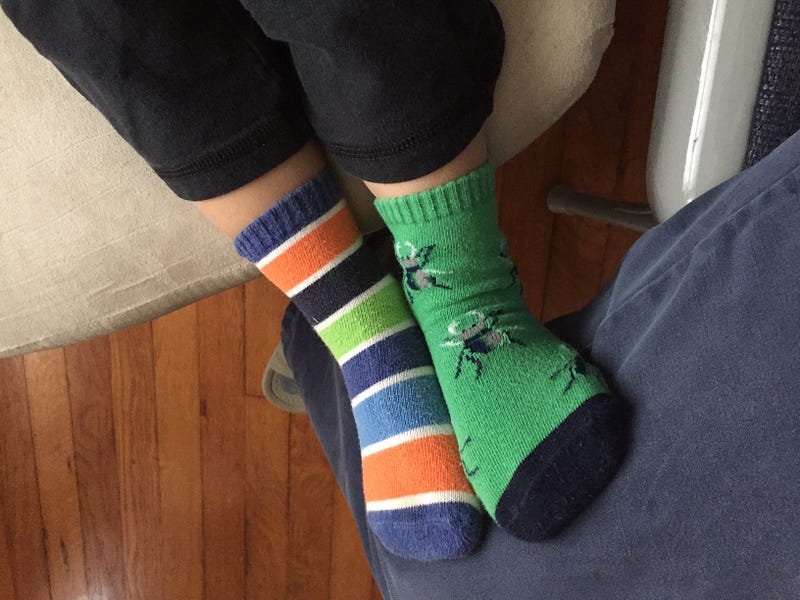
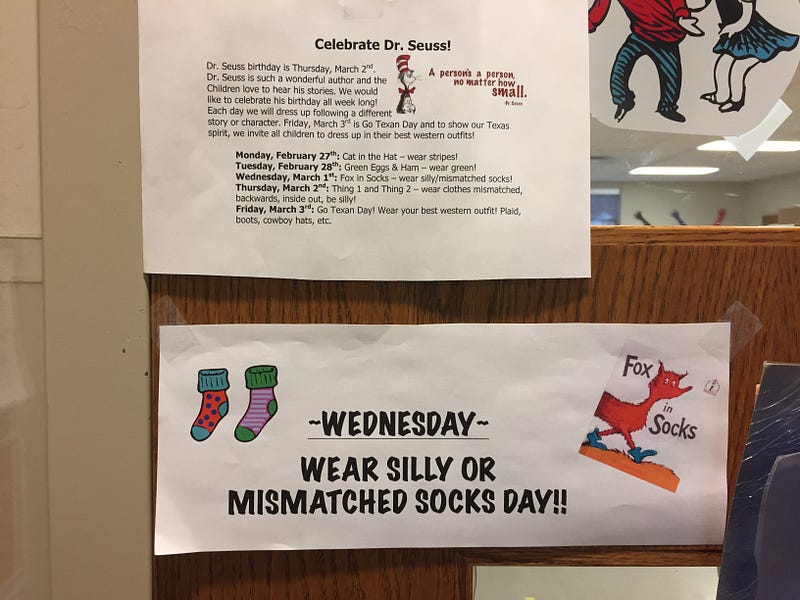
On March 1, 2017, my son wore mismatched socks in order to celebrate Dr. Seuss’ birthday.

The Re-Engagement Project is a cultural innovation project. I got the idea of Re-Engagement in March 2020. On Dec 26, 2020, I considered it an example of Project-oriented Activity Theory. The theory is a radical version of Activity Theory. It redefines the unit of “Activity as Project” which refers to a process of formation of concepts.

From the perspective of Project-oriented Activity Theory, the social process of developing a new concept is a project. If we consider Re-Engagement as a new concept that could bring some value to the world, then we should work together on the Re-Engagement project.

The idea of Re-Engagement is not new. We all have experiences of remembering someone, someday, someplace. On March 1, 2017, my son wore mismatched socks in order to celebrate Dr. Seuss’ birthday. However, I want to use the concept of Re-Engagement to highlight the creative potential between personal memory such as my son’s birthday, and collective memory such as Dr. Seuss’ birthday.

Once upon a great experience. No matter how big or small the experience is, we could re-engage with it.

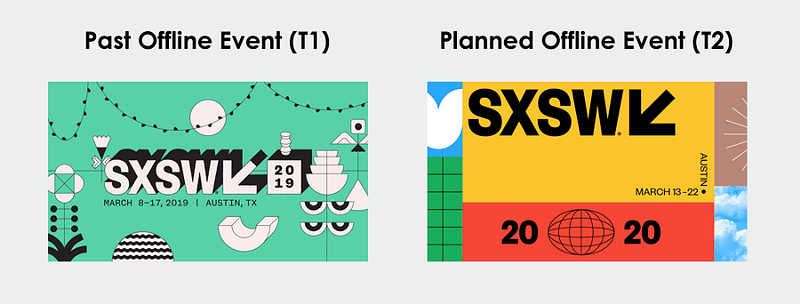
In early March 2020, SXSW, a 34-year annual tech, music, and film festival held in downtown Austin, was canceled due to the coronavirus outbreak. The SXSW 2020 was scheduled to take place from March 13th to March 22nd, Austin Mayor Steve Adler announced the cancellation of the festival on Mar 6, just one week before it.

This inspired me to propose an alternative category of an event called Re-Engagement.

  • When offline events are canceled around the world, the obvious Plan B is running online real-time conferences and virtual meetings with conferencing software such as Zoom, Google Hangouts, and Jitsi.
  • I think we can go further and I consider Re-Engagement as Plan C.

In order to describe my proposal, I created the following Re-Engagement framework with the WXMY diagram.
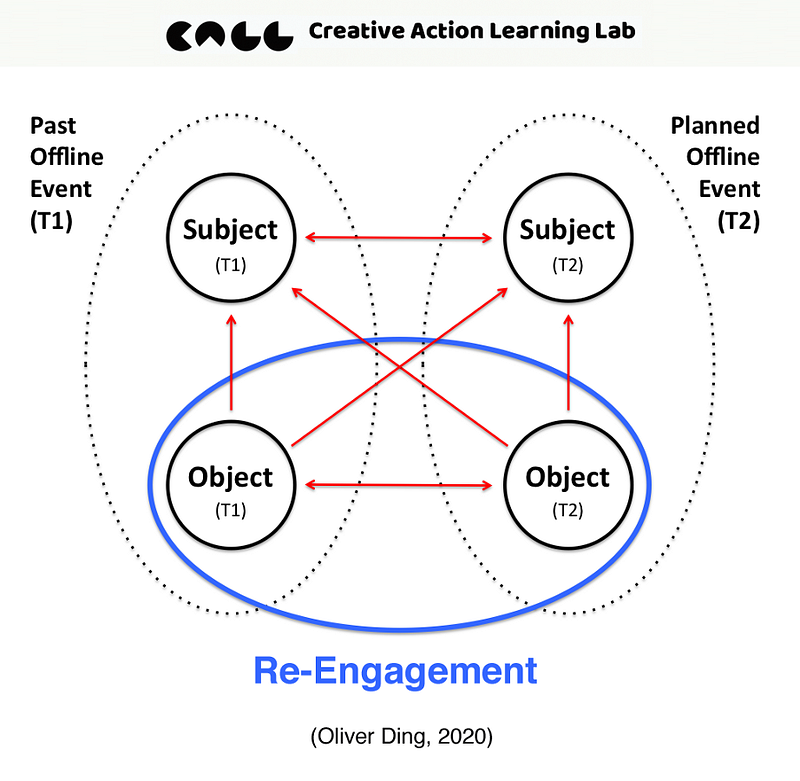
The framework was created with three ideas: the diachrony of community, the Subject-Object activity, and the WXMY diagram.

The Diachrony of Community

The first idea is the diachrony of community. I borrowed the term diachrony from Saussure’s theory of linguistics. For Saussure, it means the development and evolution of a language through history. I applied the idea to the practice of community building. While the real-time face-to-face offline event focuses on the synchrony of community, the Re-Engagement is designed about the diachrony of community. For offline events, there are past events (T1) and planned events (T2), the Re-Engagement connects T1 and T2 together.
The Subject-Object Activity

The second idea is the notion of Subject-Object. I learned the idea from Activity Theory. In traditional Activity Theory, the relationship between the Subject (human actor) and Object (the objective) forms the core of activity. The Object leads to Outcomes.

For offline events, the Subject is event curators, speakers, and attendees while the Object is various themes for discussion and potential collaboration opportunities. The Outcomes are new insights inspired by discussions and new collaborations emerging from the socialized events.

The WXMY Diagram

The third idea is the WXMY diagram. By combining the diachrony of community and Subject-Object together and placing them within the WXMY diagram, I realized that Container Z can transform into a new category: Re-Engagement.
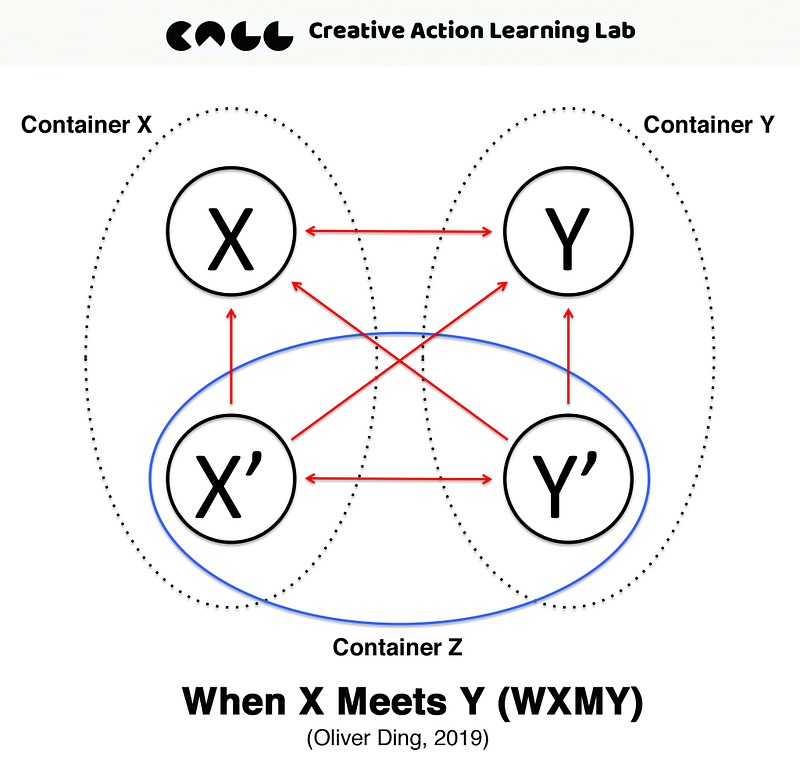
The above diagram is the WXMY diagram. You can find more details about the diagram here.

Re-engagement as “Form of Events”

I got the idea of Re-Engagement on March 7, 2020 and developed the Re-Engagement framework on March 18, 2020.

If we adopt Blunden’s Project-oriented Activity Theory, we could consider these actions as phase 1: Initialization. I developed a new concept “Re-Engagement” to help event curators to solve the problem of digital transformation of event experience.

While other people just directly move to online events such as Zoom meetings (at concrete level) from offline events such as conferences (at concrete level), I jump from the offline events such as conferences (at concrete level) to “form of events” (at an abstract level).

Re-engagement as “Content of Events”

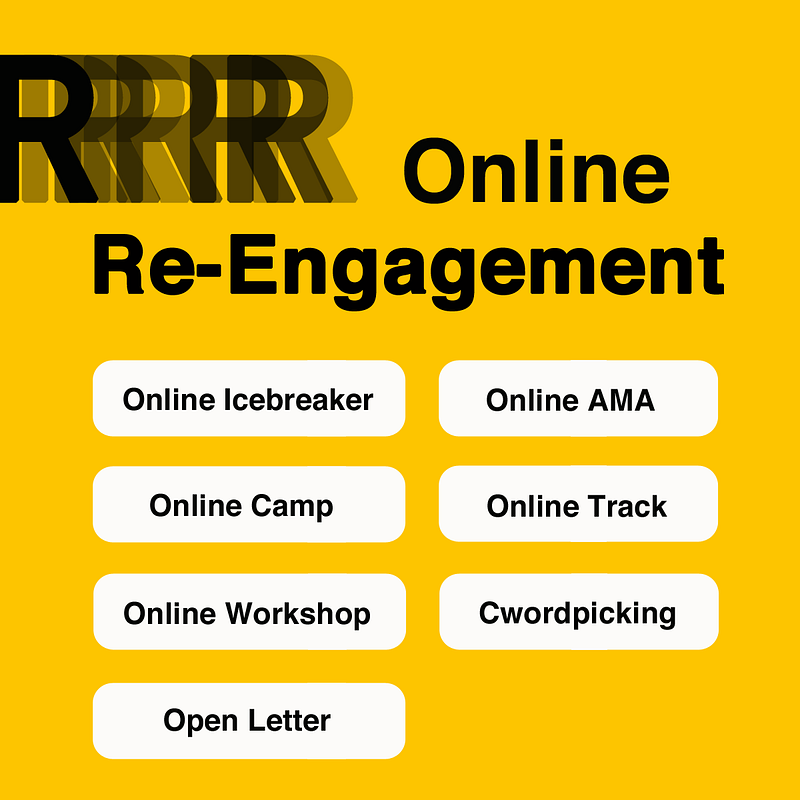
The next step is returning from the abstract level (a form of events) to the concrete level (the content of events). I designed several subforms of events for the concept “Re-Engagement”. See the picture below:
I also applied these ideas to the SXSW case and designed a mini website as a demo of the concept. Since I was a member of the team of Doowit which is a new platform for curating challenge-based activities, I used the Doowit platform to build a Doowit channel to represent my ideas. The screenshot below is the homepage of the channel.
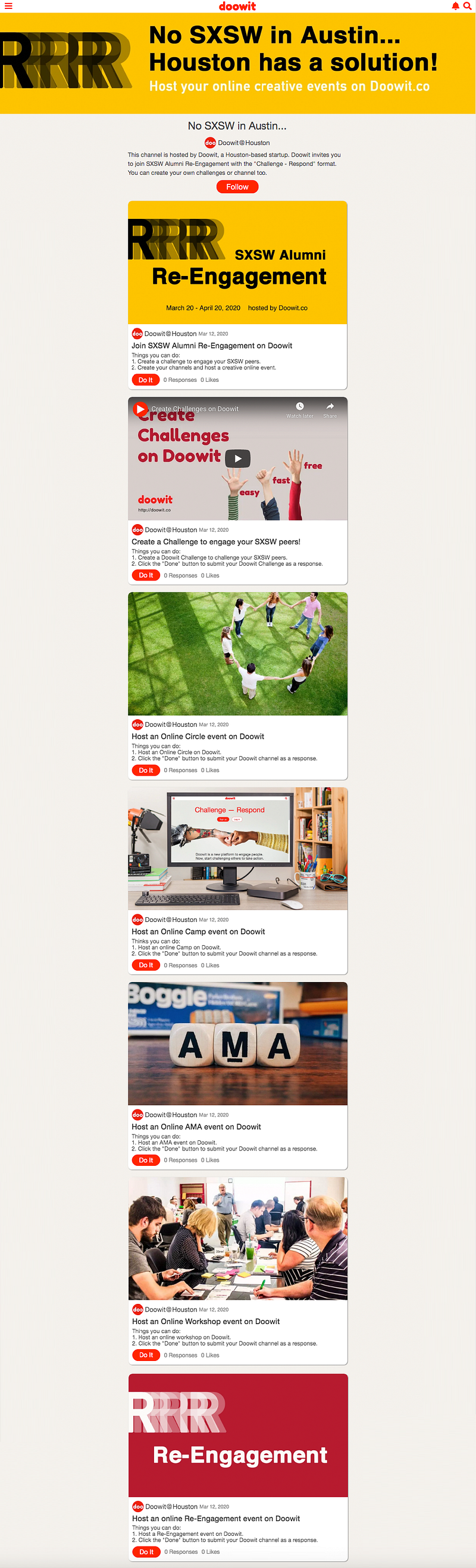
The homepage of a demo channel for representing the concept of “Re-Engagement”

Re-engagement as A “From of Activity”

Since then, I have been working on collecting cases in order to design innovative sub-formats of the concept. For instance, I found the concept of “Re-Engagement” can be applied to the academic field after reading the 2019 book Perception as Information Detection: Reflections on Gibson’s Ecological Approach to Visual Perception.
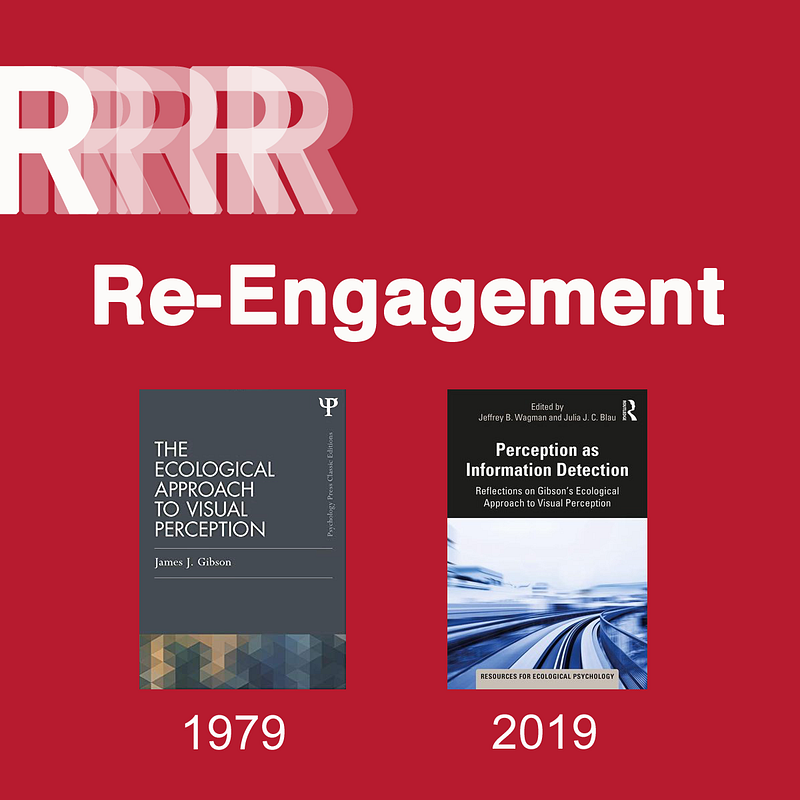
Ecological psychologist James J. Gibson published his landmark volume The Ecological Approach to Visual Perception in 1979. The 2019 book is authored by 16 ecological psychologists with a special form that provides a chapter-by-chapter update to and reflection on the 16 chapters in Gibson’s original volume.

This is an amazing Re-Engagement!

Inspired by this book, I realized that the concept of “Re-Engagement” is not only for planning online events and face-to-face meetings but for planning activities with a special theme. In order words, the concept of “Re-Engagement” refers to a new form of activity.

From the perspective of Project-oriented Activity Theory, this is the beginning of Objectification which is phase 2 of the formation of a concept. According to Andy Blunden, “A concept, like a project, is a larger (molar) unit, which is implicit in each meaningful action, disclosing its motivation. The project inheres in the artifact-mediated actions, norms, rules and symbols flowing from the project’s self-concept and underlying the actions which constitute the project.”(2014, p.9)

Re-engagement as Cultural Innovation

For Project-oriented Activity Theory, a brand new concept means a small social movement that inspires cultural innovation. However, the process is not individual creation, but collective collaboration.

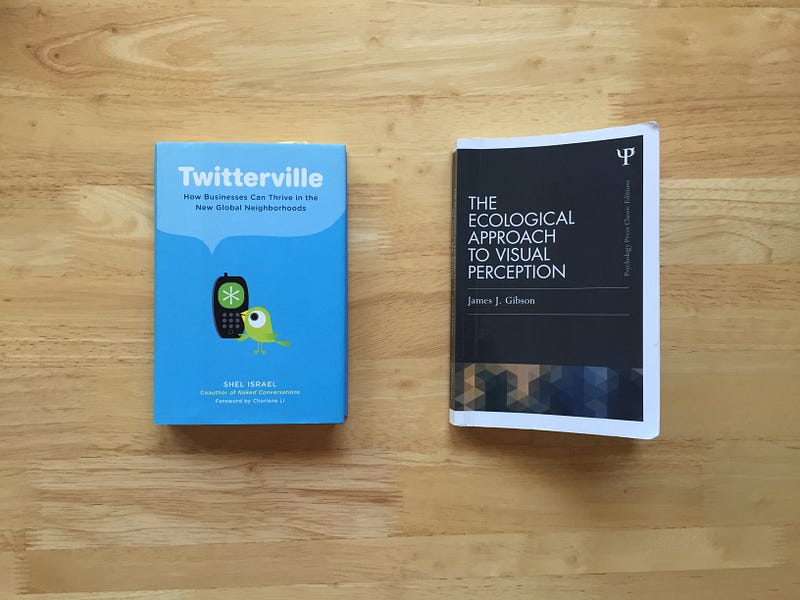
For example, I wrote an article about Twitter on Jun 19, 2020. I adopted the term Twittervill from Shel Israel’s 2009 book Twitterville: How Businesses Can Thrive in the New Global Neighborhoods. This is individual action. However, if you are a writer, you can do the same thing!
I recently attended an online workshop titled BACK TO W.E.C. which is a 2- month program. W.E.C. stands for the Whole Earth Catalog which is a counterculture magazine and product catalog published by Stewart Brand several times a year between 1968 and 1972.
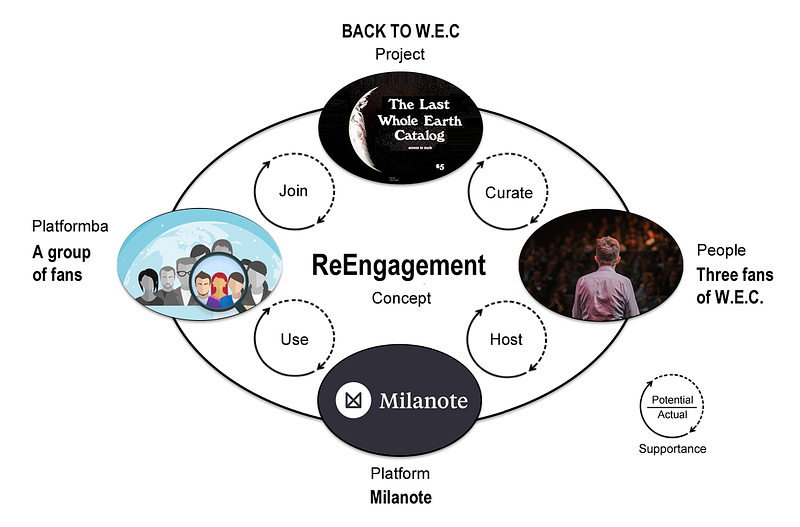
This diagram is inspired by the Supportive Cycle model.

The BACK TO W.E.C. project uses Milanote which is a virtual whiteboard to share ideas and organize discussions. As a 2-month program, the curators also host real-time meetings each week. Each time the group focuses on one chapter of W.E.C.

Re-engagement as Knowledge Innovation

The #NewMACY initiative is a project launched by the American Society for Cybernetics (ASC). The name MACY refers to MACY Conferences.

The Macy Conferences were a set of meetings of scholars from various disciplines held in New York under the direction of Frank Fremont-Smith at the Josiah Macy Jr. Foundation starting in 1941 and ending in 1960. The explicit aim of the conferences was to promote meaningful communication across scientific disciplines,[1] and restore unity to science.[2] There were different sets of conferences designed to cover specific topics, for a total of 160 conferences over the 19 years this program was active;[3] the phrase “Macy conference” does not apply only to those on cybernetics, although it is sometimes used that way informally by those familiar only with that set of events. Disciplinary isolation within medicine was viewed as particularly problematic by the Macy Foundation, and given that their mandate was to aid medical research, they decided to do something about it.[4] Thus other topics covered in different sets of conferences included: aging, adrenal cortex, biological antioxidants, blood clotting, blood pressure, connective tissues, infancy and childhood, liver injury, metabolic interrelations, nerve impulse, problems of consciousness, and renal function. — Soruce: Wikipedia
According to ASC, “#NewMacy emerged in March 2020 as the pandemic of COVID became the new global wicked challenge. Lack of effective response to this latest pandemic is both enervating and catalyzing for change: how can we — from the scale of individuals and communities to nation states and societies — evolve such that we gain resilience across physical and social scales and embrace the need for change.”

Forming a concept is a collaborative project. I’d like to share the concept of Re-engagement with you and others. Together, we can remember great people, great books, great events, great things, etc. Together, we can learn from our past, improve our present, and create a future.

You are most welcome to connect via the following social platforms:

Twitter: https://twitter.com/oliverding Doowit: https://doowit.co/profile/gm0k2ax9 Linkedin: https://www.linkedin.com/in/oliverding

License

This work is licensed under the Creative Commons Attribution-NonCommercial-ShareAlike 4.0 International (CC BY-NC-SA 4.0) License. Please click on the link for details.

Engagement
Activity Theory
Online Event
Event Design
Once Upon A Time
Recommended from ReadMedium