
Proof That Free Markets Don’t Reward The Best Work
When the greatest, most miraculous art is overlooked
Is a free market a meritocracy? Are products of the highest quality those that typically sell the best? When people are free to choose what to buy or to sell, does the cream rise to the top?
Of course, the answer depends on who you ask. Some argue that capitalism has never been meritocratic. Others argue the opposite. But is there proof one way or the other? Is there a knockdown argument that capitalism does or doesn’t reward merit? I think there is, and it’s drawn from the art world.
Humankind’s Greatest Illustrator
Meet Kim Jung Gi. If you’ve never heard of that name before, that would only bolster the following argument.
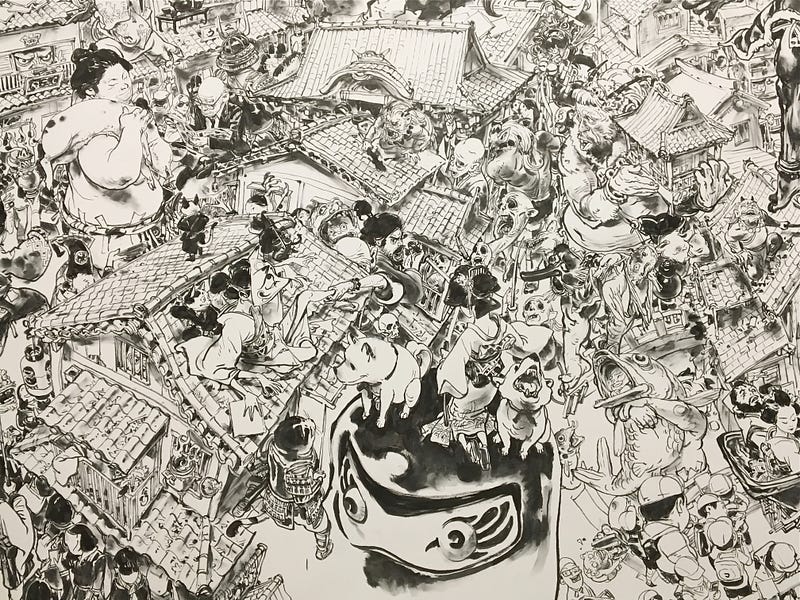
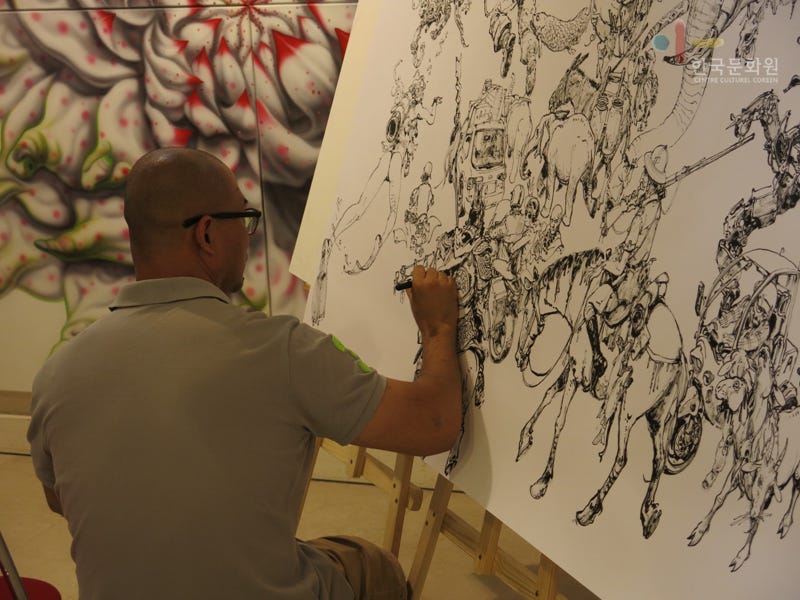
In any case, Kim is probably the greatest illustrator who has ever lived on this planet. He has a miraculous memory that enables him to draw anything whatsoever from any angle in exquisite detail, with flawless perspective, shading, and anatomy, never making major errors — and all with no pencil under-drawing. He just takes up a brush pen and goes straight to blank paper, filling it with astonishing drawings of people, animals, monsters, machines, vehicles, time periods, and on and on.
I happen to have a fine arts background from high school and have dabbled in drawing and painting, having inherited some skill from one of my grandfathers, so I have a little prior knowledge of what would be involved in drawing like Kim draws. But anyone can appreciate the greatness of Kim’s work. Since 2011, Kim has demonstrated his abilities by filming himself drawing on large canvases.
Take his latest and perhaps greatest work, a YouTube series of videos called “Drawing Now,” in which he fills up a huge, long canvas with all kinds of images to form a cohesive artwork tackling, I think, the themes of history and the human impact on nature.
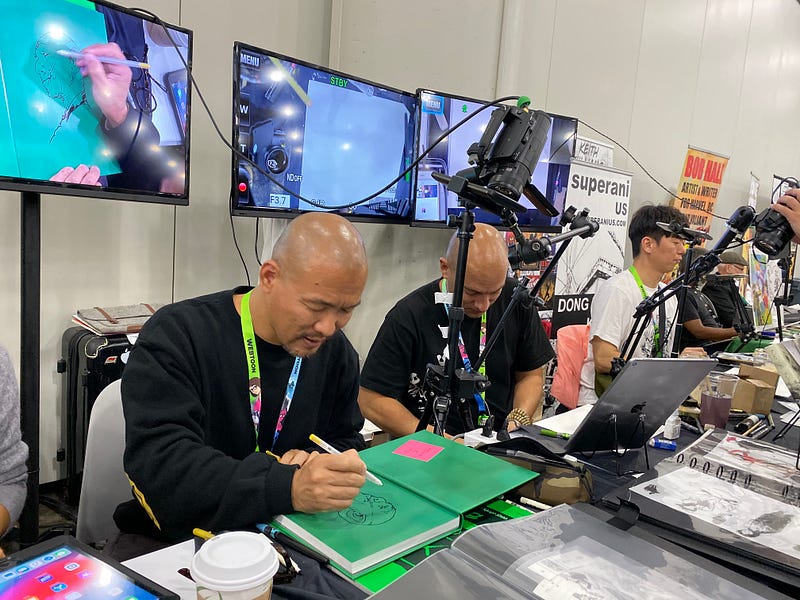
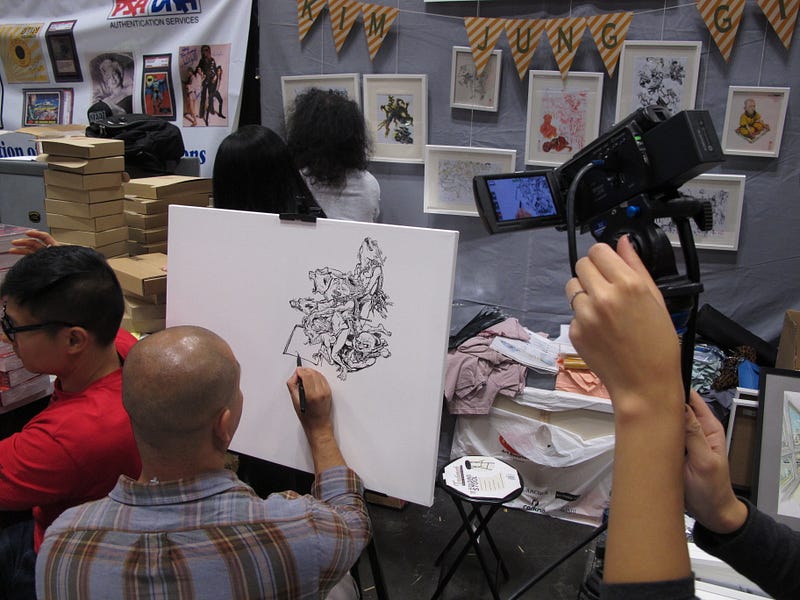
In that series, you can see Kim take breaks from working on that project, during which he’ll sign his art books for fans by customizing the front page with a sketch. Those sketches themselves are wonders to behold. In just a minute or two, Kim will sketch, for example, a complete character, not just a generic face but a face with a personality — and again with no under-drawing. He draws directly with ink and has no need for an eraser. He’ll draw geishas and cowboys and samurais and sci-fi women and wacky animals and anything else. And no two sketches will be exactly alike.
In short, Kim doodles, but he’s memorized so many technical manuals on how things look that his doodles are what normal artists would call masterpieces.
Proof that Capitalism Isn’t Meritocratic
Now, Kim Jung Gi isn’t completely unheard of. He has an art business and a YouTube channel, called Super Ani, and presumably he’s making a living as a full-time artist. But most people still haven’t heard of him. He’s not as famous as pop stars. Bizarrely, as of this writing, he doesn’t have even an English Wikipedia page, although he has one on the French Wikipedia site.
The question, then, is how capitalism could systematically reward merit if the marketplace hasn’t placed Kim at the very top of the art world where he obviously belongs. Perhaps capitalism isn’t perfect, and it takes some time for competition to award everyone what they’re due. There will, then, be plenty of mediocre artists who are passed over for one reason or another. But Kim is unmistakably the best illustrator not just in Korea or on YouTube but very probably on the entire planet. Moreover, it’s hard to see how any human in history could have drawn better and indeed more often than Kim Jung Gi.
The point is that humanity’s best illustrator is living today when the global marketplace is capitalistic. Daily, Kim performs real artistic miracles. So why isn’t Kim at least as famous as Dua Lipa, Beyonce, or Justin Bieber? If capitalism were meritocratic, if that which has merit were chiefly what people want to buy or to sell, Kim’s name would be on the tip of everyone’s tongue, and he’d have hundreds of millions of dollars.
The explanation must be that most people care about other things besides merit. In the US, which is at the forefront of the world’s entertainment, buyers and sellers prefer English content, whereas Kim speaks in Korean. We care also about superficialities such as good looks, and Kim isn’t as young or as handsome as Justin Bieber.
Moreover, because of the arrival of computers, social media, and the digitization of content, visual art as a field has been largely supplanted by more disposable entertainments such as tweets, little Tik Tok dance videos, streams of teens playing Minecraft, or vacuous, simplistic pop songs. What that means is that the greater merit involved in producing visual art — including even Kim’s astounding illustrations — is downgraded, thanks to other considerations which prevail in the evolving marketplace.
Therefore, capitalism isn’t especially meritocratic. More precisely, capitalism is only as merit-minded as most consumers and producers who are doing the buying and selling. If most people don’t care so much about quality or if we think we do but our behaviour indicates that we succumb to various irrational biases, the outcome of our economic transactions won’t be meritocratic. If we buy or sell something of the highest calibre, without succumbing to frauds or sabotaging our long-term interests, that will be almost accidental.
Our Neglect of Artistic Merit
Perhaps you’re wondering who gets to decide what counts as having the highest quality. Shouldn’t that be left up to the majority? After all, even if whatever fetches the highest price in a free market isn’t the best in some absolute sense, no one has such a perfect grasp on what’s better or worse. We’re all just voicing our opinions, and the market is where those opinions compete. So the capitalist market is the best device we have for deciding what’s best. It’s a meritocracy after all! Right?
Wrong. Just have a look at the videos of Kim drawing his pictures and ask yourself if anyone can draw better than Kim. I’m talking about the people who work at Disney animation, in comic books, in technical scientific illustrations, or in the snootiest echelons of the art world. Now ask yourself whether anyone in history has likely ever drawn better than him. I submit that if you’re not trying to troll or to be contrarian for fun’s sake, you will have to concede that Kim is indeed arguably the best illustrator that our species has ever and perhaps could ever produce. Moreover, I suspect that all the world’s billions of adults who understand the question would come up with the same answer.
So we all agree that Kim’s the best. And we know Kim’s not as famous or as rich as pop stars. Something must therefore be wrong with the marketplace’s way of measuring or rewarding merit. We know what’s best here, but we don’t throw our money at Kim. We don’t care enough about visual art anymore, or we care more about the English language, celebrity dramas, and sex appeal.
That’s why Kim’s not a gazillionaire, because even as we admit that Kim’s the best, we don’t care about that kind of merit. And capitalism caters to our most reactionary desires, not to our rare philosophical judgments. Businesspeople capitalize on what we can be persuaded to buy even if we end up violating our standards and locking ourselves into a downward spiral, which is why advertisements are filled with fallacies, not with honest or intellectually respectable presentations of evidence.
Sometimes, it’s hard to tell what has the greatest merit. People will disagree, especially when there’s no objective answer and it’s a matter of taste or perspective. But sometimes the answer is obvious, which is the case with Kim Jung Gi. This is proof positive that capitalism isn’t especially concerned with rewarding merit, not even when that merit is practically miraculous and divinely revelatory.
The reason capitalism isn’t so concerned is that we’re not. Capitalism channels our worst and our best impulses, and our worst usually get the better of us.
Elite Snobbery and Low-Brow Reactions
Those who act systematically on their judgment of what’s best according to the highest, intellectual standards are exceptions that prove the rule. They’re the elite snobs (like me), the expert critics who sneer at the folly of popular preferences.
Capitalism builds on everyone’s input, and there will be separate markets for different kinds of people. Evidently, though, there’s not a market for high-quality art that’s prepared to pay Kim as much as Beyonce’s paid. But because Kim has orders of magnitude more artistic skill than Beyonce or any of the other flashy pop stars, what this means is that there’s no art market that’s concerned more with merit than with anything else. That amounts to saying that the art world isn’t meritocratic, and assuming the other markets are similar in the relevant respects, capitalism generally rewards merit mainly by accident when it does so at all.
Capitalism more often rewards that which is “best” in a low-brow sense. Sex sells, for example, so capitalism rewards physical beauty and sex appeal. Those who are best in those ways have an advantage, but because we’re born with our physical features, that advantage or disadvantage has little to do with merit.
In most cases, however much we may accentuate our traits by going to the gym or by wearing makeup, we don’t deserve to be handsome or beautiful, and we don’t earn our unattractiveness except in extreme cases. For example, someone who mutilates himself or chooses to gain lots of weight or to starve herself bears some responsibility for the outcome. Yet even such drastic choices can be due more to a mental illness or to a genetic disorder.
More generally, capitalism rewards whatever we can be most easily suckered into preferring. In the case of music, capitalism rewards the music that exploits our neurological weakness for catchy songs that feature a hook. Musicians that excel in producing those exploitative songs will be esteemed the best, and indeed there’s a sense in which some of these songs are better than others, since some will be catchier.
But we’d have to stop a minute to ponder whether catchy songs are better than less crudely manipulative ones. Assuming we’re often too busy for such contemplation, the market will reflect our inauthentic verdict. That’s the verdict issued by our lower self or by the side of ourselves we’ll be least proud of when we’re lying on our deathbed and all we’ll be able to do is think.

Democracy and Demagoguery
Similarly, democracy isn’t meritocratic and is prone to demagogic parasitism, as the ancient Greeks understood. Far from systematically promoting those who deserve to govern, democracies are vulnerable to becoming kakistocracies, depending on the citizens’ caliber. Just as we often submit to our worst impulses as individuals, collectively we can install the worst among us as our rulers. We saw this with Trumpism, but the classic modern examples are the movements stirred up by the early fascist dictators, Mussolini and Hitler.
It’s worth remembering that Hitler’s Nazi Party gained political popularity after he tried to take over Germany in an ill-considered coup, with the Beer Hall Putsch, and after he published Mein Kampf from prison where he was locked up as a convicted traitor. Hitler capitalized not just on the global depression and on the Reichstag fire, but on Germans’ surrender to their worst impulses, to their scapegoating of Jews as a farfetched solution to Germany’s economic problems.
Hindenburg, the president of Germany, appointed Hitler as chancellor in a coalition government, which means that much of the liberal democratic state had bent to Hitler’s will because Hitler’s demagoguery had worked: just as Donald Trump received more votes in his bid for re-election in 2020 than he had when he became president, Hitler had a groundswell of support from ordinary Germans after he revealed what kind of leader he would be. Both travesties, too, are proofs that like capitalism — that other humanistic instrument for empowering Everyman — democracy is far from reliably meritocratic.
The question is whether we would want to be ruled by the best among us. Perhaps by surrounding ourselves with travesties in politics and in business, by voting in the most nakedly sociopathic leaders or by falling prey to various cons in the free market, we provide ourselves with excuses to shirk our higher calling and to submit to our worst impulses.


