
Advanced Philosophy
Democratizing Decadence: From Monarch to Liberated Everyman
The wisdom or the folly of breaking nature’s political quarantine.
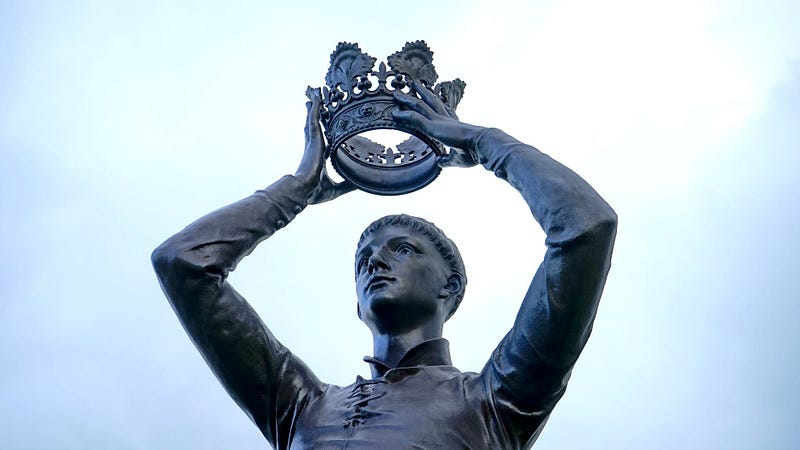
The most common societal power distribution aligns with the one in most social animal species. Power is concentrated in a single leader that settles the group’s affairs with the support of his (or sometimes her) strongest and most trusted lieutenants, each level in the hierarchy dominating the one below it.
Thus, throughout the animal kingdom, we have the dominance hierarchy or pecking order, and in most human societies in history we have the monarchy, the absolute rule of a king or queen over the masses. This arrangement can vary while maintaining the lopsided power asymmetry, giving us the aristocracy, oligarchy, theocracy, plutocracy, and secular dictatorship.
The point isn’t just that there’s a chain of command which channels power, as in the military or a private corporation; what’s more striking in most political organizations is the centralization of power. The autocratic rule of a tiny minority over what might be a vast majority, dwarfing the limited power of the lower members.
One evolutionary effect is to leave morality out of the group’s life-and-death decisions about how resources should be managed. Since those decisions affect the differential transmission of genes which is paramount in the wild and even, evidently, in human societies. The hosts of the fittest genes are given preferential treatment while the weaker or more sickly members are marginalized.
Morality is also thwarted by the process in which concentrated power over others corrupts the leader. Values of empathy, compassion, sacrifice, and the like are rationalizations of the majority’s need to submit to the upper echelons.
The herd is tamed and domesticated while the ruler is encouraged to think more about how he or she can retain the ruling position by intimidating the subordinates than about how he or she can work best to benefit the group. The causes of that encouragement are the sadistic thrill of dominating weaker members, and the attachment to privileged status, access to resources (including mates, food, and shelter), and to the release of hormones required to lead in struggles for survival.
This same power dynamic applies roughly to social animals and to most human societies.
Personal Liberty and Progress
But these unpleasant facts are less familiar to our post-industrial societies since we subscribe to something like Whig history, according to which history advances beyond such primitive forms of domination and reaches more enlightened power distributions. Science, industry, capitalism, and democracy liberate everyone, not just the most powerful members, giving the majority the right to rule.
To be sure, we liberal nations still have the imbalance between billionaires and the homeless, but we also have a democratization of decadence. Indeed, this was the upshot of the early-modern philosophers’ enlightened political rhetoric, such as that of John Locke and Immanuel Kant.
The idea was to overthrow inhumane monarchies and replace them with individualistic societies in which everyone would have the power of a king: we would have the right to rational self-determination and the freedom to do whatever we want if we don’t interfere with anyone else’s private kingdom. This is John Stuart Mill’s Harm Principle, a cornerstone of classic liberalism.
Rather than being oppressed by a spoiled, sometimes monstrous minority of power elites, the majority would rule over themselves by using science and technology to produce and to consume goods and by voting for their political representatives. The aristocrats were given exclusive access to higher education and to palaces to enrich their lives. But scientific and technological advances held the promise of sharing these benefits.
The masses would be educated, enculturated, and empowered to enrich themselves to the best of their abilities in an open marketplace of resources and ideas.
We think of this transition from the ancient and medieval worlds to the so-called modern, liberated and enlightened one as something like David’s victory over Goliath: the little guys banded together, having been roused from their slumber by the upstart philosophers and the former serfs revolted against their oppressors. This happened in North America, France, and Russia, and at the start of all other modern republics and communist societies.
The kings were sometimes beheaded or defeated in battle, since they weren’t about to surrender their godlike privileges to the mob without a fight. The individual’s freedom was won mostly by force, and we take it to be axiomatic that this victory was progressive.
Breaking Nature’s Quarantine
But there’s a less optimistic way of looking at these developments. What if in favoring the dominance hierarchy, natural selection acted not as a pseudo-oppressor of the masses but as their protector? This isn’t to suggest the dominators tend to be benevolent; rather, the thought is that power must be present somewhere in any society and the most stable arrangement might be for power and its corrupting effects on character to be quarantined.
The centralization of power makes some sense, according to the informal law of oligarchy, which says that groups become unmanageable when each member has the “liberty” to think for themselves. When the left-hand doesn’t know what the right hand is doing, you have a lack of coordination. Thus, animals typically have a single brain or control center, and this principle is extended to the social body.
The corruption and amorality of the commanders are byproducts of the system’s prioritization of efficiency in getting stuff done.
Just as each creature is corrupted or limited by its genetically determined self-interest, which drives animals to favor themselves or their selected kin, the political heads of groups are typically forced to dispense with moral or spiritual considerations to have any chance of managing the whole towards some worthwhile end.
As a result, the subordinates tend to envy the ruler. But by thrusting absolute power upon a hapless minority, the dominance hierarchy may inadvertently protect the majority from the corrosive side effects of domination.
What would happen if the right to domination were democratized, if everyone were empowered to live like a king or queen? What would happen if the majority seized political power and became autonomous?
We don’t have to imagine, of course, since this is what happened in the modern period, and some of the chief results are mass infantilization and the catastrophes of the Anthropocene, that is, the short-sighted, self-destructive despoliation of the biosphere and the sixth mass extinction, all thanks to what we call axiomatic “progress.”
We’re given higher education and the freedom to do almost whatever we want with our modern resources. Compared to peasants or slaves, most of us live like aristocrats — which means most suffer from the corrosive effects of that technological and political empowerment. We inflict our myopia, greed, and infantile fear of existential truth not just on our families, as in an old-world, oppressed society in which the multitude’s sphere of influence is limited, but on the planet.
Unless they chose to rebel against their lords, the peasants, slaves, and marginalized social segments such as women and foreigners could affect only their local areas for better or worse. The whole point of a free society is to provide everyone the opportunity to fulfill their potential as sovereigns. That’s the essential meaning of “person”: we’re sovereigns, as in autonomous beings, capable of intelligently controlling our behavior by making wise, even idealistic choices; that’s largely how people differ from animals, we presume.
Progress as a Luciferian Revolt Against the Natural Order
How wise were we in fighting for this mass liberation, enlightenment, and empowerment? If given the chance, few would prefer to live as oppressed peons or servants if they could become jet-setting, cosmopolitan consumers with relative castles to call home and even the capacity to broadcast their opinions to the world on social media. Few, then, could quarrel with the intentions of those early proponents of progress.
But neither can we argue with the predominant unintended effects; again, those are mass infantilization or decadence and the global destructiveness of the Anthropocene (overpopulation, global warming, and the sixth mass extinction).
We want to live as autocratic rulers. We view ourselves as such rulers, even in a democracy, since we presume that we have the right to dominate the planet and other animal species. As consumers, voters, and modern professionals, we have something like the power and authority of ancient courtiers or monarchs. But we must reckon also with the costs of the implicit war waged by modernity, which is the war against nature and the wilderness.
If nature prefers, as it were, for the minority to dominate the masses, possibly to preserve the latter from the madness associated with political empowerment, we prefer to dominate nature, to free ourselves from our evolutionary function and from nature’s social mechanisms of population control. By overthrowing the monarchs and emperors, we violate the evolutionary principles implied by that prevalent power asymmetry. The monarchs were only avatars of mindless nature, channels for the venting of genetic amorality.
What we call free or “modern” societies are precisely antinatural ones. The more antinatural and creative we are in devising our culture and institutions, the more progress we’ve won at nature’s expense.
This isn’t just idle talk since we’re literally destroying the natural environment. The Anthropocene, which is the prevalence of our geological impact, began sometime in the last century, depending on how you measure that impact; certainly, since the end of WWII, technoscientific advances and political freedoms began to accelerate by orders of magnitude. See, for example, the rise of human carbon emissions, which began to spike in the mid-1940s.
In short, modern progress is Luciferian. Christians are in the habit of demonizing the rebel angels that would thwart God’s plans for the cosmos. But these demonic symbols evidently represent the rational Enlightenment which had only recaptured ancient pagan naturalism.
If we separate the essence of what’s happened from the hypocritical moralistic overlay, we find that our hated Satan is more like Prometheus, the champion of humanistic progress. Prometheus freed us from Zeus’s control just as the serpent did in the moralized Garden of Eden myth. The Gnostics saw that transvaluation long ago.
These myths may be fictions but like all great fictions, they express fundamental truths. Our conceit is that we’re on the side of the gods and are fellow caretakers of nature. Instead, we’re evidently Luciferian rebels against the established order: we seek an equal measure of transhuman divinity — not just in an imaginary afterlife or state of blissed-out consciousness, but here and now, in material form as the light from our cities blots out the stars and we destroy the wild places to humanize them.


