
Pitta
The bird, not the bread

Today’s New York Times Spelling Bee letters:
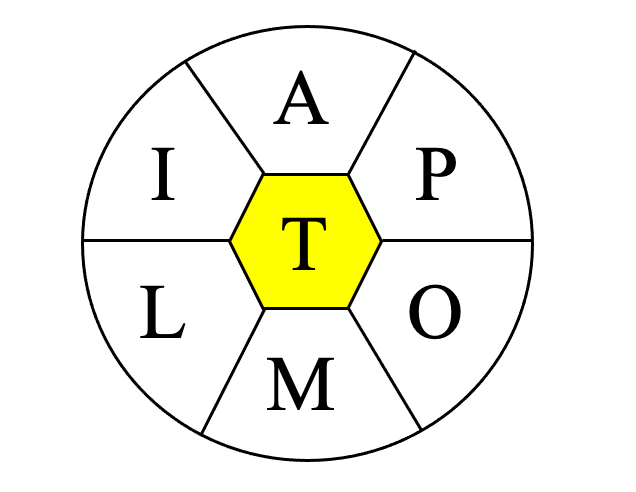
A, I, L, M, O, P, and center T (all words must include T)
Merriam-Webster says…
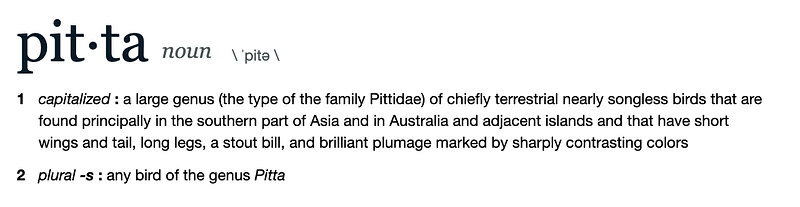
Silly little dictionary! Don’t you know that pitta can’t possibly be a word if The New York Times says it ain’t?
For further fascinating facts, check out the Spelling Bee Master.
What’s your favorite dord* from today’s puzzle?
My Two Cents
Well, I did end up posting a picture of pita bread at the top of today’s column. But Unsplash left me no choice, offering zero images when I typed “pitta” into their search function.
Although the dictionary lists the first definition of pitta as “capitalized” ––a big no-no within the rules of the Spelling Bee game–– the second one doesn’t, referring to a pitta as “any bird of the genus Pitta.” This happens a lot with animals whose common names are also the name of their genus or species. And thank goodness for that! It’s allowed me to write about several animals, including the teiid lizards and cebid monkeys this very month.
Now, could it be that The New York Times has heard only of the single-p’d pita, and not the fowl pitta? Not really, although it seems like a long time has passed since they published an article mentioning the bird. One in 2018 about a yoga retreat in India mentions pitta the Ayurvedic dosha. A piece from 2008 about the Metropolitan Opera includes Dimitri Pittas, but he is an American tenor, not a tropical bird… although both do sing.
A 1979 article about stamps describes a set from the Philippines that includes “the Mindoro imperial pigeon, Steere’s pitta, brown tit babbler, Merrill’s fruit dove, Koch’s pitta, redbreasted pitta and Philippine eared nightjar.” So, three mentions right there!
Going further back –-a lot further–– I found a piece from May 19, 1919 about the arrival at the Bronx Zoo of a stork that used to be known as the Negrokop. The article lists that bird and a few other exotic animals, like the Tasmanian black phalanger (which I suspect is what the current Tasmanian devil used to be called). The pitta is mentioned once at the beginning and once at the end.
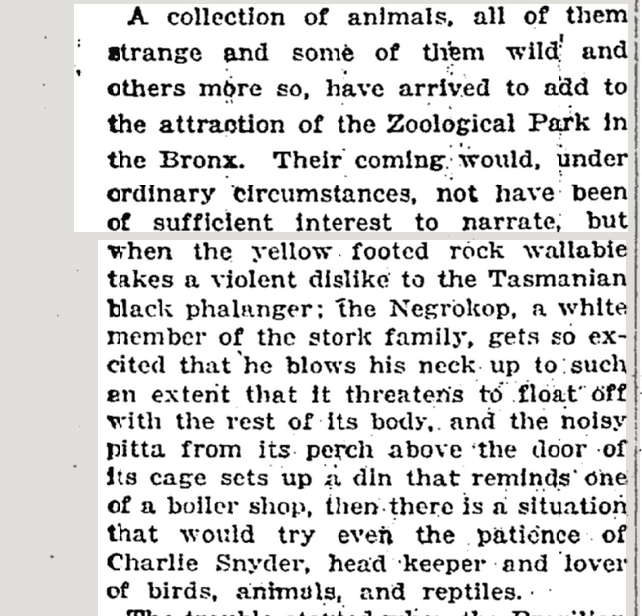
I guess one could say that it’s a pitty that the Times has forgotten about the pitta. (Groan!)
Bird is the word
Our friends at Merriam-Webster tell us that pitta comes from the New Latin word that derived from the Telugu piṭṭa, meaning “bird”. Telugu is “the Dravidian language of Telugu people”, who live predominantly in the southern part of India.
The 1911 Britannica has a nice, poetic entry on this bird:
PITTA, in ornithology, from the Telugu pitta, meaning a small bird, latinized by Vieillot in 1816 (Analyse, p. 42) as the name of a genus, and since adopted by English ornithologists as the general name for a group of birds, called by the French Brêves, and remarkable for their great beauty… There are about fifty species, divided into a number of genera, confined to the Old World, and ranging from India and North China to Australia, New Guinea and New Britain, with one species in West Africa, the greatest number being found in Borneo and Sumatra. Few birds can vie with the pittas in brightly-contrasted coloration. Deep velvety black, pure white and intensely vivid scarlet, turquoise-blue and beryl-green — mostly occupying a considerable extent of surface — are found in a great many of the species — to say nothing of other composite or intermediate hues; and, though in some a modification of these tints is observable, there is scarcely a trace of any blending of shade, each patch of colour standing out distinctly… Pittas vary in size from that of a jay to that of a lark, and generally have a strong bill, a thick-set form, which is mounted on rather high legs with scutellated “tarsi,” and a very short tail. In many of the forms there is little or no external difference between the sexes.
The modern online Britannica explains that the pittas’ patterns of bright colors help them hide among the shadows of the forest floor. But when forest floors are cleared for development, as happened in Myanmar and Thailand, the birds lose their natural camouflage. This occurred to Gurney’s pitta (P. gurneyi) in the 1950s, when it was thought to have gone extinct. It was rediscovered in 1986, and is listed as “critically endangered” as of 2019.
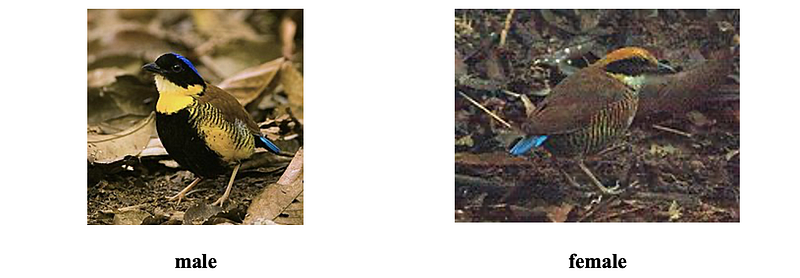
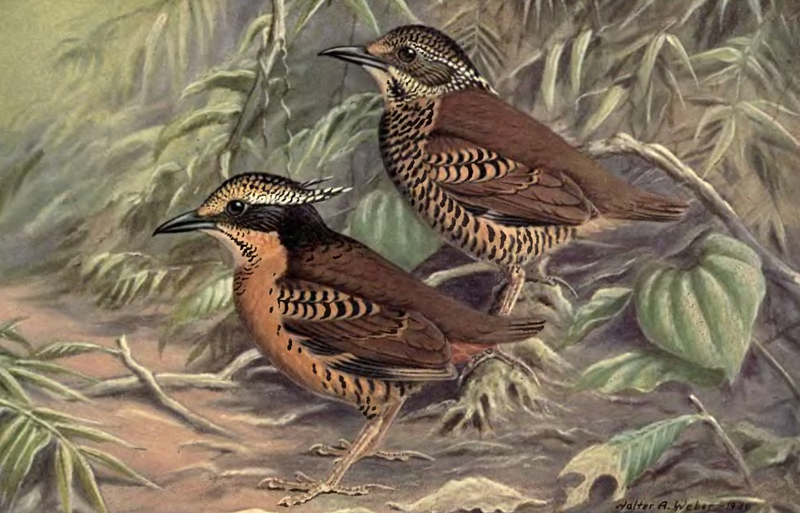
The above photos prove that the 1911 Britannica was wrong about there not being much of a difference between male and female pittas. This is known as sexual dimorphism and can clearly be seen above. However, there are a few species without much difference between the two sexes. For example, the eared pitta, which is no longer classified in the genus Pitta and is now a Hydrornis (but still in the family Pittidae).
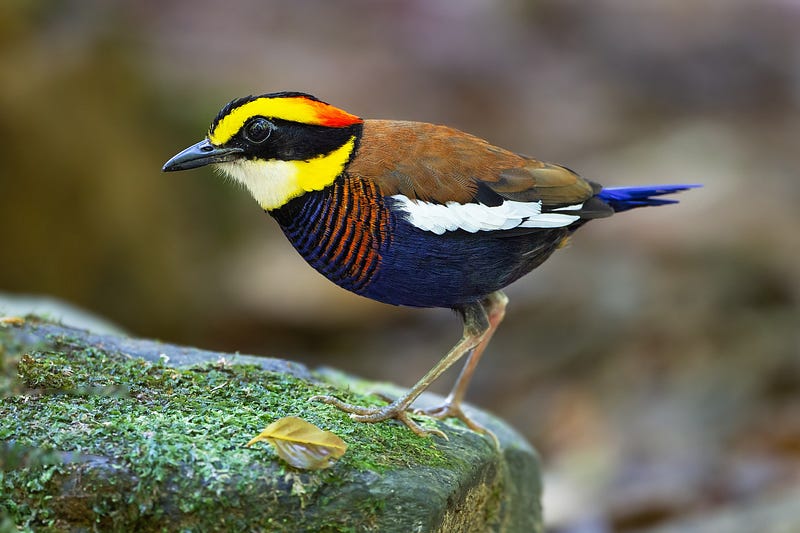
Reclassification of pittas has been a trending topic amongst ornithologists for the last couple of decades. This thanks to new tech like DNA tests. So, for example, in 2010 the banded pitta was split into three species. Not the one bird, mind you; that would have been cruel to chop it up like that. I meant the bird type. So this fellow below is now a Malayan banded pitta (Hydrornis irena).

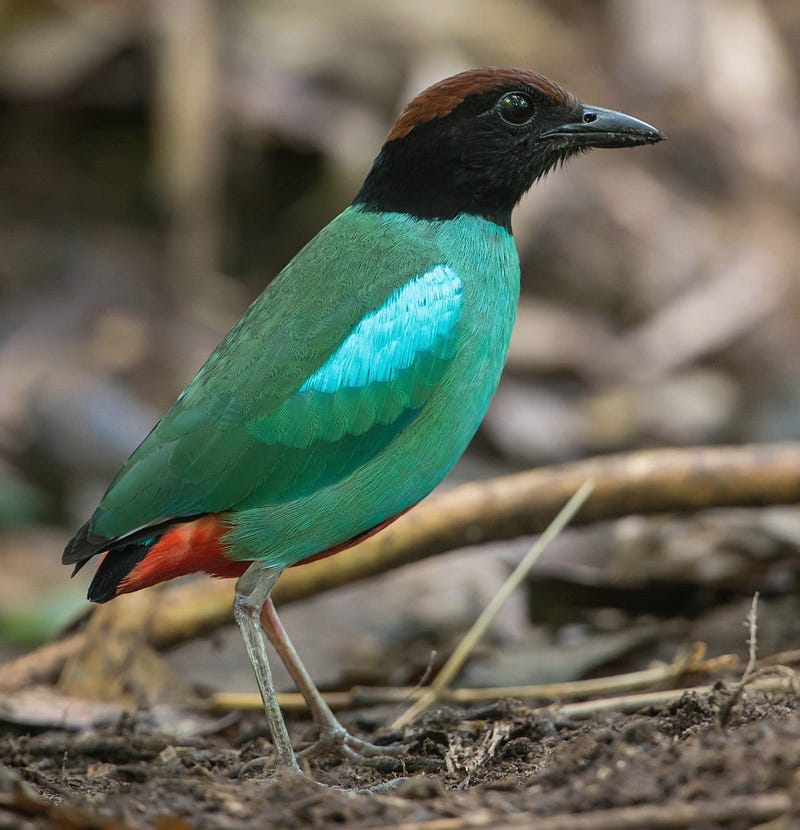
And here is the very green hooded pitta (Pitta sordida)…

…and the noisy pitta…
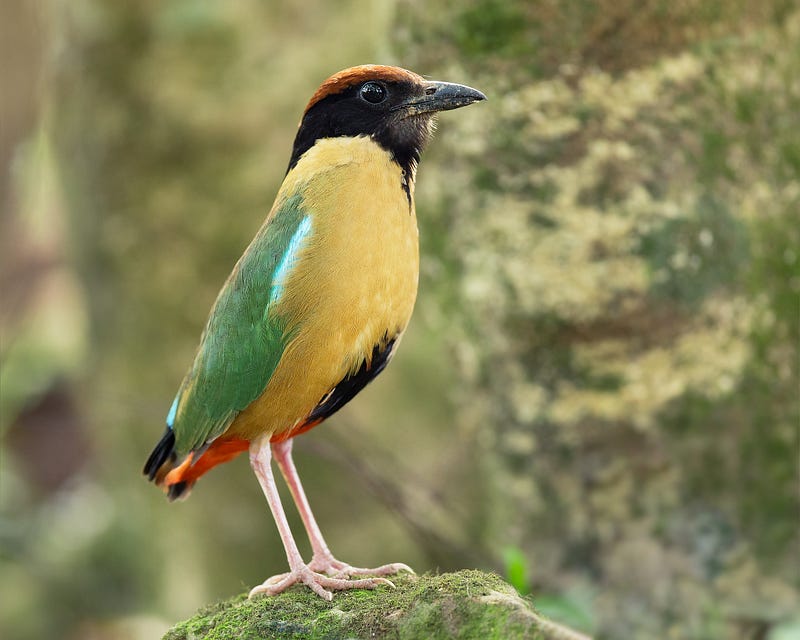

…which not only shrieks loudly (I assume), but is also known to smash snails on stones to crack them open before eating them. Not sure if they dip the snails in butter or not.
Double the fun
Pitta Pitta is a double no-no in the Spelling Bee. It’s actually two words, and begins with a capital letter. But I’m piggybacking off pitta to talk about this Australian Aboriginal language… which is now extinct. Like many other Aboriginal languages down under, Pitta Pitta had an elaborate and specific form of sing language. Which I’m guessing is also extinct. More than 40 years ago it was reported that only three speakers remained in Mount Isa, a city in Queensland.
Extinct languages are those of which there is no known individual who can speak them. Contrast this with dead languages ––Latin, for example–– that don’t belong to any specific community even though they may still be used occasionally. Some experts consider the latter to have a subdivision they call dormant, which are dead languages that serve as cultural or religious symbols to the groups that nevertheless don’t have fluent, active speakers.
Yiddish is commonly thought to be a dead or dormant language, but it’s still spoken by over half a million people worldwide. Even Aramaic (the everyday language of Jesus way back when) is not dead; forms of it are still spoken in the Middle East and even in India.
Languages are going extinct almost on a yearly basis as the last remaining elders who speak them die off. An NBC News article from 2004 explained that “as many as 90 percent of the 6,000 or so languages spoken around the world may be doomed to extinction”. Which is pretty sad. If you want to feel even sadder, you can peruse the entire list of extinct languages complied by Wikipedia.
To cheer you up, however, I offer the music video below, by South Korean singer Baek Ji-young. The song is called Botong (Ordinary) and was part of her 2011 album called Pitta.
Hmmm… come to think of it, the video is not very cheerful. My apologies.
Now you know. Next time you’re touring Asia and spot a very colorful bird cracking snails open, you can tell your friends and family that you spotted a pitta. Don’t be surprised if they ask you if you also saw some falafel and hummus… because the editors of the Spelling Bee decided that pitta is a dord*.
You can check out my previous entry on another dord* here:
*What the heck is a dord, you ask? Here’s the answer: