avatarAvi Kotzer

Free AI web copilot to create summaries, insights and extended knowledge, download it at here

4672

Abstract

in a branching hierarchy such that all members of a given taxon have the same ancestors”. Got that? No? Don’t feel bad; I didn’t either.</p><p id="5002">The point is that, as the online Britannica explains, “The taxonomy of squamates has been in flux, and new revolutionary approaches to the study of evolution… has resulted in major taxonomic rearrangements.” Furthermore, the encyclopedia clarifies this point:</p><blockquote id="b87c"><p>Although many such studies simply confirm the relationships based on antiquated methods (such as numerical <a href="https://www.britannica.com/science/taxonomy">taxonomy</a>), some have drastically changed the taxonomies depicted in classical textbooks. Most important, traditional taxonomic categories (such as order, suborder, superfamily, and the like) are fast becoming obsolete, largely because they have no evolutionary meaning. For example, the word <i>family</i> is simply a descriptor. To some extent, it is then rather arbitrary whether one refers to a particular group as family, subfamily, or other division.</p></blockquote><p id="2dbc">Why am I bothering to mention all this? Well, we here at <i>Silly Little Dictionary!</i> love to write articles about animals because we operate under the completely unproven assumption that readers enjoy articles about critters. But I’ve been finding a lot of discrepancies lately about the taxonomy of certain species, and I can now refer people back to this article to review the above information… and earn an additional 13 cents, of course.</p><p id="ea5a">Anyway, back to the <i>teiid</i> (pronounced TEE-yed).</p><p id="e793">These lizards are commonly known as <b>whiptails</b> or <b>racerunners;</b> not to be confused with the very similar-looking roadrunners. Here’s a handy visual guide that can help you:</p><figure id="9c4f"><img src="https://cdn-images-1.readmedium.com/v2/resize:fit:800/1*hZL0KKWowWfUvcBt5a97hA.png"><figcaption></figcaption></figure><p id="9a3a">Teiids mostly live on the ground, although some do spend time on trees and in even in the water. They are out and about during the day, looking to feed on insects and even smaller lizards, sometimes. They are oviparous, meaning they lay eggs. With the recent taxonomical changes I mentioned earlier, this family of lizards has been divided into two subfamilies that includes about 150 species amongst the 18 genera. A lot of them come in dull colors to blend in with their earthy surroundings, but other <i>teiids</i> can be quite colorful. For example, the Aruban whiptail…</p><figure id="677c"><img src="https://cdn-images-1.readmedium.com/v2/resize:fit:800/0*g9nxxugoltTBl9mJ.JPG"><figcaption>Photo by Bjørn Christian Tørrissen</figcaption></figure><p id="2b27">…the Ameiva tobagana…</p><figure id="d8cb"><img src="https://cdn-images-1.readmedium.com/v2/resize:fit:800/0*eoLg5eFLqB9yKM_P.jpg"><figcaption>Photo by Ian Mackenzie</figcaption></figure><p id="0d1d">…and the gold tegu…</p><figure id="ad89"><img src="https://cdn-images-1.readmedium.com/v2/resize:fit:800/0*hbW3VUjQ7fW8O1Yl.jpg"><figcaption>Credit: wikicommons</figcaption></figure><p id="e452">…which looks very green to me in the above picture.</p><p id="5e0c">By far one of the most interesting traits of some <i>teiids</i> is that there are only female members. That’s right; no males have been are known to exist in some species. How do they reproduce, you may ask. That’s a great question that brings us to our next section.</p><h2 id="5312">Mom’s the word</h2><p id="dd74">Our friends at Merriam-Webster have a rather long-winded definition of parthenogenesis:</p><blockquote id="e765"><p>Reproduction that involves development of a female or rarely of a male gamete without fertilization, that occurs commonly among lower plants and invertebrate animals but rarely as a natural process among seed plants and vertebrates although it may be induced by artificial mechanical or chemical stimulation of the eggs of some vertebrates and that in nature either constitutes the sole form of sexual reproduction or alternates with bisexual activities in a pattern adapted to the needs and peculiar life circumstances of the organism.</p></blockquote><p id="8d1a"><b>Parthenogenesis</b> comes from the Greek <i>parthénos</i> (virgin) and <i>génesis</i> (creation). Yes, it’s a type of “virgin birth”, technically speaking. This phenomenon is quite common among “lower” plants and some invertebrate animals –-for example, ants, wasps, and bees–- but is rare in vertebrates. But included in the latter are some species of <i>teiids</i>. The New Mexico whiptail (<i>Aspidoscelis neomexicanus</i>) is an example of <b>obligate</b> parthenogen

Options

esis, meaning this lizard cannot sexually reproduce. And that is because there are no males to participate in the process. <b>Facultative</b> parthenogenesis, on the other hand, refers to the ability of switching between parthenogenesis and sexual reproduction. An example of a lizard that does that is the Komodo dragon.</p><p id="61a0">Now, I’m not going to get into the technical details of parthenogenesis because it involves terms like automixis, blastomers, haploid, meiosis… and because it’s late here in Spain and I don’t feel like it. So there.</p><p id="c8b5">I will mention that in nature, there are no cases of mammals reproducing parthenogenetically. In 1936, Gregory Goodwin Pincus reported successfully inducing parthenogenesis in a rabbit, which you can read about in <a href="https://archive.org/details/eggsofmammals00pinc/page/62/mode/2up?q=rabbit">this chapter</a>. More recently, researches have claimed they’ve induced parthenogenesis <a href="https://www.pnas.org/doi/abs/10.1073/pnas.2115248119">in mice</a>.</p><p id="0ffa">The problem is that in mammals this process usually results in incomplete development. In humans, embryos may begin to divide without being fertilized; however, although skin and nerve cells can be created, other tissue cannot develop, resulting in a type of benign tumor called an ovarian <b>teratoma</b>. If you’re curious and want to see pictures of a teratoma, feel free to peruse Wikipedia’s <a href="https://en.wikipedia.org/wiki/Teratoma">entry</a>, but be warned that the images of tumors with hair and teeth are not for the faint of heart.</p><p id="50dd">There appears to be a <a href="https://www.newscientist.com/article/mg14819982-300-the-boy-whose-blood-has-no-father/">documented case</a> of a boy who had some cells in his body that contained no DNA from his father. (In humans all cells have genetic material from both parents.)</p><p id="1930">There are a few references in <i>The New York Times</i> across the years about parthenogenesis. This 1959 article mentions a turkey…</p><figure id="eec8"><img src="https://cdn-images-1.readmedium.com/v2/resize:fit:800/1*kx3B_WOzkur37TEDRI8mWA.png"><figcaption>Screenshotted by Iva Reztok; fair use</figcaption></figure><p id="dec9">…while this one from 1966 talks about a Cnemidophorus lizard…</p><figure id="6557"><img src="https://cdn-images-1.readmedium.com/v2/resize:fit:800/1*HkhJctINakuxlHwFT7zuwg.png"><figcaption>Screenshotted by Iva Reztok; fair use</figcaption></figure><p id="157e">…which is a <i>teiid</i>! So why was <i>teiid</i> rejected by the Spelling Bee today? To paraphrase the Shadow: Who knows what evil lurks in the heart of Sam Ezersky.</p><p id="7aa9">That’s it for today. If you’re ever in the Americas and see a lizard darting about between rocks, make sure to check if it has (1) large rectangular scales that form distinct transverse rows on its belly and small, granular scales on its back; (2) head scales that aren’t attached to the skull bones; and (3) teeth that are solid at the base and “glued” to the jaw bones. Then you can expertly say you’ve spotted a <i>teiid</i>. Don’t be surprised if no one believes you. Not because it’s impossible to check those three things while the lizard is darting between rocks… but because the editors of the Spelling Bee decided that <i>teiid </i>is a dord*.</p><p id="f0bd">You can check out my previous entry on another <b>dord* </b>here:</p><div id="5f32" class="link-block"> <a href="https://readmedium.com/platy-5ed825b2106b"> <div> <div> <h2>Platy</h2> <div><h3>The Mickey Mouse fish</h3></div> <div><p>medium.com</p></div> </div> <div> <div style="background-image: url(https://miro.readmedium.com/v2/resize:fit:320/0*OGXHws1Qu-B1AKDf)"></div> </div> </div> </a> </div><p id="acf7">*What the heck is a <b>dord, </b>you ask? Here’s the answer:</p><div id="563c" class="link-block"> <a href="https://www.merriam-webster.com/words-at-play/dord-a-ghost-word"> <div> <div> <h2>'Dord': A Ghost Word</h2> <div><h3>One of the questions people like to ask lexicographers is this: Can you sneak something into the dictionary? Can you…</h3></div> <div><p>www.merriam-webster.com</p></div> </div> <div> <div style="background-image: url(https://miro.readmedium.com/v2/resize:fit:320/0*PnbpGu5Qwj1-_bsK)"></div> </div> </div> </a> </div></article></body>

Teiid

Some of these lizards are father muckers
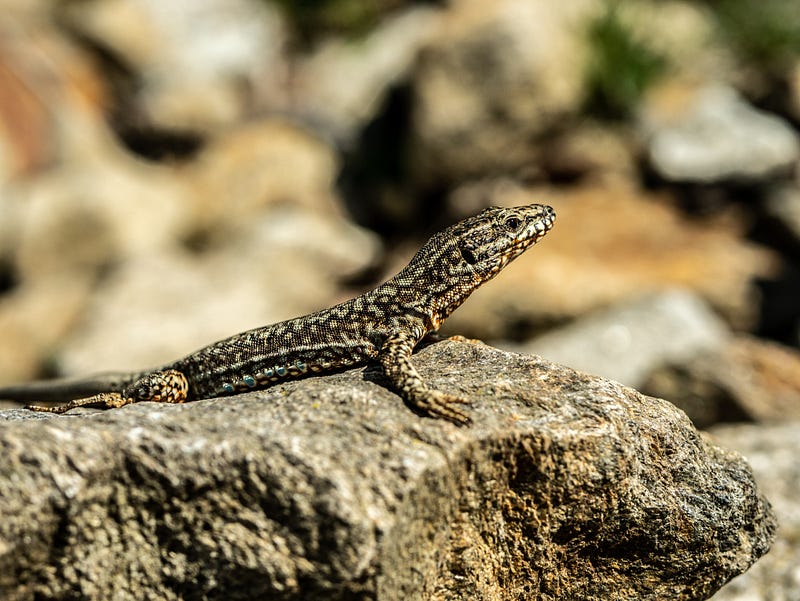
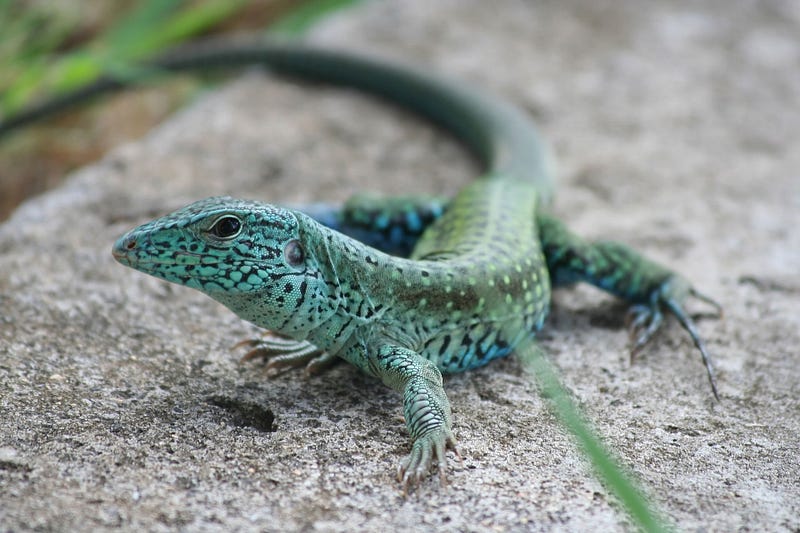
Photo by Maurice Smeets on Unsplash

Today’s New York Times Spelling Bee letters:
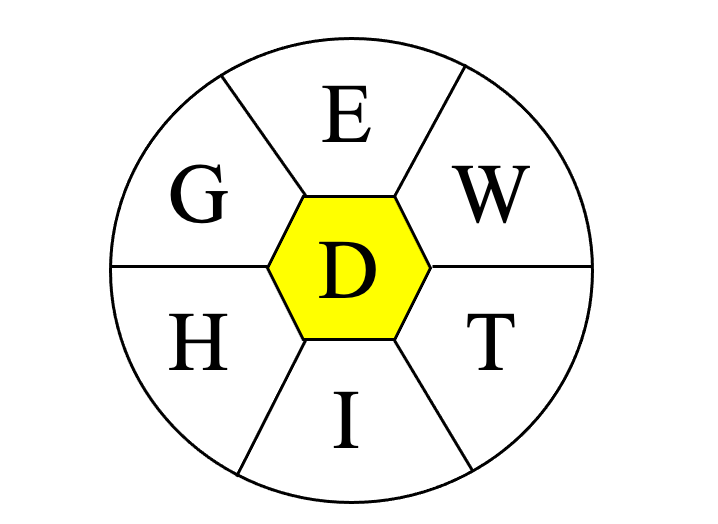
Art: Iva Reztok

E, G, H, I, T, W, and center D (all words must include D)

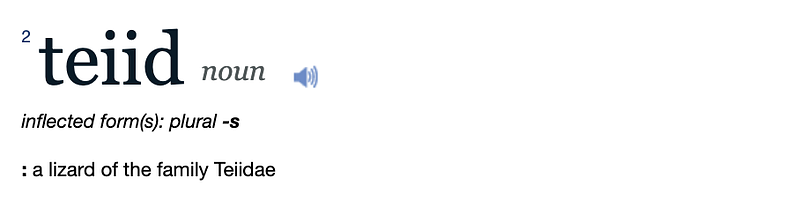
Merriam-Webster says…
Credit: merriam-webster.com

Silly little dictionary! Don’t you know that teiid can’t possibly be a word if The New York Times says it ain’t?

For further fascinating facts, check out the Spelling Bee Master.

What’s your favorite dord* from today’s puzzle?

My Two Cents

I’m not sure if the lizard in the picture at the top of today’s article is, in fact, a teiid. And although photographer Maurice Smeets is in the Netherlands, not too far away from where I live (Spain), I’m not sure I have the time to hop over and ask him. Plus, I have no idea where Maurice lives.

Taking into account that teiids are native to the Americas and Maurice lives in Europe does not automatically mean the lizard in the image is not a teiid. It’s possible Maurice took the picture while traveling across Central or South America.

Aaron Bauer’s Encyclopedia of Reptiles and Amphibians has some guidelines to distinguish teiids from other lizards (like, say, iguanas, chameleons, and geckos). So we could try to use them to determine what Maurice captured in his photo:

Photo by… Maurice from the Netherlands, people! Pay attention!

(1) A teiid has large rectangular scales that form distinct transverse rows on its belly (which is hidden from view) and small, granular scales on its back. Okay, I can give the above lizard the benefit of the doubt… mostly because i don’t know how to identify small, granular scales. (2) A teiid’s head scales are not attached to the skull bones. Hmmm… my X-ray vision is spotty today, so I can’t tell. (3) Teiid teeth are solid at the base and “glued” to the jaw bones. Well, I asked the lizard nicely if it could open its mouth, but it just kept staring silently into the void. Perhaps it’s here in Spain, where we’re having stupefying heat for the month of July.

In any case, I’ll be providing “copyright-safe” pictures of teiids in the next section, lovingly curated from wikicommons. Read on!

Autarchoglossa

The above term means “free-tongued”, and does not refer to people who speak their mind no matter what, but to a clade (evolutionary group) of lizards that use their long, narrow, forked tongues in a similar manner to snakes. Teiids belong to that group. Iguanas, whose tongues are soft and prehensile, have traditionally been classified outside the Autarchglossa clade. In fact, they were originally in the clade Iguania (which includes chameleons and “dragon lizards”), one of two in which lizards were first divided. The other one was Scleroglossa, a term that means “hard tongue”. Together, Scleroglossa and Iguania make up the larger group Squamata (sometimes referred to as an Order), which encompasses all all living lizards and snakes.

If you think that’s confusing, it’s only the tip of the iceberg. Three, two, and even one hundred years ago, lizards, like all living creatures, were classified mostly based on their morphology, or physical characteristics. But today we have advanced technology, like DNA analyisis and cladistics, which according to the dictionary is “a system of biological taxonomy that defines taxa uniquely by shared characteristics not found in ancestral groups and uses inferred evolutionary relationships to arrange taxa in a branching hierarchy such that all members of a given taxon have the same ancestors”. Got that? No? Don’t feel bad; I didn’t either.

The point is that, as the online Britannica explains, “The taxonomy of squamates has been in flux, and new revolutionary approaches to the study of evolution… has resulted in major taxonomic rearrangements.” Furthermore, the encyclopedia clarifies this point:

Although many such studies simply confirm the relationships based on antiquated methods (such as numerical taxonomy), some have drastically changed the taxonomies depicted in classical textbooks. Most important, traditional taxonomic categories (such as order, suborder, superfamily, and the like) are fast becoming obsolete, largely because they have no evolutionary meaning. For example, the word family is simply a descriptor. To some extent, it is then rather arbitrary whether one refers to a particular group as family, subfamily, or other division.

Why am I bothering to mention all this? Well, we here at Silly Little Dictionary! love to write articles about animals because we operate under the completely unproven assumption that readers enjoy articles about critters. But I’ve been finding a lot of discrepancies lately about the taxonomy of certain species, and I can now refer people back to this article to review the above information… and earn an additional 13 cents, of course.

Anyway, back to the teiid (pronounced TEE-yed).

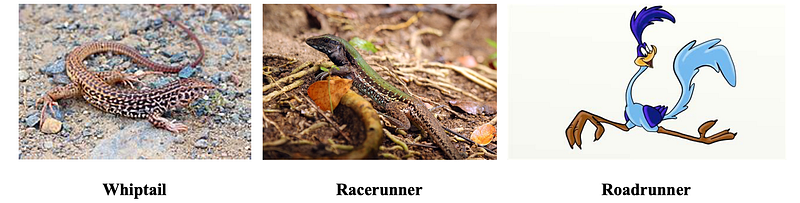
These lizards are commonly known as whiptails or racerunners; not to be confused with the very similar-looking roadrunners. Here’s a handy visual guide that can help you:
Teiids mostly live on the ground, although some do spend time on trees and in even in the water. They are out and about during the day, looking to feed on insects and even smaller lizards, sometimes. They are oviparous, meaning they lay eggs. With the recent taxonomical changes I mentioned earlier, this family of lizards has been divided into two subfamilies that includes about 150 species amongst the 18 genera. A lot of them come in dull colors to blend in with their earthy surroundings, but other teiids can be quite colorful. For example, the Aruban whiptail…
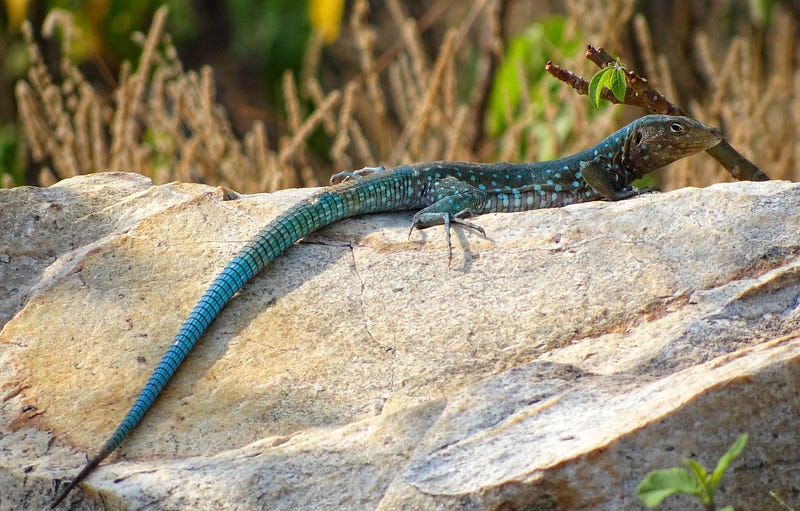
Photo by Bjørn Christian Tørrissen

…the Ameiva tobagana…

Photo by Ian Mackenzie

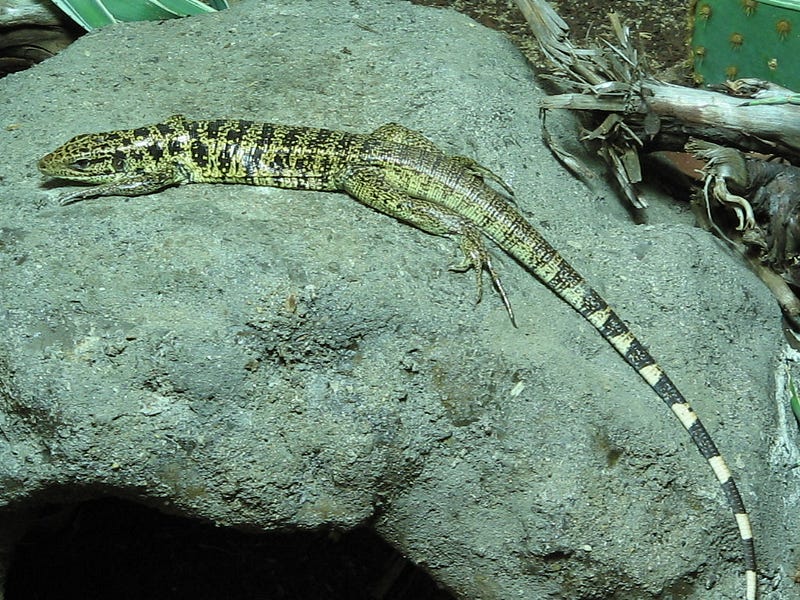
…and the gold tegu…

Credit: wikicommons

…which looks very green to me in the above picture.

By far one of the most interesting traits of some teiids is that there are only female members. That’s right; no males have been are known to exist in some species. How do they reproduce, you may ask. That’s a great question that brings us to our next section.

Mom’s the word

Our friends at Merriam-Webster have a rather long-winded definition of parthenogenesis:

Reproduction that involves development of a female or rarely of a male gamete without fertilization, that occurs commonly among lower plants and invertebrate animals but rarely as a natural process among seed plants and vertebrates although it may be induced by artificial mechanical or chemical stimulation of the eggs of some vertebrates and that in nature either constitutes the sole form of sexual reproduction or alternates with bisexual activities in a pattern adapted to the needs and peculiar life circumstances of the organism.

Parthenogenesis comes from the Greek parthénos (virgin) and génesis (creation). Yes, it’s a type of “virgin birth”, technically speaking. This phenomenon is quite common among “lower” plants and some invertebrate animals –-for example, ants, wasps, and bees–- but is rare in vertebrates. But included in the latter are some species of teiids. The New Mexico whiptail (Aspidoscelis neomexicanus) is an example of obligate parthenogenesis, meaning this lizard cannot sexually reproduce. And that is because there are no males to participate in the process. Facultative parthenogenesis, on the other hand, refers to the ability of switching between parthenogenesis and sexual reproduction. An example of a lizard that does that is the Komodo dragon.

Now, I’m not going to get into the technical details of parthenogenesis because it involves terms like automixis, blastomers, haploid, meiosis… and because it’s late here in Spain and I don’t feel like it. So there.

I will mention that in nature, there are no cases of mammals reproducing parthenogenetically. In 1936, Gregory Goodwin Pincus reported successfully inducing parthenogenesis in a rabbit, which you can read about in this chapter. More recently, researches have claimed they’ve induced parthenogenesis in mice.

The problem is that in mammals this process usually results in incomplete development. In humans, embryos may begin to divide without being fertilized; however, although skin and nerve cells can be created, other tissue cannot develop, resulting in a type of benign tumor called an ovarian teratoma. If you’re curious and want to see pictures of a teratoma, feel free to peruse Wikipedia’s entry, but be warned that the images of tumors with hair and teeth are not for the faint of heart.

There appears to be a documented case of a boy who had some cells in his body that contained no DNA from his father. (In humans all cells have genetic material from both parents.)

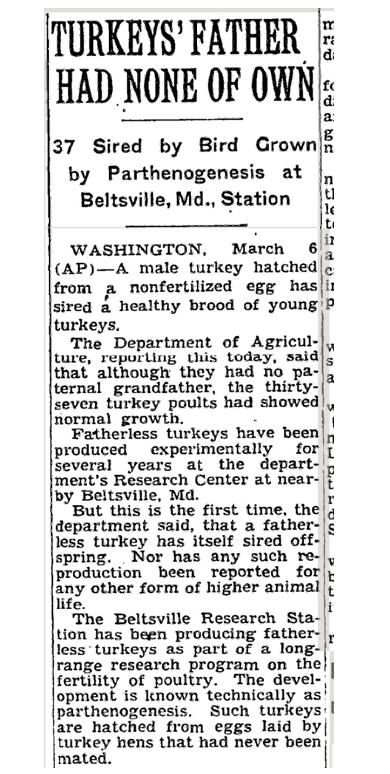
There are a few references in The New York Times across the years about parthenogenesis. This 1959 article mentions a turkey…
Screenshotted by Iva Reztok; fair use

…while this one from 1966 talks about a Cnemidophorus lizard…
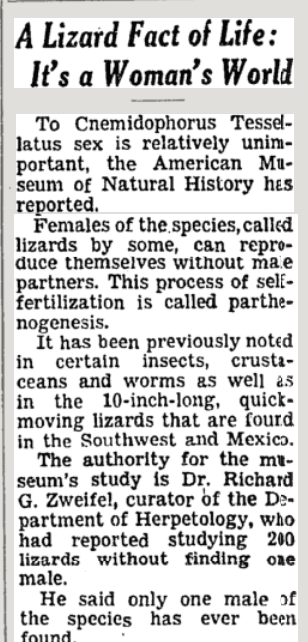
Screenshotted by Iva Reztok; fair use

…which is a teiid! So why was teiid rejected by the Spelling Bee today? To paraphrase the Shadow: Who knows what evil lurks in the heart of Sam Ezersky.

That’s it for today. If you’re ever in the Americas and see a lizard darting about between rocks, make sure to check if it has (1) large rectangular scales that form distinct transverse rows on its belly and small, granular scales on its back; (2) head scales that aren’t attached to the skull bones; and (3) teeth that are solid at the base and “glued” to the jaw bones. Then you can expertly say you’ve spotted a teiid. Don’t be surprised if no one believes you. Not because it’s impossible to check those three things while the lizard is darting between rocks… but because the editors of the Spelling Bee decided that teiid is a dord*.

You can check out my previous entry on another dord* here:

*What the heck is a dord, you ask? Here’s the answer:

Spelling Bee
Language
Lizards
Science
Parthenogenesis
Recommended from ReadMedium