
Cebid
Monkeying around on a Sunday afternoon
Today’s New York Times Spelling Bee letters:
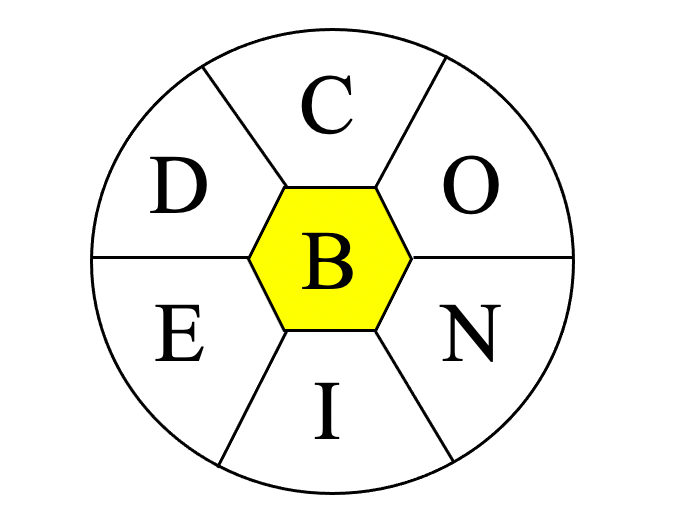
C, D, E, I, N, O, and center B (all words must include B)
Merriam-Webster says…

Silly little dictionary! Don’t you know that cebid can’t possibly be a word if The New York Times says it ain’t?
For further fascinating facts, check out the Spelling Bee Master.
What’s your favorite dord* from today’s puzzle?
My Two Cents
Okay, I’ll admit Merriam-Webster’s definition is not very helpful if you’re not a biologist or taxonomist. And it sent me on a definition hunt!
“A monkey of the family Cebidae”, Fine, so I typed in that word.
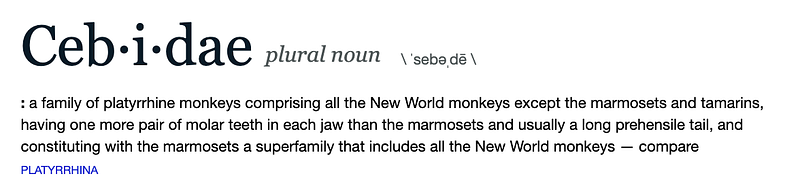
The etymology of the above term is “New Latin, from Cebus, type genus + -idae”. So I looked up Cebus, the genus:

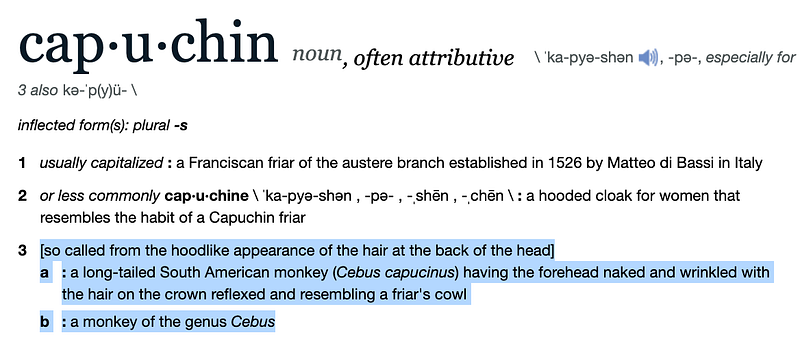
Aha! Now we’re getting somewhere. I clicked on the magic blue link for capuchin…
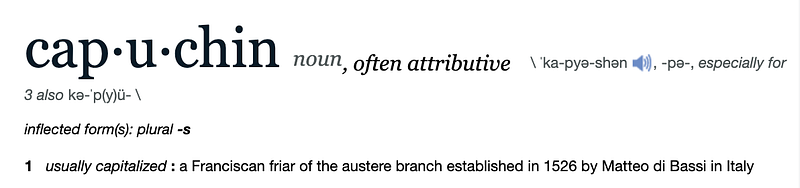
Well, that can’t be. From what I remember, Friar Tuck was played by a badger, not a monkey. Unless…
I found the archived FAQ on the Capuchin Franciscans page, and they explain the following:
A “habit” is the official garb that identifies a religious man or woman as a member of their individual order or community. The word came into use as it was the habit of religious men and women to daily dress in their respective, distinctive clothing… Capuchins received their name because of the long, distinctive hood that is part of their habit, a hood that in Italian is called a “capuche”. One breed of monkeys has been named the “Capuchin Monkey” because of the discolored fur on its back that resembles the hood of a Capuchin friar.
Now that we’ve cleared this mess up, we can move forward.
The monk, not the coffee
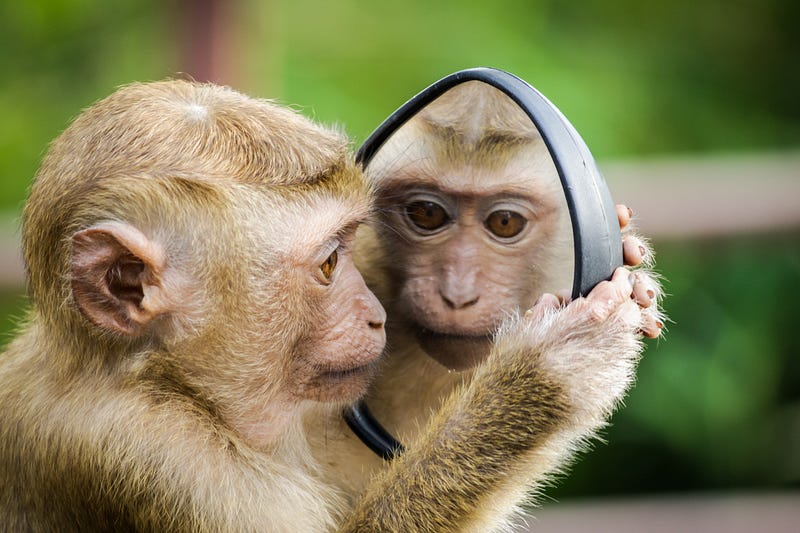
I perused several dozen photos of capuchins but couldn’t locate one with the “discolored fur on its back”, as the friar website claims. I did find several pictures of cebids with lighter-colored fur around the face and shoulders. Such as this little guy:
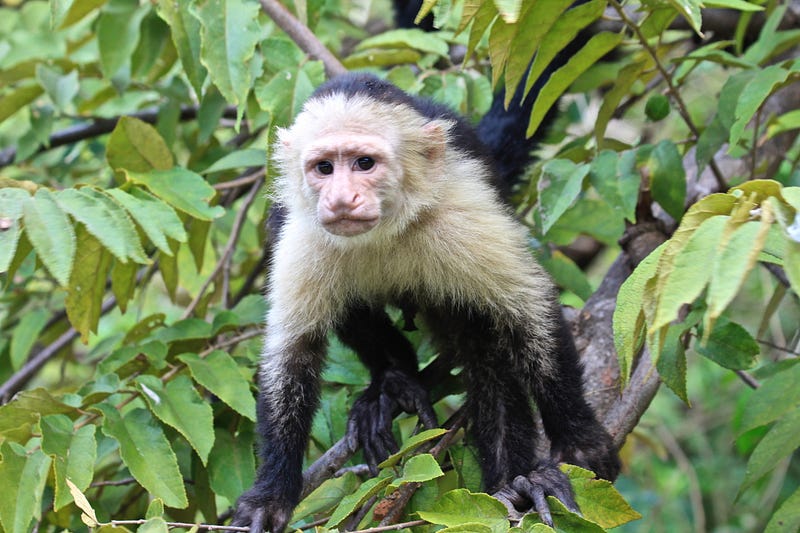
Is that close enough? Here is a selfie taken by Mateo Bassi, the original capuchin friar, who founded the order in 1525:
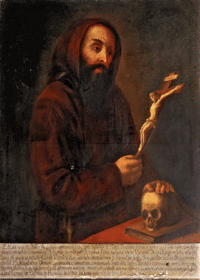
Close enough? What do you think?
The 1911 Encyclopedia Britannica sums up the
CAPUCHIN MONKEY, the English name of a tropical American monkey scientifically known as Cebus capucinus; the plural, capuchins, is extended to embrace all the numerous species of the same genus, whose range extends from Nicaragua to Paraguay. These monkeys, whose native name is sapajou, are the typical representatives of the family Cebidae, and belong to a sub-family in which the tail is generally prehensile. From the other genera of that group (Cebinae) with prehensile tails capuchins are distinguished by the comparative shortness of that appendage, and the absence of a naked area on the under surface of its extremity. The hair is not woolly, the general build is rather stout, and the limbs are of moderate length and slenderness. The name capuchin is derived from the somewhat cowl-like form assumed by the thick hair on the crown of the head of the sapajous. In their native haunts these monkeys go about in troops of considerable size, frequenting the summits of the tall forest-trees, from which they seldom, if ever, descend. In addition to fruits of various kinds, they consume tender shoots and buds, insects, eggs and young birds. Many of the species are difficult to distinguish, and very little is known of their habits in a wild state, although several members of the group are common in captivity.
I’ve set in boldface a few of the above phrases I wanted to comment on. After all, this entry was written more than one hundred years ago. So we’ll start with the last sentence and move back asswards.
§ Cebus capucinus, given by Carl Linneaus to Colombian white-faced capuchin, is still the name of the type species. That means this is the species name with which the genus is taxonomically associated forever. In other words, it’s the species that contains the “biological type specimen”. A lot of times you’ll find old texts that reference species names that have changed over time. This is not one of those cases.
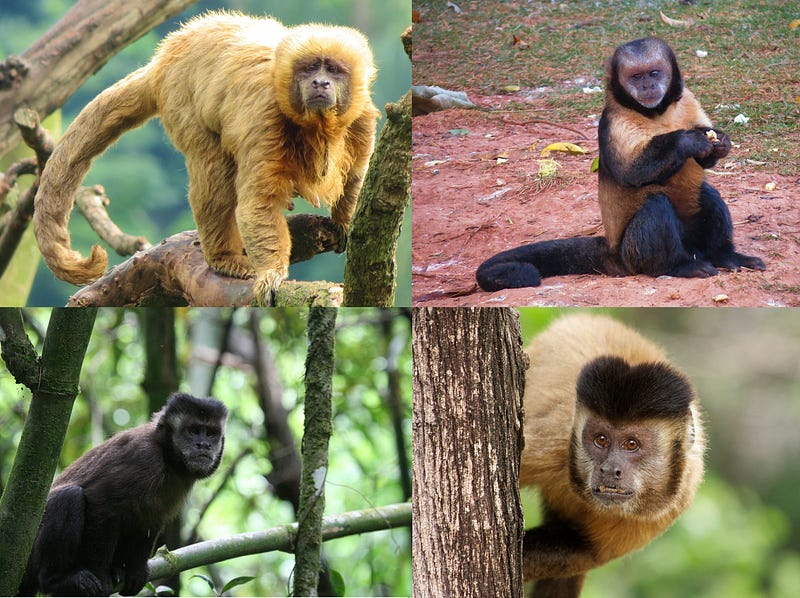
§ Sapajou, mentioned as the native name for capuchins, may have come from the language of the Tupi natives of Brazil –-although this has not been confirmed. What has happened rather recently is the splitting off of a genus in the capuchin subfamily. Previously the only genus was the one the type species belonged to (Cebus), but in 2012 Jessica W. Lynch Alfaro published an article proposing the creation of a new genus, Sapajus, for the “robust” capuchin monkeys.
Here are four species in that new genus and, as you can see from their faces, they are ecstatic about the news.
§ Despite the Britannica’s author impression that capuchins have prehensile tails, their rear appendages are considered only “partially prehensile”. They lack what is known as a tactile pad (which is sensitive to pressure, temperature, or pain), something that spider monkeys, for example, do have. Like this one shown below.
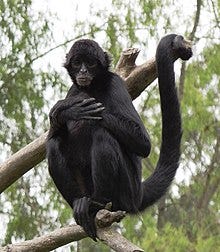
§ Finally, a lot more is known today about cebids and their habits than 111 years ago. For example, the monkeys referred to as “white-fronted capuchins” –-which includes several species in Brazil, Bolivia, Colombia, Ecuador, Peru, Venezuela, and even Trinidad and Tobago–– have been observed using tools. A 1999 paper published in the American Journal of Primatology says, in its abstract that “White-fronted capuchins were observed to use leaves as cups to retrieve water from tree cavities. On multiple occasions several individuals performed this behavior. Thus, these capuchins engage in habitual tool use, as defined by McGrew’s classificatory scheme of tool using behavior.”
The first cuckoo
British readers of a certain age who both read this column (ha, the hubris!) and have read The London Times in the 20th century may be familiar with the tradition that dates to the early 1900s. The newspaper was popular and regularly received letters to the editor from all sorts of readers: regular folk as well as distinguished professors. On February 6th, 1913, the Times published the following letter:
While gardening this afternoon I heard a faint note, which led me to say to my under-gardener, who was working with me, ‘Was that the cuckoo?’ Almost immediately afterwards we heard the full double note of a cuckoo, repeated either two or three times, I am not quite sure which. The time was 3.40 and the bird appeared to be about a quarter of a mile away. There was not the slightest doubt that the song was that of the cuckoo. The late Professor Newton, in the 4th edition of Yarrell’s British Birds (vol 2, p. 389) stated that although the arrival of the cuckoo has frequently been reported in March, or even earlier, such records must be treated with suspicion, if not with incredulity. And Mr J E Harting (Handbook of British Birds, p.112) goes even further than this, stating that there is no authentic record of the arrival of the cuckoo in this country earlier than April 6.
This may have been dismissed simply as ridiculous assertion by a dotty reader –-cuckoos usually arrived in the southern part of England a few weeks into spring and not during the harshest part of winter–- except for the fact that it was written by Richard Lydekker.
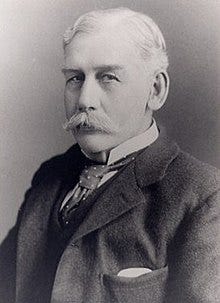
Lydekker was was an English naturalist, geologist, and writer of numerous books and articles on animals and nature. He was charged with cataloging the fossils of mammals, reptiles, and birds of the British Natural History Museum. In 1902 the Geological Society of London awarded him with the Lyell Medal, a prize awarded for “exceptional contribution of research to the scientific community”.
Heck, Lydekker was the author of the 1911 Britannica entry on capuchins you read earlier. He was a prolific writer, penning several dozen more articles for them. You can check the list here.
So it must have been with shock that people read this second letter by Lydekker barely a week after the first one:
I regret to say that, in common with many other persons, I have been completely deceived in the matter of the supposed cuckoo of February 4. The note was uttered by a bricklayer’s labourer at work on a house in the neighbourhood of the spot whence the note appeared to come. I have interviewed the man, who tells me that he is able to draw cuckoos from considerable distances by the exactness of his imitation of their notes, which he produces without the aid of any instrument.
According to some sources, letters to the editor about the “first cuckoo” became a tradition as a result of this mini-fiasco. Other authors indicate that writing to the Times about the arrival of the bird that signaled spring for many Londoners was already a tradition when Lydekker admitted his gaffe. Still, his error caught the attention of many readers, who were quite amused that such a distinguished naturalist could have been fooled so easily.
Lydekker died barely two years later, in 1915. I’m not sure if his passing was in any way connected to this screw-up ––maybe he took the expression “I’m so embarrassed I could die!” literally–– but being that it happened in April, there’s a chance he heard a real cuckoo one last time before kicking the bucket.
Now you know. Next time you’re visiting a monastery of Capuchin friars, you can try to make a joke by telling them they should really called cebids. Don’t be surprised if no one laughs at your wisecrack. Not because it’s terrible and unfunny… but because the editors of the Spelling Bee decided that cebid is a dord*.
You can check out my previous entry on another dord* here:
*What the heck is a dord, you ask? Here’s the answer: