
Wedeln
A move 007 perfected?
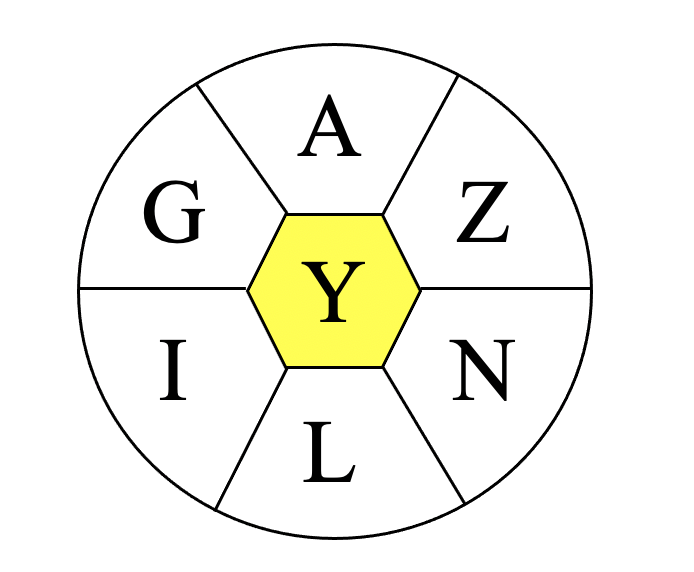
Today’s New York Times Spelling Bee letters:
Art: Iva Reztok
D, E, L, N, O, T, and center W (all words must include W)
Merriam-Webster says…
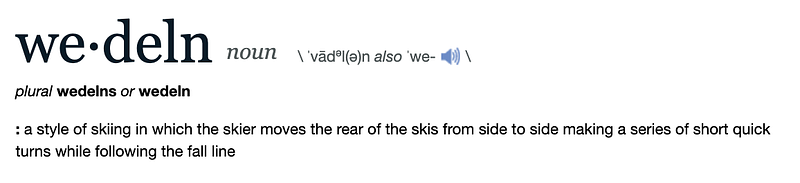
Silly little dictionary! Don’t you know that wedeln can’t possibly be a word if The New York Times says it ain’t?
For further fascinating facts, check out the Spelling Bee Master.
What’s your favorite dord* from today’s puzzle?
My Two Cents
Well, it was slim pickens today when it came to choosing a word to write about. Not that the list provided by the Spelling Bee Master was short…

…rather, I found few words inspiring. I almost picked wold, but then I remembered I wrote about this dord* in April of last year.
I wasn’t able to find a lot of information about the wedeln technique of skiing, and I’ve never been on the slopes myself. So bear with me today as I probably end up writing a shorter article than usual.
Although The New York Times has fewer than a dozen articles that mention the word, it cannot claim it didn’t know about its existence. In a piece from 1964 –-from the “New Books fro Young Readers” section–– the paper’s review of the 64-page The Happy Ski ABC, written and illustrated by Lisl Weil, includes this:
Kids, be the first on the slopes to amaze friends and parents with your mastery of the skier’s parlance. Use terms such as “mogul” (a big bump), “ruecklage” (backward‐leaning position as opposed to “vorlage,” forward lean) and “wedeln” (tail‐wagging) with complete confidence.
And a 1984 article by Bannon McHenry includes the word in its header!
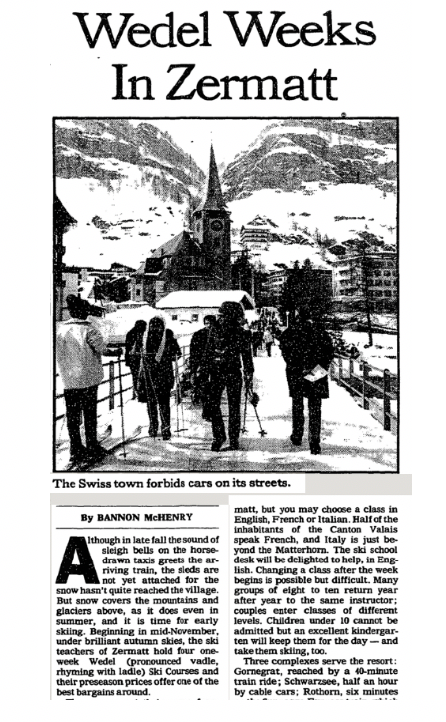
Now, I understand that skiing’s golden age may have been between the 1960s and the 1990s, but still… no excuse, Spelling Bee!
Going downhill in a hurry
First things first. Wedeln, being a German word, is not pronounced in English as you see it spelled. When spoken it sounds sort of like VAY-duln. For those of you who like to be precise about the way pronunciation is described, here you go: \ˈvādᵊl(ə)n\.
Our friends at Merriam-Webster tell su that wedeln was borrowed from the same German word, meaning literally “to fan” or “wag the tail”, from the Old High German wadalōn, itself from wadal (tail), akin to the Old Norse vēli (bird’s tail).
When I looked up wedeln in Word Reference, I got this:

(Hund is German for “dog” ––that’s where English got the word hound–– and Schwantz is “tail”.)
Then, just for kicks, I looked up wedel and got this:
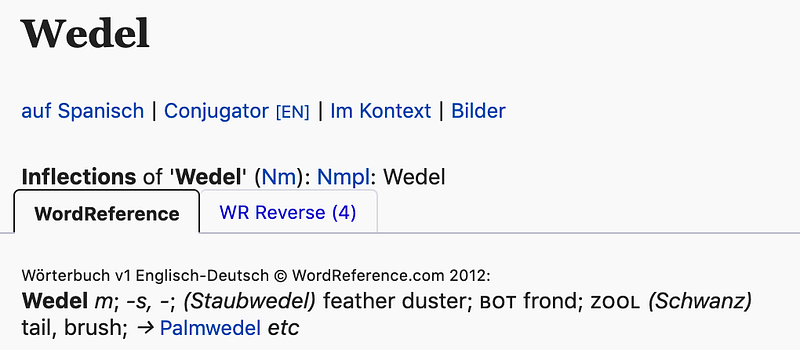
After that, I also checked the word Sprung:
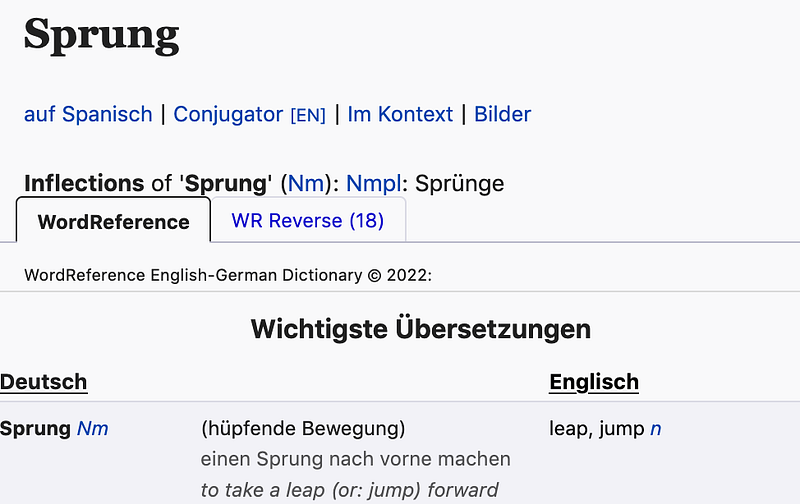
No, I wasn’t taking a crash course in German today. The reason I looked up the translation of Sprung is because of this:
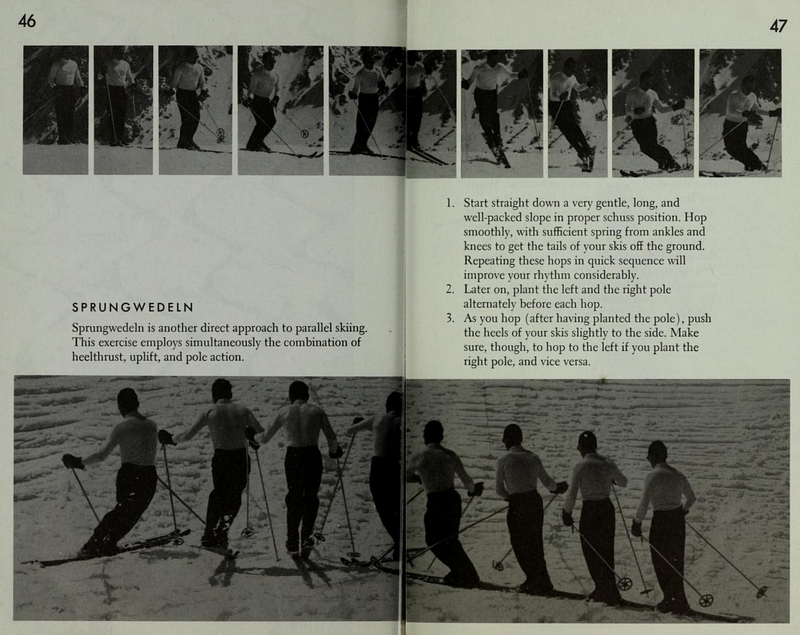
The above is the spread of pages 46 and 47 from Clemens M. Hutter’s book, The New Austrian Skiing Technique, published in 1960.
Wedeln is the new, streamlined ski technique that helps make skiing virtually effortless. The word itself means, in German, “to wag,” and that’s exactly what the skier does as he flicks the tails of his skis back and forth in a series of closely linked parallel turns. Although the use of wedeln reaches its peak in slalom, it is a technique for everyone because of its use in forests, narrow places, and on the many heavily rutted downhill runs.
And on page 45 you can see the tracks that Sprungwedeln leaves in the snow:
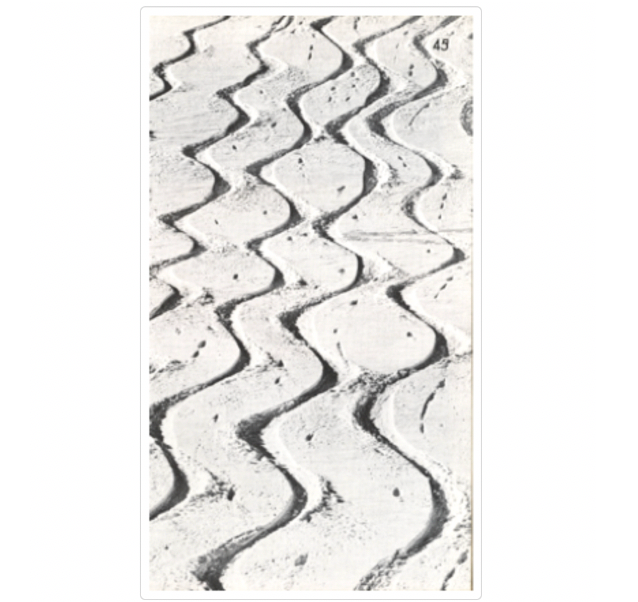
I’m guessing the word Sprungwedeln means something like “leap wagging”… or maybe “wag leaping”.
Skiing was one of the original sports included in the first Winter Olympic Games in 1924, which took place in Chamonix, France between January 25 and February 5th. (These games were billed “International Winter Sports Week” were originally created as a complementary and promotional event for the more popular Summer Olympics. But the winter event was successful enough that it was retroactively designated by the International Olympic Committee as “the first Olympic Winter Games”.)
However, the alpine skiing and slalom competitions we associate today with the Winter Olympics were events in 1924. Instead, the sport was limited to “Nordic skiing”, which is the the cross-country type. (In Nordic skiing, the toe of the ski boot is fixed, but the heel can rise off the ski; in alpine skiing, the boot is completely attached to the ski.) The four events were military patrol, cross-country skiing, the nordic combined, and ski jumping.
I assume no one was using the wedeln technique, which was developed decades later.
Stirred but not shaken
I grew up in the 1970s and 80s, which meant that my James Bond was Roger Moore. He was my favorite Bond… until my dad introduced me to the Sean Connery films. After that, and also after reading all the Ian Fleming Bond novels and stories in published order in the early aughts, I realized that Connery was much closer to what Fleming envisioned for his spy than any of the other actors that came afterwards.
And then along came Daniel Craig. His five turns as Bond were praised by some and criticized by others, but for my money he is a very close second to Connery when it comes to playing 007. Plus, his portrayal of the character was a flashback to the way Fleming wrote him in the original stories. And I’m willing to mud wrestle you on that!
None of the Sean Connery Bond flicks featured him donning a pair of skis, but his first replacement ––not-so-popular George Lazenby–– was in the first 007 ski scene in the model-turned-actor’s only movie, On Her Majesty’s Secret Service. The sequence must have been quite thrilling for fans back in 1969; I don’t think many nighttime action scenes on skis had been filmed before then.
Roger Moore took over for seven Bond roles starting in 1973; I still think his first two movies (Live and Let Die and The Man with the Golden Gun) were awesome, with the next five progressively getting campier. So far Moore holds the record for skiing in 007 films, with three movies in which he did so. First was 1977’s The Spy Who Loved Me, which had one of the most memorable endings for a ski sequence.
Moore did not ski in the next Bond film, Moonraker ––he was too busy floating in space–– but he went downhill on snowy slopes again in 1981’s For Your Eyes Only.
In his final stint as James Bond in 1985, Moore donned skis again briefly… before switching to a snowmobile. Here is the scene in From View to a Kill.
Timothy Dalton never skied in his two mostly forgettable Bond incarnations (sorry, Tim, not your fault), but Pierce Brosnan did ski in his his third 007 movie, 1999’s The World is Not Enough.
And although Daniel Craig did have an exciting chase scene in the snow in Spectre, he never actually skied in any of his five Bond movies.
Even though wedeln already existed as a technique by the time the first Sean Connery Bond movie was filmed in 1962, it doesn’t seem like 007 was ever interested in wagging around on skies. I guess it wasn’t badass enough.
Now you know. Next time you happen to be taking some skiing lessons on the Austrian Alps, you can ask your instructor to teach you how to wedeln. Don’t be surprised if they don’t understand what you’re saying, tough. Not because they don’t speak English… but because the editors of the Spelling Bee decided that wedeln is a dord*.
You can check out my previous entry on another dord* here:
*What the heck is a dord, you ask? Here’s the answer: