
Wold
What in the weld is this word?
Today’s New York Times Spelling Bee letters:
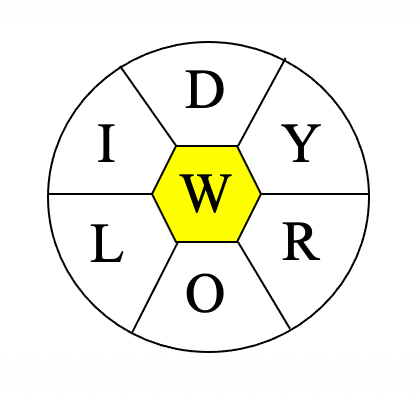
D, I, L, O, R, Y, and center W (all words must include W).
Merriam-Webster says…
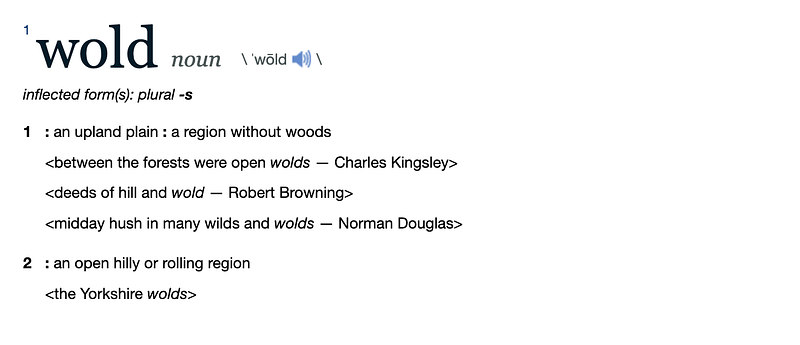
Silly little dictionary! Don’t you know wold can’t possibly be a word if the New York Times says it ain’t?
For further fascinating facts, check out the Spelling Bee Master.
What’s your favorite dord* from today’s puzzle?
My Two Cents
First things first. I get to congratulate myself today on reaching the rare Queen Bee level with the Spelling Bee puzzle. On any given day, if you find all the “valid” words on the list and get the maximum number of points, a screen pips up letting you know you’ve won. (Spoiler alert if you’re a purist: the image shows the number of words and points for today’s game.)

This doesn’t happen to me often. In fact, I think it’s the first time since I started writing this column in January. I usually do better on days there are fewer words and points to be had.
Isn’t it ironic?
According to our good friends at Merriam-Webster, the word wold comes from Middle English wald or wold, from Old English weald, wald (wood, forest); akin to Old High German wald (forest), Old Norse völlr (field, meadow), and perhaps even Old English wilde (untamed, wild).
Yet today the term refers to areas without woods.
How is that possible, you ask? Turns out wood has a different etymological background. It comes Middle English wode, in turn from Old English widu or wudu; akin to Old High German witu (wood) and Old Irish fid (tree).
However… the Middle and Old English wald, from which wold came almost directly, does mean forest. So what gives? For some mysterious reason the meaning of wold changed from “forest” to “open high ground”. Where’s Scooby Doo and the rest of the gang when you need them?
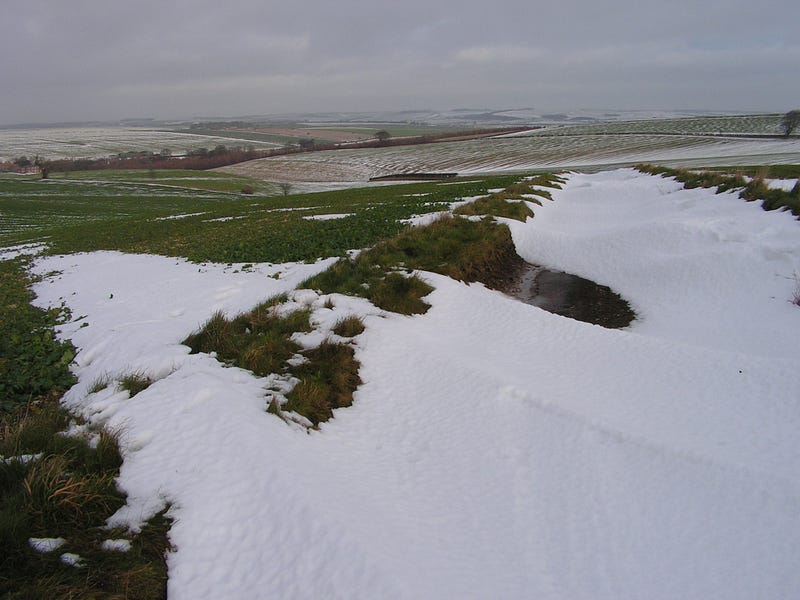
Today wold is used mostly in England in reference to a bunch of low hills with open fields under which the rocks are usually chalk, limestone, and sandstone. One of the more famous wolds is the Yorkshire Wolds Way, a national trail in… you guessed it! Yorkshire. It runs for about 79 miles (127 km) and was officially opened in 1982. Which is a lot later than I would have imagined.
The photo at the top of the article was taken there, during late summer. I’m kidding! It can’t be late summer with all that snow. It has to be early summer, obviously.
Queen Victoria’s favorite poet laureate, Lord Alfred Tennyson, wrote a ballad called Lady of Shalott. No, it’s not about a woman and her favorite onion variety. It tells the story of Elaine of Astolat, a noblewoman from Arthurian legend who was trapped in a tower close to Camelot. She had a cellphone but no reception, so no one came to her rescue.
Anyway, here is the first stanza, in which today’s word is poetically featured.
On either side the river lie Long fields of barley and of rye, That clothe the wold and meet the sky; And thro’ the field the road runs by To many-tower’d Camelot; The yellow-leaved waterlily The green-sheathed daffodilly Tremble in the water chilly Round about Shalott.
Gimme a W! Gimme an O! Gimme an L! Gimme a D!
Harry Chapin is best known as the folk singer and songwriter of “Taxi” and “Cat’s in the Cradle”.
He also wrote a song that supposedly inspired the premise of the TV sitcom WKRP in Cincinnati, about a fictional radio station in Ohio. The show did not fare well during its four seasons on CBS, but became a hit once it got syndicated.
The name of the Chapin song? W-O-L-D.
In the song released in 1973, an aging DJ tells his ex-wife about his wandering life working at several radio stations across the U.S. He reminisces about his lost opportunity to have been with his family, and acknowledges that his life, his looks, and his voice have seen better days.
Hence the O-L-D in the title of the song. The W? It’s typical for U.S. radio stations to have four-letter identification codes, and the non-military ones usually start with a K or a W.
Chapin’s tune was apparently inspired by Jim Connors, the radio guy who discovered and promoted “Taxi” on his radio station WMEX in Boston. Interestingly, there is a WOLD-FM in Marion, Virginia, which started broadcasting in 1968. An AM radio station, WHNK, was licensed as WOLD from 1962 to 2006.
And, to wrap up today’s column (and not incur the wrath of Tolkien fans), I can’t not mention the northernmost region of Rohan — the kingdom of horsemen — in Middle-earth. And that northern region is called… Edoras.
Of course not! That’s the capital of Rohan, as any LOTR devotee will yell at you.
The northern region is called Wold.
But whether we’re talking about forests and non-forests, or folk songs or folklore regions… let’s avoid that word altogether.
Because the editors of the Spelling Bee puzzle decreed that wold is a dord.*
Here is Harry Chapin singing W-O-L-D:
You can check out my previous entry on another dord* here:
*What the heck is a dord, you ask? Here’s the answer: