
Yagi
A one-hundred-year old injustice needs correcting
Today’s New York Times Spelling Bee letters:
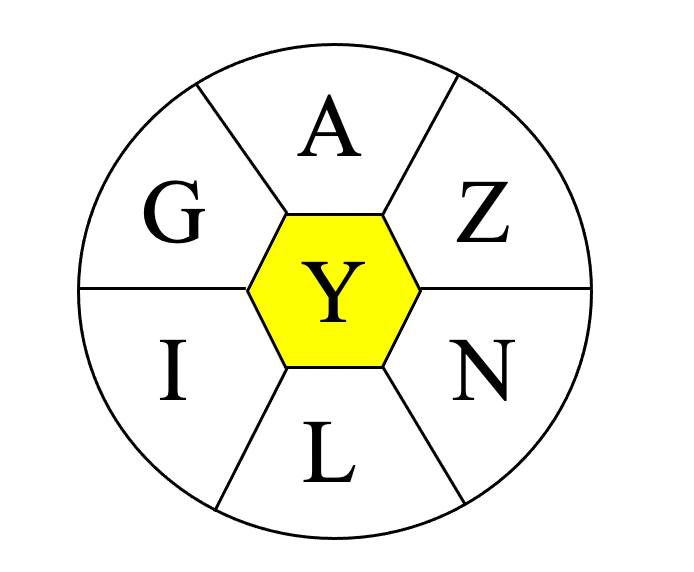
A, G, I, L, N, Z, and center Y (all words must include Y)
Merriam-Webster says…
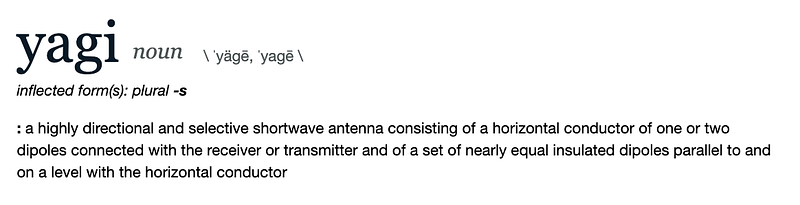
Silly little dictionary! Don’t you know that yagi can’t possibly be a word if The New York Times says it ain’t?
For further fascinating facts, check out the Spelling Bee Master.
What’s your favorite dord* from today’s puzzle?
My Two Cents
Just a few days ago I wrote about how we sometimes ignore the origins of some of the things we use on a daily basis. The example I used was the manila envelope. Today’s example may not apply to younger generations, as many people in their twenties may have grown up their entire lives with cable TV and streaming channels. But those of us of a certain age still remember having to adjust the “rabbit ears” on our TV sets to try and get a decent picture, especially if there was weather interference.
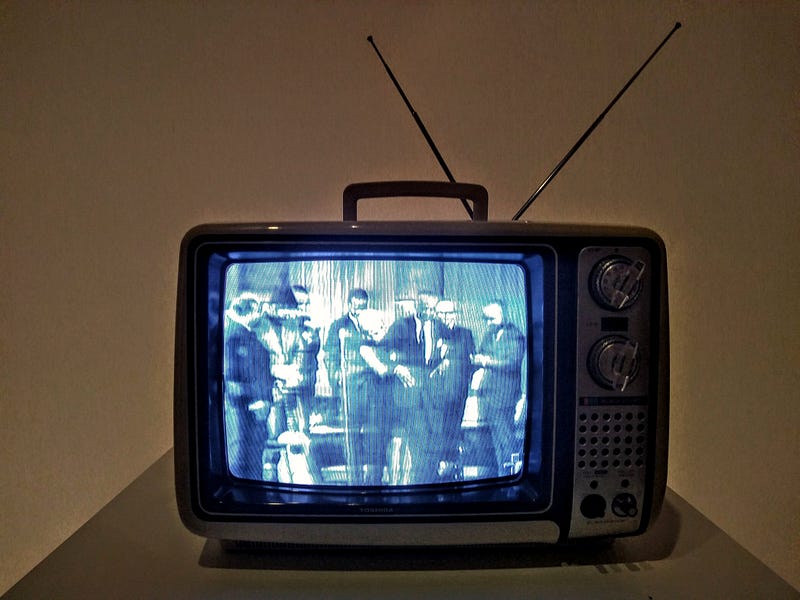
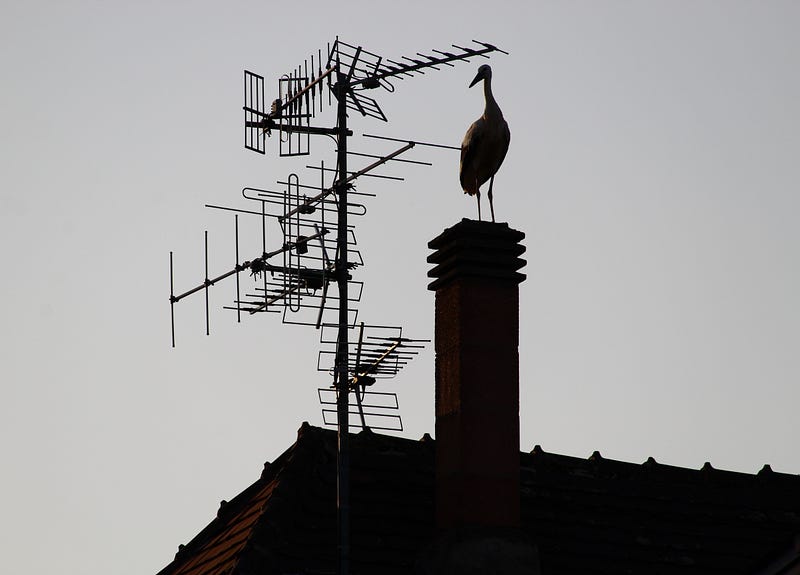
If you were lucky, your television set was connected to an antenna on the roof of the house or building in which you lived. I never had that option as a kid, so it was always up to the rabbit ears. And they weren’t always rising to the occasion.
It turns out that many of the roof antennas of decades ago were the type known as yagis, created by a couple of Japanese inventors ––Hidetsugu Yagi and Shintaro Uda–– in the 1920s. Officially, the antenna is known as Yagi-Uda, a term that combines their last names. But as it turns out, this was another case of a professor taking credit for his assistant’s work.
Although you’ll see the name of the antenna capitalized and hyphanated in many places, the dictionary lists it with a lowercase “y” and no “Uda” attached. Surely an injustice to poor Shintaro, yes, but very convenient for us here at Silly Little Dictionary!, as we can therefore claim this word should not have been rejected.
Stand by for technical difficulties
As the dictionary explains, the yagi is a directional antenna. This type of antenna emits or receives greater power in specific directions, which allows it to perform better and reduces the interference it may receive from unwanted sources. This is a distinct advantage of the dipole antennas (rabbit ears) or omnidirectional antennas, like the simple ones that walkie-talkies and cars have.
Yagis are usually built with what is known as an endfire array, a linear arrangement in which the direction of radiation goes along the line of the antenna. In yagis, this endfire array typically consists of several half-wave dipole elements set in a line. (Remember, a dipole is a “double antenna”.)
The yagi has an active element connected via a wire to the transmitter or receiver, and several passive (conductive) elements with no connection.
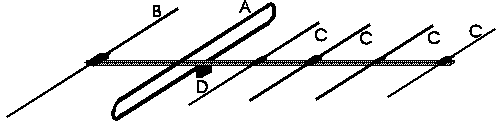
In the above illustration of a yagi, A is the active (driven) element, while B and C are passive elements, also known as parasitic elements. B is a reflector, while the C’s are directors. The parasitic elements alter the radiation pattern of the radio waves emitted by the driven element, directing the waves as a beam in a single direction, thus increasing the antenna’s directivity, or the degree to which the radiation emitted is concentrated in a single direction. The way parasitic elements do this is by acting as a passive resonator (similar to a guitar’s sound box). They basically absorb the radio waves from the driven element and emit them again with a different phase. The waves from the different antenna elements strengthen the antenna’s radiation in the desired direction, and cancel out the waves in undesired directions.
The picture below shows a yagi made for UHF television reception. The driven element is attached to the black box on the left. And just to the left of the black box there are four reflectors, which are one type of parasitic element. The other parasitic elements are the 18 directors attached to the horizontal beam at right.
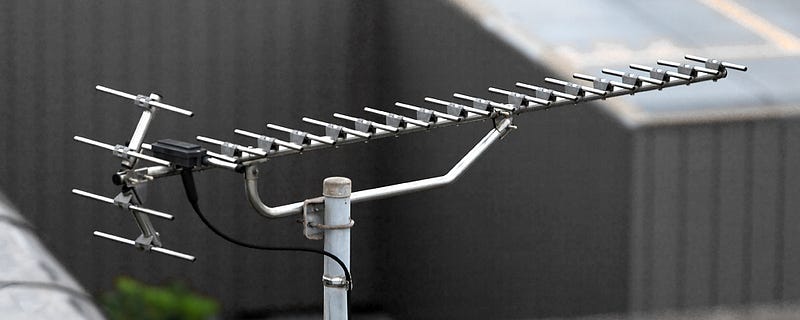
As set, the above yagi will be most sensitive to those radio waves coming from the right and parallel to the antenna’s main horizontal axis.
Yagis are mostly used on HF, VHF, and UHF bands. As I mentioned earlier, it’s best-known as a rooftop terrestrial television antennas. However, it has also been used as a radar antennas and and for long-distance shortwave communication by shortwave radio stations and radio amateurs, or hams.
Udo vs Yagi
Shintaro Uda was born in 1896 and died in 1976. For decades he was best know as the assistant professor to electrical engineer Hidetsugu Yagi at Tohoku University, where in 1926 Yagi invented an antenna with the help of Uda.
Except it was the other way around.
Well, not the assistant professor part. That’s true. Uda was the Yagi’s assistant, which is probably why he got screwed from being credited for the invention and having his last name first.
Barely eight years ago, Antennas & Propagation Magazine, ––published by the Institute of Electrical and Electronics Engineers (IEEE)–- came out with an article by Yasuto Mushiake describing what really happened with invention of the yagi in the 1920s. Mushiake was born in 1921, so when the article was published, he was was just shy of his 97th birthday. (He passed away two years ago at the age of 101!) He personally knew Uda, who mentored Mushiake during his graduation work… on yagi antennas. As Mushiake explains:
The first paper in English on the experimental study of the Yagi-Uda antenna was coauthored by H. Yagi and S. Uda in 1926… However, all the works mentioned in its conclusions were published with the single name of S. Uda in the Journal of the Institute of Electrical Engineers of Japan before and after that paper. In spite of this truth, Yagi applied for a patent with his single name, without telling anything to Uda. Moreover, it was found that the name of Uda had been omitted from the of “Inventor”.
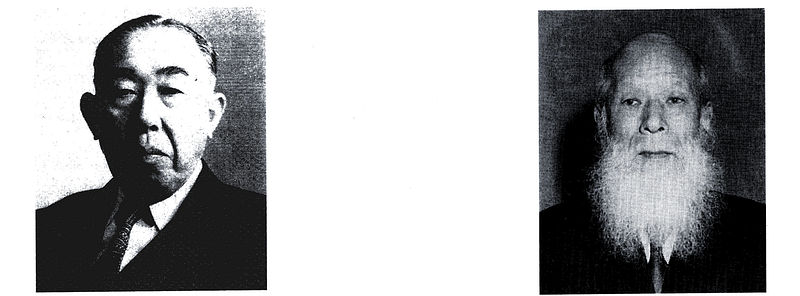
To the left is Shintaro Uda. That’s the face he likely made when he found out how many royalties he had been cheated out of. To the right is Hidetsudu Yagi, smirking all the way to the bank.
Below is the patent Yagi got in the United States in 1932: “Arrangements for changing or varying the orientation or the shape of the directional pattern of the waves radiated from an antenna or antenna system varying the electric or magnetic characteristics of reflecting, refracting, or diffracting devices associated with the radiating element.”
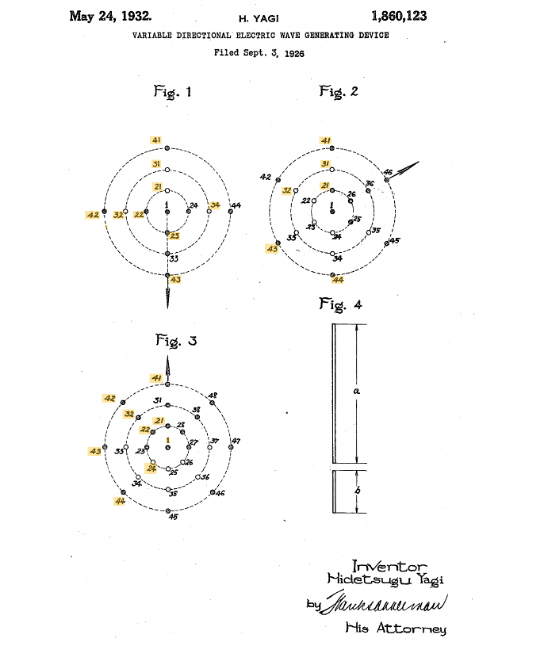
The Japanese patent was later transferred to the the Marconi Company in the UK, while the American one ended up in the hands of the RCA Corporation.
It took a war (as it does on so many occasions) to popularize the tech, though. In this case, yagis’ first widespread use ocurred during World War II as part of the radar systems of the Japanese, Germans, British and U.S. armed forces. But even though it had been invented in the land of the rising sun, it took until 1942 for the Japanese military to “discover” the yagi. During the Battle of Singapore, they obtained the notes of a British radar technician in which the term “yagi antenna” appeared. Japanese intelligence officers did not even realize the name was one of their own. It was the technician himself who explained to them the antenna had been named after a Japanese professor.
Today, the true story behind who really invented the yagi antenna is still not widely known. We here at Silly Little Dictionaty! have done our part to let our readers in on the facts. And it’s now up to you, dear readers, to help us spread the word. How? By resending and retweeting this article (yes, we’re on Twitter) until everyone ––even The New York Times–– starts calling this antenna by its real name: Uda-Yagi.
Now you know. Next time you happen to see an old-fashioned antenna on a rooftop, you can show of your knowledge by saying: “Up there! That’s a Yagi-Uda antenna, but it should really be called Uda-Yagi!” Your friends will surely think you’re nuts. Not because they’ve never seen an old outdoor antenna before… but because the editors of the Spelling Bee decided that yagi is a dord*.
You can check out my previous entry on another dord* here:
*What the heck is a dord, you ask? Here’s the answer: