
Nacelle
Turbines need homes, too

Today’s New York Times Spelling Bee letters:
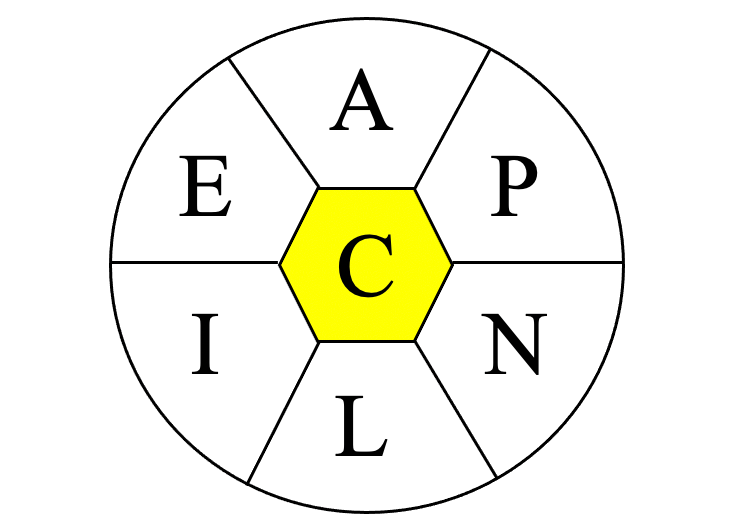
A, E, I, L, N, P, and center C (all words must include C)
Merriam-Webster says…
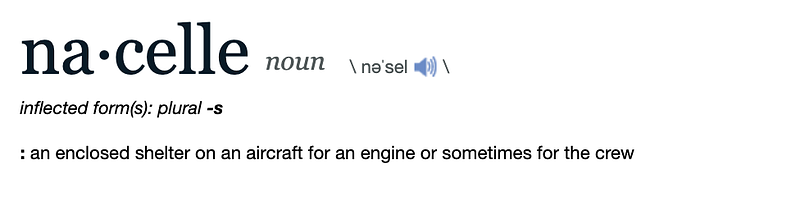
Silly little dictionary! Don’t you know that nacelle can’t possibly be a word if The New York Times says it ain’t?
For further fascinating facts, check out the Spelling Bee Master.
What’s your favorite dord* from today’s puzzle?
My Two Cents
Considering The New York Times is a progressive newspaper (or sometimes claims to be), one would expect them to consider nacelle an important word, as it’s connected to wind turbines, an alternate form of power that is now providing clean energy to many areas of the world.
Perhaps The Gray Lady is more concerned with the big picture, forgoing the details about the parts, seeing the forest and not the trees, if you will. But a cursory search in the paper’s archives show a decently-long enough list of articles in which our word of the day is mentioned.
For example, in this September 22, 1947 article about a skillful pilot saving everyone on a troubled PanAm flight, nacelle is mentioned in the seventh line of the second paragraph:
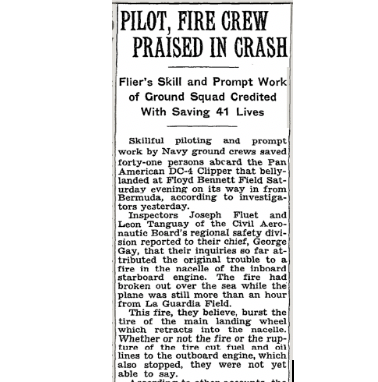
Yes, the above article is old. Maybe the Times forgot about the word over the course of the last 75 years. Except not! Just last year, in this article about wind turbines, nacelle was also mentioned. Not once, but three times.
So what gives, NYT? As we here at Silly Little Dictionary sometimes like to paraphrase: “Who knows what evil lurks in the heart of Sam Ezersky?” (Just kidding, Sam, we love you and also love to tease you.)
In airplanes
Our friends at Merriam-Webster tell us that nacelle was borrowed from the same word in French, which literally means “small boat”. That French word, in turn, came from Late Latin navicella, the diminutive of the Latin navis (ship).
But how would a boat be connected to “an enclosed shelter on an aircraft for an engine or sometimes for the crew”? Maybe it’s not. When I looked up nacelle at wordreference.com, the translation to “boat” was described as literary, with a very specific boat mentioned: a wherry. (Hopefully one day when a Spelling Bee game includes those five letters, I’ll write an article about wherries.) For now, I’ll give you a preview of what that type of boat, with a definition…
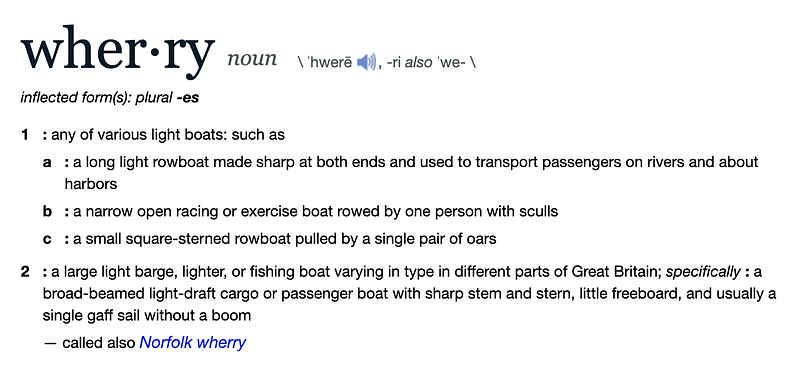
…and a picture that’s worth one grand of words.
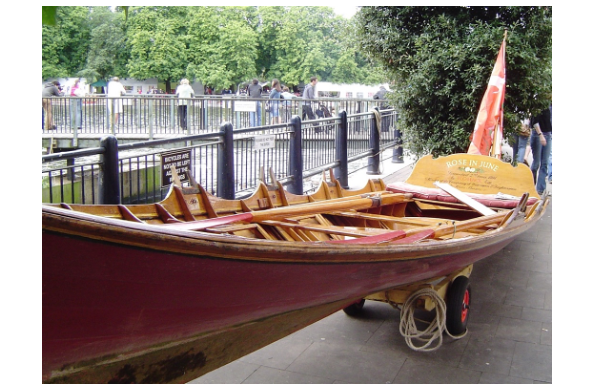
However, Word Reference also lists other translations of nacelle, presumably more modern, and that also seem more logical when talking about pods for large engines. Nacelle in French also means “basket”, “cradle”, and “baby carrier”. I’m sure engine designers think of their products as their babies, so it all works out.
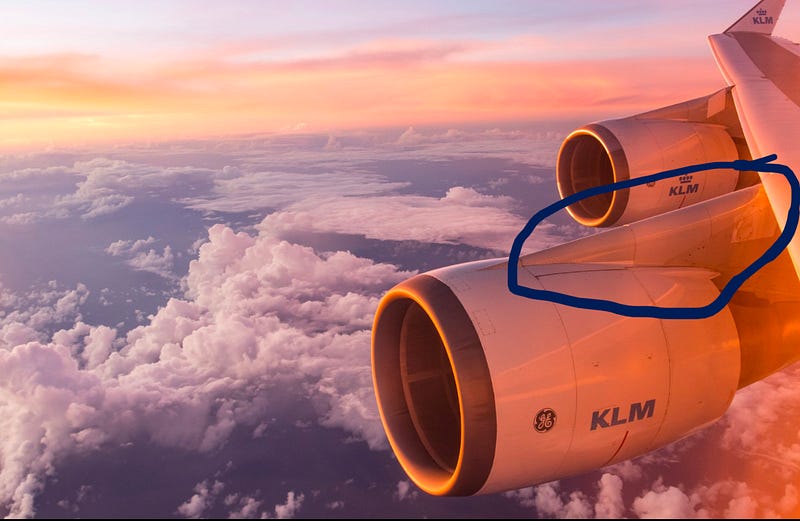
According to the Cambridge Aerospace Dictionary, a nacelle is a “streamlined body sized according to what it contains”, which today on an airplane is usually the engine. When attached is placed outside the airframe ––attached to the wing via a pylon, as is common today on many commercial aircraft–– the nacelle is sometimes referred to as a pod, and the engine as a “podded engine”. (Not to be confused with a potty engine, it’s foul-mouthed cousin.)
The photo at the top of today’s column shows just that type of nacelle. No need to scroll up, as we can provide a duplicate photo with the pylon circled to make things clearer:
The world’s first operational jet-powered bomber, the Arado Ar 234 Blitz, may also have been one of the earliest planes to use nacelles. The aircraft was built by the German Arado Flugzeugwerke company during World War II. When it was first being developed, each of the four engines had its own nacelle (and it’s own landing gear), but when this proved impractical the nacelles were pared down to two, each one housing two engines. The Ar 234 Blitz made history on August 2nd, 1944 as the first jet aircraft to fly a reconnaissance mission.
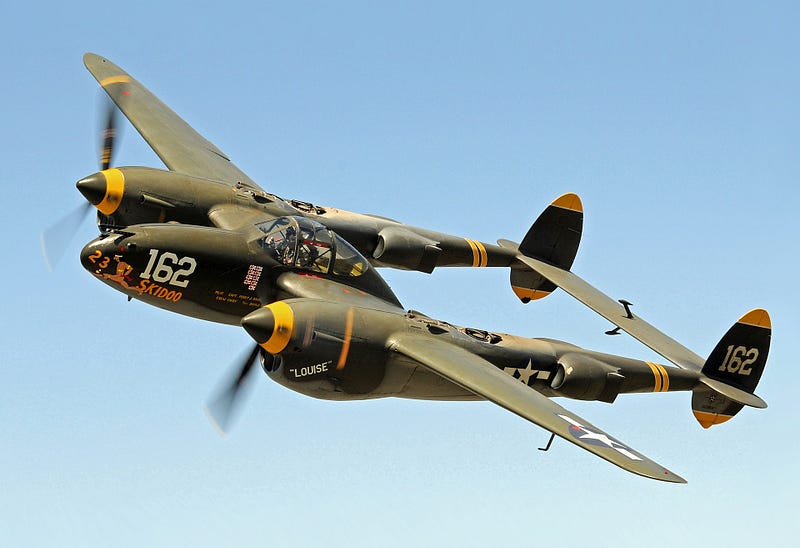
More than five years later, in January of 1939, American aerospace manufacturer Lockhead had its first flight of an airplane with a nacelle, but this one was very different. The Lockheed P-38 Lightning was a fighter aircraft (later used during World War II) with a twin-boom design surrounding a nacelle that carried included both the cockpit and the plane’s weaponry.
In today’s jet airplanes, the main issue designers face with nacelles is streamlining them to reduce drag as much as possible to make flight more efficient both in time and energy expended. That’s why the pylons that connect nacelles to the aircraft need to be slender. This is a tricky proposition, however, because you need to routing the necessary connections between the engine and rest of the plane through the narrow pylon.
Another problem is the loud noise commercial airplane engines make, partly due to the design of the nacelles themselves. To mitigate this, NASA developed chevrons in a sawtooth pattern on the trailing side of the engine nozzles. As NASA explains:
As hot air from the engine core mixes with cooler air blowing through the engine fan, the shaped edges serve to smooth the mixing, which reduces turbulence that creates noise… The new Boeing 787 is among the most modern jets relying on chevrons to reduce engine noise levels. It sports chevrons on the nacelles, or fan housings. The Boeing 747–8 has chevrons on both the nacelles and inner core engine nozzles.
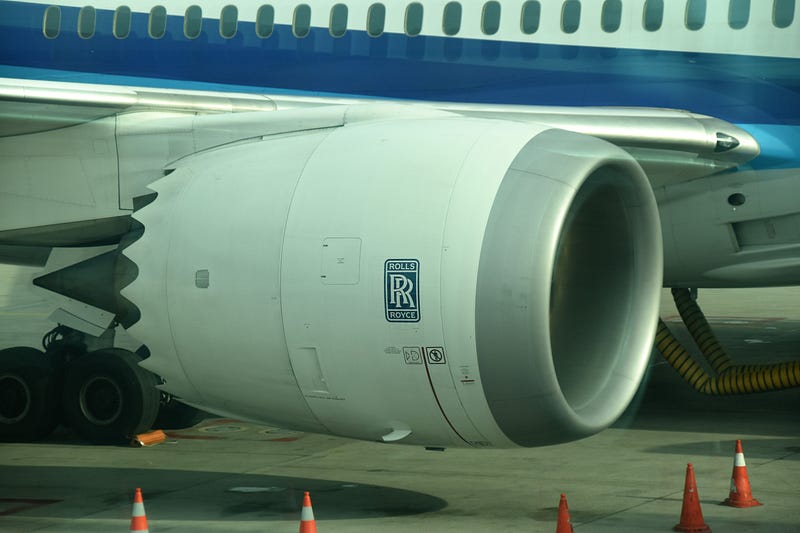
(I don’t know if the above photo is of a 787, but it does show the special chevrons.)
In wind turbines
Wind turbines are those humongous things that converts the kinetic energy of the wind into electrical energy. They are usually hanging around coastal areas, and even in the middle of the sea, although some wind farms are simply set strategically in places where there is a very very very very strong breeze most of the time.
The hundreds of thousands of wind turbines in existence worldwide were generating more than 650 gigawatts of power just a few years ago. (One gigawatt is a thousand megawatts [MW], or one billion watts.) The largest wind farm to date, Gansu Wind Farm in China, was supposed to have reached a capacity of 20,000 MW a couple of years ago. The Chinese government refuses to return my calls, so I haven’t been able to confirm this factoid. However, Iva Reztok was able to copy and paste from Wikipedia this beautiful picture of the Gansu farm:
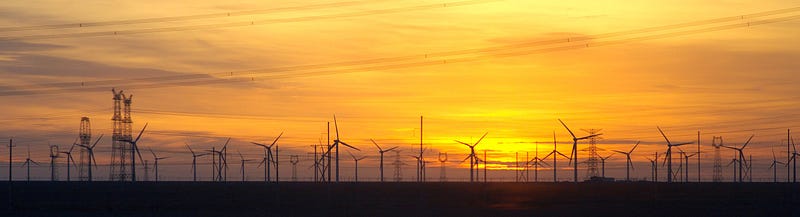
Makes you want to take your date over there for a nice romantic evening, doesn’t it?
Wind turbines don’t use any fuel during their operation, so they have very little impact on the environment in that sense. Some experts consider them to be greener than other forms of alternate power generation, including solar. But wind turbines, and wind farms in particular, have raised eyebrows for their visual impact and their effect on landscapes and birds.
However, it’s important to note that wind farms and nuclear power plants are responsible for only about 0.3––0.4 bird deaths per gigawatt-hour (GWh) of electricity. On the other hand, fossil-fueled power stations kill about 5.2 birds per GWh. According to one source, for every bird killed by a wind turbine in the U.S. in 2009, nearly 500,000 were killed by cats and another 500,000 by buildings. I was shocked by the fact that buildings are able to hunt birds. I tend to think of them as rather stationary and sluggish things.
What does all this have to do with nacelles, you ask? Oh, you didn’t ask? I’ll tell you anyway. The nacelle of three-blade, horizontal-axis wind turbines houses all of the components that help generate electricity, including the generator itself, the gearbox, the drive train, and the brake assembly. This photo shows the “components of a horizontal axis wind turbine (gearbox, rotor shaft and brake assembly) being lifted into the nacelle”.
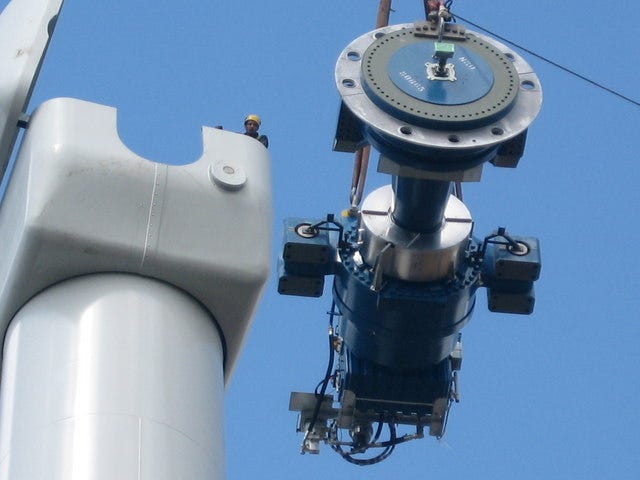
The offshore wind turbines have large platforms that can support workers when they are sent to do maintenance or repairs. The personnel can be lowered down to the platform via winches from a helicopter hovering above it. You can see a video of that here. (Fast forward to the 5:30 mark if you’d like.)
How much power do wind turbines generate? According to Sustainability Info, the “average calculated from the number of turbines in the US wind turbine database (USWTDB) and its total rated capacity” is about 1.64 megawatts per turbine. But there is a caveat:
However, the number assumes the turbines are working at full capacity, which is not the case. In reality, wind turbines usually work with a 30–40% capacity, which means that an average wind turbine in the U.S. generates 0.49–0.66 MW. If we calculate the monthly electricity generation, it would be equivalent to about 355–473 MWh per month.
One MWh means one megawatt per hour. Considering the average American household consumes about about 1,000 kWh (1 MWh) each month, you’d need two or three turbines per household in the U.S. Of course, wind turbines in other countries have different efficiencies.
If you want to get an idea of how many wind turbines it would take to power different cities around the world, you can check out the article below. At the end there is an interactive graph you can play around with.
Now you know. Next time you’re flying on an airplane, you can glance out the window and show off your knowledge by loudly proclaiming for all to hear: “Look! There’s the nacelle!” Don’t be surprised if you end up feeling like William Shatner in that episode of the The Twilight Zone… because the editors of the Spelling Bee decided that nacelle is a dord*.
You can check out my previous entry on another dord* here:
*What the heck is a dord, you ask? Here’s the answer: