
Cachucha
A dance, a hat, a vulva, and a few other interesting meanings
Today’s New York Times Spelling Bee letters:
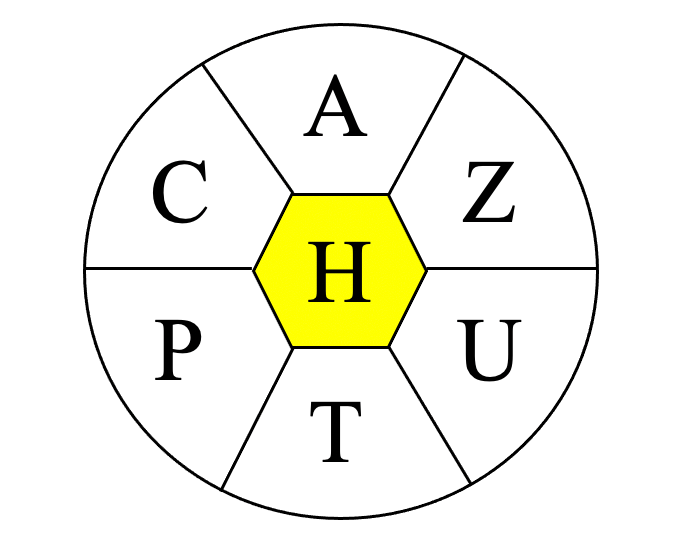
A, C, P, T, U, Z, and center H (all words must include H)
Merriam-Webster says…
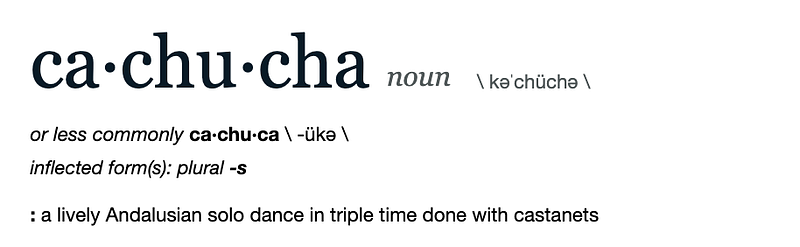
Silly little dictionary! Don’t you know that cachucha can’t possibly be a word if The New York Times says it ain’t?
For further fascinating facts, check out the Spelling Bee Master.
What’s your favorite dord* from today’s puzzle?
My Two Cents
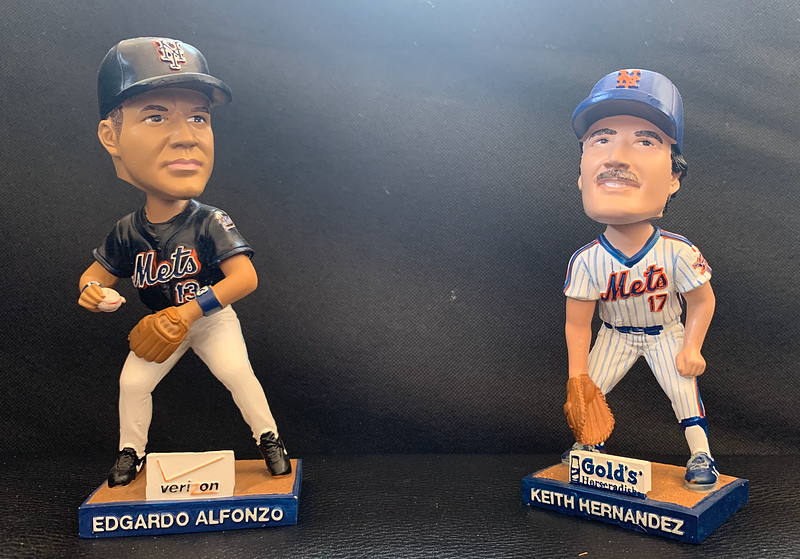
As a part-time Spanish speaker and someone who grew up in Venezuela, the first thing I associate with the word cachucha is baseball. And that’s because one of the meanings of cachucha is “cap”, as in a baseball cap. That is why you see the bobbleheads of two of my favorite Mets players in the photo at the top of today’s column. (Yes, I confess I’m a Mets fan. Whoosh! Watch my thousands of followers abandon me like rats on a sinking ship.)
Anyhow… both Edgardo Alfonzo (who was an awesome Venezuelan infielder) and Keith Hernandez (who appeared in one of the best Seinfeld episodes ever) are wearing Mets cachuchas.
I never expected cachucha to be a word in English, so imagine when I typed into the dictionary’s search function and it came up! Well, technically speaking cachucha isn’t a word, because The New New York Times says it ain’t. That’s the whole point of this column: to make fun of Merriam-Webster for including all those made-up words in their dictionary.Ahhh, that silly little dictionary doesn’t know any better!
The word I really wanted to write about today was cachapa, the Venezuelan sweet corn pancake that is folded over and served with salty cheese inside.
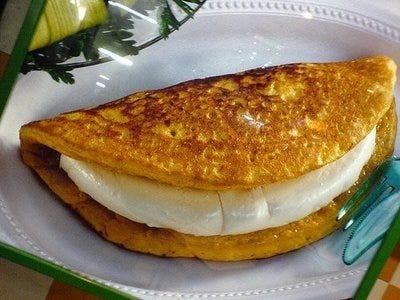
However, cachapa is not in the dictionary… yet. It’s cousin the arepa is, so I am not losing hope that the editors at Merriam-Webster will include cachapa as an entry soon enough.
Now, on to our daily dord*!
You can dance if you want to
I currently live in Spain and have been to the autonomous community of Andalusía a few times already. (Autonomous communities are the equivalent of states in the U.S.) Andalusía is the largest community in Spain by territory and the second-largest by population. It is located in the southernmost portion of peninsular Spain (as seen below), and is a highly agricultural region.
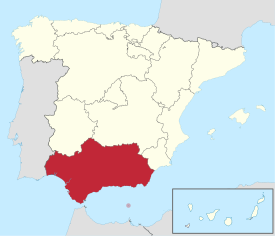
Andalusía is also has many tourist attractions, such as its capital city, Seville, the Alhambra World Heritage Site in Granada, and the miles and miles of beaches facing the Mediterranean Sea. One of its provinces, Almería, is well-known for having been the location where movies such as The Good, The Bad, and The Ugly, Conan the Barbarian (1982), Indiana Jones and the Last Crusade, Lawrence of Arabia, and Patton were filmed.
I just came back from Almería last week, and I can tell you that neither this time nor on any of the other occasions in which I’ve visited that southern part of Spain I’ve ever seen or heard of an Andalusian dance known as the cachucha. I’m not saying it doesn’t exist… I’m just publicly admitting my ignorance when it comes to regional folkloric dances in Spain.
Our friends at Merriam-Webster tell us that cachucha comes from “Spanish, small boat, cap, cachucha, probably from cacho shard, piece, probably from (assumed) Vulgar Latin cacculus pot, alteration of Latin caccabus, from Greek kakkabos, of Semitic origin; akin to Assyrian kukubu vessel”.
According to Wikipedia, the dance actually originated in Cuba. So far my Cuban have not been able to confirm that information, but I’ll keep investigating. Another source says it was actually first performed in Spain, in an 1815 opera called El disparate o La obra de los locos (Nonsense, or The Play of the Crazies) written and composed by Félix Máximo López.
What does seem like historic fact is that the cachucha became popular in Europe after Austrian dancer Fanny Elssler gave a performance of the dance in Jean Coralli’s 1836 ballet Le Diable boiteux (The Gimpy Devil). Despite this happening in Vienna, less than sixty years later the cachucha was already considered an Andalusian dance. A review of Gilbert and Sullivan’s The Gondoliers in a 1889 edition of The Graphic weekly newspaper attests to it.
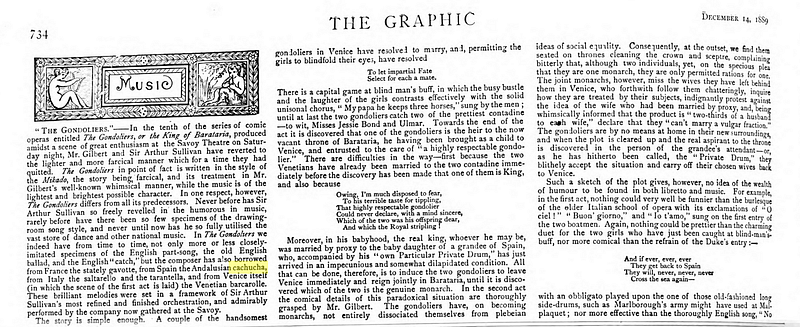
In case you’re having a hard time reading the small print, the text says: “….the composer has also borrowed from France the stately gavotte, from Spain the Andalusian cachucha, from Italy the saltarello and the tarantella, and from Venice itself… the Venetian barcarolle.” (The fifth musical number in Act II is, in fact, called “Dance a cachucha”.)
What happened in those five decades or so that turned a dance by an Austrian artist performed in Austria into a regional symbol of Spain? I have no clue, and my daily 15 minutes of intensive online research have come and gone. So that’s that.
What I can do is provide you with a reconstruction of Fanny Elssler’s performance, courtesy of Spain’s National Ballet Company…
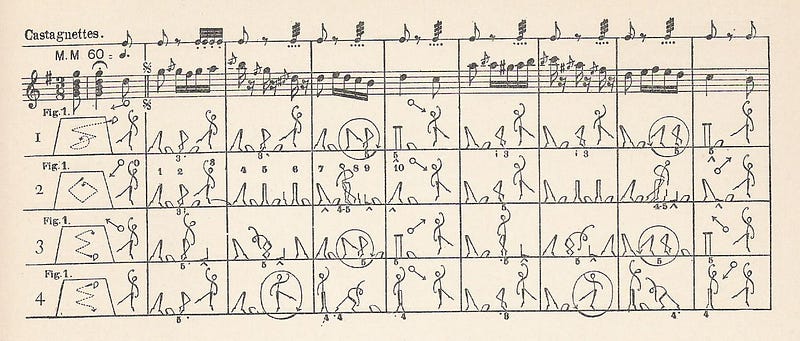
…and a dance score for La Cachucha by Friedrich Albert Zorn, in case you want to try it yourself.
En español
I’ve already mentioned that in Spanish cachucha means cap (as in the headgear). The other word typically used is gorra, which I think is more universal in the Spanish-speaking world. Cachucha is well-known as “cap” in Central America and the Caribbean area; perhaps not coincidentally, in much of that area baseball is played.
But Spanish has a plethora of other meanings for this word. You should take these into account during your travels across Latin America and Spain.
§ In Venezuela cachucha is also used to refer to career military types, especially officers. The peaked cap used by military personnel is called “gorra de plato” in Spanish.
§ In Paraguay, Argentina, and Uruguay, cachucha is slang for vulva. Not sure if this is the case in neighboring Chile, although linguistic logic dictates it could be. So just be careful using this world if you’re touring the southern parts of South America.
§ In Nicaragua, cachucha is a different type of slang altogether, used to refer to condoms. (Which makes sense, if you think about it.)
§ In Cuba, cachucho (with an “o” at the end) refers to a type of fish, the queen snapper or brim snapper (Etelis oculatus), which is, well, um, a type of snapper. However, sometimes the name is changed to cachucha. So if you’re in Havana and someone asks if you want to have cachucha for lunch, just know they are not offering to cook a baseball cap.
§ In Mexico, the expression “de cachucha” can mean “free” or “it’s on me”.
§ In many Spanish-speaking countries people may use the phrase “santa cachucha” or “por la cachucha”, which are the equivalent of “holy cow”.
Now you know. Next time you’re visiting Spain, make sure to go to Andalusía and ask if you can see a cachucha. Don’t be surprised if they pull out a baseball cap instead of directing you to the nearest dance theater. And that will happen because the editors of the Spelling Bee decided that cachucha is a dord*.
You can check out my previous entry on another dord* here:
*What the heck is a dord, you ask? Here’s the answer: