
Pepo
A berry modified fruit and a very iconic cartoonist
Today’s New York Times Spelling Bee letters:
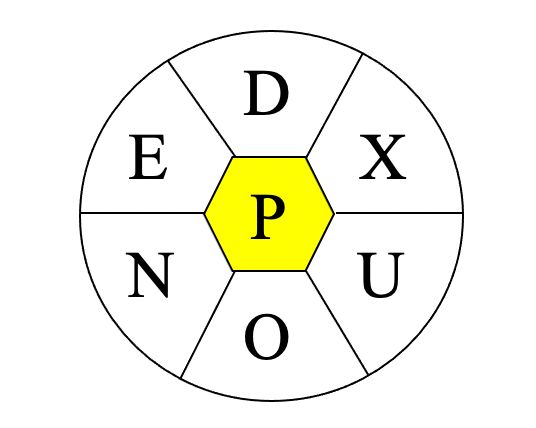
D, E, N, O, U, X, and center P (all words must include P)
Merriam-Webster says…
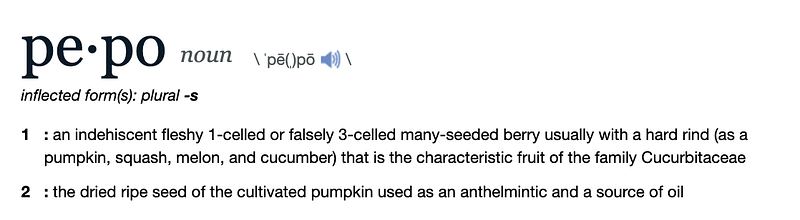
Silly little dictionary! Don’t you know pepo can’t possibly be a word if the New York Times says it ain’t?
For further fascinating facts, check out the Spelling Bee Master.
What’s your favorite dord* from today’s puzzle?
My Two Cents
Let’s see how your plant knowledge stacks up compared to mine. Which of the following fruits is a berry:
- Pumpkin
- Cucumber
- Banana
- Eggplant
- Avocado
If you answered “It’s a trick question! None of them!” then you are half right. Or half wrong, depending on whether you’re an optimist or a pessimist. It is a trick question, but that’s because all of the above are, in fact, berries. Yeah, I didn’t know either until about ten minutes ago.
lowercase p
Let’s get down to basics. Fruits are the matured ovaries of flowers. Which I guess would make the seeds the “eggs”. Covering the seeds is a component called the pericarp, which is made of three layers. The outer layer we commonly refer to as “skin” is the exocarp. The middle, fleshy, fruity part is the mesocarp. And the inner layer is called the endocarp.
My eagle-eyed readers will have noticed all four words in bold font end with the suffix -carp, a noun combining form that comes from the New Latin -carpium, from Greek -karpion, from karpos, meaning “fruit”. And the prefixes in these four words help establish their meaning: peri- (surrounding), exo- (outer), meso- (middle), and endo- (inner).
W. B. Storey in the California Avocado Society Yearbook explains how fruits are categorized:
All fruits may be classified into two broad categories: dry, and fleshy… There are two main classes of fleshy fruits: drupes and berries. Drupes are characterized by having a fleshy mesocarp but a tough-leathery or bony endocarp. They are said to have “stones” or “pits” rather than seeds (example: peaches). Also, a drupe usually has only a single seed. Berries, to the contrary, are characterized by having a fleshy endocarp, as well as mesocarp, and may have more than one seed.
Here are a couple of nice, colorful diagrams that show the difference between a berry and a drupe.
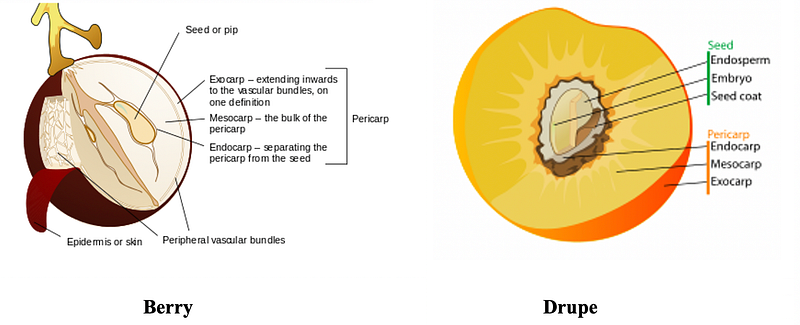
As you can see, this broad definition of berry, or “botanical berry” included a heck of a lot of fruits you may not have thought of as such. For example, citruses such as lemons, oranges, and grapefruits are all “modified berries” that have tough exocarps known as rinds. And of course, the five fruits I mentioned earlier are all considered botanical berries, although there are those who argue that the avocado is actually a drupe.
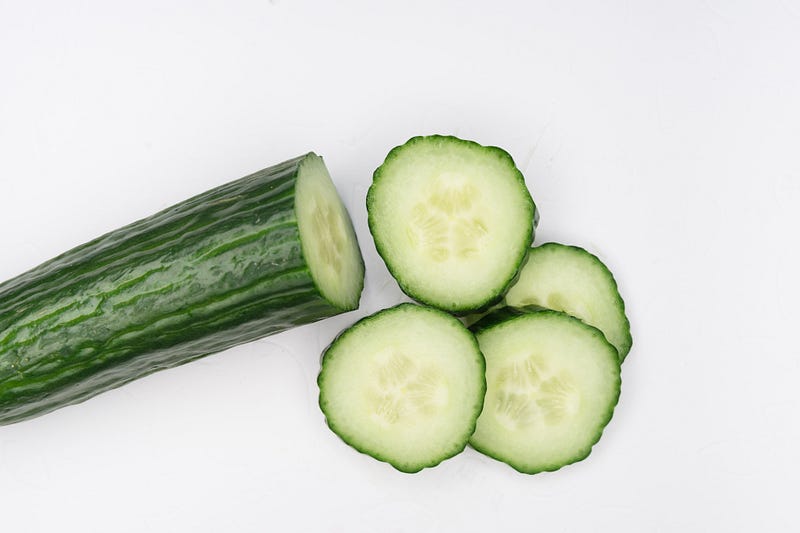
What does all this have to do with our word of the day, the pepo? Well, I mentioned that citrus fruits are modified berries; that is because they have a hard outer skin that is self-supporting when removed. Other modified berries include the melon, the pumpkin, and the cucumber.
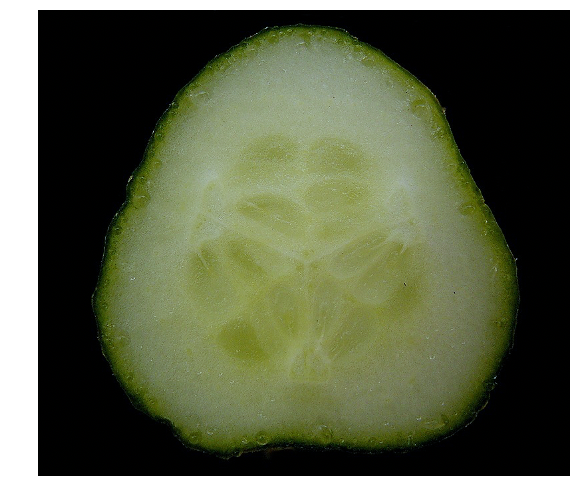
In addition, lemons, oranges, and grapefruits also have partitions that divide the fleshy part into segments. When a modified berry doesn’t have these partitions, it’s called a pepo. That brings us again to the melon, pumpkin, and cucumber (no partitions), which are all pepos.
Here are some fruits that are neither berries nor drupes: apples, pears (both pomes), blackberries (aggregate fruits), and strawberries (accessory fruits).
Uppercase P
Pepo is the nickname of René Rodolfo Ríos Boettiger, a Chilean artist who created a very famous cartoon character named Condorito.

Yes, I’m aware he looks like a Condor.
René Ríos Boettiger began drawing at a very young age, and even managed to get a cartoon published in a newspaper at age seven! (As an adult he always told children that drawing required a broad general culture, knowledge of history, psychology, architecture.) With encouragement from his dad, he continued drawing and had his own public exhibit at age ten in his town’s sweet shop.
Ate age twenty he moved to Santiago, Chile’s capital city, where he studied at the School of Fine Arts. The same year he also joined the satirical magazine Topaze, where he began to stand out as a skillful and perceptive political cartoonist.
In 1935 he adopted the nickname Pepo. As he explained, he was chubby as a kid and called a “pipón” (barrel) by other children. Pipón transformed into Pepo somehow.
One of his first political cartoons made fun of Chilean president Juan Antonio Ríos, who was Pepo’s uncle!
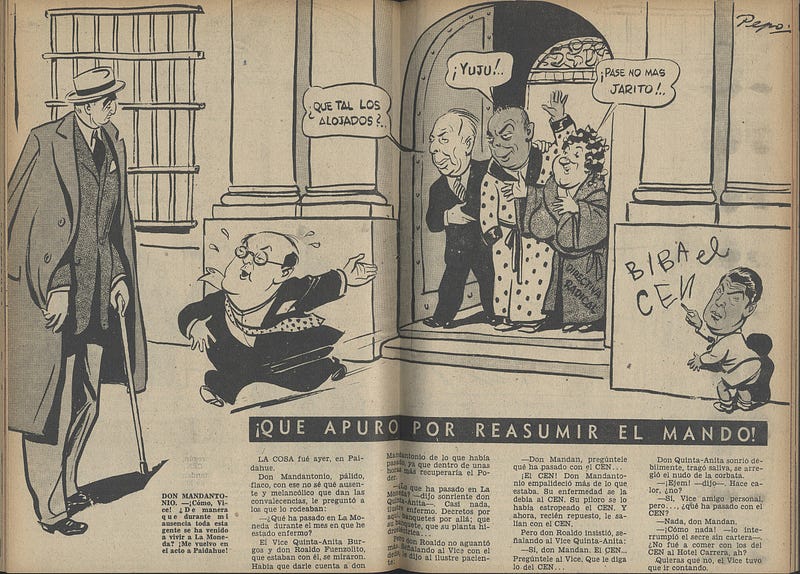
The man on the left is Juan Antonio Ríos, who would die shortly later while still technically the president.
For the next decade or so, Pepo kept lampooning presidents and other politicians in his drawings and comic strip, while also working advertising jobs on the side.
On August 6, 1949 he created “Condorito”, his best known character and comic strip. Pepo had seen the 1942 Disney film Saludos Amigos, which attempted to win over Latin American audiences. The character representing Chile was “Pedro” the anthropomorphic airplane. Apparently, Pepo was disappointed with Pedro and, considering that the condor was the most appropriate symbol of his Andean country, he came up with the character of Condorito.
Both the character and the comic books became a huge hit across all of Latin America and, beginning in the 1990s, even in the U.S. I remember reading Condorito comic books as a kid growing up in Venezuela, and later buying them in newsstands when I was living in New York as an adult.
Pepo passed away at the ripe old age of 88 in the year 2000.
If you feel like reading a bit more about Pepo’s most famous creation ––and help me earn another 13 cents–– you can do so here. (It’s in the second section titled En español.)
So… if you ever find yourself reading a Condorito comic book while munching on a cucumber, consider yourself as having a “double pepo”. Or not… because the editors of the Spelling Bee declared that pepo is a dord*.
You can check out my previous entry on another dord* here:
*What the heck is a dord, you ask? Here’s the answer: