
Picul
A light weight word for a Friday

Today’s New York Times Spelling Bee letters:
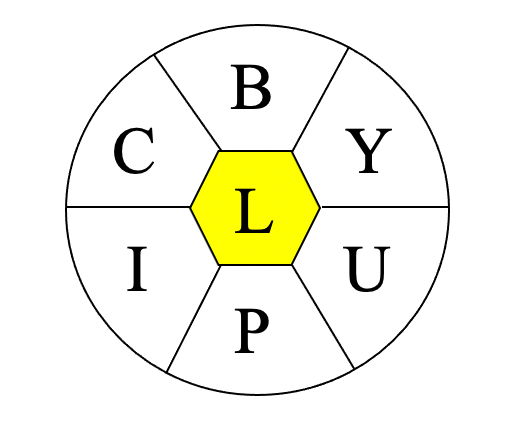
B, C, I, P, U, Y, and center L (all words must include L)
Merriam-Webster says…
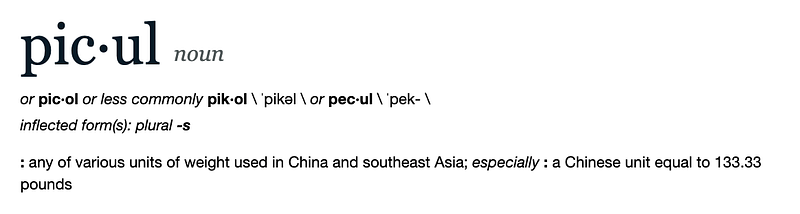
Silly little dictionary! Don’t you know picul can’t possibly be a word if the New York Times says it ain’t?
For further fascinating facts, check out the Spelling Bee Master.
What’s your favorite dord* from today’s puzzle?
My Two Cents
Considering that each combination of seven letters in the Spelling Bee “hive” (see the circle with letters by Iva Reztok above) allows for seven different puzzles when rotating the center letter, I was mildly surprised to discover that this exact game appeared less than two years ago. And I say mildly surprised because after five decades on this planet, very few things astonish or shock me about human nature.
I mean, why not just change the center letter L this time around and provide a new challenge to regular players? Very odd. I mean, I’d understand if the Times had already cycled through all seven possibilities, but it seems unlikely the Spelling Bee Master wouldn’t know about it.
I wasn’t wiring this column in June of 2020 ––or any other month of that year–– and I hope next time these same seven lettres appear, the editors of the Spelling Bee will have wisened up. Hey, hope springs eternal.
He ain’t heavy, he’s a picul
Our friends at Merriam-Webster explain that picul comes from the Malay pikul, which means “to carry a heavy load”, that is, as much as an ordinary man can lift. I assume that Naim Süleymanoğlu, also known as “The Pocket Hercules” is not included in the definition of an “ordinary man”.
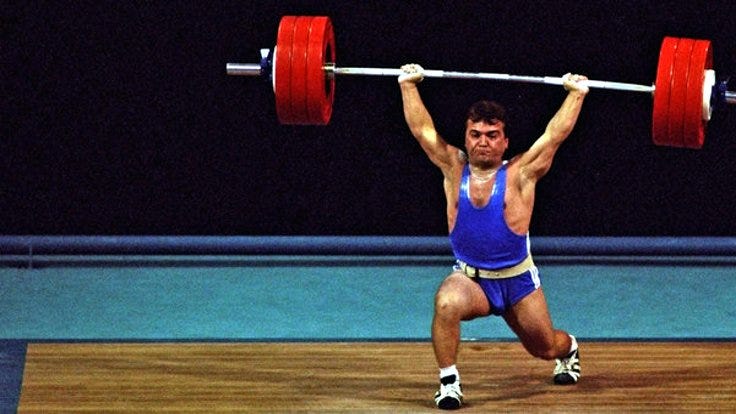
That certainly looks like it weighs more than a picul… although you may be surprised at how much a picul is when converted to kilograms (60.4) and pounds (133.33 of the avoirdupois type). How could an ordinary man lift such an amount? Where people way back when that much tougher than we are now? The answer is yes, of course, but that had nothing to do with the explanation.
In this case, the Oxford English Dictionary comes to the rescue by clarifying that this Asian unit of weight was defined thusly: “as much as a man can carry on a shoulder-pole”.

The above painting, by American artist Gari Melchers, shows a milkmaid with a shoulder yoke, which is very similar to the shoulder pole you may have seen in any movie that took place in 19th century China or Japan.

(By the way, someone should tell that poor old man that he’s holding the shoulder pole incorrectly.)
In any case, now you can see how an ordinary person might be able to carry a picul by splitting its total mass/weight and placing 30 kilos (60 pounds) in each of the two baskets.
Due to extensive maritime trade during their colonist period, the Spanish, Portuguese, British, and Dutch found the picul to be a very convenient unit that had the additional benefit of being understood by Malaysians, Filipinos, Indians, Chinese, and Arabs.
The picul was divided into 100 catties. By that I don’t mean that you could round up one hundred stray kittens and trade them 133 ¹/₃ pounds of something. The catty, or kati, was a units of mass used in China and southeast Asia equivalent to about ¹¹/₃ pounds or 600 grams.
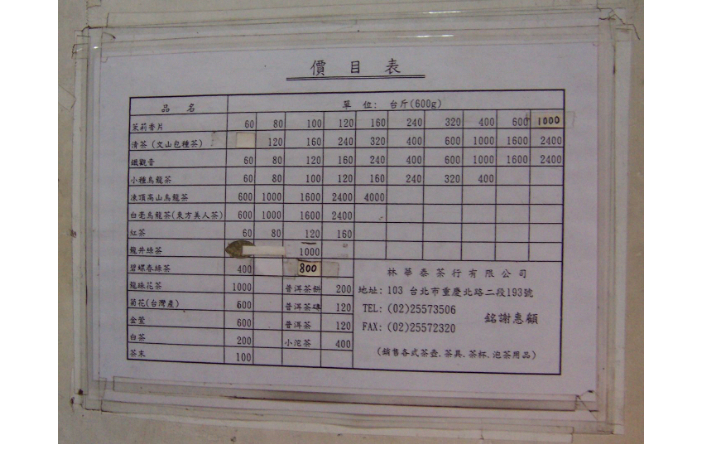
As you can clearly read on the board in the above picture, the different types of tea listed are being sold by the catty. You can even see the “600g” clarification between parentheses. And if you’re the type of person who calls phone numbers from movies just to see if they actually work, you can try dialing the one listed on the bottom right square. I’m curious to see what happens, so be sure to let us know right here in the comments section. (I’ve been told this is in Taiwan, whose country code is +886.)
Big in Hong Kong
A few days ago I discussed the hong, or guild of Chinese merchants authorized by the central government to trade with Western merchants in Guangzhou (Canton).
The British were buying tea and porcelain in exchange for silver. Concerned that they were depleting the Empire of the precious metal, they decided to use opium as their currency. This worked out well for the Brits, but the Chinese all got hooked on the drug, which displeased the rulers of the Qing dynasty. Things started to fall apart and eventually spiralled into not one, but two Opium Wars, fought between 1839–1842 and 1856–1860.
The Qing ceded Hong Kong to the British as part of their surrender in the first war. in 1841. But there were additional hostilities for another year, until finally the United Kingdom took official control of the island in the Treaty of Nanking.
In the early days as a British colony, the stone was used as a measurement of weight equal in Hong Kong. It was equivalent to 120 catties, or 160 pounds (72.6 kg), and existed alongside the picul (which was 100 catties, as we mentioned earlier). But the stone was eventually made obsolete by the Weights and Measurement Ordinance of 1885, which kept the picul.
Here is a map reproduced in the book Present Day Conditions in China, by Marshall Broomhall.
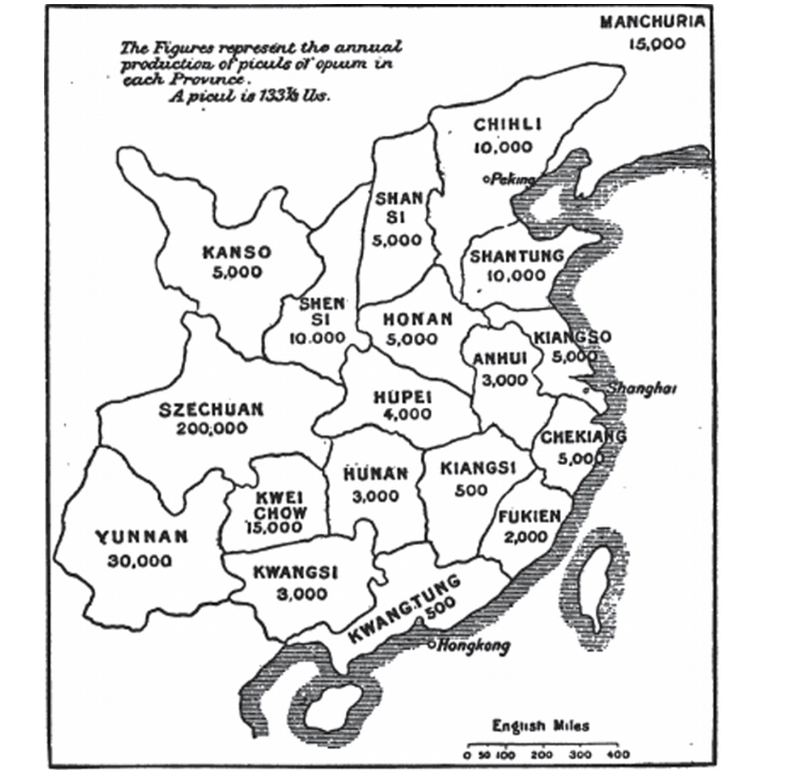
There are some interesting things to note about this map. The first is the spelling of Hong Kong as one word. The second is the reference to “English miles”, which by 1908 should have been Imperial miles, since the English system of measurement had been in disuse since around 1824. Now, from what I’ve read I surmise there was no actual difference for the mile in both systems, but I’m not 100 % sure.
In Broomhal’s book, the text below the maps has the following quote from Lord Justice Fry:
We English, by the policy we have pursued, are morally responsible for every acre of land in China which is withdrawn from the cultivation of grain and devoted to that of the poppy ; so that the fact of the growth of the drug in China ought only to increase our sense of responsibility.
That’s certainly a lot of piculs of regret.
Next time you’re in China and want to prove you’re an ordinary man, woman, gender-fluid or nonbinary person, just hoist a shoulder pole in public to do so. Just make sure beforehand that you’re able to measure a picul of weight… because the editors of the Spelling Bee decided that picul is a dord*.
You can check out my previous entry on another dord* here:
*What the heck is a dord, you ask? Here’s the answer: